Ecosystem Matter Study Guide 5th Grade Science • Module Test Prep
Matter in Ecosystems Study Guide
Part 1: Energy & Organism Roles
Read & Review Before the Test
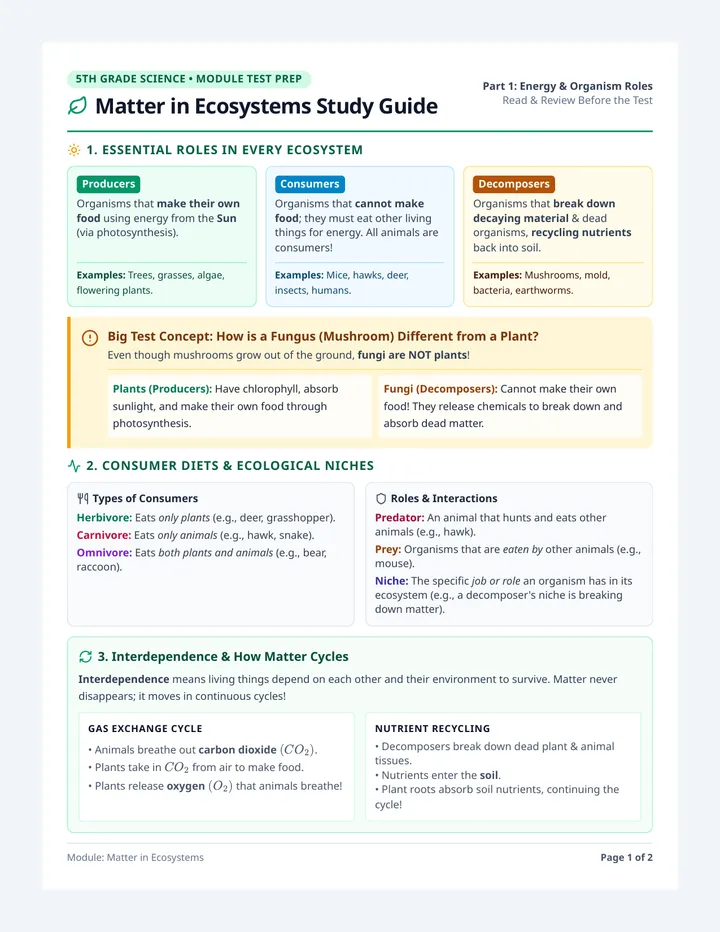
1. Essential Roles in Every Ecosystem
Producers
Organisms that make their own food using energy from the Sun (via photosynthesis).
Examples: Trees, grasses, algae, flowering plants.
Consumers
Organisms that cannot make food ; they must eat other living things for energy. All animals are consumers!
Examples: Mice, hawks, deer, insects, humans.
Decomposers
Organisms that break down decaying material & dead organisms, recycling nutrients back into soil.
Examples: Mushrooms, mold, bacteria, earthworms.
Big Test Concept: How is a Fungus (Mushroom) Different from a Plant? Even though mushrooms grow out of the ground, fungi are NOT plants !
Plants (Producers): Have chlorophyll, absorb sunlight, and make their own food through photosynthesis.
Fungi (Decomposers): Cannot make their own food! They release chemicals to break down and absorb dead matter.
2. Consumer Diets & Ecological Niches
Types of Consumers
Herbivore: Eats only plants (e.g., deer, grasshopper).Carnivore: Eats only animals (e.g., hawk, snake).Omnivore: Eats both plants and animals (e.g., bear, raccoon).
Roles & Interactions
Predator: An animal that hunts and eats other animals (e.g., hawk).Prey: Organisms that are eaten by other animals (e.g., mouse).Niche: The specific job or role an organism has in its ecosystem (e.g., a decomposer's niche is breaking down matter).
3. Interdependence & How Matter Cycles
Interdependence means living things depend on each other and their environment to survive. Matter never disappears; it moves in continuous cycles!
Gas Exchange Cycle
• Animals breathe out carbon dioxide \((CO_2)\).oxygen \((O_2)\) that animals breathe!
Nutrient Recycling
• Decomposers break down dead plant & animal tissues.soil .
Module: Matter in Ecosystems Page 1 of 2
5th Grade Science • Module Test Prep
Ecosystem Factors & Plant Science
Part 2: Plant Needs & Evidence
Scientific Claims & Experiments
4. Ecosystem Components & Influences
Biotic Factors
LIVING parts of an ecosystem
• Animals
Abiotic Factors
NON-LIVING physical parts
• Water
Limiting Factors & Invasives
Limiting Factor: Anything that restricts population growth (e.g., scarce water or space).
Invasive Species: Non-native organisms introduced (often through human interaction ) that disrupt native food webs.
5. Plant Anatomy, Growth & Transport
Root Spacing
Roots need space to spread and absorb water and nutrients without competing.
Transpiration
Water evaporates from leaves, pulling water upward from the roots.
Xylem & Phloem
Xylem: Carries water up.Phloem: Carries sugars (food) down.
Matter for Food
Plants build mass using carbon dioxide from air and water with sunlight!
6. Test Deep Dive: Grace & Linda's Plant Experiment
High Value Question
Plant W
Soil + Water | NO AIR
Result: Drooped / Wilts
Cannot make food without carbon dioxide in air!
Plant X
Soil + Open Air | NO WATER
Result: Drooped / Wilts
Cells lose turgor pressure; water is required for food.
Plant Y
Water + Open Air | NO SOIL
Result: Taller & Healthy!
Grew without soil because it had both air and water!
Claim 1 (Grace): "Plants need both air and water to grow." both air and water) grew taller.
Claim 2 (Linda): "Soil is less important for plant growth than water and air."
Module: Matter in Ecosystems Page 2 of 2
Ecosystem Review Worksheet 5th Grade Science • Review Worksheet
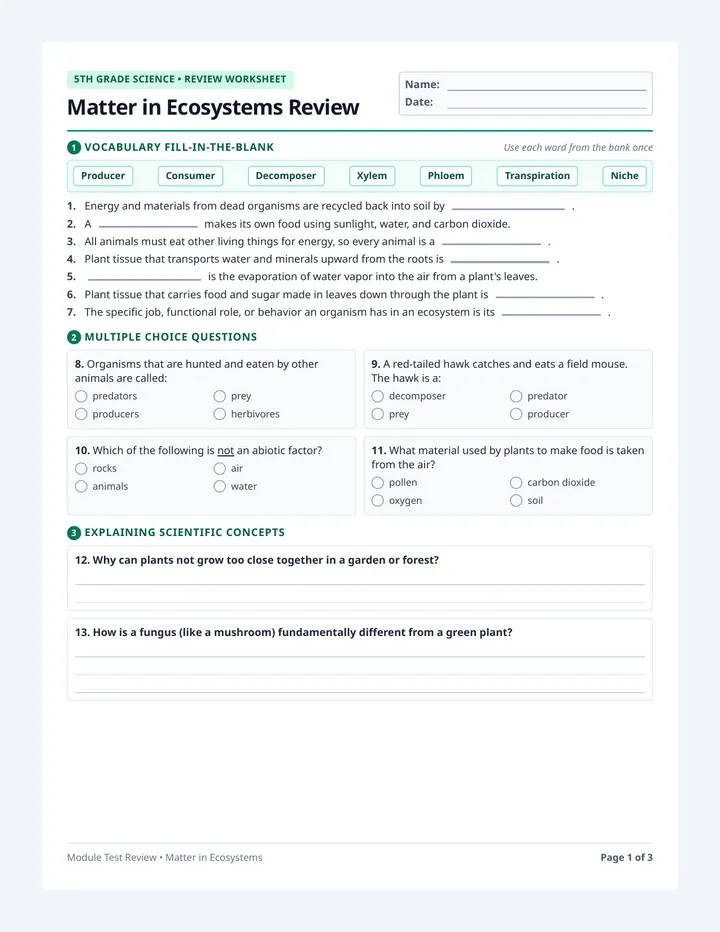
Matter in Ecosystems Review
Name:
Date:
1 Vocabulary Fill-in-the-Blank
Use each word from the bank once
Producer Consumer Decomposer Xylem Phloem Transpiration Niche
Energy and materials from dead organisms are recycled back into soil by .
A makes its own food using sunlight, water, and carbon dioxide.
All animals must eat other living things for energy, so every animal is a .
Plant tissue that transports water and minerals upward from the roots is .
is the evaporation of water vapor into the air from a plant's leaves.
Plant tissue that carries food and sugar made in leaves down through the plant is .
The specific job, functional role, or behavior an organism has in an ecosystem is its .
2 Multiple Choice Questions
8. Organisms that are hunted and eaten by other animals are called:
predators prey producers herbivores
9. A red-tailed hawk catches and eats a field mouse. The hawk is a:
decomposer predator prey producer
10. Which of the following is not an abiotic factor?
rocks air animals water
11. What material used by plants to make food is taken from the air?
pollen carbon dioxide oxygen soil
3 Explaining Scientific Concepts
12. Why can plants not grow too close together in a garden or forest?
13. How is a fungus (like a mushroom) fundamentally different from a green plant?
Module Test Review • Matter in Ecosystems Page 1 of 3
Part 2: Ecosystem Interactions & Experimental Evidence
Ecosystem Analysis & Plant Investigation
Name:
4 Ecosystem Sorting & Relationships
Write each item into the correct column: Sunlight, Earthworm, Water, Oak Tree, Rock, Soil Bacteria
Biotic Factors
Abiotic Factors
True or False Concepts
14a. The amount of water in an ecosystem can be a limiting factor on the number of organisms living there. [ T / F ]
14b. An example of interdependence is plants needing \(CO_2\) from animals, while animals eat plants and breathe \(O_2\). [ T / F ]
14c. An invasive species can be introduced into an ecosystem through human interaction. [ T / F ]
5 Analyzing Experimental Evidence (Test Question 18 Practice)
Investigation Setup: Grace and Linda investigate growing conditions for three identical healthy plants placed in identical containers. After several days, here are their observations:
Plant W
Soil + Water
Result: Drooped & wilted
Plant X
Soil + Open Air
Result: Drooped & wilted
Plant Y
Water + Open Air
Result: Taller & healthy!
15a. Grace claims: "The results show that plants need both air and water to grow."
Does the evidence support or not support Grace's claim? Explain using evidence from the plants:
15b. Linda claims: "The results show that soil is less important for plant growth than water and air."
Does the evidence support or not support Linda's claim? Explain using evidence from Plant Y compared to Plants W and X:
Module Test Review • Matter in Ecosystems Page 2 of 3
Part 3: Plant Structures & Internal Transport
Plant Anatomy Labeling
Name:
6 Structure Word Bank
Label each lettered line on the diagram below
Roots Stem Xylem Phloem Stomata Leaf Flower
SOIL LINE Blue = Water Orange = Sugar A B C D E F G
Write the matching plant part name for each letter:
A Part A:
B Part B:
C Part C (leaf pores):
D Part D:
E Part E (carries water up):
F Part F (carries sugar down):
G Part G:
7 Structure & Function Match
Write the letter of the correct structure next to its function: [ A: Roots | B: Stem | C: Leaf | D: Flower | E: Stomata | F: Xylem | G: Phloem ]
16. Absorbs water & minerals from soil; anchors the plant.
17. Main site of photosynthesis; captures sunlight and \(CO_2\).
18. Internal tubes moving water and minerals upward from roots.
19. Internal tubes moving food and sugars throughout the plant.
20. Tiny pore openings on leaves for gas exchange and transpiration.
21. Holds the plant upright and houses the transport bundle.
Module Test Review • Matter in Ecosystems Page 3 of 3
Ecosystem Review Answer Key Teacher Reference • Answer Key & Guide
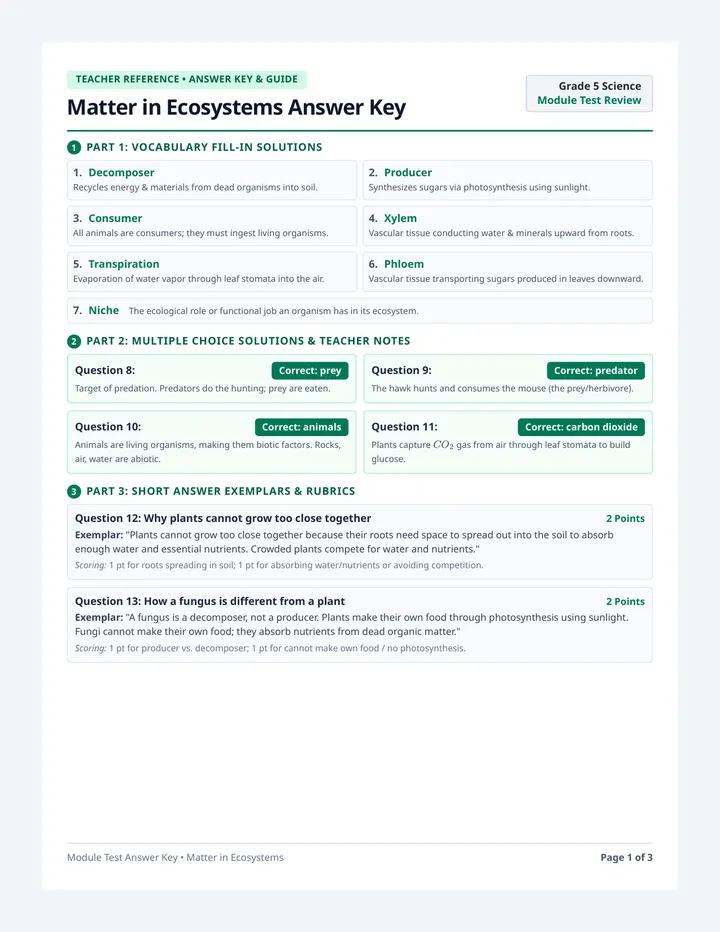
Matter in Ecosystems Answer Key
Grade 5 Science
Module Test Review
1 Part 1: Vocabulary Fill-in Solutions
Decomposer
Recycles energy & materials from dead organisms into soil.
Producer
Synthesizes sugars via photosynthesis using sunlight.
Consumer
All animals are consumers; they must ingest living organisms.
Xylem
Vascular tissue conducting water & minerals upward from roots.
Transpiration
Evaporation of water vapor through leaf stomata into the air.
Phloem
Vascular tissue transporting sugars produced in leaves downward.
Niche The ecological role or functional job an organism has in its ecosystem.
2 Part 2: Multiple Choice Solutions & Teacher Notes
Question 8: Correct: prey
Target of predation. Predators do the hunting; prey are eaten.
Question 9: Correct: predator
The hawk hunts and consumes the mouse (the prey/herbivore).
Question 10: Correct: animals
Animals are living organisms, making them biotic factors. Rocks, air, water are abiotic.
Question 11: Correct: carbon dioxide
Plants capture \(CO_2\) gas from air through leaf stomata to build glucose.
3 Part 3: Short Answer Exemplars & Rubrics
Question 12: Why plants cannot grow too close together 2 Points
Exemplar: "Plants cannot grow too close together because their roots need space to spread out into the soil to absorb enough water and essential nutrients. Crowded plants compete for water and nutrients."
Scoring: 1 pt for roots spreading in soil; 1 pt for absorbing water/nutrients or avoiding competition.
Question 13: How a fungus is different from a plant 2 Points
Exemplar: "A fungus is a decomposer, not a producer. Plants make their own food through photosynthesis using sunlight. Fungi cannot make their own food; they absorb nutrients from dead organic matter."
Scoring: 1 pt for producer vs. decomposer; 1 pt for cannot make own food / no photosynthesis.
Module Test Answer Key • Matter in Ecosystems Page 1 of 3
Teacher Reference • Part 2 Solutions
Experiment Analysis & CER Scoring Guide
NGSS 5-LS1-1 & 5-LS2-1
4 Part 4: Sorting & True/False Solutions
Biotic Factors (Living)
✓ Earthworm
✓ Oak Tree
✓ Soil Bacteria
Abiotic Factors (Non-Living)
✓ Sunlight
✓ Water
✓ Rock
14a. Water is a limiting factor: TRUE
Without enough water, populations cannot grow larger.
14b. Interdependence (\(CO_2\) & \(O_2\)): TRUE
Animals rely on plants for oxygen/food; plants rely on animals for \(CO_2\).
14c. Invasives introduced by humans: TRUE
Boats, travel, agriculture, and pet trade commonly introduce non-native species.
5 Part 5: Claims & Scientific Evidence (Test Question 18)
15a. Grace's Claim: "Plants need both air and water to grow." SUPPORTS CLAIM
Exemplar Response: "The evidence supports Grace's claim. Plant W was given water and soil but no air, and it drooped and wilted. Plant X was given air and soil but no water, and it also drooped and wilted. Only Plant Y, which received both open air and water, grew taller and stayed healthy. This proves that having only one condition is not enough; plants require both air and water to grow."
Full Credit Checklist (3 pts): (1) States clearly that evidence supports the claim; (2) Cites Plant W (no air = wilt) and/or Plant X (no water = wilt); (3) Connects to Plant Y thriving because it had both air and water.
15b. Linda's Claim: "Soil is less important for plant growth than water and air." SUPPORTS CLAIM
Exemplar Response: "The evidence supports Linda's claim. Plant Y was placed in plain water with no soil at all, yet it grew taller than when it started. Meanwhile, Plants W and X were both given soil, but they failed to grow and wilted because they lacked either air or water. This demonstrates that soil alone cannot support plant growth, and plants can grow without soil if they have air and water."
Full Credit Checklist (3 pts): (1) States clearly that evidence supports the claim; (2) Highlights that Plant Y grew taller despite having zero soil; (3) Contrasts with Plants W and X failing even though they had soil.
Instructional Tip for 5th Grade NGSS Standard 5-LS1-1:
Students often hold the persistent misconception that plants "eat" soil to grow big and gain weight. Use Linda's claim and Plant Y to reinforce that the actual physical mass of a plant comes primarily from carbon dioxide in the air and water , which the plant synthesizes into sugar and plant structure (cellulose).
Module Test Answer Key • Matter in Ecosystems Page 2 of 3
Teacher Reference • Part 3 Solutions
Plant Anatomy & Vascular Transport Solutions
Plant Transport & Structures
6 Plant Diagram Labeling Answer Key (Letters A–G)
Part A: Flower
Reproduction / Seeds
Part B: Leaf
Site of Photosynthesis
Part C: Stomata
Leaf Pores / Gas Exchange
Part D: Stem
Support & Conduction
Part E: Xylem
Tubes Moving Water Up
Part F: Phloem
Tubes Moving Sugar Down
Part G: Roots
Absorbs water and minerals from soil; anchors plant firmly
7 Part 7: Structure & Function Match Solutions
[ A ] 16. Absorbs water & minerals; anchors plant: Roots
[ C ] 17. Main site of photosynthesis; captures sunlight: Leaf
[ F ] 18. Internal tubes moving water/minerals upward: Xylem
[ G ] 19. Internal tubes moving food/sugars throughout: Phloem
[ E ] 20. Tiny pore openings for gas exchange/transpiration: Stomata
[ B ] 21. Holds plant upright; houses transport bundle: Stem
Helpful Classroom Mnemonics for 5th Graders:
Xylem = Water (Up)
Think: "W-X-Y-Z" — Water flows through Xylem, shooting Up like high-flying fireworks!
Phloem = Food (Down/All)
Think: "Ph" sound = "Food" — Phloem carries sugar/Food produced in leaves to all cells.
Stomata = Breathing Mouths
From Greek stoma ("mouth"). Tiny lips open to inhale \(CO_2\) and exhale water vapor.
Module Test Answer Key • Matter in Ecosystems Page 3 of 3