Eco Detective Matching Worksheet Plus Eco-Detective Field Guide
Name:
Date:
Welcome, Detective! Your mission is to connect the biological clues. Match each term and its visual evidence to the correct scientific definition. Draw a clear line from the term box to the matching definition box.
Part 1: Characteristics of Life
🧫
Cells
🫁
Respiration
🐣
Reproduce
⚡
Stimulus
🚮
Excrete
The process by which living things produce offspring (new individuals) of the same kind.
The tiny, basic building blocks that make up all living organisms.
The chemical process of releasing energy from food (nutrients) using oxygen.
The process of getting rid of waste products from the body.
A change in the environment (like light or heat) that causes an organism to react.
Part 2: Ecology & Population Dynamics
🐾
Biotic
🪨
Abiotic
🐜
Population
📉
Carrying Capacity
🏭
Pollution
🔥
Wildfire
The maximum number of individuals of a species that an environment can support over time.
Non-living parts of an ecosystem, such as sunlight, water, soil, and temperature.
A group of organisms of the same species living in the same area at the same time.
Living or once-living parts of an ecosystem, such as plants, animals, and bacteria.
Harmful substances introduced into the environment that can damage resources.
A destructive fire that spreads quickly, affecting populations and habitats.
Detective Notes:
Briefly explain how a change in an abiotic factor (like water) could affect a population of plants.
Life in Balance Slides Plus Life in Balance
Characteristics of living things and the forces that shape ecosystems.
The Living Checklist
To be Living (Biotic), an organism needs ALL of these:
🧫
Cells
The basic building blocks.
🐣
Reproduce
Produce offspring.
⚡
Stimulus
Responds to changes.
🔋
Energy
Nutrients and Metabolism.
🚮
Excrete
Removes waste products.
🌱
Growth
Develops over time.
Brainstorm: Life in Action
Can you give an example for...
🧫
Cells
🐣
Reproduce
⚡
Stimulus
🔋
Energy
🚮
Excrete
🌱
Growth
Reference: Life in Action
🧫
Cells
Example: All animals and plants are built from tiny cells.
🐣
Reproduce
⚡
Stimulus
🔋
Energy
🚮
Excrete
🌱
Growth
Reference: Life in Action
🧫
Cells
Example: All animals and plants are built from tiny cells.
🐣
Reproduce
Example: A sunflower drops seeds to grow more flowers.
⚡
Stimulus
🔋
Energy
🚮
Excrete
🌱
Growth
Reference: Life in Action
🧫
Cells
Example: All animals and plants are built from tiny cells.
🐣
Reproduce
Example: A sunflower drops seeds to grow more flowers.
⚡
Stimulus
Example: An earthworm crawls away when it feels a bright light.
🔋
Energy
🚮
Excrete
🌱
Growth
Reference: Life in Action
🧫
Cells
Example: All animals and plants are built from tiny cells.
🐣
Reproduce
Example: A sunflower drops seeds to grow more flowers.
⚡
Stimulus
Example: An earthworm crawls away when it feels a bright light.
🔋
Energy
Example: A rabbit eats grass to get fuel for movement.
🚮
Excrete
🌱
Growth
Reference: Life in Action
🧫
Cells
Example: All animals and plants are built from tiny cells.
🐣
Reproduce
Example: A sunflower drops seeds to grow more flowers.
⚡
Stimulus
Example: An earthworm crawls away when it feels a bright light.
🔋
Energy
Example: A rabbit eats grass to get fuel for movement.
🚮
Excrete
Example: You exhale CO2 waste every time you breathe out.
🌱
Growth
Reference: Life in Action
🧫
Cells
Example: All animals and plants are built from tiny cells.
🐣
Reproduce
Example: A sunflower drops seeds to grow more flowers.
⚡
Stimulus
Example: An earthworm crawls away when it feels a bright light.
🔋
Energy
Example: A rabbit eats grass to get fuel for movement.
🚮
Excrete
Example: You exhale CO2 waste every time you breathe out.
🌱
Growth
Example: A small seedling developing into a massive oak tree.
Challenge 1: Sorting
Decide: Is it Biotic or Abiotic ?
Use the Checklist
Criteria for Life
🧫 Cells
🐣 Reproduce
⚡ Stimulus
🔋 Energy
🚮 Excrete
🌱 Growth
🌳
Tree
🏔️
Mountain
🍄
Mushroom
☀️
Sunlight
Growth and Limits
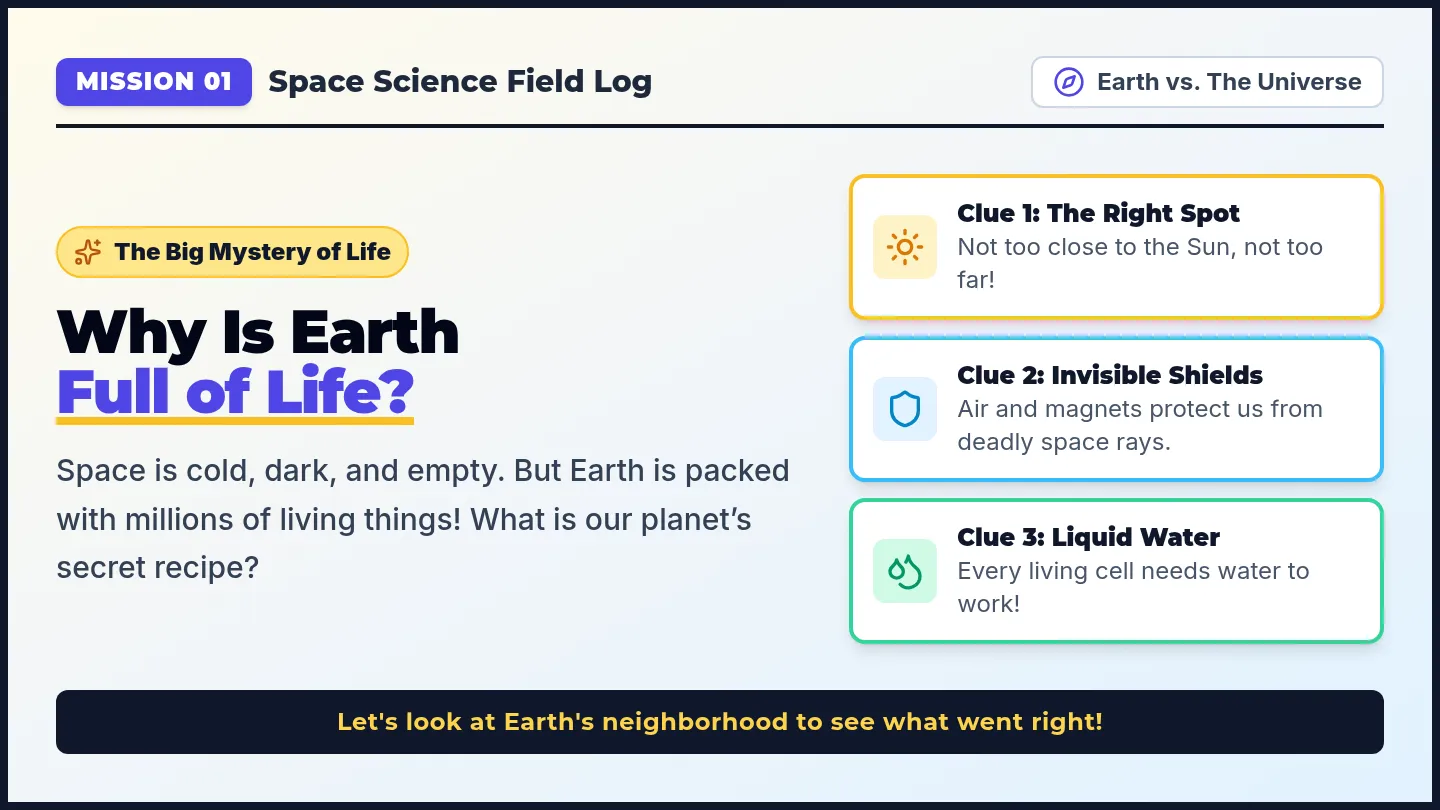
Carrying Capacity
The maximum population size supported by an ecosystem.
Limiting Factors
Resources like food, space, and water that stop population growth.
Visual Example: Habitat Size
Small Habitat (Backyard)
🐿️ 🐿️
Low Capacity
Resources for 2-3 squirrels.
Large Habitat (City Park)
🐿️ 🐿️ 🐿️ 🐿️ 🐿️ 🐿️
High Capacity
Resources for 20+ squirrels.
Larger habitat = More limiting factors available = Higher Carrying Capacity.
Equilibrium
Balanced Size
Limiting Factors
Anything that restricts a population's size and slows or stops it from growing.
Resources
Limited food, water, and nesting space.
Mortality
Predators, disease, and weather events.
Disasters
Wildfires, floods, or pollution.
Challenge 2: Data Check
Capacity Limiting Biotic
1. Animals and plants are examples of ________________ factors.
2. Carrying ________________ is the maximum size of a population.
3. A ________________ factor keeps a population from growing.
Eco Detective Answer Key Answer Key
Eco-Detective Field Guide
Part 1: Characteristics of Life
Cells The tiny, basic building blocks that make up all living organisms.
Respiration The chemical process of releasing energy from food (nutrients) using oxygen.
Reproduce The process by which living things produce offspring (new individuals) of the same kind.
Stimulus A change in the environment (like light or heat) that causes an organism to react.
Excrete The process of getting rid of waste products from the body.
Part 2: Ecology & Population Dynamics
Biotic Living or once-living parts of an ecosystem.
Abiotic Non-living parts of an ecosystem, such as sunlight and water.
Population A group of organisms of the same species in the same area.
Carrying Capacity The maximum individuals an environment can support.
Pollution Harmful substances introduced into the environment.
Wildfire A large, destructive fire that spreads quickly through woodland.
Sample Response (Detective Notes):
"If the amount of water (abiotic) decreases during a drought, the population of plants may struggle to survive because they need water for photosynthesis. This could cause the plant population to shrink or even die out in that area."
Eco Detective Fill Blank Worksheet Eco-Detective Case Files
Name:
Date:
Detective, use your knowledge of ecology to complete the sentences below. Choose the correct word from the evidence locker (word bank) to fill in each blank.
Evidence Locker: Word Bank
• Biotic
• Abiotic
• Population
• Organism
• Living
• Non-living
• Stimulus
• Respiration
• Cells
• Reproduce
• Excrete
• Nutrients
• Survive
• Wildfire
• Pollution
• Carrying Capacity
Every single ________________________ is a unique individual living thing, such as a single bird or a single oak tree.
All living things are made of tiny building blocks called ________________________, which are the smallest units of life.
A group of the same species living in the same area at the same time is known as a ________________________.
Sunlight, water, and temperature are examples of ________________________ factors because they are non-living parts of the environment.
To maintain energy, organisms must use ________________________ to release energy from the food they eat.
In an ecosystem, the ________________________ factors include all the living things like plants and animals.
A ________________________ is any change in the environment that causes a living thing to react, like a plant growing toward light.
Living things must ________________________ to ensure their species continues to exist by producing offspring.
Harmful substances added to the environment, known as ________________________, can damage ecosystems and hurt populations.
The maximum size a population can reach before resources run out is called the ________________________.
To stay healthy, organisms need ________________________, which are the substances in food that provide energy and growth.
A sudden environmental event like a ________________________ can quickly change a habitat and force animals to move.
Organisms must ________________________ waste from their bodies to keep their internal systems clean and healthy.
Eco Detective Fill Blank Answer Key Answer Key
Eco-Detective Case Files
Every single Organism is a unique individual living thing.
All living things are made of tiny building blocks called Cells.
A group of the same species living in the same area is a Population.
Sunlight, water, and temperature are Abiotic factors.
To maintain energy, organisms must use Respiration to release energy.
In an ecosystem, the Biotic factors include all living things.
A Stimulus is any change in the environment that causes a reaction.
Living things must Reproduce to ensure their species continues.
Harmful substances added to the environment are Pollution.
The maximum size a population can reach is the Carrying Capacity.
To stay healthy, organisms need Nutrients for energy and growth.
A sudden environmental event like a Wildfire can change a habitat.
Organisms must Excrete waste from their bodies.
Sample Final Conclusion:
"A population stops growing at its carrying capacity because the ecosystem runs out of resources like food, water, or nesting space. If there isn't enough for everyone, some individuals won't survive or be able to reproduce, keeping the population size steady."
Limiting Factors Investigation Activity Plus Limiting Factor Lab
Detective:
Case Date:
Investigate environmental evidence and the factors that restrict population size at the carrying capacity .
Terminology Locker
Abiotic
Biotic
Carrying Capacity
Limiting Factor
Case File 1: Evidence Sorting
🍄 Mushroom
☀️ Sunlight
🐺 Wolf
🪨 Rock
Case File 2: Scientific Report
Living parts of an ecosystem are (1) __________________ factors. Non-living parts are (2) __________________ factors. Every population has a limit called its (3) ___________________________. This size is restricted by (4) ___________________________ factors.
Case A: The Island Rabbits
A drought causes half the clover (food) to die. The rabbit population shrinks.
Limiting Factor:
Abiotic or Biotic?
Case B: Forest Fire
A massive fire destroys 40% of the nesting sites and food in the forest.
Limiting Factor:
Impact on Capacity:
Detective's Summary
Explain why a population cannot grow forever. Use the terms resources and limiting factor .
Limiting Factors Answer Key Plus Answer Key
Limiting Factor Lab
Case File 1: Evidence Sorting
Mushroom: Biotic
Sunlight: Abiotic
Wolf: Biotic
Rock: Abiotic
Case File 2: Scientific Report
(1) Biotic
(2) Abiotic
(3) Carrying Capacity
(4) Limiting
Case File 3: Field Scenarios
Case A: The Island Rabbits
Factor: Food (Clover) / Drought | Type: Clover (Biotic) / Drought (Abiotic)
Case B: Forest Fire
Factor: Wildfire / Habitat Loss | Impact: Carrying Capacity Decreased
Sample Detective's Summary:
"Populations cannot grow forever because ecosystems have a set amount of resources like food, water, and space. Once these resources start to run out, they act as limiting factors that keep the population size near the carrying capacity. If the population gets too large, competition for resources increases, slowing down the growth rate."
Survival Showdown Game Board Survival Showdown
Mission:
Keep your population alive and balanced!
Welcome to the ecosystem! You are the leader of a new population. Navigate the board, face limiting factors, and reach Equilibrium at your Carrying Capacity.
Players:
2-4
Time:
20m
START 0
10
20
BIOTIC30
40
50
LIMIT60
70
80
90
100
110
ABIOTIC120
130
140
150
160
170
180
190
─── CARRYING CAPACITY THRESHOLD (200 - 250) ───
200
210
IDEAL220
230
240
250
CRASH260
270
280
BALANCE WIN
Goal
Enter the Green Zone (200-250) and stay there for 3 turns to reach equilibrium.
Movement
Roll a die to increase population. Draw a Showdown Card if you land on a special space.
The Crash
Going over 250 means you've exceeded carrying capacity. Move back to 100 immediately!
Player 1
____
Population
Player 2
____
Population
Player 3
____
Population
Player 4
____
Population
Survival Showdown Game Cards Survival Showdown: Challenge Cards
Cut these cards along the dashed lines. Use them when a player lands on a BIOTIC, ABIOTIC, or LIMIT space!
Biotic Factor
Plentiful Clover
A sudden bloom of clover provides extra food for everyone!
+30 Population
Abiotic Factor
Summer Drought
The water holes have dried up. Resources are low.
-40 Population
Limiting Factor
Disease Outbreak
Because the population is large, disease spreads quickly through the group.
-50 Population
Natural Disaster
Sudden Wildfire
A massive wildfire destroys nesting sites and food sources.
Reset to 100
Biotic Factor
New Predators
Wolves have moved into the area. Your population is under pressure!
-20 Population
Abiotic Factor
Ideal Sunlight
Perfect weather helps plants grow, providing more nutrients!
+20 Population
Limiting Factor
Intense Competition
Groups are fighting over limited nesting space. Some individuals leave.
-30 Population
Human Impact
Severe Pollution
Chemical runoff has poisoned the local stream. Many cannot survive.
-60 Population
Biotic Factor
Baby Boom
It's a great season for reproduction! Many new offspring are born.
+50 Population
Survival Showdown Teacher Guide Survival Showdown: Teacher Guide
A gamified activity to simulate population dynamics, limiting factors, and carrying capacity.
Learning Objectives
• Identify biotic and abiotic factors.
• Explain how limiting factors control population growth.
• Define carrying capacity and equilibrium.
Materials Needed
• Survival Showdown Game Board (1 per group)
• Survival Showdown Challenge Cards (1 set per group)
• 6-sided dice (1 per group)
• Small tokens/place markers (4 per group)
How to Play
1
Setup:
Students start at '0' population. Shuffle the Challenge Cards and place them face down.
2
Growth Phase:
Players roll a die to move forward. Each number on the die represents +10 Population (e.g., a roll of 3 moves the player to the '30' space).
3
Limiting Factors:
If a player lands on a labeled space (Biotic, Abiotic, or Limit), they must draw a Challenge Card and follow its instructions immediately.
4
Equilibrium:
The goal is to land in the Ideal Zone (200-250) . Once in this zone, a player must survive 3 full rounds of turns without being forced out by a card to win.
Post-Game Debrief
Growth Limits
"What factors made it hard for your population to reach equilibrium? How did 'Disease' or 'Competition' affect your score?"
Population Crashes
"What happens to an ecosystem if the population grows past its capacity too fast? Why did the game force you back to 100?"
Environmental Impact
"How did the abiotic factors (like drought or wildfire) change the habitat's ability to support your population?"
Limiting Factors Answer Key Plus Answer Key
Limiting Factor Lab
Case File 1: Evidence Sorting
Mushroom: Biotic
Sunlight: Abiotic
Wolf: Biotic
Rock: Abiotic
Case File 2: Scientific Report
(1) Biotic
(2) Abiotic
(3) Carrying Capacity
(4) Limiting
Case File 3: Field Scenarios
Case A: The Island Rabbits
Factor: Food (Clover) / Drought | Type: Clover (Biotic) / Drought (Abiotic)
Case B: Forest Fire
Factor: Wildfire / Habitat Loss | Impact: Carrying Capacity Decreased
Sample Detective's Summary:
"Populations cannot grow forever because ecosystems have a set amount of resources like food, water, and space. Once these resources start to run out, they act as limiting factors that keep the population size near the carrying capacity. If the population gets too large, competition for resources increases, slowing down the growth rate."