Blueprint Slides GENETIC BLUEPRINT
The 2-Minute Transcription & Translation Lab
Transcription
Translation
The 2-Minute Mission
Timer
02:00
1
Transcribe
Turn the DNA blueprint into an mRNA message.
2
Translate
Decode the mRNA into a chain of amino acids.
3
Locate
Label the diagram: Nucleus vs. Ribosome.
Ready your lab sheet...
Visual Guide
NUCLEUS
TRANSCRIPTION
DNA → mRNA
RIBOSOME
TRANSLATION
mRNA → PROTEIN
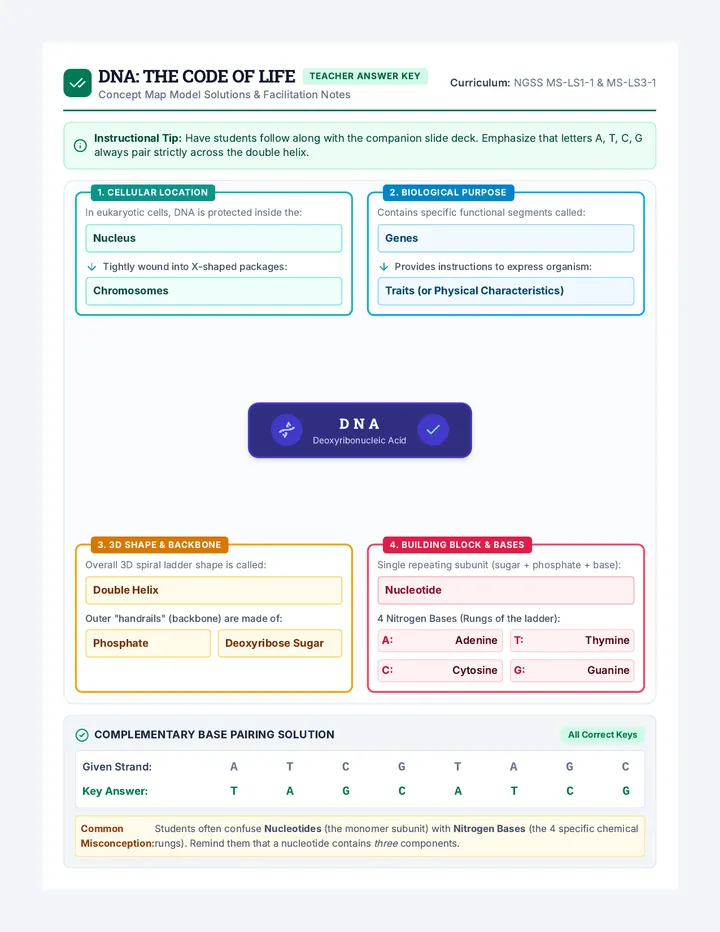
Remember the base-pairing rule for RNA: A pairs with U, and C pairs with G.
Blueprint Lab Sheet GENETIC BLUEPRINT LAB
TEKS 4.B: Protein Synthesis
NAME:
DATE:
1
Part 1: Transcription
Convert the DNA template into a messenger RNA (mRNA) strand inside the nucleus.
DNA Template:
T A C G G C A T T C G A
mRNA Message:
2
Part 2: Translation
Use the codon chart below to translate your mRNA sequence into a chain of amino acids at the ribosome.
Codon Amino Acid AUG Methionine CCG Proline UAA STOP GCU Alanine
Amino Acid Chain:
3
Part 3: The Big Picture
Location A
Organelle:
Process:
Location B
Organelle:
Process:
Blueprint Teacher Guide Teacher Guide
Genetic Blueprint Lab • Bio 4.B
INSTRUCTIONAL RESOURCE
Materials Required
Blueprint Slides (Projected)
Blueprint Lab Sheet (1 per student)
Pencil or Pen
Stopwatch / Timer (on slides)
Standard Codon Chart (for reference)
Lab Execution (2 Mins)
0:00 - 0:30: Students transcribe DNA to mRNA (Part 1).
0:30 - 1:30: Students translate mRNA to amino acids using the provided mini-chart (Part 2).
1:30 - 2:00: Students label the organelles and processes (Part 3).
Implementation Notes
Misconception Alert
Students often try to pair T with A during transcription. Remind them that mRNA does not have Thymine; it uses Uracil (U) instead.
Quick Check
Walk the room. If a student is stuck on Part 2, point out that they should be looking at the mRNA codons, not the original DNA.
TEKS Focus
Focus on the location. STAAR frequently asks where these processes occur (Nucleus vs. Ribosome).
Lab Sheet Answer Key
Part 1:
A U G C C G U A A G C U
Part 2:
Methionine → Proline → STOP → Alanine
Nucleus Box
Organelle: Nucleus
Process: Transcription
Ribosome Box
Organelle: Ribosome
Process: Translation
Blueprint Instructional Script Instructional Script
Genetic Blueprint Lab • Teacher Delivery Guide
Mission Control
Preparation
This lab is designed to be high-energy and fast-paced. Ensure all students have the Blueprint Lab Sheet and a pencil before beginning. Project the Blueprint Slides at the front of the room.
1
The Hook (30 Seconds)
"Scientists, look at the screen. You are looking at the master blueprint for a living organism: DNA. But a blueprint is useless if it stays locked in a vault. Today, you have exactly two minutes to extract that information, send it to the factory, and build a protein. This is the Central Dogma in real-time."
Action: Advance to Slide 2 (The Mission).
2
The Mission (Instruction)
"On your lab sheet, you have three objectives. First, transcribe that DNA into mRNA—remember your base-pairing rules for RNA! Second, use the mini-codon chart to translate those messages into amino acids. Finally, label the map at the bottom. Nucleus or Ribosome? Transcription or Translation? Your two minutes start... NOW."
Action: Start the timer. Circulate the room.
3
The 2-Minute Hustle (Circulating)
Pacing Prompt (60s left):
"One minute remaining! You should be finishing your mRNA and moving to the codon chart."
Common Correction:
"Check your mRNA! If you see a 'T', you made a mistake. Think 'U' for Uracil!"
4
The Debrief & Transition
"Pencils down! Mission complete. Look at Slide 3. Check your flow. Did you start in the nucleus? That's Transcription. Did you end at the ribosome? That's Translation. If your protein chain starts with Methionine and ends with a STOP codon, your blueprint was decoded successfully."
Action: Distribute the SCR Assessment.
Pro-Tip: After the lab, use the SCR Assessment as a silent "Exit Ticket" or independent check. Students should use their completed lab sheet as a reference if this is their first time seeing the content.
Blueprint Lab Key Lab Answer Key
Genetic Blueprint Lab • Bio 4.B
Teacher Only
Part 1: Transcription Key
DNA TEMPLATE:
T A C G G C A T T C G A
Correct mRNA Message:
A U G C C G U A A G C U
Part 2: Translation Key
METHIONINE
(AUG)
PROLINE
(CCG)
STOP
(UAA)
ALANINE
(GCU)
Part 3: Diagram Labels
Location A (Circle)
Organelle: Nucleus
Process: Transcription
Location B (Rectangle)
Organelle: Ribosome
Process: Translation
Blueprint Assessment SCR Student BIOLOGY SCR ASSESSMENT
Standard: Bio 4.B / 5.C • Protein Synthesis
Student Name
Date
Diagram: The Central Dogma
Organelle X
mRNA
Organelle Y
Fig 1. Model of Protein Synthesis in a Eukaryotic Cell
Short Constructed Response (SCR)
Identify the specific biological process occurring at Organelle Y and explain the role of mRNA in determining the final protein product.
Score
/ 2
Blueprint Assessment Key SCR Answer Key
Bio 4.B • Assessment Guide
Teacher Only
STAAR-Style Scoring Rubric
Correctly identifies the process at Organelle Y as translation.
Explains that mRNA carries the genetic code/codons from the nucleus to the ribosome.
States that the mRNA sequence determines the specific order of amino acids.
|
| 1 | Correctly identifies the process as translation BUT provides a vague or incomplete explanation of mRNA's role. |
| 0 | Incorrect identification and explanation, or response is irrelevant. |
Exemplar Responses
High Score (2/2):
"The process occurring at Organelle Y is translation. The mRNA is essential because it carries the instructions from the DNA in the nucleus to the ribosome. Each set of three bases on the mRNA, called a codon, tells the ribosome which specific amino acid to add to the growing protein chain."
Partial Score (1/2):
"The process at Organelle Y is translation. mRNA is a message that helps make the protein at the ribosome."
Key Misconceptions to Monitor
Process Swap: Students calling the process at the ribosome "Transcription" instead of "Translation."Component Confusion: Thinking DNA itself goes to the ribosome, rather than the mRNA copy.Protein vs. Amino Acid: Failing to mention that mRNA determines the sequence of amino acids that build the protein.