Sky Flyers Reading Passage
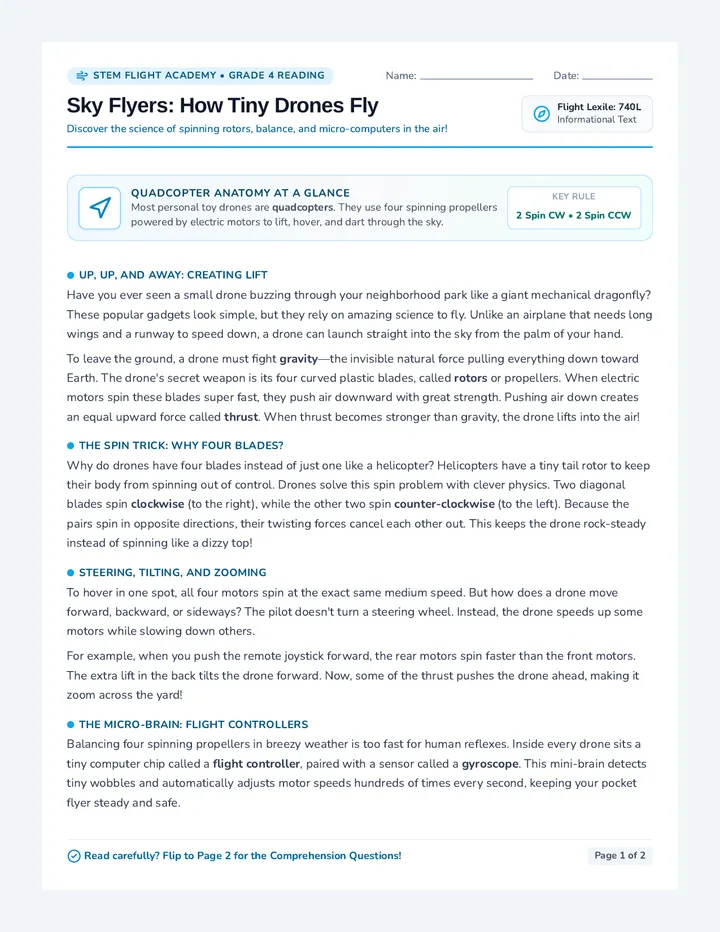
STEM Flight Academy • Grade 4 Reading
Name: Date:
Sky Flyers: How Tiny Drones Fly
Discover the science of spinning rotors, balance, and micro-computers in the air!
Flight Lexile: 740L Informational Text
Quadcopter Anatomy at a Glance
Most personal toy drones are quadcopters. They use four spinning propellers powered by electric motors to lift, hover, and dart through the sky.
Key Rule 2 Spin CW • 2 Spin CCW
Up, Up, and Away: Creating Lift
Have you ever seen a small drone buzzing through your neighborhood park like a giant mechanical dragonfly? These popular gadgets look simple, but they rely on amazing science to fly. Unlike an airplane that needs long wings and a runway to speed down, a drone can launch straight into the sky from the palm of your hand.
To leave the ground, a drone must fight gravity—the invisible natural force pulling everything down toward Earth. The drone's secret weapon is its four curved plastic blades, called rotors or propellers. When electric motors spin these blades super fast, they push air downward with great strength. Pushing air down creates an equal upward force called thrust. When thrust becomes stronger than gravity, the drone lifts into the air!
The Spin Trick: Why Four Blades?
Why do drones have four blades instead of just one like a helicopter? Helicopters have a tiny tail rotor to keep their body from spinning out of control. Drones solve this spin problem with clever physics. Two diagonal blades spin clockwise (to the right), while the other two spin counter-clockwise (to the left). Because the pairs spin in opposite directions, their twisting forces cancel each other out. This keeps the drone rock-steady instead of spinning like a dizzy top!
Steering, Tilting, and Zooming
To hover in one spot, all four motors spin at the exact same medium speed. But how does a drone move forward, backward, or sideways? The pilot doesn't turn a steering wheel. Instead, the drone speeds up some motors while slowing down others.
For example, when you push the remote joystick forward, the rear motors spin faster than the front motors. The extra lift in the back tilts the drone forward. Now, some of the thrust pushes the drone ahead, making it zoom across the yard!
The Micro-Brain: Flight Controllers
Balancing four spinning propellers in breezy weather is too fast for human reflexes. Inside every drone sits a tiny computer chip called a flight controller, paired with a sensor called a gyroscope. This mini-brain detects tiny wobbles and automatically adjusts motor speeds hundreds of times every second, keeping your pocket flyer steady and safe.
Read carefully? Flip to Page 2 for the Comprehension Questions! Page 1 of 2
Comprehension Check
Sky Flyers: Reading Questions
Score ____ / 5
Directions: Read each question carefully. Darken the circle next to the best answer for questions 1 through 5.
1
What is the main idea of this entire reading passage?
A) How to build a homemade drone from toy kits
B) How small quadcopters fly, balance, and steer
C) Why airplanes fly much faster than helicopters
D) The history of radio-controlled model toys
2
Why do two drone blades spin clockwise while the other two spin counter-clockwise?
A) To cancel twisting forces and stop spinning
B) To allow the drone to fly upside down
C) To save battery power during windy flights
D) To create loud sounds that warn wild animals
3
Based on the passage, what happens when a drone's rear motors spin faster than its front motors?
A) The drone immediately falls down
B) The drone tilts forward and moves ahead
C) The drone spins rapidly in place
D) The drone stops and hovers completely still
4
In the passage, what does the scientific word thrust mean?
A) A cool breeze from the sky
B) A radio signal sent from the pilot's remote
C) An upward push made by pushing air downward
D) The heavy weight pulling objects to the ground
5
According to the text, why does a drone need an internal flight controller chip?
A) It corrects tiny wobbles faster than humans can
B) It plays music through small built-in speakers
C) It charges the drone battery while flying
D) It tells the drone when to land in tall trees
Flight Engineer Challenge: Written Response Bonus +2 pts
Imagine a sudden gust of wind tilts a hovering drone to the left. Using what you learned about drone motors, what must the motors do to level the drone back out?
Sky Flyers • Reading Comprehension Assessment Page 2 of 2
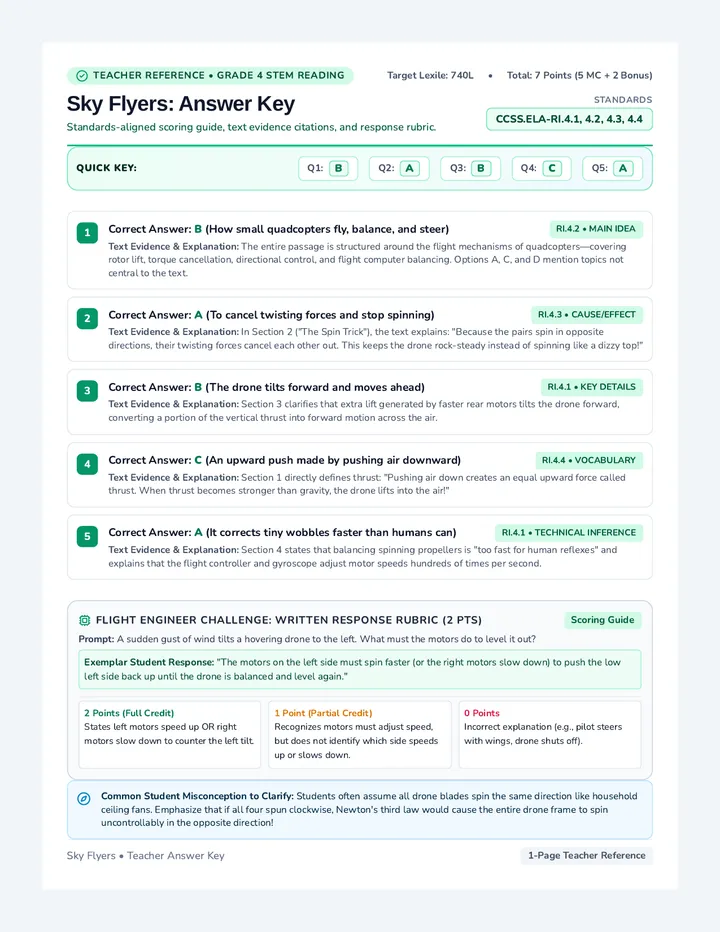
Sky Flyers Answer Key
Teacher Reference • Grade 4 STEM Reading
Target Lexile: 740L • Total: 7 Points (5 MC + 2 Bonus)
Sky Flyers: Answer Key
Standards-aligned scoring guide, text evidence citations, and response rubric.
Standards CCSS.ELA-RI.4.1, 4.2, 4.3, 4.4
Quick Key:
Q1: B
Q2: A
Q3: B
Q4: C
Q5: A
1
Correct Answer: B (How small quadcopters fly, balance, and steer) RI.4.2 • Main Idea
Text Evidence & Explanation: The entire passage is structured around the flight mechanisms of quadcopters—covering rotor lift, torque cancellation, directional control, and flight computer balancing. Options A, C, and D mention topics not central to the text.
2
Correct Answer: A (To cancel twisting forces and stop spinning) RI.4.3 • Cause/Effect
Text Evidence & Explanation: In Section 2 ("The Spin Trick"), the text explains: "Because the pairs spin in opposite directions, their twisting forces cancel each other out. This keeps the drone rock-steady instead of spinning like a dizzy top!"
3
Correct Answer: B (The drone tilts forward and moves ahead) RI.4.1 • Key Details
Text Evidence & Explanation: Section 3 clarifies that extra lift generated by faster rear motors tilts the drone forward, converting a portion of the vertical thrust into forward motion across the air.
4
Correct Answer: C (An upward push made by pushing air downward) RI.4.4 • Vocabulary
Text Evidence & Explanation: Section 1 directly defines thrust: "Pushing air down creates an equal upward force called thrust. When thrust becomes stronger than gravity, the drone lifts into the air!"
5
Correct Answer: A (It corrects tiny wobbles faster than humans can) RI.4.1 • Technical Inference
Text Evidence & Explanation: Section 4 states that balancing spinning propellers is "too fast for human reflexes" and explains that the flight controller and gyroscope adjust motor speeds hundreds of times per second.
Flight Engineer Challenge: Written Response Rubric (2 Pts) Scoring Guide
Prompt: A sudden gust of wind tilts a hovering drone to the left. What must the motors do to level it out?
Exemplar Student Response: "The motors on the left side must spin faster (or the right motors slow down) to push the low left side back up until the drone is balanced and level again."