Diplomatic Envoy Slides
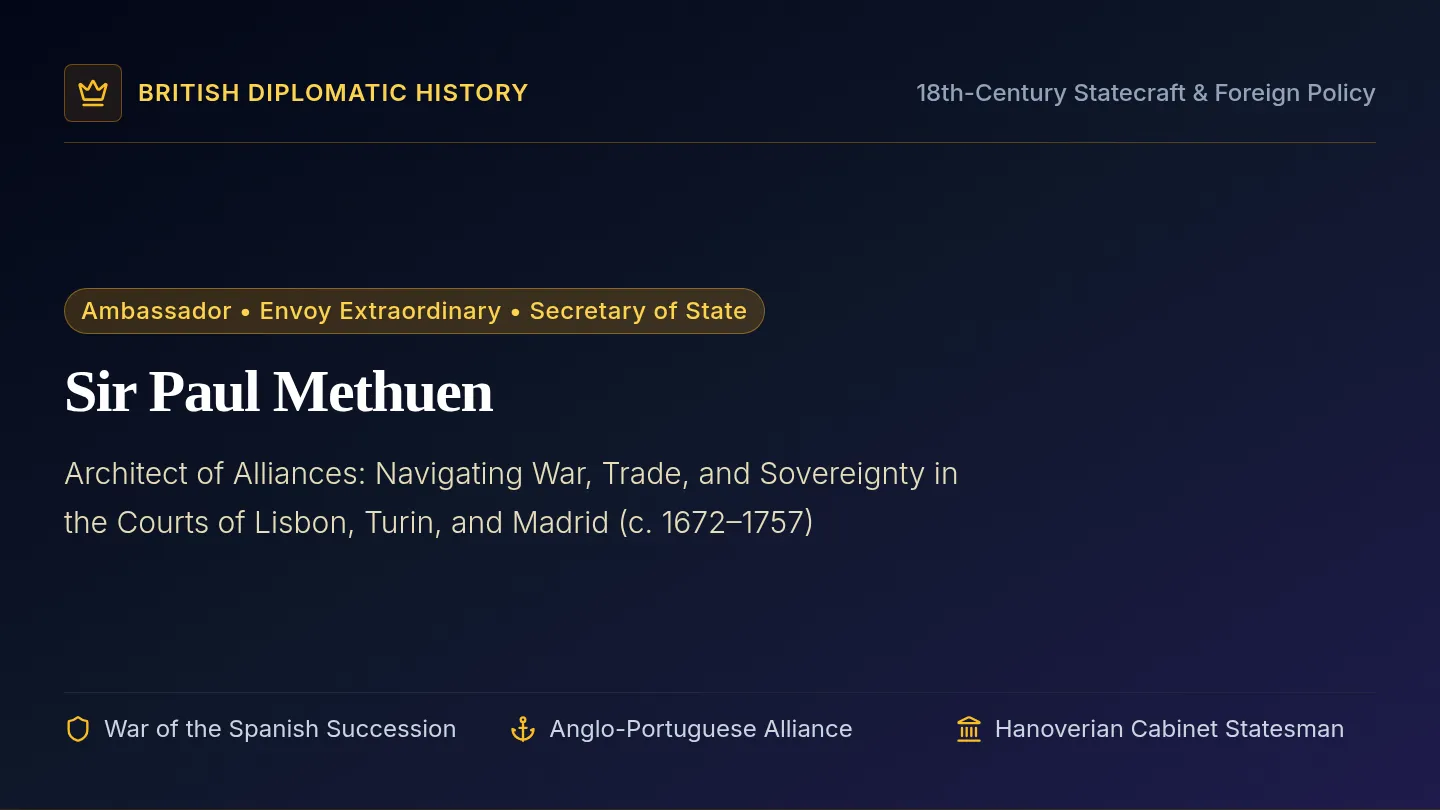
British Diplomatic History
18th-Century Statecraft & Foreign Policy
Ambassador • Envoy Extraordinary • Secretary of State
Sir Paul Methuen
Architect of Alliances: Navigating War, Trade, and Sovereignty in the Courts of Lisbon, Turin, and Madrid (c. 1672–1757)
War of the Spanish Succession
Anglo-Portuguese Alliance
Hanoverian Cabinet Statesman
Strategic Landscape (c. 1700–1714)
The Balance of Power at Stake
European Theaters
Bourbon Hegemony
The union of France and Spain under the Bourbon dynasty threatened British commerce and Protestant succession.
Strategic Goal: Contain Louis XIV
Naval Access
The Royal Navy required deep-water ports along the Tagus and Mediterranean routes to maintain continuous fleet operations.
Strategic Goal: Secure Lisbon's Harbor
Commercial Treaties
Diplomacy secured preferred tariff conditions for English textiles while integrating southern wine and Atlantic trade flows.
Strategic Goal: Expand Merchant Wealth
Diplomatic Mandate: Build bilateral alliances to divert French forces and preserve English commercial dominance.
Mission in Portugal (1697–1708)
Anchor of the Grand Alliance
Court of Peter II & John V
The Methuen Partnership
Paul served alongside his father, John Methuen, mastering court protocol, negotiating treaties, and stepping in as chief envoy when John died suddenly in 1706.
Military Coordination
Coordinated combined Allied land campaigns into Spain with Portuguese forces, the Earl of Galway, and Archduke Charles of Austria.
Treaty Enforcement
Protecting the Methuen Treaty
- Preserved preferential duties for British woolen cloths in Lisbon.
- Guaranteed Portuguese Port wine low tariffs in London over French wines.
- Secured Tagus estuary anchorage for Queen Anne's naval squadrons.
Key Trait: Known for calm resolve under pressure during military setbacks in the Iberian theater.
Role: Envoy Extraordinary (1697–1706) • Ambassador Extraordinary (1706–1708) Solidified Portugal as Britain's Longest Ally
Alpine Diplomacy (1705–1706)
The High-Stakes Mission to Savoy
Court of Victor Amadeus II
Phase 1
Dangerous Crossing
Sent on a delicate special assignment across war-torn Europe to the fortified court of Turin, surrounded by French armies.
Direct courier line to London & Vienna
Phase 2
Financial Subsidies
Negotiated financial subsidies from Queen Anne to prevent the Duke of Savoy from signing a separate peace with Louis XIV.
Crucial silver transfers secured
Phase 3
Relief of Turin
Coordinated with Prince Eugene of Savoy, enabling the Allied victory at the Siege of Turin in September 1706 that drove France from Italy.
Turned the Mediterranean balance
Strategic Significance: Methuen's Savoy mission proved his skill in multilateral coalition management, balancing Italian princely ambition with British maritime strategy.
Madrid & Westminster (1714–1730)
Ambassador to Spain & Cabinet Statesman
Hanoverian Succession
Ambassador to Spain (1714–1715)
Sent by King George I to the court of Philip V in Madrid following the Treaty of Utrecht to establish peaceful diplomatic relations and restore merchant trade treaties.
Concluded the Anglo-Spanish Treaty of Commerce (December 1715), restoring trade rights across Spanish ports.
Cabinet Leadership at Court
Methuen transformed his international expertise into high executive power in Britain's emerging Whig administration:
- Secretary of State for Southern Department (1716–1717)
- Comptroller of the Household (1720–1725)
- Treasurer of the Household (1725–1730)
Distinction: Invested as Knight Companion of the Order of the Bath (KB) in 1725 and respected as a trusted privy councillor.
Career Progression
Timeline of Methuen's Diplomatic Service
1697 – 1730
1697
Lisbon Mission
Appointed Envoy Extraordinary to Portugal; establishes embassy networks.
Court of Portugal
1705
Savoy Mission
Special envoy to Victor Amadeus II; locks in military alliance in Turin.
Turin & Alps
1706
Ambassador
Succeeds father John Methuen as Ambassador Extraordinary to Lisbon.
Peninsular War
1714
Madrid Treaty
Post-war ambassador to Philip V; negotiates crucial commercial convention.
Court of Spain
1716+
Cabinet Minister
Secretary of State, Comptroller, and Treasurer in Hanoverian administration.
Westminster
Takeaway: Methuen bridged tactical field negotiation during wartime with grand strategic policymaking at the seat of royal government.
Historical Legacy
The Modern Diplomat Emerges
Seminar Inquiry
Key Contributions
- Institutionalized Diplomacy: Transformed ad-hoc royal embassies into permanent, professionalized diplomatic representation.
- Commercial Realism: Tied diplomatic treaties directly to mercantile prosperity and naval logistics.
- Patronage & Culture: Assembled one of England's premier private art collections, now preserved at Corsham Court.
Inquiry Questions
Seminar Discussion Prompts
1. How did the Methuen Treaty structure the geopolitical interdependence between Britain and Portugal for over a century?
2. In what ways did Methuen's diplomatic missions in wartime Spain and Savoy differ from peacetime diplomacy?
Reference the student handout for detailed primary source vocabulary and dates.
Crown and Embassy • Historical Dossier Sir Paul Methuen (c. 1672–1757)
Crown Diplomat Handout
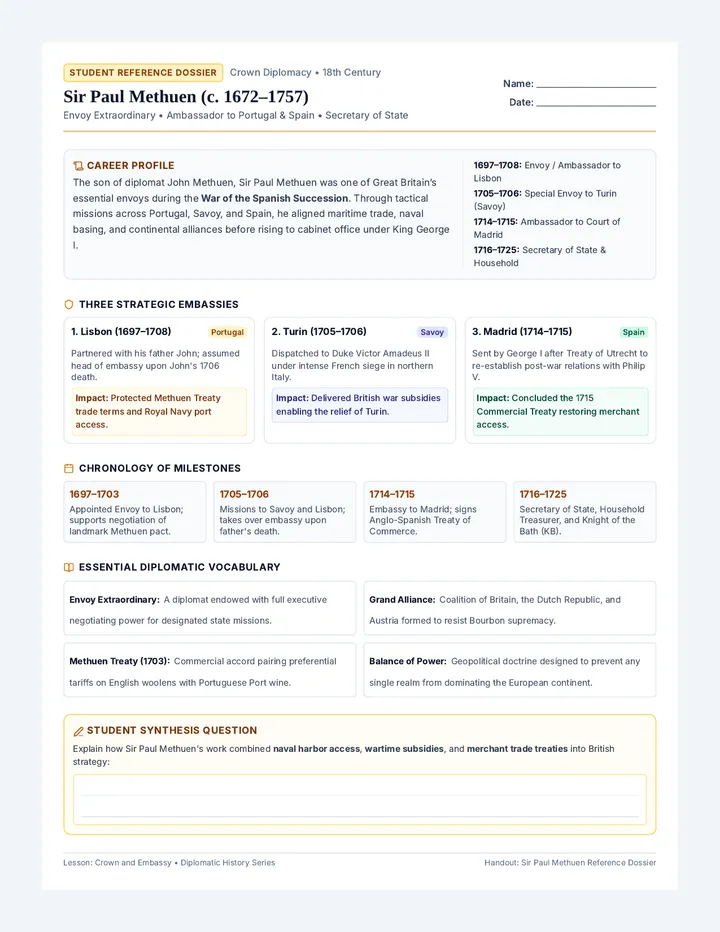
Student Reference Dossier Crown Diplomacy • 18th Century
Sir Paul Methuen (c. 1672–1757)
Envoy Extraordinary • Ambassador to Portugal & Spain • Secretary of State
Name: ___________________________
Date: ___________________________
Career Profile
The son of diplomat John Methuen, Sir Paul Methuen was one of Great Britain’s essential envoys during the War of the Spanish Succession. Through tactical missions across Portugal, Savoy, and Spain, he aligned maritime trade, naval basing, and continental alliances before rising to cabinet office under King George I.
1697–1708: Envoy / Ambassador to Lisbon
1705–1706: Special Envoy to Turin (Savoy)
1714–1715: Ambassador to Court of Madrid
1716–1725: Secretary of State & Household
Three Strategic Embassies
1. Lisbon (1697–1708) Portugal
Partnered with his father John; assumed head of embassy upon John's 1706 death.
Impact: Protected Methuen Treaty trade terms and Royal Navy port access.
2. Turin (1705–1706) Savoy
Dispatched to Duke Victor Amadeus II under intense French siege in northern Italy.
Impact: Delivered British war subsidies enabling the relief of Turin.
3. Madrid (1714–1715) Spain
Sent by George I after Treaty of Utrecht to re-establish post-war relations with Philip V.
Impact: Concluded the 1715 Commercial Treaty restoring merchant access.
Chronology of Milestones
1697–1703
Appointed Envoy to Lisbon; supports negotiation of landmark Methuen pact.
1705–1706
Missions to Savoy and Lisbon; takes over embassy upon father's death.
1714–1715
Embassy to Madrid; signs Anglo-Spanish Treaty of Commerce.
1716–1725
Secretary of State, Household Treasurer, and Knight of the Bath (KB).
Essential Diplomatic Vocabulary
Envoy Extraordinary: A diplomat endowed with full executive negotiating power for designated state missions.
Grand Alliance: Coalition of Britain, the Dutch Republic, and Austria formed to resist Bourbon supremacy.
Methuen Treaty (1703): Commercial accord pairing preferential tariffs on English woolens with Portuguese Port wine.
Balance of Power: Geopolitical doctrine designed to prevent any single realm from dominating the European continent.
Student Synthesis Question