Gravity Explorers Slides Physics Demonstrations Investigating Fundamental Forces
Gravity Under the Lens
How does gravitational force change when you alter mass and distance? Two hands-on demonstrations reveal the universal rule.
Focus: Observe data patterns, identify relationships, explain the physics
Slide 01 / 10
Inquiry Question
02 / 10
What Controls the Strength of Gravity?
Every object with mass exerts a pull on every other object. But what makes this invisible attraction grow stronger or fade away?
Variable 1: Mass
How does the amount of matter in one or both objects affect how strongly they pull on each other?
Explored in Demonstration 1
Variable 2: Distance
How does the separation gap between the centers of two objects change the force between them?
Explored in Demonstration 2
Goal: Record observations and deduce the mathematical pattern for each variable.
Demo 1: Setup The Mass Multiplier
03 / 10
Measuring Earth's Gravitational Pull
We use a calibrated spring scale (force meter in Newtons) suspended from a stand. We hang identical 100-gram metal cylinders one by one at the exact same elevation.
Independent Variable: Total suspended mass (100g, 200g, 300g, 400g).
Dependent Variable: Downwards gravitational force in Newtons (N).
Controlled Factor: Distance from Earth's center remains constant.
Spring Scale Apparatus
The internal spring stretches directly in response to the downward gravitational pull exerted on the mass.
Watch the gauge as each standard mass is linked onto the hook. Look for the numerical pattern!
Demo 1: Data Recorded Spring Scale Readings
04 / 10
Observations: Mass vs. Downward Force
1 Unit 100 g
~ 0.98 N
2 Units 200 g
~ 1.96 N
3 Units 300 g
~ 2.94 N
4 Units 400 g
~ 3.92 N
Observe & Describe:
What happens to the gravitational force when you double or triple the mass? Is this relationship direct or inverse?
Ratio: Force divided by mass equals a constant value (\(g \approx 9.8\text{ N/kg}\)). Direct Proportionality
Demo 1: Explanation The Mass Principle Explained
05 / 10
Key Principle: Gravity is Directly Proportional to Mass
Direct Relationship
If you double the mass of an object, the gravitational pull between it and the Earth exactly doubles (\(2\times\)).
\(F_{\text{gravity}} \propto \text{mass}_1 \times \text{mass}_2\)
Cosmic Meaning
This is why massive bodies like Jupiter or the Sun exert vastly stronger gravitational forces than asteroids or moons. More mass means more gravity!
Summary takeaway: More mass = Stronger gravitational attraction. Next: Does distance work the same way?
Newton's First Key: The force scales linearly with mass. 1 of 2 rules established
Demo 2: Setup The Distance Drop-Off
06 / 10
Investigating Field Strength Over Distance
To visualize and measure how radial force falls off with distance, we use a tensioned spandex gravity-well model with a central 2 kg sphere, paired with distance-indexed pull gauges at set radii: r, 2r, and 3r.
Independent Variable: Distance (\(r\)) from the central attractor.
Dependent Variable: Inward pulling force exerted on the test object.
Controlled Factor: Mass of both objects remains unchanged.
Curved Space Well Model
The slope steepness models gravitational field intensity at varying radial distances from the center.
Compare the inward pull at \(10\text{ cm}\), \(20\text{ cm}\), and \(30\text{ cm}\). Does the force drop linearly?
Demo 2: Data Pull Force vs. Distance Measurements
07 / 10
Observations: Distance vs. Inward Pull
Base Distance Radius \(r\) (10 cm)
Full Force: \(1.00\text{ F}\)
Steepest slope, rapid inward acceleration
Double Distance Radius \(2r\) (20 cm)
Reduced to: \(0.25\text{ F}\) (\(1/4\))
Dramatic drop: not half, but a fourth!
Triple Distance Radius \(3r\) (30 cm)
Reduced to: \(0.11\text{ F}\) (\(1/9\))
Gentle slope, faint inward pull
Observe & Describe:
When distance doubles (\(2\times\)), why does force drop to \(1/4\)? What math connects \(2 \rightarrow 4\) and \(3 \rightarrow 9\)?
Notice: The drop-off is much steeper than a simple linear decline! Inverse-Square Pattern
Demo 2: Explanation The Inverse-Square Law
08 / 10
Key Principle: Gravity Follows an Inverse-Square Law
Why Square the Distance?
Gravity spreads out spherically in three-dimensional space like light from a bulb. When distance doubles, the force spreads over 4 times the area.
\(F_{\text{gravity}} \propto \frac{1}{\text{distance}^2}\)
Testing the Rule
• Double distance (\(2r\)) \(\rightarrow \frac{1}{2^2} = \frac{1}{4}\) force
• Triple distance (\(3r\)) \(\rightarrow \frac{1}{3^2} = \frac{1}{9}\) force
• Quadruple distance (\(4r\)) \(\rightarrow \frac{1}{4^2} = \frac{1}{16}\) force
Summary takeaway: Greater distance = Rapidly weakening gravitational force. Let's combine both rules!
Newton's Second Key: The force weakens with the square of distance. 2 of 2 rules established
Synthesis The Universal Law of Gravitation
09 / 10
Connecting Both Discoveries: Newton's Equation
Newton's Law of Universal Gravitation
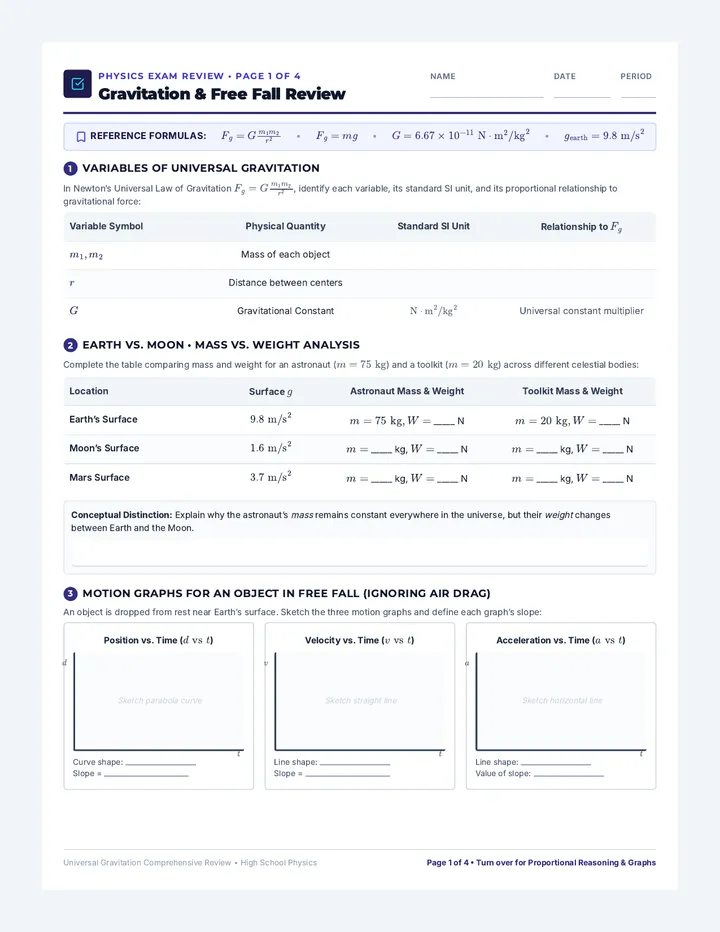
\[F = G \frac{m_1 m_2}{r^2}\]
Mass in the Numerator
Increasing either mass directly multiplies the gravitational attraction between them.
Distance in the Denominator
Increasing separation distance (\(r\)) rapidly weakens force because distance is squared.
\(G\) is Newton's gravitational constant (\(6.674 \times 10^{-11}\text{ N}\cdot\text{m}^2/\text{kg}^2\)). Universal across all bodies
Class Challenge Apply Your Knowledge
10 / 10
Predict the Gravitational Outcome
Use the patterns you observed from both demonstrations to solve these two scenarios:
Scenario A: The Moon Trip
The Moon has about \(1/6\) the mass of Earth. If an astronaut stands on the Moon's surface:
How does the gravitational force pulling on them compare to on Earth? Why?
Scenario B: Orbit Elevation
A satellite is moved from Earth's surface to a distance \(3\times\) farther from Earth's center:
By what factor does Earth's gravitational pull on the satellite drop?
Turn and talk: Share your explanations with your partner. Ready for class discussion
Gravity Detectives Handout Guided Investigation Handout
Cosmic Pull: Gravity Under the Lens
Name:
Date: Period:
Guiding Question: How does gravitational force change when you systematically alter the mass of an object or the distance between objects?
Part 1: Demonstration 1 — The Mass Multiplier
Variable Under Test: Mass
Independent Variable Total Mass (grams)
Dependent Variable Gravitational Force (N)
Controlled Variable Distance from Earth
Observation Data Table
Trial
Mass Added (g)
Mass in kg
Force Gauge Reading (N)
Ratio (Force / Mass kg)
1 unit
100 g
0.10 kg
~ 0.98 N
2 units
200 g
0.20 kg
~ 1.96 N
3 units
300 g
0.30 kg
~ 2.94 N
4 units
400 g
0.40 kg
~ 3.92 N
1. Pattern Recognition: What happens to the force reading each time the suspended mass is doubled (e.g., from 100g to 200g, or 200g to 400g)?
2. Relationship Classification: Is the relationship between mass and gravitational force direct or inverse? Cite evidence from your data table to justify your choice.
3. Prediction: If you hung a 1,000 g (1.0 kg) mass from the same spring scale, what would the force reading be?
Cosmic Pull Lab • Student Handout Turn over for Part 2 & Universal Synthesis → Page 1 of 2
Cosmic Pull Lab • Student Investigation Name: ______________________
Part 2: Demonstration 2 — The Distance Drop-Off
Variable Under Test: Distance
Independent Variable Distance from Center (\(r\))
Dependent Variable Inward Pull Force
Controlled Variable Mass of Both Spheres
Observation Data Table
Radial Position
Distance (\(r\))
Relative Force Value
Fraction of Base Force
Calculation \((1/r^2)\)
Base Radius
\(1r\) (10 cm)
1.00 F
Full Force (\(1/1\))
\(1 / 1^2 = 1\)
Double Radius
\(2r\) (20 cm)
0.25 F
One-Fourth (\(1/4\))
\(1 / 2^2 = 1/4\)
Triple Radius
\(3r\) (30 cm)
0.11 F
One-Ninth (\(1/9\))
\(1 / 3^2 = 1/9\)
4. Pattern Analysis: When distance is doubled from \(10\text{ cm}\) to \(20\text{ cm}\), why did the force not drop to \(1/2\)? Explain the mathematical pattern.
5. Geometric Reasoning: Why does gravitational force spread out according to an inverse-square law instead of a simple linear drop-off?
Part 3: Newton's Law of Universal Gravitation
\(F = G \frac{m_1 m_2}{r^2}\)
Newton unified both demonstrations into a single law: Gravitational attraction is directly proportional to the product of the two masses and inversely proportional to the square of the distance between their centers.
Scenario A: The Moon Trip
The Moon has about \(1/6\) the mass of Earth. How will your weight (gravitational pull) change on the Moon?
Scenario B: Satellite in High Orbit
A satellite is moved to a distance \(4\times\) farther from Earth's center. What fraction of Earth's gravity does it experience?
Cosmic Pull Lab • Student Handout Newton's Law of Universal Gravitation Page 2 of 2
Gravity Detectives Answer Key Teacher Answer Key & Facilitation Guide
Cosmic Pull: Gravity Under the Lens
Unit: Forces & Universal Gravitation Target: Middle / High School Physics
Instructional Goal: Guide students to discover that gravitational force scales linearly with mass (\(F \propto m\)) and falls off with the square of distance (\(F \propto 1/r^2\)) before introducing Newton's formal equation.
Part 1 Solutions: Demonstration 1 — The Mass Multiplier
[ANSWER KEY]
Completed Observation Data Table
Trial
Mass (g)
Mass (kg)
Measured Force (N)
Ratio: \(F / m\) (N/kg)
1 unit
100 g
0.10 kg
~ 0.98 N
9.8 N/kg
2 units
200 g
0.20 kg
~ 1.96 N
9.8 N/kg
3 units
300 g
0.30 kg
~ 2.94 N
9.8 N/kg
4 units
400 g
0.40 kg
~ 3.92 N
9.8 N/kg
1. Pattern Recognition Model Response:
Exemplar Answer: When the suspended mass doubles (e.g., from 100g to 200g, or 200g to 400g), the measured gravitational force also exactly doubles (0.98 N → 1.96 N, and 1.96 N → 3.92 N). When mass triples, force triples.
2. Relationship Classification Model Response:
Exemplar Answer: The relationship is directly proportional . The ratio of downward gravitational force to mass is constant (\(F/m \approx 9.8\text{ N/kg}\)), creating a straight-line graph passing through the origin \((0,0)\).
3. Prediction Calculation:
Exemplar Answer: For a 1,000 g (1.0 kg) mass, the gravitational force would be:
Common Misconception Alert: Mass vs. Weight
Students often confuse mass (amount of matter in kg) with weight (gravitational force in N). Emphasize that mass remains identical everywhere in the universe, whereas gravitational force changes depending on the attracting body.
Cosmic Pull Lab • Teacher Answer Key Turn over for Part 2 & Universal Synthesis Solutions → Page 1 of 2
Cosmic Pull Lab • Teacher Answer Key & Guide Part 2: Distance & Cosmic Synthesis
Part 2 Solutions: Demonstration 2 — The Distance Drop-Off
[ANSWER KEY]
Completed Observation Data Table
Radial Position
Distance (\(r\))
Relative Force
Fraction of Base Force
Formula Check \((1/r^2)\)
Base Radius
\(1r\) (10 cm)
1.00 F
Full Force (\(1/1\))
\(1 / 1^2 = 1.00\)
Double Radius
\(2r\) (20 cm)
0.25 F
One-Fourth (\(1/4\))
\(1 / 2^2 = 0.25\)
Triple Radius
\(3r\) (30 cm)
0.11 F
One-Ninth (\(1/9\))
\(1 / 3^2 \approx 0.11\)
4. Pattern Analysis Model Response:
Exemplar Answer: When distance is doubled from 10 cm to 20 cm, the force drops to \(1/4\) (one-fourth), not \(1/2\). The denominator is squared: \((2)^2 = 4\). When distance is tripled, the force drops to \(1/(3^2) = 1/9\).
5. Geometric Reasoning Model Response:
Exemplar Answer: Gravity radiates outward spherically in 3D space. The surface area of a sphere scales with \(r^2\) (\(A = 4\pi r^2\)). Therefore, the gravitational field intensity is diluted over an area that grows with the square of distance.
Part 3: Newton's Law Worked Solutions
\(F = G \frac{m_1 m_2}{r^2}\)
Remind students that mass is on top (multiplying the pull) and distance squared is on the bottom (weakening the pull).
Scenario A: The Moon Trip
Question: Moon has \(1/6\) Earth's mass. How does weight change?
Worked Solution: Weight is directly proportional to the attracting mass (\(F \propto M_{\text{body}}\)). Therefore, an astronaut weighs approximately \(1/6\) as much on the Moon as on Earth (e.g., a 600 N person on Earth weighs ~100 N on the Moon).
Scenario B: High Orbit Satellite
Question: Moved to \(4\times\) the distance from Earth's center.
Worked Solution: By the inverse-square law, \(F \propto \frac{1}{r^2}\). If \(r\) is quadrupled (\(4r\)), the force drops by a factor of \(4^2 = 16\). The satellite experiences \(1/16\) (6.25%) of surface gravity.
Debrief Prompt for Class: Ask: "Why do astronauts in orbit float if gravity is still ~90% as strong at 400 km altitude?" (Clarify that they are in continuous free-fall, not zero-gravity!).
Cosmic Pull Lab • Teacher Answer Key Newton's Law of Universal Gravitation Page 2 of 2
Gravity Checkpoint Exit Ticket Quick Check
Gravity & Orbit Checkpoint
Name:
Period:
1. Mass Effect: If a planet has 3 times the mass of Earth (same radius), what happens to your weight (gravitational pull) on that planet?
A 1/3 of Earth weight
B Same Earth weight
C 3× Earth weight
D 9× Earth weight
2. Distance Effect: Two research probes double their separation distance (\(2\times\) farther apart). The gravitational pull between them becomes:
A 1/2 as strong
B 1/4 as strong
C 2× stronger
D 4× stronger
3. Explain: Why does increasing distance weaken gravitational attraction much faster than decreasing mass does? Refer to Newton's law:
Cosmic Pull Lab • Formative Check Newton's Universal Gravitation
Cut here (2 slips per sheet)
Quick Check
Gravity & Orbit Checkpoint
Name:
Period:
1. Mass Effect: If a planet has 3 times the mass of Earth (same radius), what happens to your weight (gravitational pull) on that planet?
A 1/3 of Earth weight
B Same Earth weight
C 3× Earth weight
D 9× Earth weight
2. Distance Effect: Two research probes double their separation distance (\(2\times\) farther apart). The gravitational pull between them becomes:
A 1/2 as strong
B 1/4 as strong
C 2× stronger
D 4× stronger
3. Explain: Why does increasing distance weaken gravitational attraction much faster than decreasing mass does? Refer to Newton's law:
Cosmic Pull Lab • Formative Check Newton's Universal Gravitation