Matter Detectives Practice Worksheet 8th Grade Physical Science MS-PS1-2 // Matter & Interactions
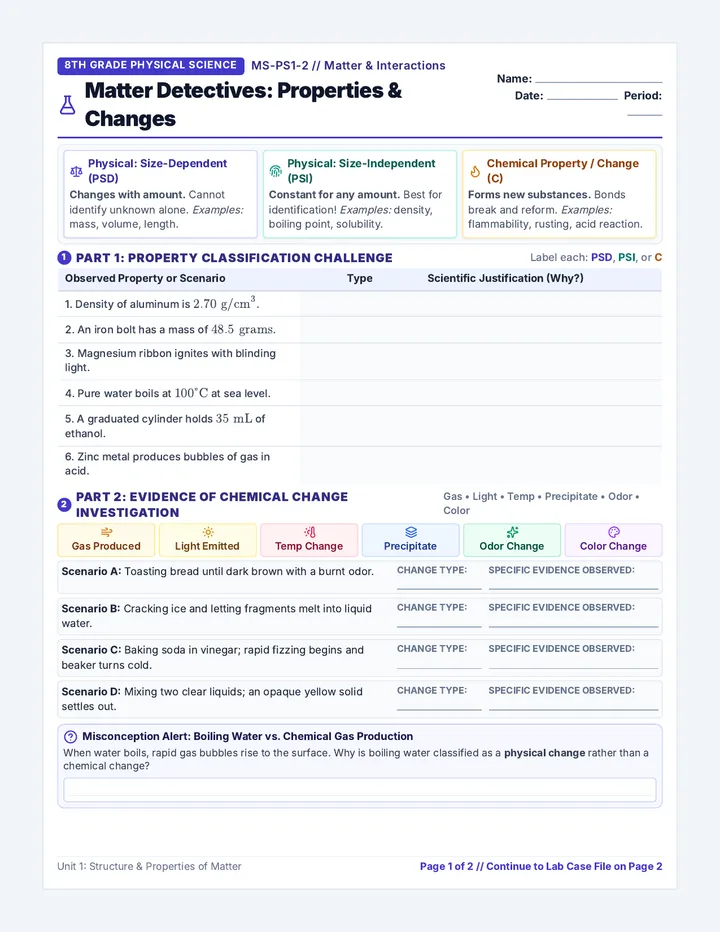
Matter Detectives: Properties & Changes
Name:
Date: Period:
Physical: Size-Dependent (PSD)
Changes with amount. Cannot identify unknown alone. Examples: mass, volume, length.
Physical: Size-Independent (PSI)
Constant for any amount. Best for identification! Examples: density, boiling point, solubility.
Chemical Property / Change (C)
Forms new substances. Bonds break and reform. Examples: flammability, rusting, acid reaction.
1 Part 1: Property Classification Challenge
Label each: PSD , PSI , or C
Observed Property or Scenario
Type
Scientific Justification (Why?)
1. Density of aluminum is \( 2.70 \text{ g/cm}^3 \).
2. An iron bolt has a mass of \( 48.5 \text{ grams} \).
3. Magnesium ribbon ignites with blinding light.
4. Pure water boils at \( 100^\circ\text{C} \) at sea level.
5. A graduated cylinder holds \( 35 \text{ mL} \) of ethanol.
6. Zinc metal produces bubbles of gas in acid.
2 Part 2: Evidence of Chemical Change Investigation
Gas • Light • Temp • Precipitate • Odor • Color
Gas Produced
Light Emitted
Temp Change
Precipitate
Odor Change
Color Change
Scenario A: Toasting bread until dark brown with a burnt odor.
Change Type:
Specific Evidence Observed:
Scenario B: Cracking ice and letting fragments melt into liquid water.
Change Type:
Specific Evidence Observed:
Scenario C: Baking soda in vinegar; rapid fizzing begins and beaker turns cold.
Change Type:
Specific Evidence Observed:
Scenario D: Mixing two clear liquids; an opaque yellow solid settles out.
Change Type:
Specific Evidence Observed:
Misconception Alert: Boiling Water vs. Chemical Gas Production
When water boils, rapid gas bubbles rise to the surface. Why is boiling water classified as a physical change rather than a chemical change?
Unit 1: Structure & Properties of Matter Page 1 of 2 // Continue to Lab Case File on Page 2
Forensic Science Lab Evidence Case File #802
Part 3: Identifying Unknown Substances from Data
Student Name:
Lab Briefing: Two unlabeled containers of white powders (Sample X and Sample Y) were recovered from a science storage room. Use reference properties and reaction evidence below to identify both substances.
Table 1: Reference Database of Known Substances
Substance Name
State
Density (\(\text{g/cm}^3\))
Solubility
Reaction with Acetic Acid (Vinegar)
Reaction with Iodine Solution
Baking Soda (Sodium Bicarb.)
White powder
2.20
Dissolves well
Vigorous fizzing & \( \text{CO}_2 \) gas
Yellowish-brown (no reaction)
Cornstarch
Fine powder
1.50
Insoluble (cloudy)
No gas, no reaction
Deep blue-black color change
Chalk (Calcium Carbonate)
White powder
2.71
Insoluble (settles)
Slow bubbling & gas release
Pale brown (no reaction)
Table Sugar (Sucrose)
Crystals
1.59
Very soluble
No gas, no reaction
Amber-brown (no reaction)
Table 2: Mystery Sample Experimental Test Results
Unknown Sample
Mass
Volume
Calculated Density
Water Solubility
Acetic Acid Test
Iodine Solution Test
Sample X
15.0 g
10.0 cm³
Insoluble (cloudy)
No bubbles observed
Instant deep purple-black
Sample Y
44.0 g
20.0 cm³
Dissolved completely
Vigorous fizzing & foaming gas
Stays yellowish-brown
1. Density Calculation (Show formula, substitution with units, and calculated density value):
Sample X Density (\( D = \frac{m}{V} \)):
Sample Y Density (\( D = \frac{m}{V} \)):
2. Size-Dependent vs. Size-Independent Properties Reasoning:
Why couldn't investigators determine the identity of Sample Y using only its mass (44.0 g) or volume (20.0 cm³)? Why was density effective?
3. Chemical Reaction Evidence Analysis:
Identify two tests from Table 2 that produced conclusive evidence of a chemical change . Name the specific sign of chemical change for each:
4. Final Forensic Verdict (Claim-Evidence-Reasoning)
Sample X Identity:
List 1 physical property + 1 chemical reaction evidence supporting this:
Sample Y Identity:
List 1 physical property + 1 chemical reaction evidence supporting this:
Eighth Grade Science Investigation Page 2 of 2 // End of Practice Sheet
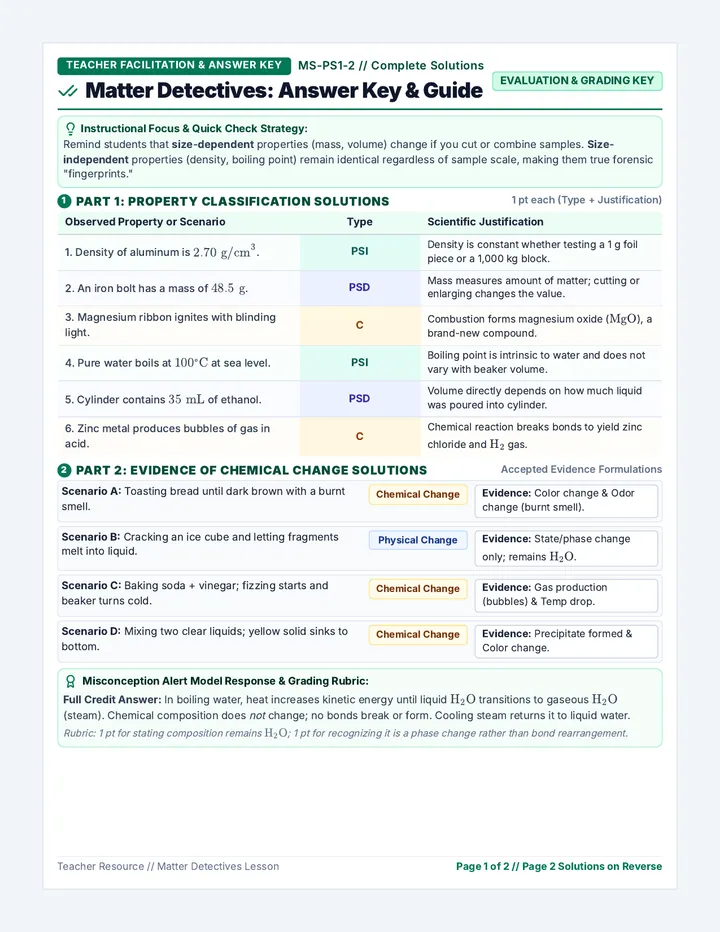
Matter Detectives Answer Key Teacher Facilitation & Answer Key MS-PS1-2 // Complete Solutions
Matter Detectives: Answer Key & Guide
EVALUATION & GRADING KEY
Instructional Focus & Quick Check Strategy:
Remind students that size-dependent properties (mass, volume) change if you cut or combine samples. Size-independent properties (density, boiling point) remain identical regardless of sample scale, making them true forensic "fingerprints."
1 Part 1: Property Classification Solutions
1 pt each (Type + Justification)
Observed Property or Scenario
Type
Scientific Justification
1. Density of aluminum is \( 2.70 \text{ g/cm}^3 \).
PSI
Density is constant whether testing a 1 g foil piece or a 1,000 kg block.
2. An iron bolt has a mass of \( 48.5 \text{ g} \).
PSD
Mass measures amount of matter; cutting or enlarging changes the value.
3. Magnesium ribbon ignites with blinding light.
C
Combustion forms magnesium oxide (\(\text{MgO}\)), a brand-new compound.
4. Pure water boils at \( 100^\circ\text{C} \) at sea level.
PSI
Boiling point is intrinsic to water and does not vary with beaker volume.
5. Cylinder contains \( 35 \text{ mL} \) of ethanol.
PSD
Volume directly depends on how much liquid was poured into cylinder.
6. Zinc metal produces bubbles of gas in acid.
C
Chemical reaction breaks bonds to yield zinc chloride and \( \text{H}_2 \) gas.
2 Part 2: Evidence of Chemical Change Solutions
Accepted Evidence Formulations
Scenario A: Toasting bread until dark brown with a burnt smell.
Chemical Change
Evidence: Color change & Odor change (burnt smell).
Scenario B: Cracking an ice cube and letting fragments melt into liquid.
Physical Change
Evidence: State/phase change only; remains \( \text{H}_2\text{O} \).
Scenario C: Baking soda + vinegar; fizzing starts and beaker turns cold.
Chemical Change
Evidence: Gas production (bubbles) & Temp drop.
Scenario D: Mixing two clear liquids; yellow solid sinks to bottom.
Chemical Change
Evidence: Precipitate formed & Color change.
Misconception Alert Model Response & Grading Rubric:
Full Credit Answer: In boiling water, heat increases kinetic energy until liquid \( \text{H}_2\text{O} \) transitions to gaseous \( \text{H}_2\text{O} \) (steam). Chemical composition does not change; no bonds break or form. Cooling steam returns it to liquid water.
Rubric: 1 pt for stating composition remains \( \text{H}_2\text{O} \); 1 pt for recognizing it is a phase change rather than bond rearrangement.
Teacher Resource // Matter Detectives Lesson Page 1 of 2 // Page 2 Solutions on Reverse
Forensic Lab Solutions Evidence Case File #802
Part 3: Unknown Substance Identification Key
Grade 8 Physical Science
Table 1: Reference Key & Substance Elimination Guide
Substance
Density
Solubility
Acid Test
Iodine Test
Teacher Diagnostic Clue
Baking Soda
2.20
Soluble
Vigorous fizzing
No reaction
Matches Sample Y density & acid reaction.
Cornstarch
1.50
Insoluble
No reaction
Deep blue-black
Matches Sample X density & iodine indicator.
Chalk
2.71
Insoluble
Slow bubbling
No reaction
Eliminated: higher density (\(2.71\)) and insoluble.
Table Sugar
1.59
Very soluble
No reaction
No reaction
Eliminated: soluble in water, no iodine reaction.
Table 2: Completed Mystery Sample Calculations & Observations
Unknown Sample
Mass
Volume
Calculated Density
Solubility
Acid Test
Iodine Test
Sample X
15.0 g
10.0 cm³
\( 1.50 \text{ g/cm}^3 \)
Insoluble (cloudy)
No bubbles
Deep dark purple-black
Sample Y
44.0 g
20.0 cm³
\( 2.20 \text{ g/cm}^3 \)
Dissolved completely
Vigorous fizzing & foaming
Stays yellowish-brown
1. Density Calculation (Model Student Math Work):
Sample X Density:
\( D = \frac{m}{V} = \frac{15.0\text{ g}}{10.0\text{ cm}^3} = \mathbf{1.50\text{ g/cm}^3} \)
Matches cornstarch density exactly.
Sample Y Density:
\( D = \frac{m}{V} = \frac{44.0\text{ g}}{20.0\text{ cm}^3} = \mathbf{2.20\text{ g/cm}^3} \)
Matches baking soda density exactly.
2. Size-Dependent vs. Size-Independent Reasoning:
Key Concept: Mass (44.0 g) and volume (20.0 cm³) are size-dependent properties; any powder can have those values if you measure that quantity. In contrast, density (\( 2.20 \text{ g/cm}^3 \)) is characteristic and size-independent, allowing direct identification.
3. Chemical Reaction Evidence Analysis:
1. Sample Y with Acetic Acid: Vigorous bubbling and foaming gas (\(\text{CO}_2\)), demonstrating gas production.
2. Sample X with Iodine Solution: Turned from amber/brown to deep purple-black, demonstrating an unexpected color change.
4. Final Forensic Verdict (Claim-Evidence-Reasoning Model Responses)
Sample X: Cornstarch
Physical: Density of \( 1.50 \text{ g/cm}^3 \) and insolubility match cornstarch.Chemical: Instant purple-black with iodine confirms starch; unreactive with acid.
Sample Y: Baking Soda
Physical: Density of \( 2.20 \text{ g/cm}^3 \) and water solubility match sodium bicarb.Chemical: Vigorous bubbling (\(\text{CO}_2\) gas) with acetic acid confirms reaction.
Differentiated Extension: Ask students how to distinguish chalk (\(2.71\text{ g/cm}^3\)) from baking soda (\(2.20\text{ g/cm}^3\)) using solubility if a scale wasn't available. NGSS: MS-PS1-2
Eighth Grade Science Investigation // MS-PS1-2 Page 2 of 2 // End of Answer Key
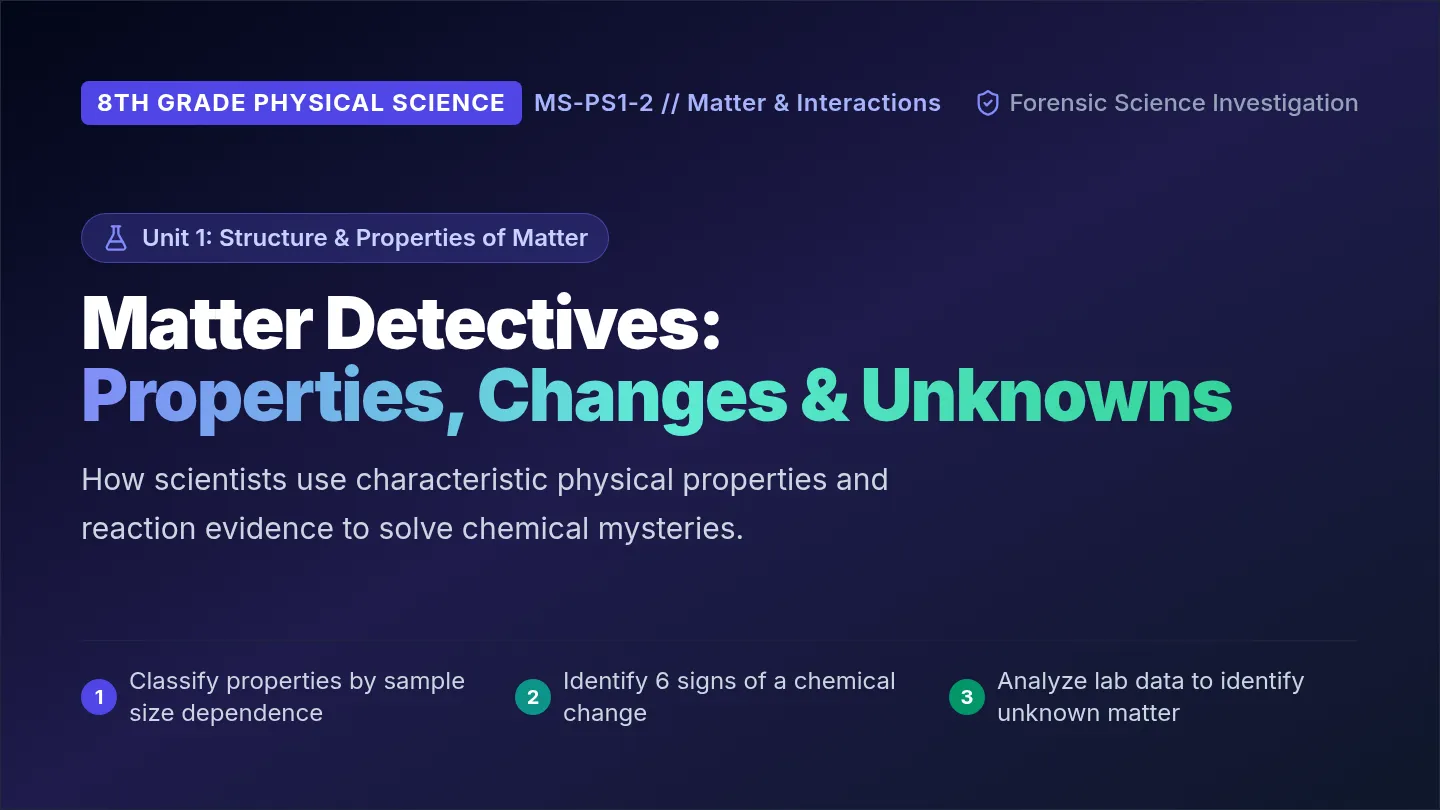
Matter Detectives Slides 8th Grade Physical Science MS-PS1-2 // Matter & Interactions
Forensic Science Investigation
Unit 1: Structure & Properties of Matter
Matter Detectives:
Properties, Changes & Unknowns
How scientists use characteristic physical properties and reaction evidence to solve chemical mysteries.
1 Classify properties by sample size dependence
2 Identify 6 signs of a chemical change
3 Analyze lab data to identify unknown matter
Concept 1 // Physical Properties
Size-Dependent vs. Size-Independent
Slide 2 of 6
Size-Dependent (Extensive)
Properties that change whenever the amount of matter changes.
Common Examples:
Mass (grams)
Volume (\( \text{cm}^3 \) or mL)
Length, Width & Shape
Cannot identify an unknown substance alone!
Size-Independent (Intensive)
Properties that stay constant no matter how large or small the sample is.
Characteristic "Fingerprints":
Density (\( D = m / V \))
Melting & Boiling Points
Solubility in water (\( \text{g}/100\text{ mL} \))
Essential for conclusively identifying unknowns!
Forensic Rule: 1 gram of gold and 1,000 kilograms of gold both have the exact same density (\( 19.3 \text{ g/cm}^3 \)). Intensive Property
Concept 2 // Chemical Reactions
What Makes a Change "Chemical"?
Slide 3 of 6
The Fundamental Definition:
A chemical change occurs when existing chemical bonds break and new bonds form, producing one or more brand-new substances with completely different physical and chemical properties.
Flammability & Combustion
Burning wood reacts with oxygen to form ash, carbon dioxide, and water vapor.
Reactivity with Acid
Baking soda or zinc reacts with acid, reorganizing atoms to release gas bubbles.
Oxidation & Rusting
Iron slowly bonds with oxygen and moisture to produce brittle iron oxide (rust).
Remember: Physical changes alter shape or state, but the chemical formula stays identical. New Substance = Chemical Change
Evidence Toolkit // Reaction Indicators
The 6 Signs of a Chemical Change
Slide 4 of 6
1. Gas Production
Rapid bubbling, fizzing, or foaming when reactants mix (not from boiling!).
2. Light Emitted
Glow sticks snapping, fireworks exploding, or magnesium burning brightly.
3. Temp Change
Releases heat (exothermic) or absorbs heat (endothermic cooling) without a heater.
4. Precipitate Formed
An insoluble solid suddenly forms and separates when two clear liquids mix.
5. Odor Change
Food spoiling, milk souring, or bread baking emitting brand-new aromas.
6. Color Change
An unexpected new hue appears (e.g., silver metal rusting orange, iodine turning purple).
Forensic Rule: Look for at least one clear sign before claiming a chemical reaction occurred. Empirical Evidence
Lab Application // Data Analysis
How to Crack Unknown Substance Case Files
Slide 5 of 6
1
Calculate Density
Mass (\(15.0\text{ g}\)) and volume (\(10.0\text{ cm}^3\)) change with size, but density is size-independent:
\( D = \frac{15.0\text{ g}}{10.0\text{ cm}^3} = 1.50\text{ g/cm}^3 \)
2
Check Physical Match
Compare calculated density and water solubility against reference data:
• Density: \( 1.50\text{ g/cm}^3 \)
• Insoluble in water (cloudy)
3
Verify Chemical Signs
Confirm with chemical indicator test evidence:
• Iodine turned purple-black
Verdict: Cornstarch!
Winning Formula: Physical Property (Density) + Chemical Test (Iodine) = Conclusive Identity! CER Method
Critical Thinking Check // Lab Ready
Misconception Alert & Student Mission
Slide 6 of 6
Common Trap: Boiling Water Makes Gas Bubbles... So Is It Chemical?
NO! It is 100% Physical. Liquid \( \text{H}_2\text{O} \) simply turns into gaseous \( \text{H}_2\text{O} \) (steam). The molecules spread out, but no chemical bonds break and no new compound is formed!
Now It's Your Turn:
Open Your "Matter Detectives" Practice Sheet
Classify properties, spot reaction signs, and solve for Unknown Samples X & Y!
Begin Lab
8th Grade Physical Science // Matter Detectives Lesson Investigation Underway