Total Oxygen (O) atoms (\(6 \times 1\)):
NYS Science Standard MS-LS1-7: Matter and Energy Flow in Organisms Page 1 of 2
Atom Accounting & Conservation Analysis
Student Name:
Part 4: Atom Accounting Graphic Organizer
Transfer your calculations from Page 1 to verify whether the number of each type of atom matches before and after the chemical reaction.
| Element Name & Symbol | Inputs (Reactants)
\(\text{C}_{6}\text{H}_{12}\text{O}_{6} + 6\text{O}_{2}\) | Outputs (Products)
\(6\text{CO}_{2} + 6\text{H}_{2}\text{O}\) | Equal Count?
(Check / Circle) |
| --- | --- | --- | --- |
| C Carbon |
|
|
[ ] Yes [ ] No
| | H Hydrogen |
|
|
[ ] Yes [ ] No
| | O Oxygen |
|
|
[ ] Yes [ ] No
| | Total Number of Atoms |
|
|
[ ] Match [ ] Differ
|
Part 5: Law of Conservation of Matter
Scientific Principle: The number of each atom is exactly the same on both sides because matter (atoms) cannot be created or destroyed. Atoms are never created from nothing, nor do they disappear. They are merely rearranged into new molecules.
Question: Using evidence from your graphic organizer above, explain how the total atom counts prove the Law of Conservation of Matter during cellular respiration:
Part 6: Same Atoms, Different Energy Levels
If the inputs and outputs contain the exact same atoms, why do cells do respiration? The difference is energy! The atoms in the inputs (glucose) are linked in a high-energy bond configuration. When they rearrange into outputs (\(\text{CO}_{2}\) and \(\text{H}_{2}\text{O}\)), they form stable, lower-energy bonds. The extra chemical bond energy is released to power life functions!
Synthesis Question: What is the main difference between the inputs and outputs, and where does the energy released by the cell come from?
NYS Science Standard MS-LS1-7: Matter and Energy Flow in Organisms Page 2 of 2
Misconception 2: "Food is converted into energy."
Correction: Matter does NOT turn into energy! All atoms from glucose become \(\text{CO}_2\) and \(\text{H}_2\text{O}\). Energy comes from the rearrangement of bonds.
NYS Science Learning Standards MS-LS1-7 • Teacher Resource Page 1 of 2
Differentiation & Delivery Protocol
IEP • 504 • ENL/ELL Support
Graphic Organizer Scaffolding
Simplified Language & Sentence Frames
Warm-Up (8 min)
Slides 1–2: Phenomenon inquiry — where does running energy come from?
Direct (12 min)
Slides 3–4: Bond energy contrast & Slide 5 balanced formula modeling.
Practice (20 min)
Atom Tracker Worksheet (Tasks 1 & 2) in collaborative pairs.
Exit / Wrap (8 min)
Slide 6 synthesis: ATP rechargeable battery & Law of Conservation.
Task 1: Decoding Output Molecules
• \(6\text{CO}_2\): Elements = Carbon, Oxygen. Carbon atoms = 6 (\(6 \times 1\)); Oxygen atoms = 12 (\(6 \times 2\)).
• \(6\text{H}_2\text{O}\): Elements = Hydrogen, Oxygen. Hydrogen atoms = 12 (\(6 \times 2\)); Oxygen atoms = 6 (\(6 \times 1\)).
Task 2 & Reflection Answers
• Carbon: 6 In = 6 Out (Equal: Yes). Hydrogen: 12 In = 12 Out (Equal: Yes). Oxygen: 18 In = 18 Out (Equal: Yes). Total: 36 In = 36 Out (Match).
• Conservation Proof: Exactly 36 atoms enter and 36 exit; zero atoms gained or destroyed, only rearranged.
• Energy Source: Energy is released because products have lower-energy bonds than glucose inputs.
NYS Science Learning Standards MS-LS1-7 • Teacher Resource Page 2 of 2
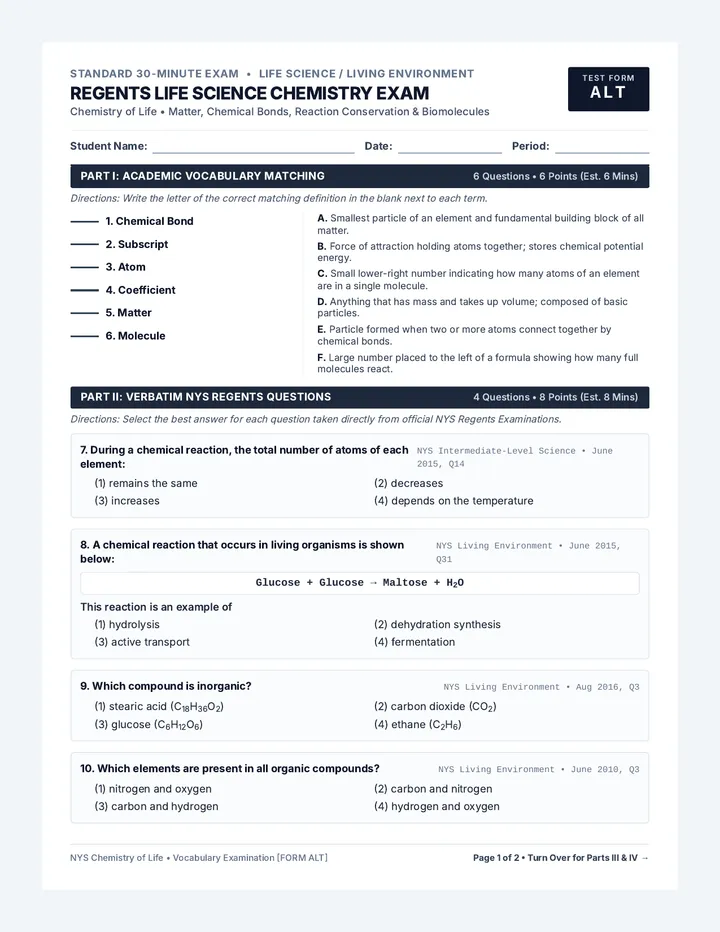
(1) universal gravitation
(2) conservation of matter
(3) thermal expansion
(4) natural selection
Question 8 June 2015 NYS ILS Test, Question 23
Which equation correctly represents the chemical process of cellular respiration occurring in cells?
(1) \(\text{Carbon dioxide} + \text{Water} \rightarrow \text{Glucose} + \text{Oxygen} + \text{Energy}\)
(2) \(\text{Glucose} + \text{Oxygen} \rightarrow \text{Carbon dioxide} + \text{Water} + \text{Energy}\)
(3) \(\text{Glucose} + \text{Carbon dioxide} \rightarrow \text{Oxygen} + \text{Water}\)
(4) \(\text{Oxygen} + \text{Water} \rightarrow \text{Glucose} + \text{Carbon dioxide}\)
NYS Statewide Intermediate Science Item Bank • Standard MS-LS1-7 Page 2 of 4
NYS Statewide MS Science Practice (Continued) Part A: Multiple Choice Items
Question 9 June 2014 NYS ILS Test, Question 15
A student exercises vigorously on a bicycle. Which change occurs in the student's muscle cells to provide the additional energy needed?
(1) The rate of photosynthesis increases.
(2) The rate of cellular respiration increases.
(3) The muscle cells stop taking in oxygen gas.
(4) The cells combine carbon dioxide molecules to form glucose.
Question 10 June 2013 NYS ILS Test, Question 27
Which molecule acts as the primary "rechargeable energy battery" that directly powers life functions in living cells?
(1) ATP
(2) DNA
(3) RNA
(4) Cellulose
Question 11 June 2012 NYS ILS Test, Question 17
During cellular respiration, oxygen gas (\(\text{O}_{2}\)) is taken in by organisms primarily to
(1) prevent the cell interior from drying out
(2) react with and break down glucose molecules to release stored chemical energy
(3) convert carbon atoms into new nitrogen atoms
(4) create new matter inside the cell nucleus
Question 12 June 2010 NYS ILS Test, Question 31
If 6 molecules of carbon dioxide (\(6\text{CO}_{2}\)) are produced during cellular respiration, how many total oxygen atoms are present in these 6 carbon dioxide molecules?
(1) 2
(2) 6
(3) 12
(4) 18
NYS Statewide Intermediate Science Item Bank • Standard MS-LS1-7 Page 3 of 4
NYS Statewide MS Science Practice (Conclusion) Questions 13–15 & Student Answer Grid
Question 13 June 2009 NYS ILS Test, Question 22
Which gas is removed from the atmosphere by organisms performing photosynthesis and released into the atmosphere by organisms performing cellular respiration?
(1) Oxygen
(2) Nitrogen
(3) Carbon dioxide
(4) Hydrogen
Question 14 June 2008 NYS ILS Test, Question 19
Why does the total number of atoms stay exactly the same before and after cellular respiration occurs?
(1) Atoms can only be rearranged, never created or destroyed.
(2) Energy is converted directly into new atoms inside the cell.
(3) All of the atoms are permanently expelled as pure heat energy.
(4) Cells continuously produce new replacement atoms from water.
Question 15 June 2007 NYS ILS Test, Question 28
The energy stored in the chemical bonds of glucose molecules originally comes from
(1) solar energy captured during photosynthesis
(2) geothermal heat from deep within Earth
(3) sound energy produced in the atmosphere
(4) nuclear energy inside soil minerals
Student Answer Grid (Record Answers Here) Total Score: _____ / 15
1:
2:
3:
4:
5:
6:
7:
8:
9:
10:
11:
12:
13:
14:
15:
NYS Statewide Intermediate Science Item Bank • Standard MS-LS1-7 Page 4 of 4