NYS Intermediate-Level Science Exam, June 2022, Question 51
7. Red blood cells lose their nucleus when mature, leaving extra space to carry oxygen through the body. Explain how carrying more oxygen helps muscle cells and the muscular system function.
NYS Intermediate-Level Science Exam, June 2023, Question 61
8. Trace an oxygen molecule from outside the body until it reaches a mitochondrion in a leg muscle cell. Name at least two body systems working together.
Exam Pacing Reflection: Total minutes elapsed: _______ / 20 min goal
On Pace (≤ 20 min) Over Time (> 20 min)
Part 2: Multi-System Coordination Page 2 of 2
Academic Vocabulary (Part 2)
Packet Page 1
Main Office
The control center holding DNA instructions for making proteins, growing, and dividing.
Power Plant
The powerhouses that release usable energy from food so the cell can work and move.
Solar Kitchen
Plant-only structure that uses sunlight to make sugar (food) through photosynthesis.
Outer Box
A stiff outer layer found only in plant cells that gives shape, support, and protection.
Reference Table on Worksheet Page 1 Slide 5 of 18
Academic Vocabulary (Part 3)
Packet Page 1
Level 2
A group of similar specialized cells working together on the same job.
Example: Muscle tissue, skin tissue
Level 3
Different tissues working together to do a major body job.
Example: Heart, stomach, plant leaf
Level 4
A group of organs collaborating to keep the whole organism alive.
Example: Circulatory, digestive system
Hierarchy: Cell → Tissue → Organ → Organ System → Organism Slide 6 of 18
Mini-Lesson (Part 1)
Packet Page 2
1
Plant cells capture sunlight in chloroplasts to make sugar.
Both plant and animal cells use mitochondria to break down that sugar and release energy so the cell can do work.
2
The cell membrane acts like a selective doorway.
It lets in water and oxygen while pushing toxic waste products out, keeping the cell balanced and healthy (homeostasis).
Read along on Page 2 of your student packet Slide 7 of 18
Mini-Lesson (Part 2)
Packet Page 2
3
The nucleus directs tiny ribosomes to assemble proteins.
These proteins repair damaged cell parts, build new cell structures, and allow living things to grow.
4
To heal cuts and help organisms grow, cells reproduce!
The nucleus copies its DNA instructions, and the cell divides into two identical new cells.
Read along on Page 2 of your student packet Slide 8 of 18
Quick Check
Worksheet Page 2
Question A Energy Teamwork
Name two organelles that must work together so an animal cell gets and uses energy:
Key Answer: Cell membrane (lets food/oxygen in) & Mitochondria (releases energy from food).
Question B Healing an Injury
What role does the nucleus play when an organism heals from a paper cut?
Key Answer: It copies its DNA instructions so skin cells can divide and form new tissue to close the cut.
Verify answers on Page 2 of your packet Slide 9 of 18
Activity
17:00 Total Time
Questions 1–4
Located on Page 3. Spend about 1.5 to 2 minutes on each question.
Target: 7–8 minutes
Questions 5–7
Located on Page 4. Write clear, complete scientific sentences connecting cells to body systems.
Target: 9–10 minutes
Self-Check
Underline key words: mitochondria, cell membrane, tissues, and systems.
Check box at bottom of Page 4
Turn to Page 3 in your packet • Timer starts now Slide 10 of 18
NYS Intermediate-Level Science Exam, June 2018, Question 14 Worksheet Page 3
A cell → organ → tissue → organ system
B tissue → cell → organ system → organ
C cell → tissue → organ → organ system
D organ system → organ → tissue → cell
Explanation: Single cells form tissues, tissues form organs, organs form systems Slide 11 of 18
NYS Intermediate-Level Science Exam, June 2019, Question 22 Worksheet Page 3
A Chloroplast
B Mitochondria
C Cell wall
D Large central vacuole
Explanation: Mitochondria release energy from food to power constant heart pumping Slide 12 of 18
NYS Intermediate-Level Science Exam, June 2021, Question 31 Worksheet Page 3
A Cytoplasm
B Cell membrane
C Nucleus
D Endoplasmic reticulum
Explanation: The nucleus stores DNA instructions and directs all cell activities Slide 13 of 18
NYS Intermediate-Level Science Exam, June 2022, Question 39 Worksheet Page 3
A Cell wall
B Cell membrane
C Ribosome
D Nuclear membrane
Explanation: The cell membrane is the outer gate controlling entry and exit of molecules Slide 14 of 18
NYS Intermediate-Level Science Exam, June 2022, Question 47 Worksheet Page 4
Scenario: A person feels unusually tired and weak. Medical tests reveal that their muscle cells are having trouble releasing energy from food because one type of organelle is damaged.
(a) Identify the Organelle
Mitochondria
The powerhouses responsible for releasing usable energy from food molecules.
(b) Muscular System Impact
Loss of Movement Force
Without usable energy, muscle tissues cannot contract, leaving the entire muscular system weak and exhausted.
Written Response Scoring: 1 pt for organelle + 1 pt for system explanation Slide 15 of 18
NYS Intermediate-Level Science Exam, June 2023, Question 53 Worksheet Page 4
Flexible rounded shape; surrounded by cell membrane only; has nucleus and mitochondria.
Rigid rectangular shape; has outer cell wall around cell membrane and nucleus.
Structure & Advantage: The plant cell has a stiff cell wall. This structure provides strong support and protection, allowing plants to stand upright without bones.
Written Response Scoring: 1 pt for structure + 1 pt for survival advantage Slide 16 of 18
NYS Intermediate-Level Science Exam, June 2023, Question 58 Worksheet Page 4
Step 1
Lungs take in oxygen molecules from the air during breathing.
Step 2
Blood carries oxygen and food nutrients directly to muscle cells.
Step 3
Uses oxygen to release energy from food so muscles can contract.
Systems Interaction Takeaway: Body systems work as one united team to feed and power microscopic organelles inside individual cells!
Connecting microscopic organelles to whole-body organ systems Slide 17 of 18
Wrap-Up
Worksheet Page 4
Pacing Self-Check
Mark your check box on Page 4:
Target pacing on NYS exam: ~1.5 to 2 minutes per question.
Final Step
Clear your desk of notes. Complete your 5-minute Exit Ticket independently.
Reminder: 20-minute timed homework assignment is due next class session!
Submit your Exit Ticket before leaving class today Slide 18 of 18
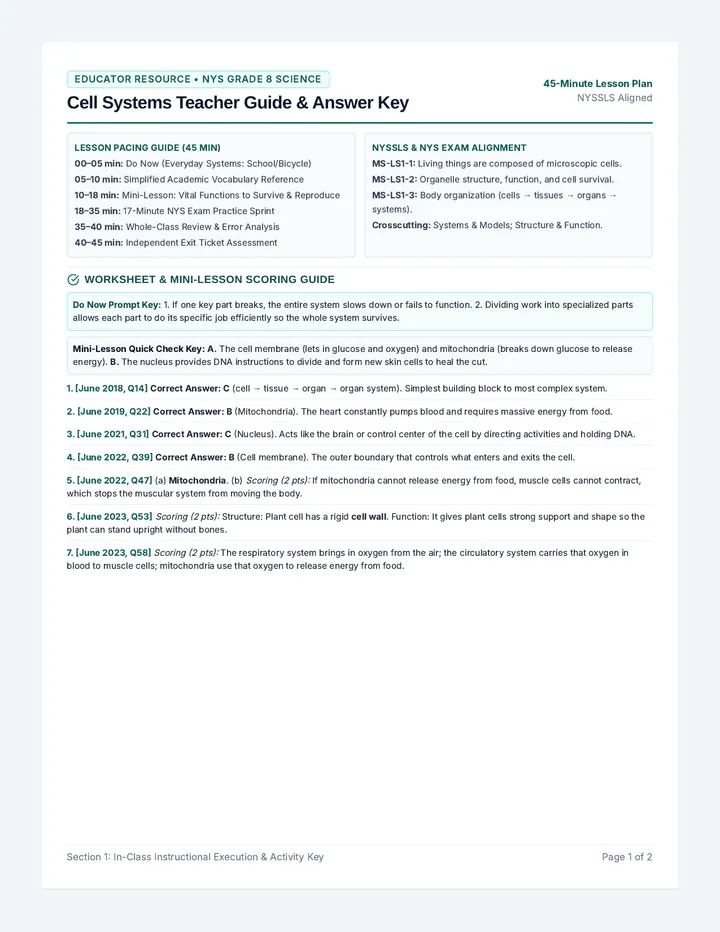
7. [June 2023, Q58] Scoring (2 pts): The respiratory system brings in oxygen from the air; the circulatory system carries that oxygen in blood to muscle cells; mitochondria use that oxygen to release energy from food.
Section 1: In-Class Instructional Execution & Activity Key Page 1 of 2
Assessment Keys & Instructional Guidance
Grading Reference
1. [June 2017, Q11]: B (Mitochondrion)
2. [June 2018, Q17]: C (Organ)
3. [June 2021, Q24]: C (Chloroplast & cell wall)
4. [June 2022, Q29]: A (Absorb food nutrients to fuel cells)
5. [June 2023, Q35]: A (Cell membrane — controls what passes through)
6. [June 2019, Q55]: (a) Mitochondria. (b) Food nutrients (glucose) and oxygen.
7. [June 2022, Q51]: Without a nucleus, red blood cells have more space to carry oxygen to muscles so mitochondria can release energy for movement.
8. [June 2023, Q61]: Air → Respiratory System (lungs) → Circulatory System (blood vessels) → Cell Membrane → Cytoplasm → Mitochondria.
Section 2: Diagnostic Keys & Instructional Strategies Page 2 of 2