Delayed Liberty Bell Ringer Historical Analysis Series
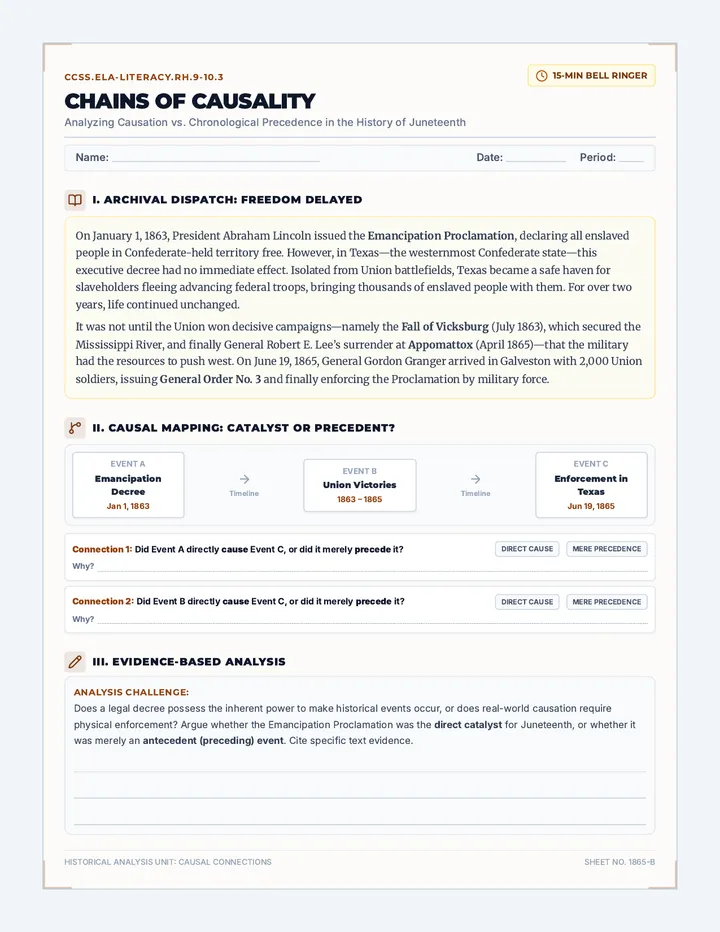
DELAYED LIBERTY
Analyzing the Causality of Juneteenth & General Order No. 3
CCSS.ELA-LITERACY.RH.9-10.3 Analyze a series of events; determine if earlier events caused later ones or simply preceded them.
Historian:
Date:
Class Period:
Chronological Dispatches
Sept 22, 1862
Preliminary Proclamation
President Lincoln issues an ultimatum giving rebel states 100 days to cease rebellion or face the immediate legal emancipation of all enslaved people under rebel control.
Jan 1, 1863
The Executive Order
The official Emancipation Proclamation takes effect. Legally, it changes the status of 3.5 million enslaved people, but its actual enforcement depends entirely on Union military conquests.
April 9, 1865
Lee's Eastern Surrender
General Robert E. Lee surrenders the Army of Northern Virginia. While celebrated as the "end of the war," Confederate armies in the West and deep South continue armed resistance.
June 2, 1865
Trans-Mississippi Collapse
Confederate General Edmund Kirby Smith surrenders the isolated Trans-Mississippi Department (including Texas), officially ending organized Confederate military hold in the state.
June 19, 1865
General Order No. 3
Union General Gordon Granger arrives in Galveston, Texas, backed by 2,000 soldiers, to enforce the executive proclamation, declaring "an absolute equality of personal rights."
Historical Causality Challenge
Instruction: Read the historical dispatches on the left. In historical analysis, we must distinguish between events that simply happened earlier (precedence ) and events that actively triggered later ones (causation ). Answer the analytical prompts below.
Task 1 Did Robert E. Lee's surrender on April 9 directly cause General Granger's arrival in Texas on June 19, or did it simply precede it? Explain the difference using evidence from the timeline.
Task 2 The Emancipation Proclamation was signed on January 1, 1863. Did General Order No. 3 cause emancipation in Texas, or was Granger's arrival merely the vehicle for a cause established in 1863?
Task 3: Assessing the Chain of Direct Causes
Analyze the connections below. Circle the correct relationship based on historical logic:
A. Lincoln's Preliminary Proclamation (1862) to the Jan 1 Executive Order (1863).
Direct Cause Only Preceded
B. General Lee's Surrender in Virginia to the Surrender of General Kirby Smith in Texas.
Direct Cause Only Preceded
C. General Kirby Smith's Surrender (June 2) to General Granger's Arrival in Galveston (June 19).
Direct Cause Only Preceded
Unit: Emancipation & Reconstruction Era "We are all declared free..." — Gen. Gordon Granger Document Code: RH9103-JUN-01
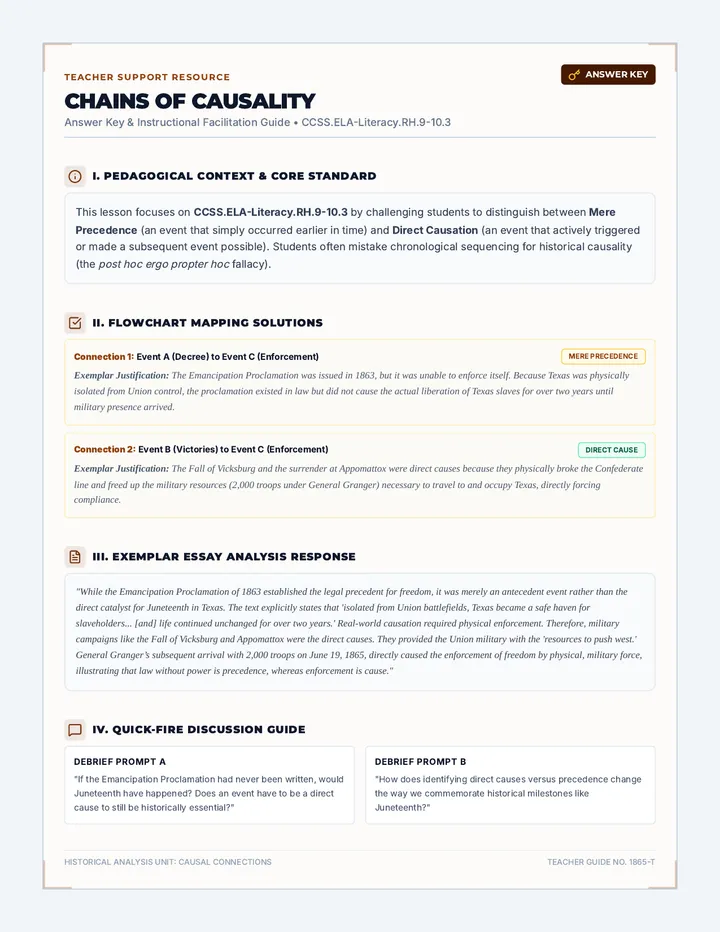
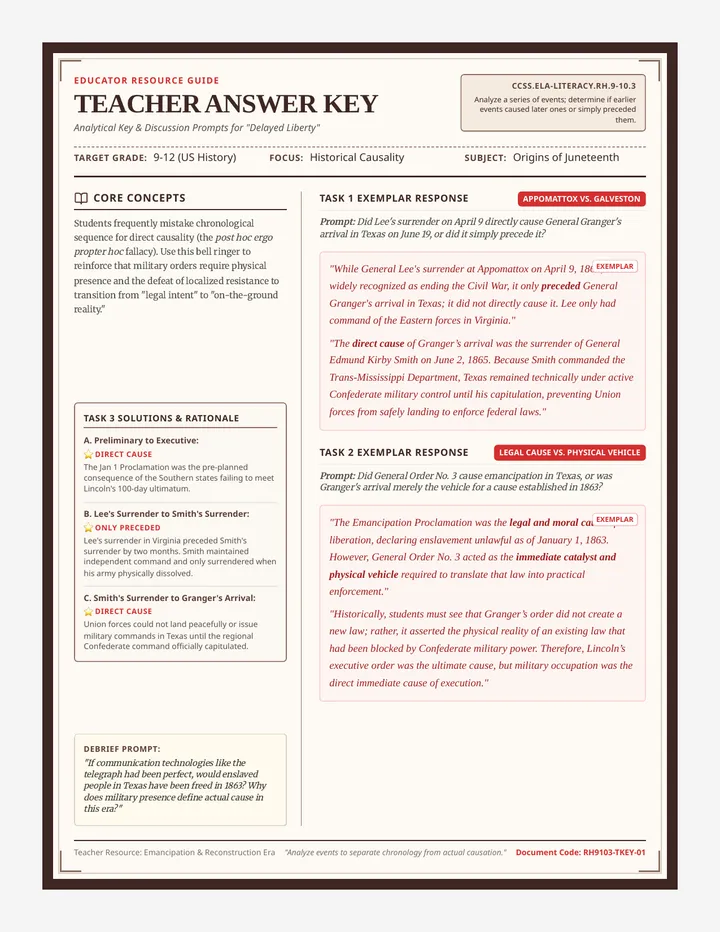
Delayed Liberty Teacher Key Educator Resource Guide
TEACHER ANSWER KEY
Analytical Key & Discussion Prompts for "Delayed Liberty"
CCSS.ELA-LITERACY.RH.9-10.3 Analyze a series of events; determine if earlier events caused later ones or simply preceded them.
Target Grade: 9-12 (US History)
Focus: Historical Causality
Subject: Origins of Juneteenth
Core Concepts
Students frequently mistake chronological sequence for direct causality (the post hoc ergo propter hoc fallacy). Use this bell ringer to reinforce that military orders require physical presence and the defeat of localized resistance to transition from "legal intent" to "on-the-ground reality."
Task 3 Solutions & Rationale
A. Preliminary to Executive: ⭐ Direct Cause
The Jan 1 Proclamation was the pre-planned consequence of the Southern states failing to meet Lincoln's 100-day ultimatum.
B. Lee's Surrender to Smith's Surrender: ⭐ Only Preceded
Lee's surrender in Virginia preceded Smith's surrender by two months. Smith maintained independent command and only surrendered when his army physically dissolved.
C. Smith's Surrender to Granger's Arrival: ⭐ Direct Cause
Union forces could not land peacefully or issue military commands in Texas until the regional Confederate command officially capitulated.
Debrief Prompt:
"If communication technologies like the telegraph had been perfect, would enslaved people in Texas have been freed in 1863? Why does military presence define actual cause in this era?"
Task 1 Exemplar Response Appomattox vs. Galveston
Prompt: Did Lee's surrender on April 9 directly cause General Granger's arrival in Texas on June 19, or did it simply precede it?
Exemplar
"While General Lee's surrender at Appomattox on April 9, 1865, is widely recognized as ending the Civil War, it only preceded General Granger's arrival in Texas; it did not directly cause it. Lee only had command of the Eastern forces in Virginia."
"The direct cause of Granger’s arrival was the surrender of General Edmund Kirby Smith on June 2, 1865. Because Smith commanded the Trans-Mississippi Department, Texas remained technically under active Confederate military control until his capitulation, preventing Union forces from safely landing to enforce federal laws."
Task 2 Exemplar Response Legal Cause vs. Physical Vehicle
Prompt: Did General Order No. 3 cause emancipation in Texas, or was Granger's arrival merely the vehicle for a cause established in 1863?
Exemplar
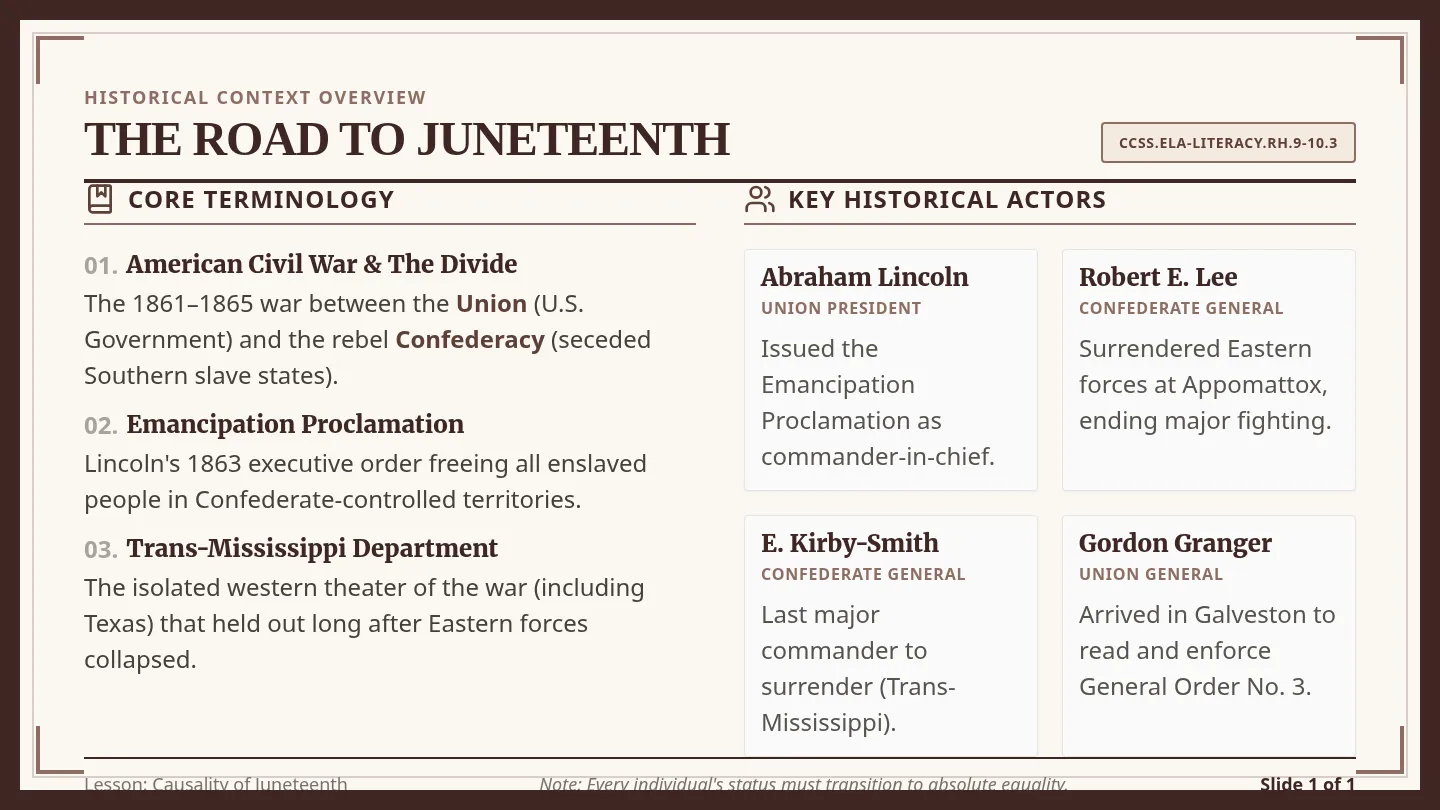
Delayed Liberty Slides Historical Context Overview
THE ROAD TO JUNETEENTH
CCSS.ELA-LITERACY.RH.9-10.3
Core Terminology
01. American Civil War & The Divide
The 1861–1865 war between the Union (U.S. Government) and the rebel Confederacy (seceded Southern slave states).
02. Emancipation Proclamation
Lincoln's 1863 executive order freeing all enslaved people in Confederate-controlled territories.
03. Trans-Mississippi Department
The isolated western theater of the war (including Texas) that held out long after Eastern forces collapsed.
Key Historical Actors
Abraham Lincoln
Union President
Issued the Emancipation Proclamation as commander-in-chief.
Robert E. Lee
Confederate General
Surrendered Eastern forces at Appomattox, ending major fighting.
E. Kirby-Smith
Confederate General
Last major commander to surrender (Trans-Mississippi).
Gordon Granger
Union General
Arrived in Galveston to read and enforce General Order No. 3.
Lesson: Causality of Juneteenth Note: Every individual's status must transition to absolute equality. Slide 1 of 1