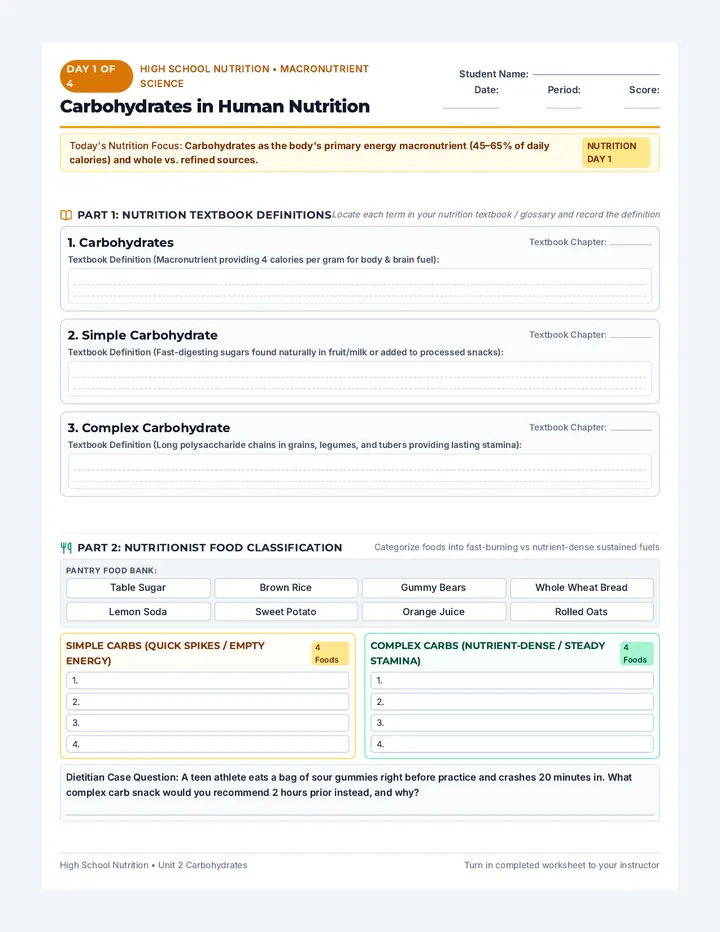
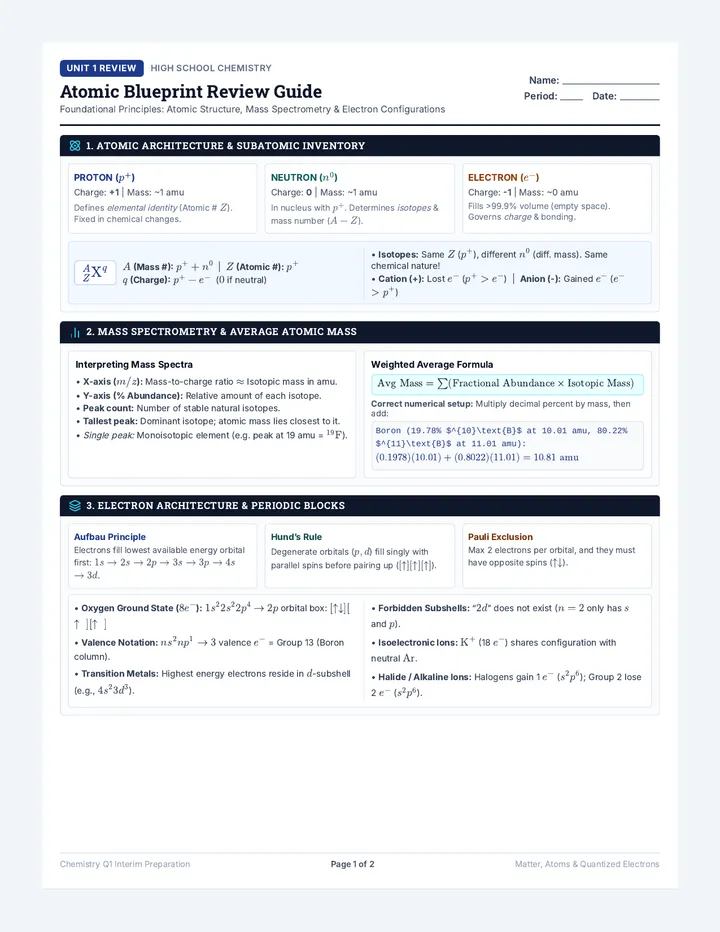
Carb Breakdown Slides
Biology & Physiology • 45 Min
Unit: Human Metabolism
Carb Crash Course:
Sugar Breakdown & Absorption
How our digestive system disassembles complex starches into fuel, transports glucose across membranes, and regulates cellular energy.
1. Molecular Structure
2. Enzymatic Cleavage
3. Cellular Uptake
Do Now • The 2:00 PM Phenomenon
Think-Pair-Share (3 mins)
Why do you crash after a candy bar, but not after oatmeal?
Scenario A: 40g Pure Sucrose (Soda / Candy)
Rapid Spike & Sudden Crash
Fast absorption floods blood with glucose within minutes. Pancreas surges insulin, causing blood glucose to plummet below baseline.
Result: Brain fog, shakiness, craving more sugar
Scenario B: 40g Complex Starch (Rolled Oats)
Sustained Slow Cleavage
Tightly coiled polysaccharide chains require sequential enzymatic breakdown. Glucose enters bloodstream slowly and steadily.
Result: 3+ hours of stable physical and mental energy
Guiding Question: What biochemical machinery determines the speed of this breakdown?
Chemical Architecture
Guided Notes: Part 1
The Carbohydrate Spectrum
Carbohydrates are categorized by how many sugar monomers are chemically bonded together.
1
Monosaccharide
Single Ring (Monomer)
Directly absorbable. No digestive splitting required.
Examples: Glucose, Fructose, Galactose
2
Disaccharide
Double Ring (Two Monomers)
Connected by a glycosidic bond. Rapidly split by 1 enzyme.
Examples: Sucrose, Lactose, Maltose
300+
Polysaccharide
Long Polymer Chains
Hundreds of bonded glucose rings requiring multiple digestive stages.
Examples: Amylose (Starch), Glycogen, Cellulose
Golden Rule: The human intestine can ONLY absorb single monomers (monosaccharides) into blood!
Digestive Assembly Line
Guided Notes: Part 2
From Starch to Sugar: The 3 Zones
How physical digestion and biological catalysts systematically snip bonds.
Stage 1 Mouth
Salivary Amylase
Saliva initiates starch breakdown into smaller maltose fragments while chewing.
Inactivated in Stomach
HCl acid (pH ~2) denatures salivary amylase.
Stage 2 Duodenum
Pancreatic Amylase
Pancreatic juice neutralizes acid and chops remaining starches into disaccharides.
Chops into 2-ring units
Starch → Maltose (glucose + glucose)
Stage 3 Microvilli
Brush Border Enzymes
Enzymes anchored to intestinal villi perform final snips directly at the gate.
The Final Cut
Maltase, Sucrase, Lactase → Monomers
Enzyme Quick Math: Sucrase splits Sucrose into Glucose + Fructose
Cellular Absorption
Guided Notes: Part 3
Crossing the Boundary: Gut to Blood to Cell
Glucose cannot cross cell membranes without specific protein transporters.
1
Gut Lumen → Bloodstream
Intestinal epithelial cells use SGLT1 co-transporters (fueled by a sodium gradient) to pull glucose against its concentration gradient into the villi.
GLUT2 transporters then pass glucose across the basolateral membrane into surrounding blood capillaries.
2
Bloodstream → Target Cells
High blood glucose triggers the pancreas to secrete Insulin. Insulin acts like a key, binding surface receptors.
This signal instructs vesicles to deploy GLUT4 doors to muscle and adipose cell membranes, pulling sugar inside for ATP synthesis or storage.
Key takeaway: Without insulin binding, glucose remains trapped in the blood!
Lab Challenge • 8 Minutes
Activity Sheet Ready
The Cracker Chemistry Challenge
Experience enzymatic cleavage happening in real-time inside your mouth.
Step 1: The Baseline
Place on Tongue
Place 1 piece of unsalted cracker on your tongue.
DO NOT CHEW! Let saliva coat it.
Step 2: 90 Seconds
Observe Flavor Shift
Note the exact moment taste changes from bland/floury to distinct sweetness.
Timer running: 0:00 to 2:00
Step 3: Explain
Record Chemistry
Complete the questions on your Cracker Chemistry Lab Sheet.
Identify the enzyme & sugar!
What are you tasting? Starch → Maltose (sweet disaccharide)
Physiological Impact
Guided Notes: Part 4
The Glycemic Response Curve
How molecular complexity directly governs insulin surge and metabolic stability.
High Glycemic Index
Rapid Cleavage
- Instant blood sugar peak within 15–30 min
- High insulin surge triggers fat storage mode
- Hypoglycemic rebound (the crash) at 60–90 min
Examples: Soda, gummy candy, white bread
Low Glycemic Index
Gradual Cleavage
- Gentle, steady glucose release over 2–4 hours
- Moderate insulin pulse maintains homeostatic balance
- Prolonged satiety, steady cognitive performance
Examples: Lentils, steel-cut oats, fibrous vegetables
Fiber Factor: Soluble fiber physically forms a gel barrier in the gut, slowing down amylase access!
Lesson Debrief • Exit Check
Final 5 Minutes
Mastery Review: 3 Core Pillars
Verify your guided notes before turning in today's work.
#1 Breakdown
Enzyme Relay
Amylases break starch polymers into disaccharides; brush-border enzymes cut them into absorbable monosaccharides.
#2 Absorption
Transporter Gates
SGLT1 pumps glucose into villi; GLUT2 transports it into capillaries to enter systemic circulation.
#3 Regulation
Insulin & GLUT4
Insulin signals muscle & adipose cells to insert GLUT4 channels, allowing glucose entry and preventing blood toxicity.
Exit Question for Notes Page:
"Why does an untreated diabetic with low insulin have high blood sugar but starving muscle cells?"
Complete Part 4 Now
Carb Digestion Guided Notes
Biology / Physiology Unit: Metabolism & Absorption
Carbohydrate Breakdown & Absorption Guided Notes
Name:
Date:
Period:
Directions: Fill in the key terms during the slides and lab observation. Every blank requires a specific biochemical term. 45-Min Pacing
1
Carbohydrate Architecture & Complexity
Monosaccharide 1 Ring
Single sugar monomer. Absorbed directly across gut with ZERO cleavage needed.
Primary blood sugar: G _ _ _ _ _ _
Disaccharide 2 Rings
Two monomers linked by a bond. Cleaved by 1 enzyme.
Table sugar: S _ _ _ _ _ _
Polysaccharide 300+ Rings
Long polymers. Must be progressively chopped into single units before entering cells.
Plant energy: S _ _ _ _ _
2
The Digestive Assembly Line: Enzyme Relay
1. Mouth Saliva
Glands produce salivary , starting starch breakdown into maltose. In the stomach, high acid (pH ~2) will (denature) this enzyme.
2. Duodenum Pancreas
The secretes pancreatic amylase + bicarbonate, snipping long starches into the 2-ring disaccharide .
3. Microvilli Brush Border
Membrane enzymes do the final cut: Maltase yields 2 glucose; Sucrase yields glucose + fructose; Lactase yields glucose + .
3
Intestinal Absorption & Cellular Hormone Delivery
Gut to Capillaries
• SGLT1: Uses active co-transport with (Na+) ions to pull glucose from gut lumen into intestinal cells.
• GLUT2: Facilitates passage of glucose out the basolateral side directly into blood .
Bloodstream to Body Cells
• Pancreatic beta cells sense high glucose and release .
• Hormone binds receptors, signaling vesicle translocation of GLUT_ gates to cell membranes, allowing ATP synthesis or storage as .
4
Glycemic Curves & Clinical Exit Check
High Glycemic Index (Candy / Soda)
Rapid bond cleavage → Blood glucose → Heavy insulin surge → Rebound hypoglycemia (the "crash").
Low Glycemic Index (Oats / Whole Grains)
Polysaccharides + dietary slow down enzyme access → Gradual release → Stable cognitive & physical energy.
Clinical Application: Why does an individual with untreated Type 1 diabetes experience severe cellular starvation and fatigue even when their blood is overflowing with glucose?
Cracker Chemistry Activity
Quick Lab • 10 Minutes Hands-On Enzyme Investigation
Cracker Chemistry: The Salivary Amylase Trial
Name:
Date:
Period:
Investigation Objective: Directly observe chemical digestion occurring in the oral cavity as biological catalysts break complex polysaccharides into disaccharides.
Materials: Unsalted Cracker + Timer
1
Trial Protocol & Rules
Step 1: Placement Place 1 piece of unsalted cracker onto the center of your tongue. Do not chew or swallow!
Step 2: Salivation Start your timer. Let saliva saturate the starch. Swirl gently with your tongue without biting.
Step 3: Sweetness Trigger Pinpoint the exact second you detect a shift from bland flour to sweetness. Record below.
2
Observation Log & Sweetness Rating (Scale 1 = Starchy/Bland • 5 = Noticeably Sweet)
Sweetness First Detected At: ______ sec
| Time Elapsed | Physical Texture | Sweetness Level (1–5) | Flavor Notes & Sensations |
|---|
| 0 Seconds | Dry, crisp, solid | 1 (Zero sweetness) | Dry flour, powdery baseline |
| 30 Seconds | | | |
| 60 Seconds | | | |
| 90 Seconds | | | |
| 120 Seconds | | | |
Biochemical Reaction: Starch (Polysaccharide) + Salivary Amylase → Maltose (Disaccharide)
Optimal pH: ~6.8–7.0
3
Scientific Analysis & Conceptual Synthesis
1. Why could your taste buds NOT detect any sweetness when the cracker first touched your tongue at 0 seconds, but detected sweetness after 60–90 seconds?
2. If you swallowed a piece of cracker whole without chewing, where would starch breakdown pause, and which digestive organ would resume this breakdown later? Explain why.
3. Prediction: What would occur if you swished with pure lemon juice (pH 2.0) immediately before holding the cracker? Explain what happens to the enzyme's active site.
Carb Crash Course • Laboratory Protocol Concept: Enzymatic Hydrolysis • Substrate Specificity • Taste Receptor Activation
Carb Digestion Teacher Key
Teacher Resource • Answer Key Biology / Physiology Lesson
Carb Crash Course: Pacing Guide & Solutions Key
Target Duration: 45 Minutes
00–05 Min Hook & 2 PM Crash
05–18 Min Slides: Structure & Enzymes
18–28 Min Cracker Lab Trial
28–38 Min Absorption & Insulin
38–45 Min Debrief & Exit Check
Guided Notes Answer Key
Part 1: Chemical Structure
• Monosaccharide: Blood sugar = Glucose.
• Disaccharide: Connected by a glycosidic bond; Table sugar = Sucrose.
• Polysaccharide: Plant storage = Starch (amylose/amylopectin).
Part 2: Digestive Assembly Line
• Mouth: Glands produce salivary amylase; low pH acid will denature (deactivate) it.
• Duodenum: The pancreas secretes amylase; starch becomes disaccharide maltose.
• Microvilli: Lactase breaks lactose into glucose + galactose.
Part 3: Absorption & Insulin Mechanism
• SGLT1 uses active co-transport with sodium (Na+) ions; GLUT2 transports glucose to capillaries.
• Beta cells release insulin; mobilizes GLUT4 transporters; storage as glycogen.
Part 4: Glycemic Curves & Exit Synthesis
• Simple: blood glucose spike → reactive hypoglycemic crash.
• Complex: dietary fiber slows enzyme access.
• Clinical synthesis response: Type 1 diabetics lack insulin; without insulin binding, GLUT4 gates cannot translocate to muscle/fat membranes. Glucose remains trapped in blood, starving cells of ATP fuel.
Cracker Chemistry Lab Notes & Sample Responses
Expected Experimental Data:
At 0s: solid, bland flour (rating 1). At 30–60s: softening paste. At 60–90s: noticeable distinct sweetness detected (rating 3–4) as maltose concentration peaks in saliva before swallowing.
Q1: Delay in Sweetness
Taste bud receptors only recognize simple sugars (maltose, glucose), not bulky insoluble starch polymers. Sweetness only registers once salivary amylase hydrolyzes alpha-1,4-glycosidic bonds.
Q2: Swallowed Whole