Autumn Physics Scavenger Hunt MS Physical Science Campus Object Quest • Trafalgar, IN
November Matter & Energy Hunt
Hoosier Autumn Physics Hunt
Locate specific objects on campus demonstrating properties of matter, chemical changes, and energy.
Environment: Trafalgar (38°F–52°F)
Field Agent Name(s):
Date & Period:
Outdoor Conditions:
Sector 1: Outdoor Campus Grounds (Matter & Energy in the Field) 50 Points Total
1
Seek: An Object Transferring Thermal Energy
(MS-PS3-3 • Heat Transfer)
10 Pts
Find an outdoor object actively absorbing, radiating, or conducting thermal energy (e.g., dark sunlit asphalt, cold metal bleacher rail, brick wall, vehicle engine hood).
Object Found & Exact Location:
Method (Conduction, Convection, Radiation):
Evidence of Thermal Energy Flow:
2
Seek: An Object with a High/Low Physical Property
(MS-PS1-2 • Physical Properties)
10 Pts
Locate an object showcasing a measurable physical property (e.g., high thermal conductivity of steel vs. low for wood, density of acorn in water, malleability of chain link, brittleness of dry leaves).
Object & Material Composition:
Specific Physical Property Identified:
Intensive (inherent) or Extensive?
3
Seek: Evidence of an Outdoor Chemical Change
(MS-PS1-2 • Chemical Reactions)
10 Pts
Find an outdoor item showing clear evidence of a chemical change where a brand new substance formed (e.g., rusted steel bolt or bike rack [iron oxide], decomposing leaf litter producing odor/gas).
Object & Evidence (Color change, gas, odor, new solid):
Identify Reactants & the New Chemical Substance:
4
Seek: Evidence of an Outdoor Physical Change
(MS-PS1-4 • Physical Changes)
10 Pts
Locate a substance or structure showing evidence of a physical change where its chemical identity stays identical (e.g., morning frost melting, puddle evaporating, crushing dry leaves, concrete expansion joint).
Object / Substance & Physical Change Observed:
Proof this is Physical (Why did molecules stay the same?):
5
Seek: Two Surfaces with Contrasting Friction
(MS-PS2-2 • Surface Forces)
10 Pts
Find two outdoor walking surfaces with contrasting friction coefficients (e.g., dry textured concrete vs. wet rotting leaves or smooth metal). Test with sneaker tread.
Surface A (High Friction) vs. Surface B (Low Friction):
How microscopic physical texture causes the difference:
Outdoor Sector Total: _____ / 50 Pts Turn Page for Indoor Sector Object Quest → Page 1 of 2
Sector 2 Indoor Heated Campus • Hallways & Labs
Controlled Environment Investigations
Indoor Matter, Chemical Properties & Energy Systems
Locate indoor objects demonstrating chemical stability, electrical charge, phase changes, and machines.
Sector Target: 50 Pts (100 Pts Total)
6
Seek: An Object Engineered for a Chemical Property
(MS-PS1-2 • Chemical Properties)
10 Pts
Find an indoor object selected specifically for its chemical property (e.g., stainless steel sink resisting corrosion, fire extinguisher chemical resisting combustion, plastic beaker resisting acid reactivity).
Object & Exact Location:
Target Chemical Property:
Why was this property engineered?
7
Seek: An Object Inducing a Phase Change
(MS-PS1-4 • Thermal Energy & States)
10 Pts
Locate a cold indoor surface and cause or observe a phase change (e.g., exhale warm water vapor breath onto a cold exterior window pane, or observe condensation on a cold water fountain pipe).
Cold Surface Object & Phase Change Name (Gas → Liquid):
Direction of Thermal Energy Flow (Which lost heat?):
8
Seek: An Object That Accumulates Static Charge
(MS-PS2-3 • Electric Forces & Atoms)
10 Pts
Dry heated November air increases static. Seek out an object that easily gains or discharges static electricity by friction (e.g., rubber sneaker sole on carpet, plastic ruler on fleece, metal door latch spark).
Object Tested & Friction Source:
Subatomic Particle Transferred & Observable Evidence:
9
Seek: A Working Simple Machine
(MS-PS2-1 • Forces & Work)
10 Pts
Hunt down an object in the school building actively functioning as a simple machine (e.g., door handle lever, pencil sharpener wheel & axle, ADA inclined ramp, window blind pulley).
Object & Exact Room Location:
Simple Machine Classification:
Mechanical Advantage (How it helps):
10
Seek: An Architectural Acoustic Reflector or Absorber
(MS-PS4-2 • Wave Mechanics)
10 Pts
Locate a campus structure designed to reflect sound waves (e.g., hard ceramic tile hallway, gym bleacher wall) OR absorb sound waves (e.g., carpeted library floor, acoustic ceiling tile). Test with a single sharp hand clap.
Object / Material & Primary Wave Action (Reflect or Absorb):
Explain how physical density/porosity dictates wave behavior:
Master Synthesis: Physical vs. Chemical Changes on Campus (Bonus 10 Pts)
Compare one physical change and one chemical change you discovered today. What is the fundamental rule for deciding whether a change is physical or chemical?
Total Score
____ / 100
Rank: Physics Agent
Trafalgar Middle School Physical Science • NGSS MS-PS1-2, MS-PS1-4, MS-PS2-1, MS-PS2-2, MS-PS3-3, MS-PS4-2 Page 2 of 2
Physics Hunt Teacher Guide Educator Facilitation Manual Matter, Energy & Change • NGSS MS-PS1 & MS-PS3
Trafalgar, IN • Early November
Physics Hunt Facilitator Guide
Scavenger hunt setup, object spotting guide, and physical vs. chemical conceptual frameworks.
Format: Object-Seeking Field Lab
Object-Seeking Strategy: Student Agency in the Field
Unlike passive station worksheets, students act as physical science agents tasked with hunting down concrete physical objects on campus that fit strict scientific criteria. In early November in Trafalgar, campus grounds offer rich contrasts between freezing outdoor surfaces and heated indoor spaces.
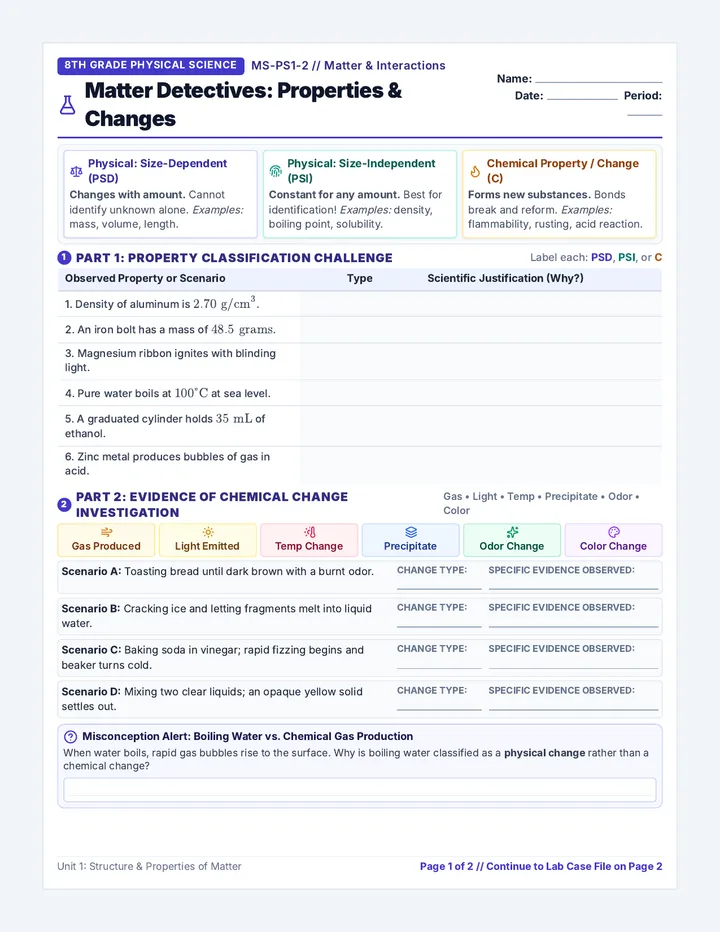
Physical vs. Chemical Properties: Physical: Observable/measurable without changing molecular identity (density, thermal conductivity, state, malleability, solubility). Chemical: Characteristic ability to react and form new substances (flammability, oxidation reactivity, acid resistance).
Physical vs. Chemical Changes: Physical: State change (condensation/frost melting), shape/size change (crushing leaves, thermal expansion). Chemical: Chemical bonds break and reform; produces a new substance (rusting chain-links, rotting leaves releasing gases/humus).
Campus Object Spotting Matrix (Where to Guide Students)
Thermal Energy Objects: Dark asphalt parking lot or bus loop (absorbing solar radiation); metal bleachers (conducting heat out of hands); running facility truck hoods (thermal radiation).
Chemical Change Objects: Orange rust (iron oxide) on chain-link fences, stadium gate latches, or weathered bicycle racks; decomposing soggy November oak leaf piles in fence corners.
Physical Change Objects: Morning grass frost sublimation/melting; puddle evaporation; sidewalk rubber expansion joints expanding/contracting with autumn temperature swings.
Engineered Chemical Property Objects: Stainless steel water fountain basins (corrosion-proof); cafeteria fire extinguishers (carbon dioxide / monoammonium phosphate flame-suppressants); lab bench epoxy tops.
Phase Change Objects: Exterior classroom window panes (breath condensation); refrigerated drinking fountain cold water supply pipes (dew point condensation).
Simple Machine Objects: Heavy exterior door handles (Class 2 levers); classroom pencil sharpeners (wheel & axle); ADA entrance ramps (inclined planes); window blind cords (pulleys).
50-Minute Mission Pacing
00–08 min: Launch briefing & buddy assignments.08–24 min: Sector 1 Outdoor Grounds exploration.24–40 min: Sector 2 Indoor Halls & Labs investigation.40–50 min: Class debrief & synthesis matrix scoring.
Safety & Code of Conduct
Keep groups in designated courtyard and athletic perimeter. Students must keep indoor voices low and use single sharp hand claps for acoustic checks. Gloves should be removed only briefly for thermal touch tests.
Trafalgar, IN • Middle School Physical Science Turn Page for Complete Answer Key & Rubric → Page 1 of 2
Master Solution Key Scientific Principles & Model Explanations
100 Points Total
Mission-by-Mission Answer Key & Science Principles
10 Pts Per Mission
Outdoor Sector Keys (Missions 1–5)
1. Thermal Energy Transfer: Asphalt/Brick: Absorbs solar electromagnetic radiation and radiates infrared heat. Metal Railing: Conducts thermal energy away from warm skin into cold steel (\(k \approx 45\text{ W/m}\cdot\text{K}\)). Evidence is tactile temperature gradient or IR thermometer reading.
2. Physical Property Detective: Examples: Steel railing (high thermal conductivity, malleability, high density); dry oak leaf (brittleness, low density \(\approx 0.3\text{ g/cm}^3\)); aluminum flagpole (low density, metallic luster). Thermal conductivity and density are intensive properties (independent of amount).
3. Outdoor Chemical Change: Rusting Iron: Iron reacts with atmospheric oxygen and water to produce a brand new reddish-brown compound, iron(III) oxide: \(4\text{Fe} + 3\text{O}_2 \rightarrow 2\text{Fe}_2\text{O}_3\). Rotting Leaves: Microbial decomposition breaks down cellulose, producing humus, organic acids, and methane/carbon dioxide gases (distinct autumn earthy odor).
4. Outdoor Physical Change: Frost Melting or Puddle Evaporating: Solid ice \(\rightarrow\) liquid water \(\rightarrow\) water vapor. Water molecules (\(\text{H}_2\text{O}\)) remain chemically intact; only particle spacing and kinetic energy change. Crushed Leaves: Physical size/shape reduction without altering cellulose chemical bonds.
5. Surface Friction Contrast: Dry concrete has rough asperities that interlock with sneaker rubber soles (\(\mu \approx 0.7\)). Decomposing wet leaves trap moisture and release cellular oils, forming a slippery liquid lubricant barrier that prevents microscopic interlocking, dropping friction coefficient below \(0.2\).
Indoor Sector Keys (Missions 6–10)
6. Engineered Chemical Property: Stainless Steel: Chromium alloy forms a microscopic, non-reactive chromium oxide passive layer that resists oxidation (rusting) from tap water. Fire Extinguisher: Dry chemical powder is non-combustible and thermally decomposes to blanket flames and smother oxygen contact.
7. Phase Change on Cold Surfaces: Exhaling on Cold Window: Water vapor (gas) in breath condenses into micro-droplets of liquid water on glass (dew point). Thermal energy flows from the warm breath into the cold glass , causing water vapor molecules to slow down and coalesce.
8. Static Charge Accumulator: Frictional rubbing strips loosely bound valence electrons from one surface to another (triboelectric effect). In dry, heated November indoor air (\(<30\%\text{ humidity}\)), lack of atmospheric water vapor prevents charge dissipation, resulting in sparks or electrostatic attraction of paper scraps.
9. Simple Machine Recon: Lever: Door handle (effort applied far from pivot increases torque). Wheel & Axle: Pencil sharpener (turning large crank rotates small gear cutting assembly). Inclined Plane: Entrance ramp (trades longer distance for smaller input force).
10. Acoustic Reflection vs. Absorption: Hard Ceramic Tile: Dense, non-porous structure causes specular sound wave reflection (echo). Carpet/Acoustic Tiles: Porous fibrous matrix traps propagating sound waves, converting kinetic acoustic vibrations into negligible thermal energy (absorption).
Master Synthesis Response & Scoring Guide
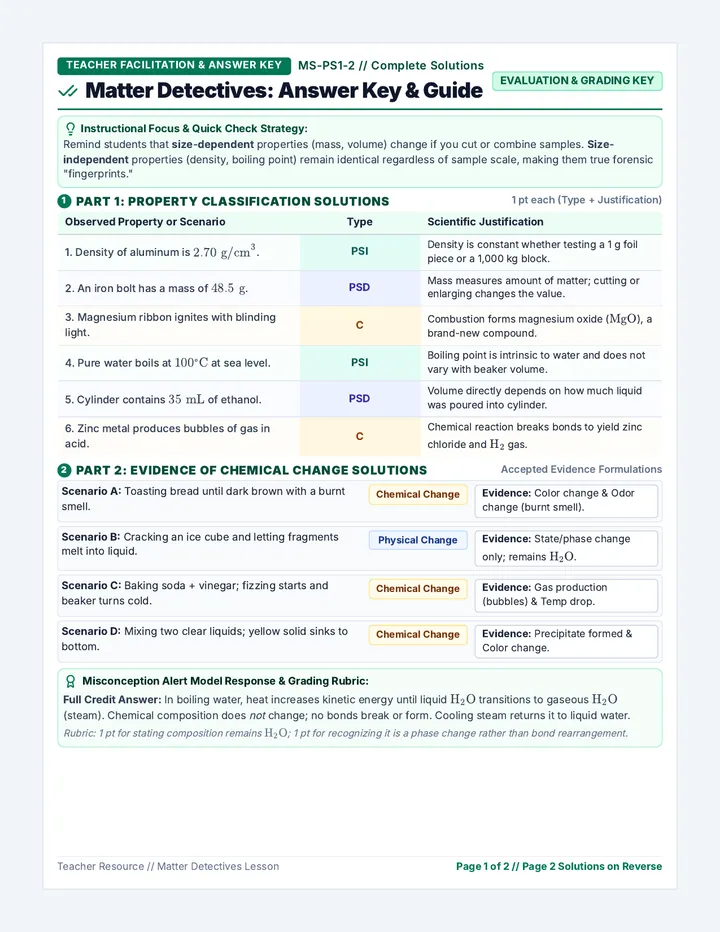
Fundamental Rule: A physical change alters only the form, state, or appearance of matter (particle identity remains identical, e.g., ice melting to water). A chemical change breaks and forms atomic bonds, rearranging atoms into one or more chemically distinct new substances with new properties (e.g., iron turning into brittle iron oxide rust).
Exemplary (90–100 Pts) All 10 objects accurately located with clear distinction between physical/chemical properties and changes.
Proficient (75–89 Pts) 8–9 objects logged with sound scientific rationale; minor confusion on intensive/extensive classification.
Developing (<75 Pts) Incomplete log or misidentifies physical changes as chemical reactions (e.g., confusing phase change with reaction).
Trafalgar, IN • Middle School Physical Science Standards: MS-PS1-2, MS-PS1-4, MS-PS2-1, MS-PS2-2, MS-PS3-3, MS-PS4-2 Page 2 of 2
Autumn Physics Mission Slides Campus Object Quest MS Physical Science • NGSS Core
Trafalgar, Indiana
Early November Matter & Energy Expedition
Hoosier Autumn Physics Hunt
Hunt down real campus objects demonstrating thermal energy, physical & chemical properties, and matter in change!
Equip: Clipboard, Pencil, Field Packet Target: 10 Specific Object Missions Duration: 45–50 Minutes
Rules of Scientific Reconnaissance
Field Protocol
Indoor Walking Feet
Classes are working. Move quietly in buddy pairs. Use single sharp claps for acoustic tests only!
Designated Zones
Stay in the courtyard, bleachers, and main sidewalk loop. Never enter bus loops or parking lanes.
Observe & Record
You are hunting evidence! Do not damage property, pick living plants, or force building mechanisms.
Your Goal: Locate authentic campus objects that prove physical science concepts in action!
Physical vs. Chemical: Your Concept Decoder
Matter Principles
Physical Properties & Changes
Property: Observable without changing identity (density, thermal conductivity, state, texture).
Change: Identity stays identical! Phase changes (melting frost, evaporating water) or shape changes (crushed leaves).
Chemical Properties & Changes
Property: Ability to undergo chemical reactions (flammability, oxidation potential, acid resistance).
Change: Atomic bonds break and reform to create a brand new substance (rusting iron, rotting leaves).
Key Question: Did the fundamental molecules stay the same or form a new substance? 10 Points per Mission
Sector 1
Outdoor Object Targets (Campus Grounds)
Time: 15–18 Mins
Target 1: Thermal Energy Transfer
Seek an object absorbing, radiating, or conducting heat (asphalt, steel railing, vehicle hood).
Target 2: Physical Property Object
Find an object with high thermal conductivity, density, malleability, or brittleness.
Target 3: Outdoor Chemical Change
Seek visible proof of a new substance (rusted iron bolts, decomposing leaf litter).
Target 4: Outdoor Physical Change
Find a substance undergoing a state, size, or shape change without altering identity.
Target 5: Contrasting Friction Surfaces
Compare sneaker grip on high-friction dry concrete vs. low-friction wet decaying leaves.
50 Outdoor Points Available
Completed Sector 1? Transition inside for Sector 2. Log exact object name and room/grounds location!
Sector 2
Indoor Object Targets (Halls & Labs)
Time: 15–18 Mins
Target 6: Engineered Chemical Property
Seek an item engineered to resist rust, acid, or combustion (stainless sink, fire extinguisher).
Target 7: Phase Change Surface
Exhale on cold exterior glass or check cold water pipes. Observe condensation (gas → liquid)!
Target 8: Static Charge Accumulator
Find an object that charges or sparks in dry November air (carpet, fleece, plastic ruler).
Target 9: Working Simple Machine
Locate a lever (door handle), wheel & axle (pencil sharpener), or ramp easing work.
Target 10: Sound Reflector vs. Absorber
Test hallway tile reflection (echo) vs. carpet/tile sound absorption with one sharp clap.
Bonus: Complete the 10-Pt Synthesis Matrix!
Total Target: 100 Points + 10 Bonus 50 Indoor Points Available
Mission Debrief: Matter & Energy Takeaways
Class Share-Out
01
Thermal Energy
Heat transfer is everywhere: radiation warms dark asphalt, conduction chills hands on metal, and convection heats our rooms!
02
Physical vs. Chemical
Physical changes alter form or state without changing molecules. Chemical changes create new substances like rust or decomposed humus.
03
November Science
Chilly outdoor air and dry indoor heat make early November in Indiana the ultimate natural physics and chemistry lab!
Turn in your field log to claim your Physical Science Investigator rank! Excellent field work!