Cell Theory Research Article
Junior Journal of Life Sciences
Vol. 14 • Student Research Edition • Middle School Biology
CURRICULUM INVESTIGATION: Cell Theory
Lead Investigator:
Date:
Class/Period:
Peer-Reviewed Science Brief • Chronological Investigation
The Invisible Kingdom: How Pioneers Built Cell Theory
A historical and microscopic investigation into the fundamental building blocks of all living organisms.
Abstract & Research Purpose
For thousands of years, humans could only study living things visible to the naked eye. The development of polished glass lenses in the 17th century opened an uncharted microscopic realm. This paper examines the collaborative timeline of early naturalists whose collective observations formed Cell Theory—the bedrock principle that all life on Earth is constructed from microscopic living units called cells.
Chronological Discovery Spectrum (1665 → 1852) Coordinated with color-coded section boxes below
1665 Hooke (Cork) Names "cells"
1674 Leeuwenhoek Living microbes
1838–1839 Schleiden & Schwann Plants & Animals
1852 Robert Remak Cell division law
1665 • ENGLAND Robert Hooke
1. Coining the Word "Cell"
English scientist Robert Hooke built an early compound microscope and examined thin slices of tree cork bark. He observed hundreds of tiny, box-like honeycomb compartments.
Historic Note: Hooke named them "cellulae" (cells) because they resembled the tiny bare rooms of monks. He was observing dead plant cell walls!
1674 • NETHERLANDS A. van Leeuwenhoek
2. The First Living "Animalcules"
Dutch draper and lens-maker Antonie van Leeuwenhoek ground handheld lenses magnifying up to 270×. When observing pond water and dental scrapings, he discovered swarming, motile single-celled organisms.
He called these agile beings "animalcules" (today known as bacteria and protozoa), proving cells could be alive and autonomous.
1838–1839 • GERMANY Schleiden & Schwann
3. Plants & Animals Unite
Nearly 170 years after Hooke, two German scientists compared laboratory notes over dinner and realized a universal biological pattern:
- Matthias Schleiden (1838): After inspecting thousands of plant samples, he concluded all plant bodies are built entirely of cells.
- Theodor Schwann (1839): Studying animal nerve and cartilage tissues, he reached the same verdict: all animals are composed of cells.
Together, they authored the first two foundational laws of classical cell theory.
Field Investigator Lexicon Highlighted in Yellow in Text
Cell: The smallest membrane-bound structure capable of carrying out all life processes.
Unicellular: An organism consisting of only one independent cell (e.g., amoeba, bacterium).
Multicellular: An organism formed of many specialized cells working in harmony (e.g., trees, humans).
Junior Journal of Life Sciences • Peer-Reviewed Article No. 04 Page 1 of 2 Turn over for Tenets & Scientific Modeling →
Junior Journal of Life Sciences • Research Report Continued Cell Theory Core Tenets, Structural Hierarchy & Student Modeling
1852 • POLAND / GERMANY Robert Remak (True Discoverer)
Completing the Puzzle: Robert Remak and Cell Division
Early naturalists debated whether cells magically crystallized from fluid. In 1852, embryologist Robert Remak proved all new cells originate from pre-existing cells through cell division ("Omnis cellula e cellula"), completing the third pillar of cell theory.
The Three Pillars & Student Model Workspaces
Highlight Text & Draw Models
TENET 1 1839
All Living Things Are Made of Cells
Every living organism is composed of one or more functional cells—whether unicellular or multicellular.
Model 1: Organism Cells Drawing Space
DRAW: Plant, Animal, or Microbial Cells
TENET 2 1839
The Cell Is the Basic Unit of Life
Cells are the fundamental building blocks of all biological structure and function.
Cell → Tissue → Organ → System
Model 2: Structural Hierarchy Drawing Space
DRAW: Cell → Tissue → Organ → System
TENET 3 1852
Cells Come From Pre-Existing Cells
Cells do not form spontaneously; they reproduce by dividing (Robert Remak).
Model 3: Cell Division Drawing Space
DRAW: Parent Cell Splitting Into Daughters
Structural Hierarchy in Multicellular Life Microscopic to Macroscopic
Tenet 2 explains how life scales up: specialized cells group into tissues (e.g., muscle tissue), tissues collaborate to form organs (e.g., heart or leaf), and organs coordinate in organ systems (e.g., circulatory system) to sustain the complete organism.
Prokaryotes: Single-celled (unicellular); carries out all functions.
Eukaryotes: Cells specialize into tissues, organs, and systems (multicellular).
CER Investigation Bridge: Transfer your models, hierarchy labels, and highlighted text evidence directly into your CER Worksheet!
Ready for CER Analysis
Junior Journal of Life Sciences • Middle School Field Biology Series Page 2 of 2 Research Report & Models Complete • Proceed to CER Worksheet
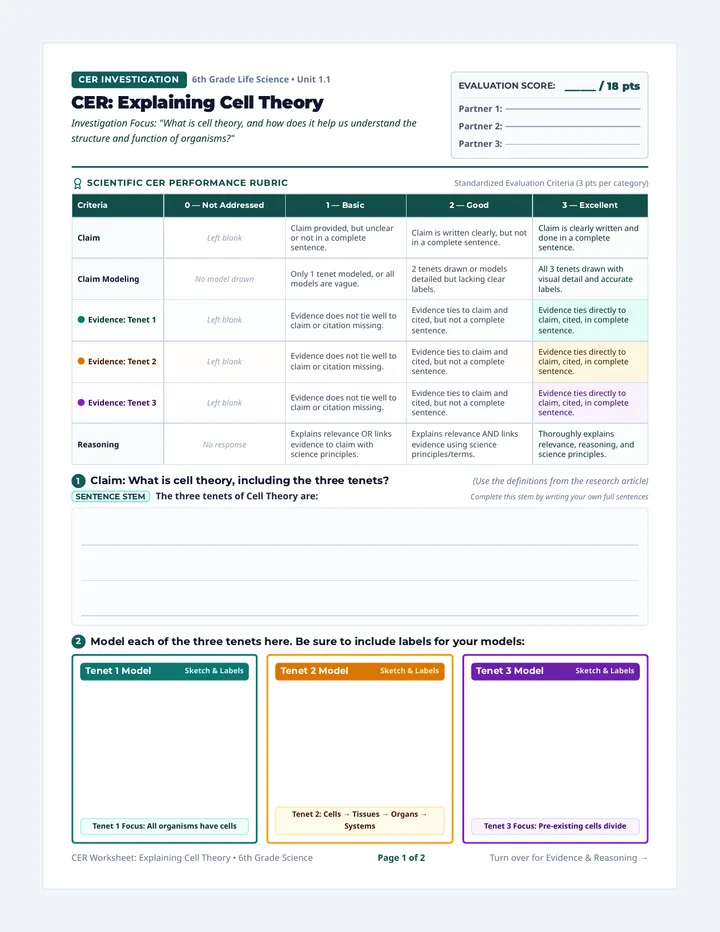
Cell Theory CER Worksheet
CER Investigation 6th Grade Life Science • Unit 1.1
CER: Explaining Cell Theory
Investigation Focus: "What is cell theory, and how does it help us understand the structure and function of organisms?"
Evaluation Score: ______ / 18 pts
Partner 1:
Partner 2:
Partner 3:
Scientific CER Performance Rubric
Standardized Evaluation Criteria (3 pts per category)
| Criteria |
0 — Not Addressed |
1 — Basic |
2 — Good |
3 — Excellent |
| Claim |
Left blank |
Claim provided, but unclear or not in a complete sentence. |
Claim is written clearly, but not in a complete sentence. |
Claim is clearly written and done in a complete sentence. |
| Claim Modeling |
No model drawn |
Only 1 tenet modeled, or all models are vague. |
2 tenets drawn or models detailed but lacking clear labels. |
All 3 tenets drawn with visual detail and accurate labels. |
| Evidence: Tenet 1 |
Left blank |
Evidence does not tie well to claim or citation missing. |
Evidence ties to claim and cited, but not a complete sentence. |
Evidence ties directly to claim, cited, in complete sentence. |
| Evidence: Tenet 2 |
Left blank |
Evidence does not tie well to claim or citation missing. |
Evidence ties to claim and cited, but not a complete sentence. |
Evidence ties directly to claim, cited, in complete sentence. |
| Evidence: Tenet 3 |
Left blank |
Evidence does not tie well to claim or citation missing. |
Evidence ties to claim and cited, but not a complete sentence. |
Evidence ties directly to claim, cited, in complete sentence. |
| Reasoning |
No response |
Explains relevance OR links evidence to claim with science principles. |
Explains relevance AND links evidence using science principles/terms. |
Thoroughly explains relevance, reasoning, and science principles. |
1
Claim: What is cell theory, including the three tenets?
(Use the definitions from the research article)
Sentence Stem The three tenets of Cell Theory are:
Complete this stem by writing your own full sentences
2
Model each of the three tenets here. Be sure to include labels for your models:
Tenet 1 Model Sketch & Labels
Tenet 1 Focus: All organisms have cells
Tenet 2 Model Sketch & Labels
Tenet 2: Cells → Tissues → Organs → Systems
Tenet 3 Model Sketch & Labels
Tenet 3 Focus: Pre-existing cells divide
CER Worksheet: Explaining Cell Theory • 6th Grade Science Page 1 of 2 Turn over for Evidence & Reasoning →
CER: Explaining Cell Theory • Evidence & Reasoning Based on Research Article: The Invisible Kingdom
3
Evidence: Provide evidence from your research article that scientists found to support each of the tenets of cell theory.
Sentence Stems Provided: Use the sentence stem "The text says..." to introduce evidence, then finish by writing your own complete sentence citing scientists and observations.
Tenet 1 Evidence (All living organisms are made of cells):
1839 Schleiden & Schwann
StemThe text says.....
Tenet 2 Evidence (The cell is the basic unit of structure & function — cells build tissues, organs, & systems):
1839 Schleiden & Schwann
StemThe text says.....
Tenet 3 Evidence (Cells come only from pre-existing cells through cell division):
1852 Robert Remak
StemThe text says.....
Article Source Citation: Record the title of your research article
Article Title:
4
Reasoning: Connect your evidence to the claim using scientific principles.
Grammar & Precision Reminder: Use complete sentences, correct capitalization, periods, and scientific vocabulary (e.g., cell division, tissues, organs, organ systems, microscopic, structure, function).
Sentence Stem This shows that the three Tenets of Cell Theory are accurate because:
(Complete this stem by writing your own full sentences linking your evidence back to your claim)
CER Worksheet: Explaining Cell Theory • Partner Investigation Page 2 of 2 Final Submission Verified • Score: _____ / 18