Celestial Empire Review Worksheet
A Journey Through Ancient China's Legacy
Student:
Date:
Part 1: Vocabulary Match
Match the term on the left with its correct definition on the right by writing the corresponding letter.
___ 1. Loess
___ 2. Oracle Bones
___ 3. Filial Piety
___ 4. Oasis
___ 5. Yin and Yang
___ 6. Qin Shi Huangdi
___ 7. Liu Bang
A. A poor peasant who overthrew the Qin and started the Han Dynasty.
B. Fertile, yellowish soil found in the Huang He (Yellow) River.
C. Concepts representing balance and opposite forces in nature.
D. First Emperor who united China and ordered the Great Wall.
E. Devotion and loyalty to the male head of the household.
F. A fertile place in a desert where water can be found.
G. Shells or bones used by the Shang to communicate with gods.
Part 2: China's Geography
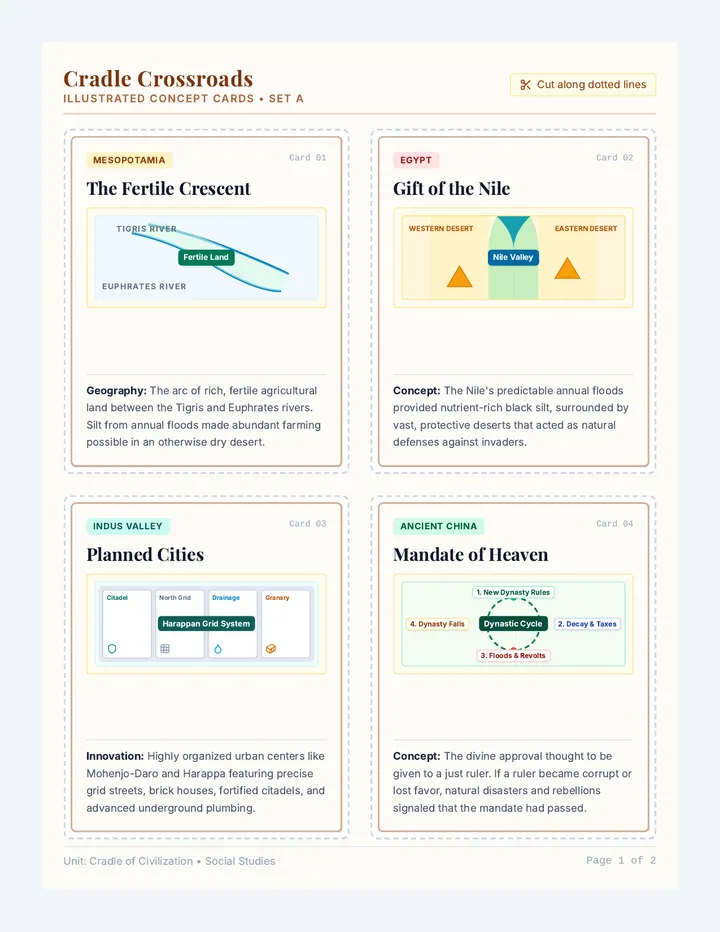
8. Which two major rivers provided water and fertile land for early Chinese civilizations?
A. Nile and Euphrates
B. Huang He and Yangtze
C. Indus and Ganges
D. Tigris and Amazon
9. China was isolated from trade and invaders by several natural boundaries. Which of these was NOT a boundary mentioned in your studies?
A. Gobi Desert
B. Himalayan Mountains
C. Atlantic Ocean
D. Tibetan Plateau
Part 3: The Dynastic Timeline
10. Place the four major dynasties in chronological order (1 being the earliest):
1. Earliest
4. Latest
11. Mandate of Heaven & Feudalism
Which dynasty introduced the belief that the emperor was selected by Heaven and used a system of exchanging land for loyalty?
12. Shang Craftsmanship
The Shang military used weapons made of which material, while artisans made jewelry from jade?
Part 4: The Three Philosophies
| Philosophy | Key Beliefs & Terms |
|---|
| Confucianism | |
| Focuses on social order and the 5 Relationships. | |
Who was the founder?
What is the term for loyalty to the male head of house?
|
| Daoism |
Emphasized living in harmony with nature and "Chi."
What symbol represents balance in nature?
What physical practice do people use today?
|
| Legalism |
Taught that humans are naturally evil and need strict control.
Who founded this philosophy?
What two things were emphasized for order?
|
Part 5: Imperial Achievements
13. The Great Wall was built to protect China from:
A. Floods from the Yellow River
B. Invaders from the North
C. Rebellious farmers in the South
14. Why were the Terracotta Warriors created?
A. To train the real army for battle
B. To decorate the Great Wall
C. To guard Shi Huangdi's tomb
15. The Han Dynasty's "Golden Age" featured which of these achievements? (Select all that apply)
Iron Weapons
Oracle Bones
Silk Production
Human Sacrifice
Confucianism
Standardized Money
Part 6: The Silk Road
16. The Silk Road was not a single paved road. What was it actually?
17. List three dangers travelers faced on the Silk Road:
Danger 1
Danger 2
Danger 3
Celestial Empire Answer Key
Answer Key: Celestial Empire
Ancient China Study Review Guide
Teacher Reference
Part 1: Vocabulary Match
- B 1. Loess
- G 2. Oracle Bones
- E 3. Filial Piety
- F 4. Oasis
- C 5. Yin and Yang
- D 6. Qin Shi Huangdi
- A 7. Liu Bang
Part 2: Geography
8. Major Rivers
B. Huang He and Yangtze
9. Natural Boundaries (NOT a boundary)
C. Atlantic Ocean
(Note: China is bordered by the Pacific Ocean, not the Atlantic.)
Part 3: The Dynastic Timeline
10. Chronological Order:
1. Shang → 2. Zhou → 3. Qin → 4. Han
11. Mandate / Feudalism
Zhou Dynasty
12. Materials
Bronze (weapons) and Jade (jewelry)
Part 4: The Three Philosophies
| Philosophy | Answers |
|---|
| Confucianism | |
| Founder: Confucius | |
Term: Filial Piety
|
| Daoism |
Symbol: Yin and Yang
Practice: Tai-chi
|
| Legalism |
Founder: Hanfeizi
Emphasis: Strict laws and harsh punishments
|
Part 5: Imperial Achievements
13. Great Wall Purpose
B. Invaders from the North
14. Terracotta Warriors Purpose
C. Guard Shi Huangdi's tomb
15. Han Dynasty Achievements
Iron Weapons, Silk Production, Confucianism
Part 6: The Silk Road
16. What was it actually?
A series of trade routes.
17. Three Dangers (Any 3):
- Bandits/criminals
- Sandstorms / Weather
- Mirages
- Wild animals
- Injury/Illness