Associative learning processes connecting neutral stimuli with unconditioned responses to produce learned behavior. Examines Pavlovian experiments, stimulus generalization, and the mechanics of extinction and recovery.
A comprehensive introductory psychology sequence for university students, exploring the biological, cognitive, and social foundations of human behavior through a lens of scientific inquiry and critical analysis.
A foundational university-level psychology curriculum covering biological bases, cognitive processes, behavioral theories, and social dynamics. This sequence provides a rigorous introduction to the scientific study of the human mind and behavior.
This graduate-level sequence challenges the 'general process' view of learning by exploring biological constraints and complex modern paradigms. Students analyze the Garcia Effect, psychoneuroimmunology, evaluative conditioning, and complex associative chaining, culminating in an ethical experimental design proposal.
This sequence explores the principles of B.F. Skinner's operant conditioning, focusing on how environmental consequences shape voluntary behavior. Students move from basic definitions of reinforcement and punishment to the complexities of reinforcement schedules, shaping, and ethical behavioral design.
A comprehensive unit on operant conditioning, taking students from basic behavioral principles to the ethical application of behavior modification techniques. Students will explore reinforcement, punishment, schedules, and shaping through simulations and projects.
A graduate-level sequence exploring the mathematical, neurobiological, and clinical dimensions of classical conditioning. Students move from the Rescorla-Wagner model's prediction error to the neural circuits of fear and the translation of inhibitory learning theory into modern exposure therapy.
A high school social science lesson exploring the ethical complexities and foundational impact of the Stanford Prison Experiment, Little Albert, and Bobo Doll studies. Students analyze the tension between scientific discovery and human rights while learning about modern ethical standards like informed consent and IRBs.
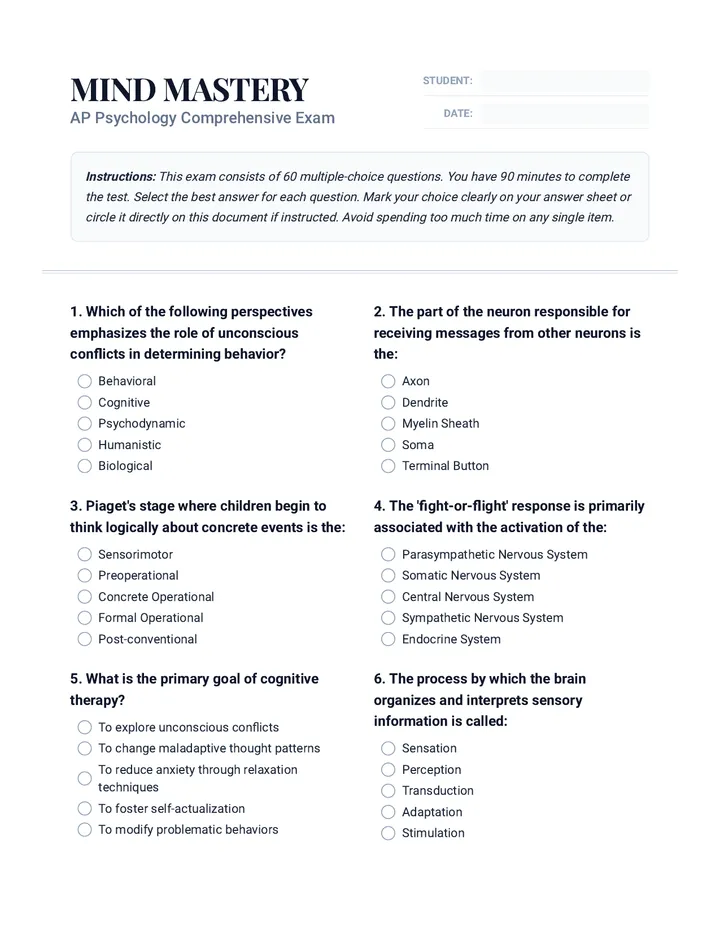
A comprehensive 90-minute assessment covering the breadth of the AP Psychology curriculum, including a 60-question multiple-choice exam, a post-exam reflection, and a detailed study guide for review.
A deep dive into the behavioral etiology of anxiety disorders, focusing on how classical conditioning initiates fear and operant conditioning maintains it through the Cycle of Anxiety. Students will map the transition from trigger to reinforcement using specific phobias as case studies.