Lenny.com
Explore
Create
ActivitiesNewMathEnglish Language ArtsScience & EngineeringSocial StudiesGlobal LanguagesHealth & Physical EducationSpecial EducationCounseling & Life SkillsArts & CreativityESL
Lenny.com
Lenny.com
Explore
Create
ActivitiesNewMathEnglish Language ArtsScience & EngineeringSocial StudiesGlobal LanguagesHealth & Physical EducationSpecial EducationCounseling & Life SkillsArts & CreativityESL
Lenny.com
Lenny.com

Solutions

Lenny for EducatorsLenny for SchoolsLenny for Districts

Product

ExploreSign inCreateSupportAbout

Resources

Getting startedMTSS Acceleration Program

Newsletters

School Funding Newsletter

© 2026 Lenny Learning Inc.

TermsPrivacyAccessibility
LinkedInInstagramX
Lenny

The Silk Road

Ancient transcontinental trade networks linking East Asia with the Mediterranean. Examines the exchange of silk, spices, and cultural ideologies between diverse civilizations.

Social StudiesSocial Studies PracticesLocation WordsMapsOrder EventsChronology and CausationEvaluating SourcesHistorical ThinkingGeography, Humans, & the EnvironmentAmerican Symbols and LandmarksCitiesStatesState CapitalsRegions of the United StatesGeographic SkillsPhysical GeographyHuman GeographyRegional GeographyGeography of AfricaGeography of AsiaGeography of EuropeGeography of OceaniaGeography of the AmericasSociety and Environment of EuropeSociety and Environment of AsiaSociety and Environment of The AmericasSociety and Environment of the Middle EastSociety and Environment of AfricaHistoryPrehistoryComparing Ancient River CivilizationsAncient MesopotamiaAncient Egypt and KushAncient South AsiaEarly ChinaGreeceRome and the Byzantine EmpireAncient World HistoryNative Peoples of North AmericaNative Peoples of Mesoamerica and South AmericaAfrican EmpiresMedieval AsiaMedieval EuropeThe Silk RoadMedieval HistoryIslamic EmpiresWorld ReligionsRenaissance PeriodAge of ExplorationThe Thirteen ColoniesThe American RevolutionUS History Early RepublicFounding of the United StatesUS History AntebellumUS Civil WarReconstruction PeriodThe Gilded AgeUS ImperialismWorld ImperialismWorld War IUS History 1920sGreat DepressionWorld War IIThe Cold WarUS History 1950-60sUS History 1960s-70sWorld History 20th CenturyContemporary US HistoryContemporary World HistoryHolidaysCivics and GovernmentCitizenshipGovernment FoundationsThe ConstitutionUS ConstitutionExecutive BranchLegislative BranchJudicial BranchState and LocalPolitical ParticipationPublic PolicyPolitical SystemsPower and AuthoritySocial MovementsDefining DevianceTheories of DevianceCrime and Criminal JusticeEconomicsBasic Economic PrinciplesSupply and DemandWhat is MoneyEconomic FundamentalsMicroeconomicsMacroeconomicsBanking and FinanceEconomic SystemsGlobal EconomicsCorporations and PowerThe Changing WorkplaceUnemployment and LaborClass and InequalitySocial MobilityGlobal InequalityPsychologyHistory of PsychologyPsychology as a ScienceBrain and Nervous SystemNeuroscience and BehaviorGenetics and BehaviorSleep and ConsciousnessSensory ProcessesPerceptual OrganizationClassical ConditioningOperant ConditioningObservational LearningCognitive LearningMemory ProcessesThinking and Problem SolvingLanguage and CognitionTheories of MotivationStress and CopingPrenatal and Infant DevelopmentChildhood DevelopmentAdolescent DevelopmentAdulthood and AgingSelf and IdentitySocial CognitionSocial InfluenceAttraction and RelationshipsGroup BehaviorPrejudice and DiscriminationAnxiety and Mood DisordersClinical PsychologyForensic PsychologyPhilosophy & EthicsIntroduction to PhilosophyMajor Philosophers & IdeasMind and Body ProblemFree Will vs DeterminismEthics & MoralityReligion & PhilosophyPolitical Philosophy

Videos

How Cultures Connect and Change

How Cultures Connect and Change

This educational video provides a comprehensive overview of how cultures evolve and interact through the processes of diffusion, convergence, and divergence. Opening with the historical anecdote of the "Crash at Crush" train collision as a metaphor for cultural encounters, the video breaks down complex anthropological concepts into digestible lessons. It explores the origins of cultural traits in "hearths" and examines the various mechanisms—trade, invasion, colonization, and communication technology—that facilitate the spread of ideas and behaviors across the globe. The content vividly illustrates these abstract concepts with diverse historical and modern examples. Students learn about the Silk Road, the Roman Empire, and Spanish colonization to understand diffusion and assimilation. The video then pivots to modern cultural convergence, using relatable examples like global sports fandom (Super Bowl vs. World Cup) and the international popularity of Anime and Manga. Finally, it addresses cultural divergence through the poignant history of the Maori and Moriori peoples in New Zealand, demonstrating how isolation and environment shape cultural development. This resource is highly valuable for Social Studies and Geography classrooms as it connects historical events to contemporary student interests. By asking direct questions and providing pause points, it encourages active engagement and critical thinking about how students' own lives are influenced by global cultural flows. The video effectively bridges the gap between ancient history and the digital age, helping learners analyze the role of technology in accelerating cultural exchange.

Miacademy & MiaPrep Learning ChannelMiacademy & MiaPrep Learning Channel

11mins 17s

Designing Your Dream City: Urbanization Explained

Designing Your Dream City: Urbanization Explained

In this engaging educational video, viewers are "hired" as urban planners and tasked with designing a master plan for their own fictional dream city. The host, Justin, guides students through the fundamental principles of urban geography by exploring how cities have historically developed and what makes them successful today. The video uses a mix of historical context, such as early river valley civilizations, and modern examples like Japan's high-speed rail system to illustrate key concepts.

Miacademy & MiaPrep Learning ChannelMiacademy & MiaPrep Learning Channel

12mins 8s

Discovering the Golden Age of Ancient China

Discovering the Golden Age of Ancient China

This educational video explores the reunification and subsequent "Golden Age" of Ancient China under the Sui and Tang dynasties. Narrated by Mia, it takes students on a journey through a timeline of chaos following the Han Dynasty to the stability established by the Sui. The video details significant technological advancements, including the Four Great Inventions (gunpowder, paper, printing, and the compass) and the construction of the massive Grand Canal, highlighting how these innovations connected the world and fueled economic growth. The content dives deep into the cultural explosion of the Tang Dynasty, showcasing its poetry, landscape paintings, ceramics, music, and cuisine. It emphasizes the aesthetic and social values of the time, illustrating how art and daily life were intertwined. Furthermore, the video addresses the philosophical and religious landscape of the era, specifically examining how Buddhism and Confucianism coexisted and complemented one another to guide social behavior and spiritual life. This resource is highly valuable for World History curriculums, offering a clear, engaging overview of a complex historical period. It provides opportunities to discuss the impact of technology on society, the role of infrastructure in economic development, and the syncretism of religious beliefs. Teachers can use the embedded questions to check for understanding and the rich visuals of artifacts and maps to anchor lessons on geography and art history.

Miacademy & MiaPrep Learning ChannelMiacademy & MiaPrep Learning Channel

10mins 10s

How Trade and Learning Built the Empires of West Africa

How Trade and Learning Built the Empires of West Africa

This educational video explores the rich history of West African civilizations during the Middle Ages, specifically focusing on the empires of Ghana, Mali, and Songhai. It details how the trans-Saharan trade routes served as more than just economic arteries for gold and salt; they were superhighways for the exchange of ideas, religion, and technology. The narrative highlights the pivotal role of geography, specifically the Sahara Desert, and how overcoming its challenges led to prosperity and global connection. Themes include the economic mechanics of the gold-salt trade, the spread and impact of Islam, and the reverence for education in cities like Timbuktu. The video examines key historical figures such as Mansa Musa and Askia the Great, illustrating how their leadership styles and policies regarding trade and religion shaped their respective empires. It also delves into specific intellectual achievements in astronomy, mathematics, architecture, and medicine that flourished in centers of learning like the University of Sankore. For educators, this video is an excellent resource for World History units covering African civilizations or the Middle Ages. It moves beyond simple dates and names to explain the *causes* of the rise of these empires—specifically the interplay between economic control and cultural development. It provides natural pause points for critical thinking questions and connects historical events to tangible innovations that students can understand, making it a strong anchor for lessons on economic systems, cultural diffusion, or historical geography.

Miacademy & MiaPrep Learning ChannelMiacademy & MiaPrep Learning Channel

14mins 15s

How the Silk Roads Spread Ideas and Religions

How the Silk Roads Spread Ideas and Religions

This educational video explores the concept of cultural diffusion through the historical lens of the Silk Roads. While often remembered for the trade of luxury goods like silk and spices, the video argues that the most significant exchange was actually invisible: the spread of ideas, worldviews, and religious beliefs. Host Alizé Carrère guides viewers through how religions like Buddhism, Islam, and Christianity spread and evolved across Asia, Africa, and Europe via these networks, illustrating complex geographic concepts such as relocation, expansion, contagion, and hierarchical diffusion.

CrashCourseCrashCourse

11mins 30s

How the Black Death Reshaped Medieval Europe

How the Black Death Reshaped Medieval Europe

This educational video provides a comprehensive overview of the Black Death (Bubonic Plague) and its profound impact on medieval Europe. It traces the origins of the plague from Asia along the Silk Road, explains the biological transmission through fleas and rats, and details how trade routes facilitated its rapid spread across the continent. The narrative uses maps and animations to visualize the trajectory of the disease from coastal ports to inland cities. Beyond the biology and timeline, the video deeply explores the social, economic, and cultural transformations triggered by the pandemic. It examines how the massive loss of life paradoxically led to better wages and rights for peasants, shifted power from kings to local governments, and sparked advancements in medicine, sanitation, and education. The content addresses misconceptions of the time, such as the miasma theory, and connects these historical events to the eventual rise of the Renaissance. This resource is highly valuable for history and social studies classrooms as it moves beyond just the "horror" of the plague to analyze its long-term structural effects on civilization. It offers excellent opportunities to teach cause-and-effect relationships in history, the intersection of biology and geography, and basic economic principles like supply and demand in a labor shortage. The concluding comparison to modern healthcare challenges makes the history relevant to contemporary students.

Miacademy & MiaPrep Learning ChannelMiacademy & MiaPrep Learning Channel

12mins 34s

Materials

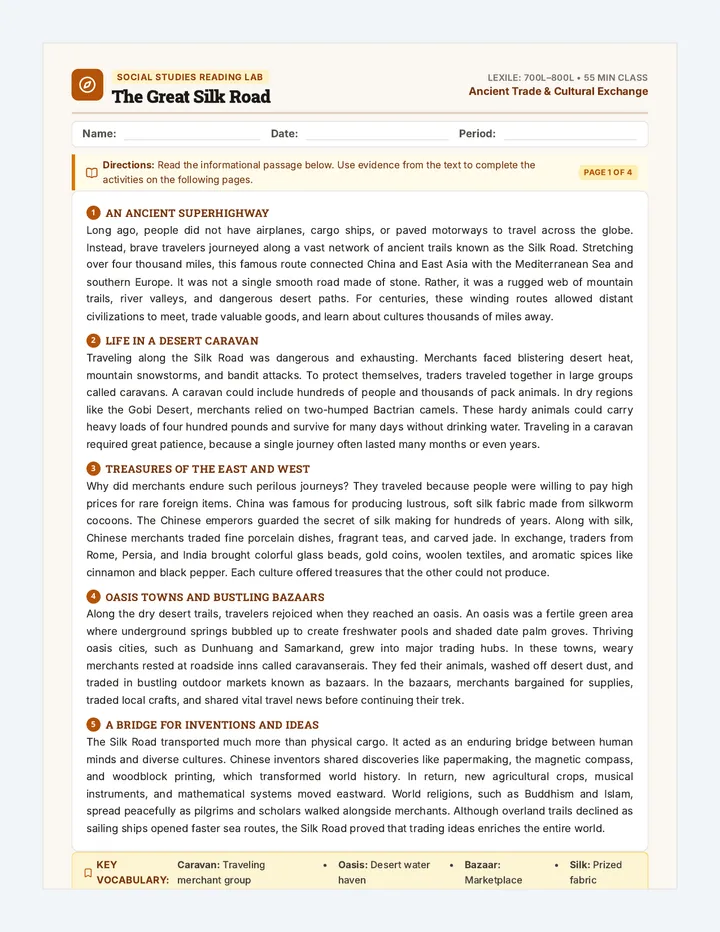
Silk Road Quest Reading Comprehension

Silk Road Quest Reading Comprehension

A comprehensive 4-page social studies reading comprehension packet exploring the ancient Silk Road at a 700-800 Lexile level. Includes a 5-paragraph informational text, 10 multiple choice questions, 10 true/false items, 5 fill-in-the-blank sentences, a verified 10x10 word search, an intersecting crossword puzzle, and 2 evidence-based open response prompts.

WM

Wilberto Mejias

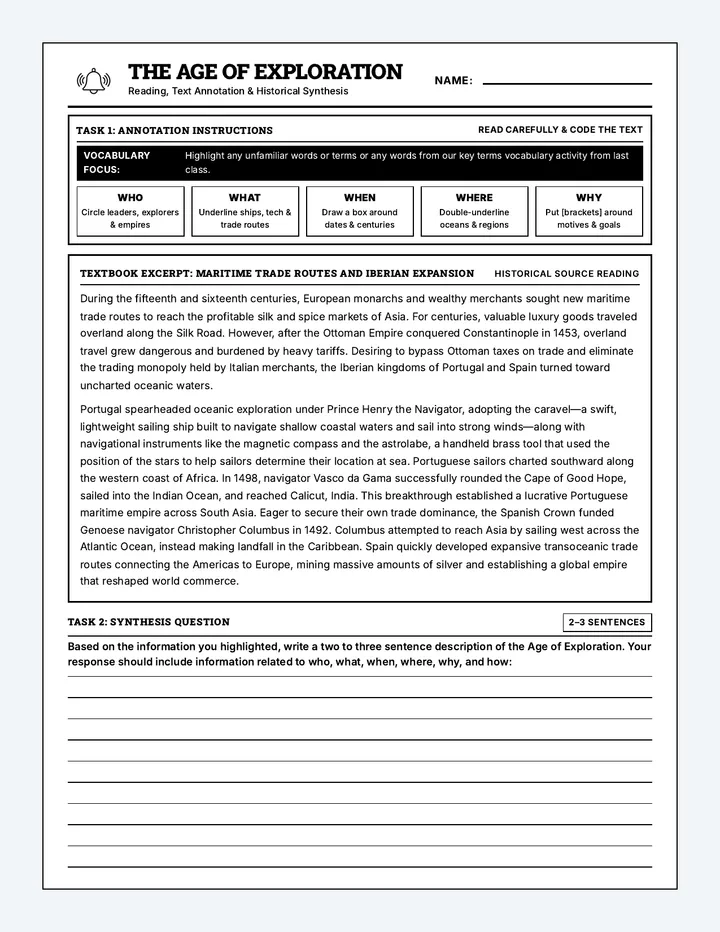
The Age of Exploration Bellringer

The Age of Exploration Bellringer

A high-contrast black-and-white 9th-grade bellringer featuring a bell icon, textbook excerpt on Spanish and Portuguese maritime trade routes during the Age of Exploration with context clues for caravel and astrolabe, unbolded text with 5 Ws and vocabulary annotation instructions, and an open 10-line response section prompting students to include who, what, when, where, why, and how.

KT

Kyle Trocolla

Source Clash Task Cards

Source Clash Task Cards

A 5-page printable task card set featuring eight paired-source historical corroboration bellringers, with Card 07 specifically detailing when and why the Alternative Center for Excellence (ACE) in Danbury CT opened in 1977, paired with a weekly student analysis log.

KT

Kyle Trocolla

Sequences

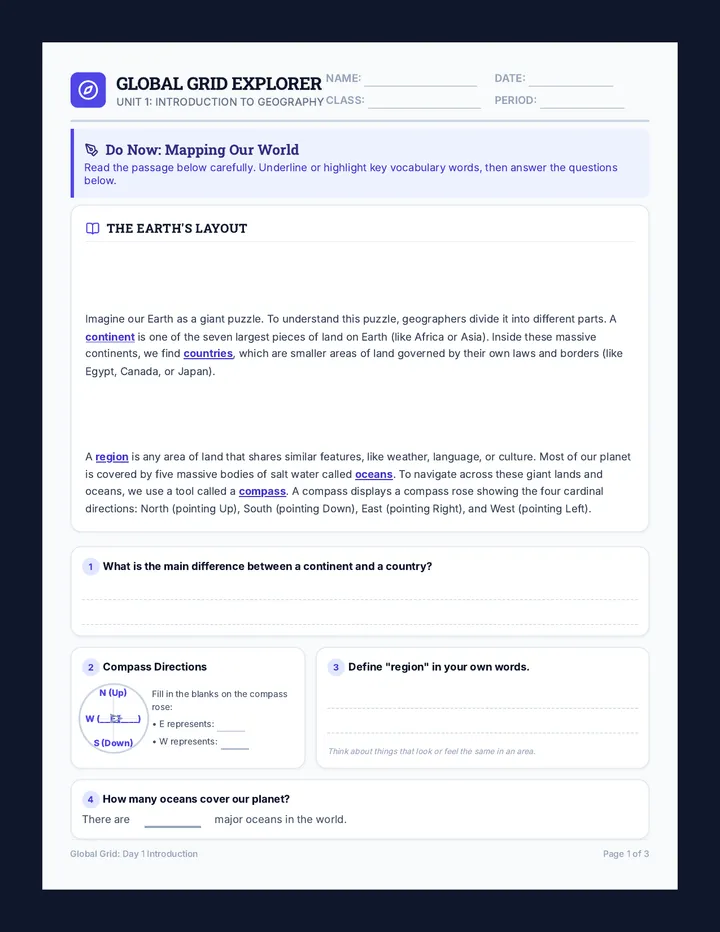
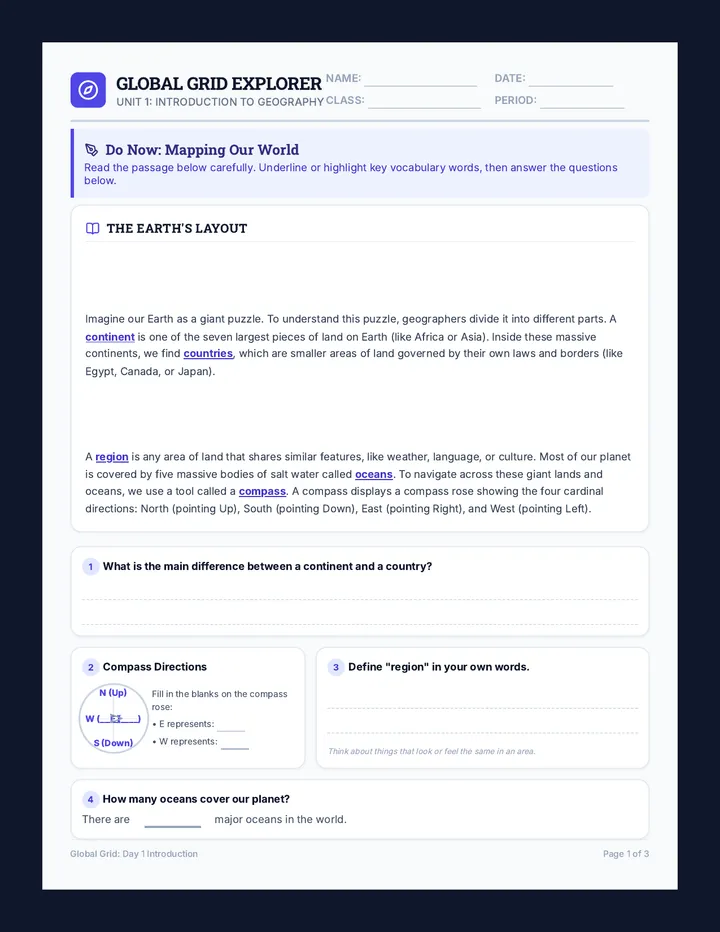
Global Grid Student Handbook

Power of Position

A 4-day introductory world history sequence exploring how geographic location, natural barriers, and famous trade routes shaped the rise, wealth, and power of global empires.

AG

Amina Gueye

14
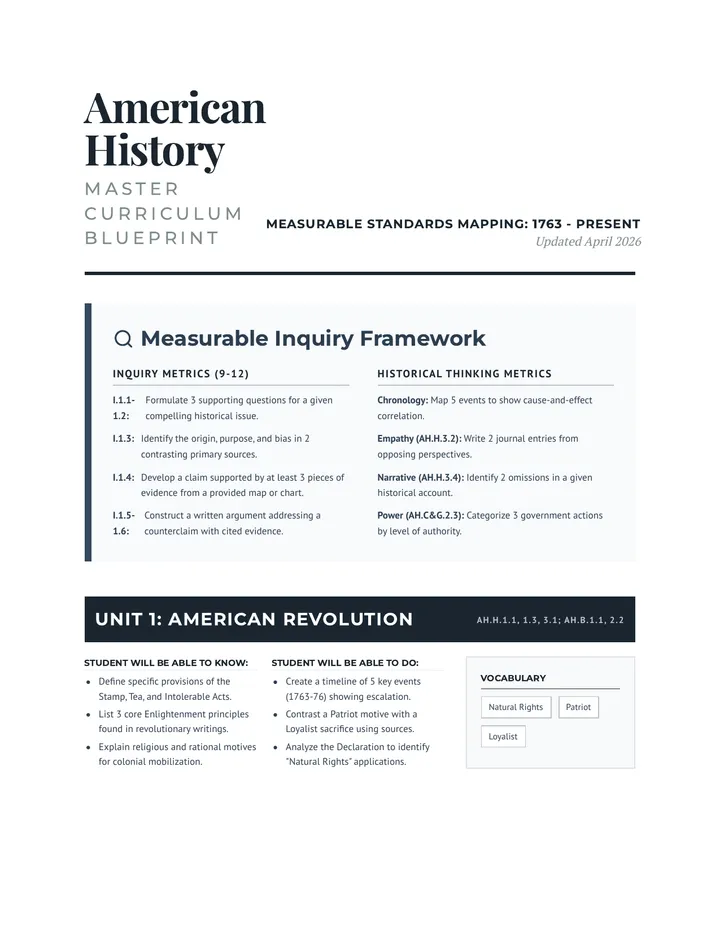
Curriculum Blueprint Document v2

History Horizon Sequence

A comprehensive high school curriculum plan for American History, covering 13 units from the American Revolution to the modern era, aligned with North Carolina Social Studies standards.

AK

Amity Kea

21
Land of Contrast Slides

Desert and Delta

A 3-lesson unit focused on the geography, trade, and kingdoms of Sub-Saharan Africa, specifically designed for WIDA level 1/2 ESL students with heavy visual support and sentence scaffolding.

RR

Ranjini Reddy

9
Global Grid Student Handbook

Power of Position

A 4-day introductory world history sequence exploring how geographic location, natural barriers, and famous trade routes shaped the rise, wealth, and power of global empires.

D

david.marques

14
World in Transition Worksheet

Medieval Worlds

A comprehensive 10-lesson unit exploring the political, economic, religious, and technological landscape of the Middle Ages across Western Europe, Japan, and the Islamic Empire. Students will analyze feudal systems, cultural achievements, and global connections through slides, guided activities, and comparative studies.

J

joseph.vida

12
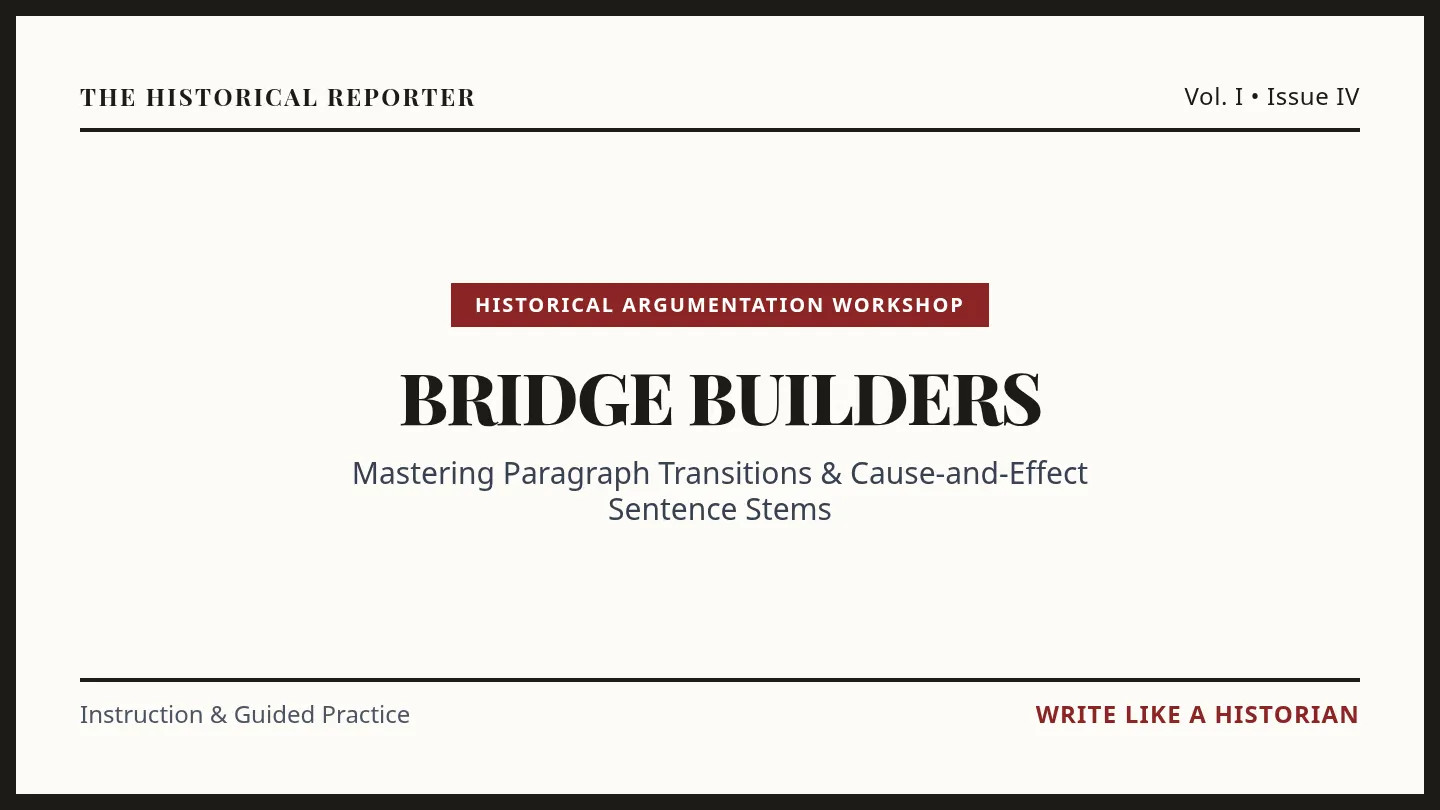
Bridge Builders Slides

Chronicle Connectors

A comprehensive writing workshop sequence helping students write powerful historical arguments. Covers general transitions, cause-and-effect connections, and specialized argument structures for U.S. History.

JR

Juan Ronco

5

Lessons

Explorer Epochs Wall Chart

Early World Explorers

A comprehensive lesson on early world exploration from 300 BCE to 1500 CE, focusing on the geographical, cultural, and religious impacts of key explorers across different continents.

J

jcasey

14
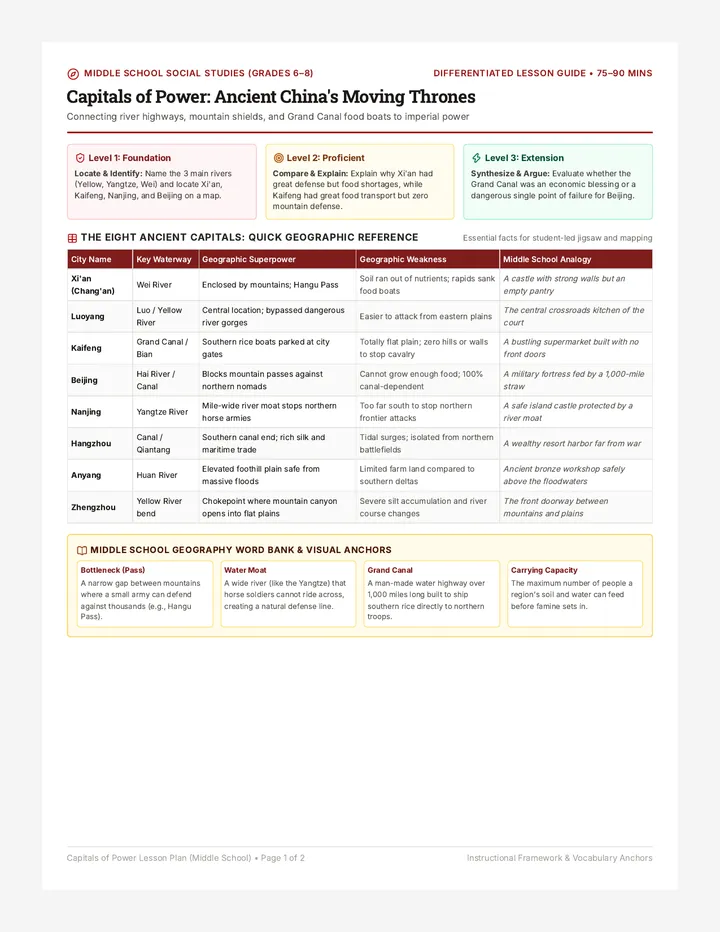
Capitals of Power Lesson Plan

Capitals of Power

An immersive geography and history investigation exploring China's eight ancient capitals, examining how river systems, mountain barriers, and agricultural heartlands dictated imperial power centers over four millennia. Students trace spatial shifts across China's major geographic zones through interactive mapping, comparative trade-off analysis, and strategic case studies.

DB

Danielle Burham

6
Silk Road Slides

Desert Caravans

A comprehensive exploration of the Silk Road's geography, challenging terrain, and the vital role of trade routes connecting East and West. Students will analyze physical barriers and key trading hubs.

WM

Wilberto Mejias

7
Caravan Quest Slides

Silk Road Caravan

A comprehensive activity-based lesson on the Silk Road, focusing on trade, geography, and cultural exchange through a merchant simulation.

MR

Mi Rendon

4
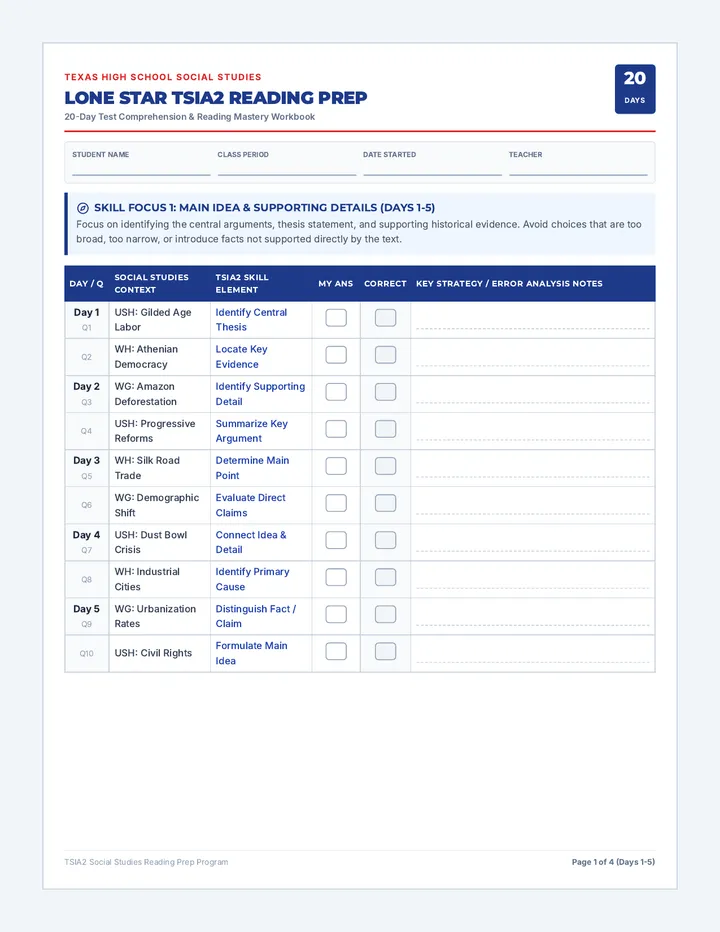
Lone Star TSIA2 Prep Tracker

Lone Star TSIA2 Reading Prep

A comprehensive 20-day test preparation program combining Texas High School Social Studies content (US History, World History, and World Geography) with high-yield TSIA2 Reading comprehension skills, complete with daily warm-up slides and a highly-structured student tracking workbook.

PR

Penne Reed

2
Standard Explorers Anchor Charts

Standard Explorers

A sequence of student-facing anchor charts designed to unpack the priority 6th-grade social studies standards for Civics, Economics, Geography, and History. Each standard is transformed into a highly visual, student-friendly reference poster.

SZ

Sandra Zoerhoff

1