Lenny.com
Explore
Create
ActivitiesNewMathEnglish Language ArtsScience & EngineeringSocial StudiesGlobal LanguagesHealth & Physical EducationSpecial EducationCounseling & Life SkillsArts & CreativityESL
Lenny.com
Lenny.com
Explore
Create
ActivitiesNewMathEnglish Language ArtsScience & EngineeringSocial StudiesGlobal LanguagesHealth & Physical EducationSpecial EducationCounseling & Life SkillsArts & CreativityESL
Lenny.com
Lenny.com

Solutions

Lenny for EducatorsLenny for SchoolsLenny for Districts

Product

ExploreSign inCreateSupportAbout

Resources

Getting startedMTSS Acceleration Program

Newsletters

School Funding Newsletter

© 2026 Lenny Learning Inc.

TermsPrivacyAccessibility
LinkedInInstagramX
Lenny

Reconstruction Period

Examines the political and social restructuring of the United States following the Civil War. Addresses the implementation of the 13th, 14th, and 15th Amendments, the role of the Freedmen's Bureau, and the eventual rise of Jim Crow laws.

Social StudiesSocial Studies PracticesLocation WordsMapsOrder EventsChronology and CausationEvaluating SourcesHistorical ThinkingGeography, Humans, & the EnvironmentAmerican Symbols and LandmarksCitiesStatesState CapitalsRegions of the United StatesGeographic SkillsPhysical GeographyHuman GeographyRegional GeographyGeography of AfricaGeography of AsiaGeography of EuropeGeography of OceaniaGeography of the AmericasSociety and Environment of EuropeSociety and Environment of AsiaSociety and Environment of The AmericasSociety and Environment of the Middle EastSociety and Environment of AfricaHistoryPrehistoryComparing Ancient River CivilizationsAncient MesopotamiaAncient Egypt and KushAncient South AsiaEarly ChinaGreeceRome and the Byzantine EmpireAncient World HistoryNative Peoples of North AmericaNative Peoples of Mesoamerica and South AmericaAfrican EmpiresMedieval AsiaMedieval EuropeThe Silk RoadMedieval HistoryIslamic EmpiresWorld ReligionsRenaissance PeriodAge of ExplorationThe Thirteen ColoniesThe American RevolutionUS History Early RepublicFounding of the United StatesUS History AntebellumUS Civil WarReconstruction PeriodThe Gilded AgeUS ImperialismWorld ImperialismWorld War IUS History 1920sGreat DepressionWorld War IIThe Cold WarUS History 1950-60sUS History 1960s-70sWorld History 20th CenturyContemporary US HistoryContemporary World HistoryHolidaysCivics and GovernmentCitizenshipGovernment FoundationsThe ConstitutionUS ConstitutionExecutive BranchLegislative BranchJudicial BranchState and LocalPolitical ParticipationPublic PolicyPolitical SystemsPower and AuthoritySocial MovementsDefining DevianceTheories of DevianceCrime and Criminal JusticeEconomicsBasic Economic PrinciplesSupply and DemandWhat is MoneyEconomic FundamentalsMicroeconomicsMacroeconomicsBanking and FinanceEconomic SystemsGlobal EconomicsCorporations and PowerThe Changing WorkplaceUnemployment and LaborClass and InequalitySocial MobilityGlobal InequalityPsychologyHistory of PsychologyPsychology as a ScienceBrain and Nervous SystemNeuroscience and BehaviorGenetics and BehaviorSleep and ConsciousnessSensory ProcessesPerceptual OrganizationClassical ConditioningOperant ConditioningObservational LearningCognitive LearningMemory ProcessesThinking and Problem SolvingLanguage and CognitionTheories of MotivationStress and CopingPrenatal and Infant DevelopmentChildhood DevelopmentAdolescent DevelopmentAdulthood and AgingSelf and IdentitySocial CognitionSocial InfluenceAttraction and RelationshipsGroup BehaviorPrejudice and DiscriminationAnxiety and Mood DisordersClinical PsychologyForensic PsychologyPhilosophy & EthicsIntroduction to PhilosophyMajor Philosophers & IdeasMind and Body ProblemFree Will vs DeterminismEthics & MoralityReligion & PhilosophyPolitical Philosophy

Videos

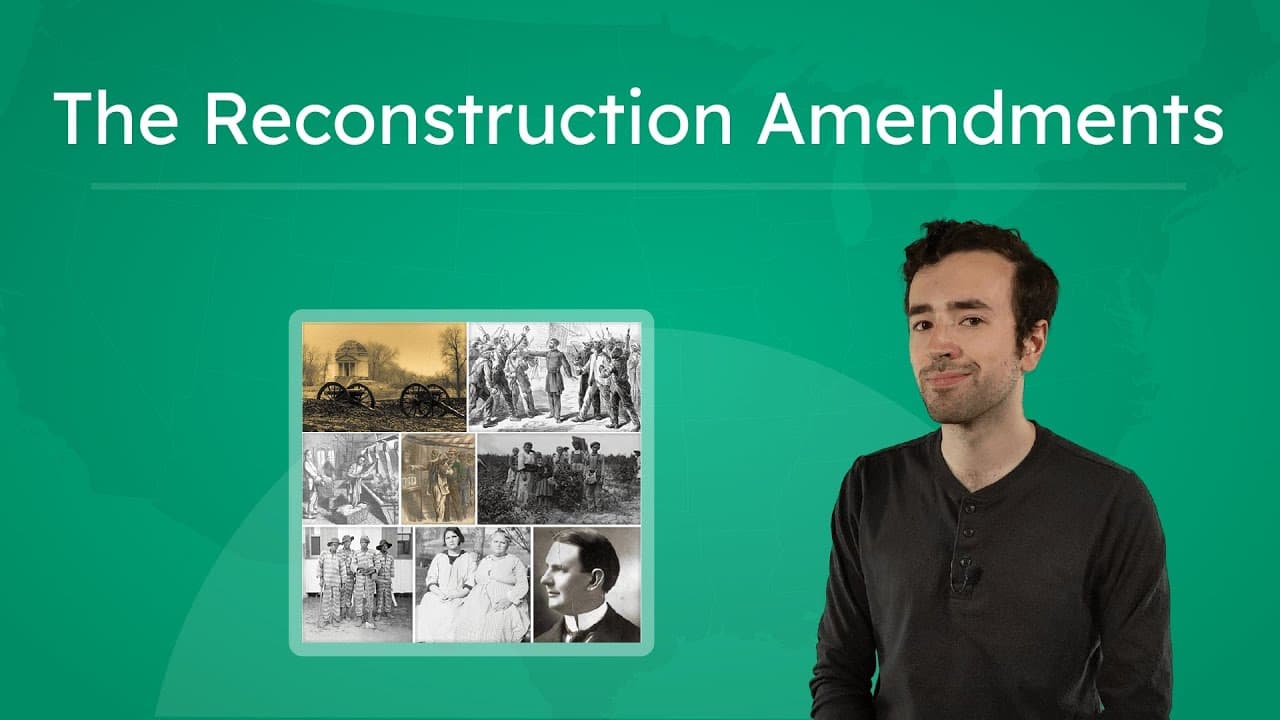
The Reconstruction Amendments and Their Legacy

The Reconstruction Amendments and Their Legacy

This educational video provides a comprehensive analysis of the Reconstruction Amendments—the 13th, 14th, and 15th Amendments to the U.S. Constitution—passed in the wake of the Civil War. It explains the legal intent of these amendments: abolishing slavery, establishing citizenship and equal protection, and granting voting rights. The video breaks down complex legal concepts like "due process" and "birthright citizenship" using historical examples and court cases. The narrative critically examines how these constitutional advancements were undermined by state and local actions following the end of Reconstruction. It explores the loopholes and lack of enforcement that allowed for the rise of Jim Crow laws, Black Codes, and discriminatory practices like debt peonage and vagrancy laws. The video highlights specific Supreme Court cases, such as *Yick Wo v. Hopkins* and *Buck v. Bell*, to demonstrate how the amendments were applied (or ignored) regarding immigrants and those deemed "mentally deficient." This resource is highly valuable for U.S. History and Civics classrooms. It moves beyond a surface-level definition of the amendments to explore the nuanced reality of their historical application. Teachers can use this video to spark discussions about systemic inequality, the difference between written law and enforcement, and the evolution of civil rights in America. It connects historical events to broader themes of citizenship, immigration, and bioethics.

Miacademy & MiaPrep Learning ChannelMiacademy & MiaPrep Learning Channel

12mins 33s

How Plessy v. Ferguson Legalized Segregation

How Plessy v. Ferguson Legalized Segregation

This educational video from Crash Course Black American History provides a comprehensive analysis of the landmark 1896 Supreme Court case, Plessy v. Ferguson. Hosted by Clint Smith, the video details the story of Homer Plessy, a mixed-race man from New Orleans who participated in a carefully orchestrated act of civil disobedience to challenge the Separate Car Act of 1890. It explains the legal arguments presented, the Supreme Court's 7-1 ruling that established the "separate but equal" doctrine, and the sole dissenting opinion that argued the Constitution should be colorblind. The video explores complex themes including the social construction of race, the "one-drop rule," and the strategic nature of civil rights activism. It highlights how the Committee of Citizens planned Plessy's arrest as a test case, debunking the myth that such events were random acts of defiance. Furthermore, it examines the devastating long-term impact of the ruling, which legalized racial segregation and ushered in the Jim Crow era that oppressed Black Americans for nearly seventy years. For educators, this resource is an invaluable tool for teaching U.S. History, Civics, and Government. It moves beyond a surface-level timeline of events to explore the mechanics of the judicial system and how laws can be used to both fight and perpetuate oppression. The video provides clear definitions of constitutional amendments and offers a nuanced look at the specific legal language used to justify segregation, making it an excellent anchor for discussions on systemic racism, legal precedent, and the history of civil rights in America.

CrashCourseCrashCourse

10mins 36s

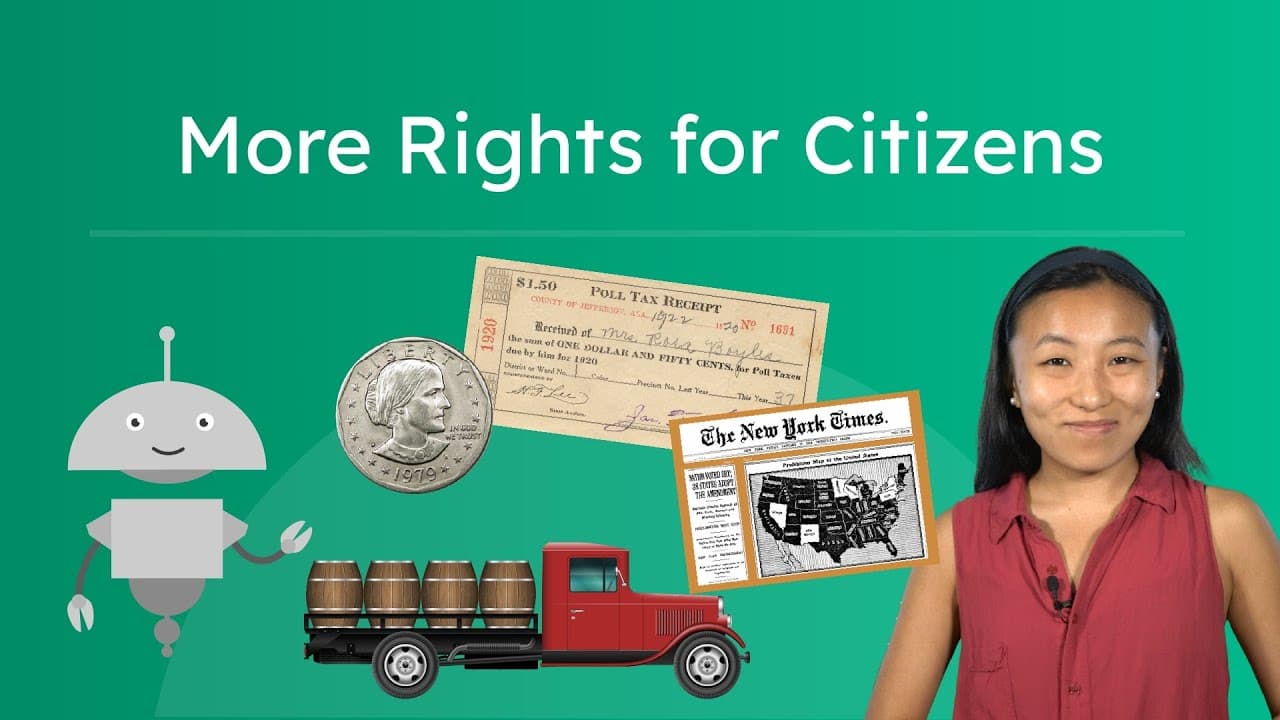
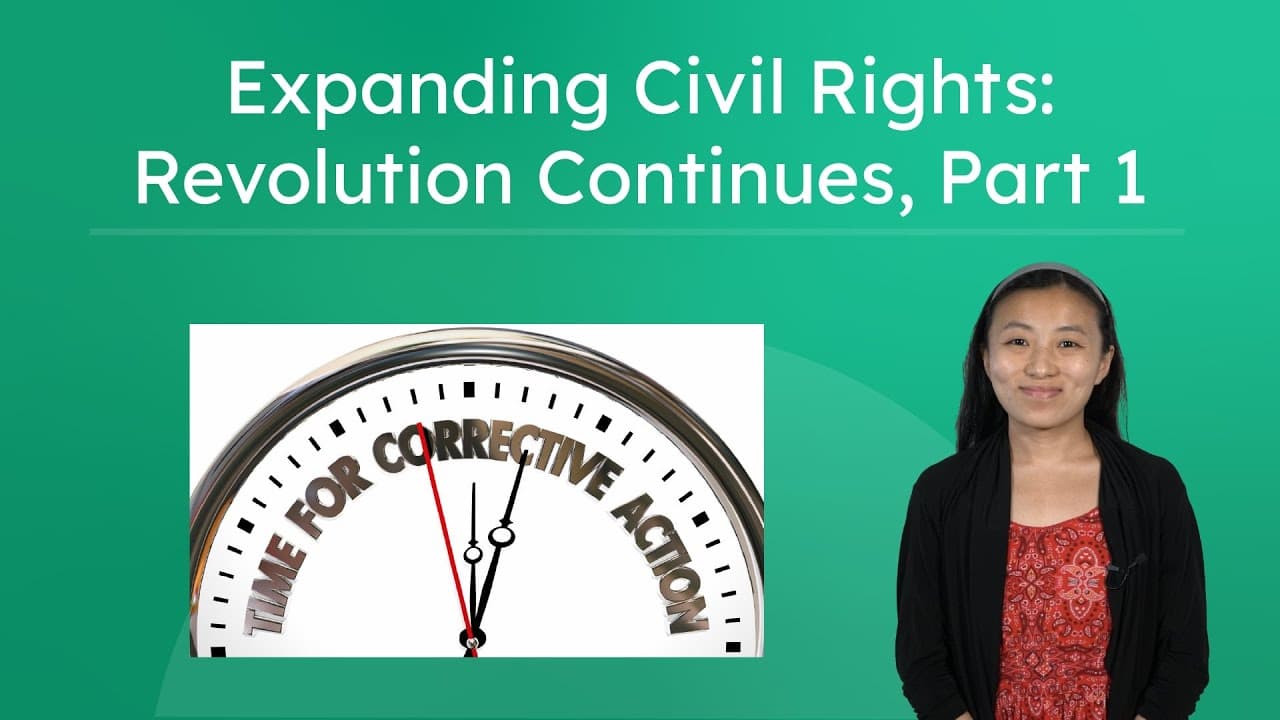
How Constitutional Amendments Expanded Citizen Rights

How Constitutional Amendments Expanded Citizen Rights

This educational video provides a comprehensive overview of the United States Constitutional amendments that expand citizen rights beyond the original Bill of Rights. Narrated by a student host named Caroline alongside an animated robot character, the video systematically categorizes these amendments into logical groups: the Ninth Amendment (unenumerated rights), Post-Civil War Amendments (13, 14, 15), Voting Rights Amendments (17, 19, 23, 24, 26), and Prohibition Amendments (18, 21). The content connects historical events to legal changes, explaining how the Civil War led to the abolition of slavery and definitions of citizenship, how the women's suffrage movement achieved the 19th Amendment, and how the Vietnam War influenced lowering the voting age to 18. It also tackles the unique case of Prohibition—the only time an amendment restricted rights and was subsequently repealed. The video utilizes historical photographs, maps, and clear text overlays to make complex constitutional history accessible. Teachers can use this video to help students understand the living nature of the Constitution and the specific struggles that led to the expansion of American democracy. It is an excellent resource for Civics and U.S. History units, offering clear definitions of key amendments while highlighting the ongoing importance of voting and civic participation.

Miacademy & MiaPrep Learning ChannelMiacademy & MiaPrep Learning Channel

8mins

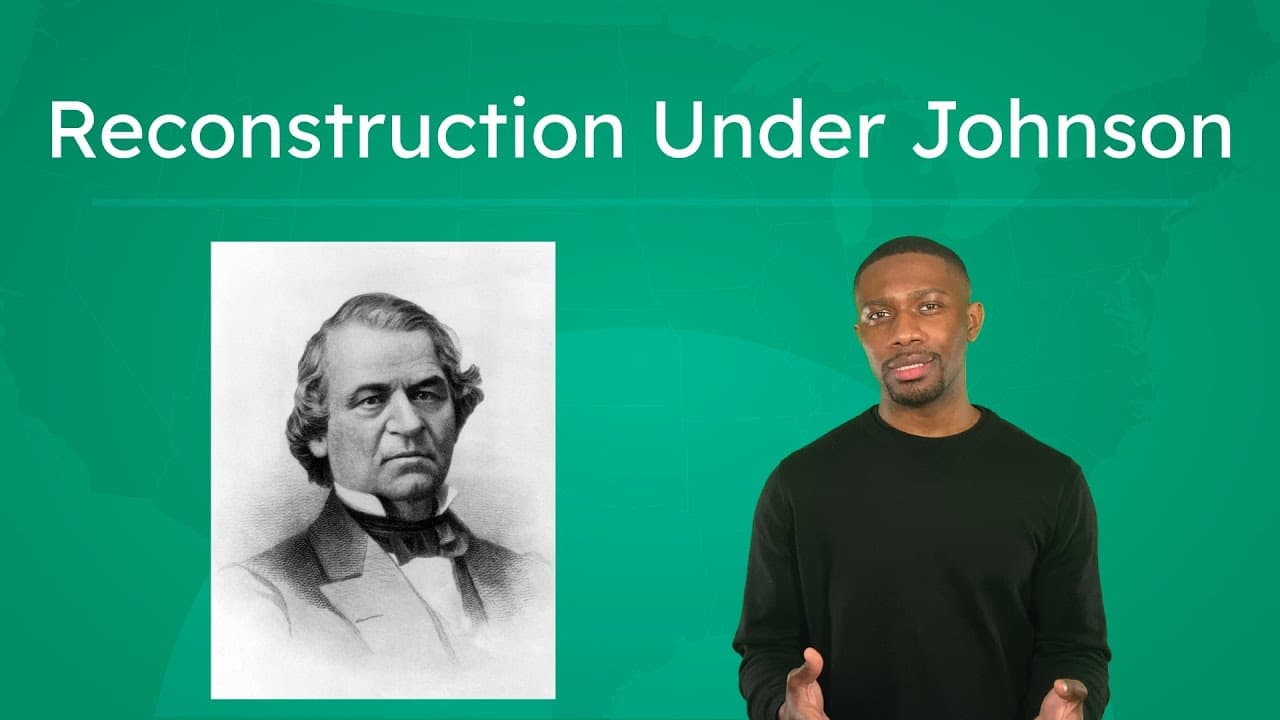
The Battle Over Reconstruction: Johnson vs. Congress

The Battle Over Reconstruction: Johnson vs. Congress

This educational video provides a comprehensive overview of the early Reconstruction era following the assassination of Abraham Lincoln, focusing on the tumultuous presidency of Andrew Johnson. It details the ideological and political conflict between President Johnson, a Southern Democrat who favored leniency toward the former Confederacy, and the Radical Republicans in Congress who sought to secure rights for formerly enslaved people. The narrative covers key events such as the passing of Black Codes, the Civil Rights Act of 1866, the 14th Amendment, and the Military Reconstruction Acts. The video explores central themes of executive versus legislative power, systemic racism, and the definition of citizenship. It highlights the struggle to define the status of freed people through the lens of Johnson's white supremacist policies and Congress's legislative counterattacks, culminating in Johnson's impeachment. The content explains how these historical decisions shaped the trajectory of American civil rights and the reintegration of Southern states. For educators, this video serves as an excellent resource for teaching the complexities of the Reconstruction era beyond just dates and battles. It clearly defines difficult concepts like impeachment, vetoes, and constitutional amendments while providing context for the rise of Jim Crow laws through the explanation of Black Codes. The video is well-suited for sparking discussions about checks and balances, the enduring impact of policy on social justice, and the difficulties of national reunification after civil war.

Miacademy & MiaPrep Learning ChannelMiacademy & MiaPrep Learning Channel

10mins 7s

The Extraordinary Life and Legacy of Frederick Douglass

The Extraordinary Life and Legacy of Frederick Douglass

This episode of Crash Course Black American History explores the extraordinary life and legacy of Frederick Douglass, one of the most influential figures in American history. Hosted by Clint Smith, the video traces Douglass's journey from his birth into slavery in Maryland to his escape and subsequent rise as a world-renowned orator, writer, and abolitionist. It details the pivotal moments that shaped his worldview, including his covert education, his physical resistance against a "slave-breaker," and his escape to the North with the critical assistance of Anna Murray. The video delves into key themes such as the power of literacy as a tool for liberation, the strategic use of rhetoric to shift public opinion, and the complex political landscape of the mid-19th century. It highlights Douglass's career as an editor of *The North Star*, his advocacy for women's rights, and his influential relationship with Abraham Lincoln during the Civil War, where he pushed for Black enlistment as a path to citizenship. For educators, this resource serves as a powerful anchor for units on the Civil War, the abolitionist movement, or American literature. It humanizes a historical icon, moving beyond simple facts to explore his internal motivations, his partnership with his wife Anna, and his unwavering faith in the face of systemic oppression. The content naturally sparks discussions about resistance, the importance of education, and the definition of American citizenship.
CrashCourseCrashCourse

12mins 19s

Using Revolutionary Traditions to Create Social Change

Using Revolutionary Traditions to Create Social Change

This educational video explores how the core principles of the United States' founding documents—the Declaration of Independence and the Constitution—created a "revolutionary tradition" that has been utilized by marginalized groups to effect social change. It defines key concepts like popular sovereignty, natural rights, and the distinction between suffrage (voting) and mass democracy (participation outside the voting booth). The video argues that these founding ideals provide a "measuring stick" against which society can be judged and improved.

Miacademy & MiaPrep Learning ChannelMiacademy & MiaPrep Learning Channel

12mins 18s

Materials

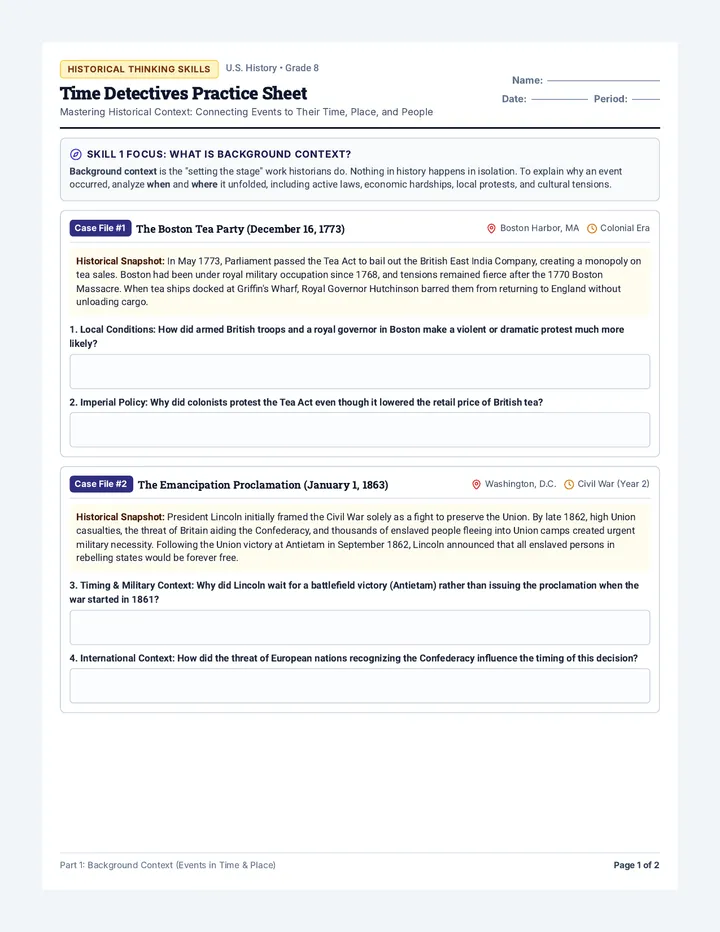
Time Detectives Practice Sheet

Time Detectives Practice Sheet

A two-page 8th-grade U.S. History practice sheet guiding students through background context and source context analysis across the American Revolution, Civil War, and Reconstruction.

JM

Justin Montalvo

Southern Reconstruction Lecture Slides

Southern Reconstruction Lecture Slides

A comprehensive high school US History lecture slide deck analyzing how the southern economy and society transformed after the Civil War, covering devastation, labor shifts, sharecropping, constitutional amendments, racial backlash, and the Compromise of 1877.

LS

LeVar St Germain

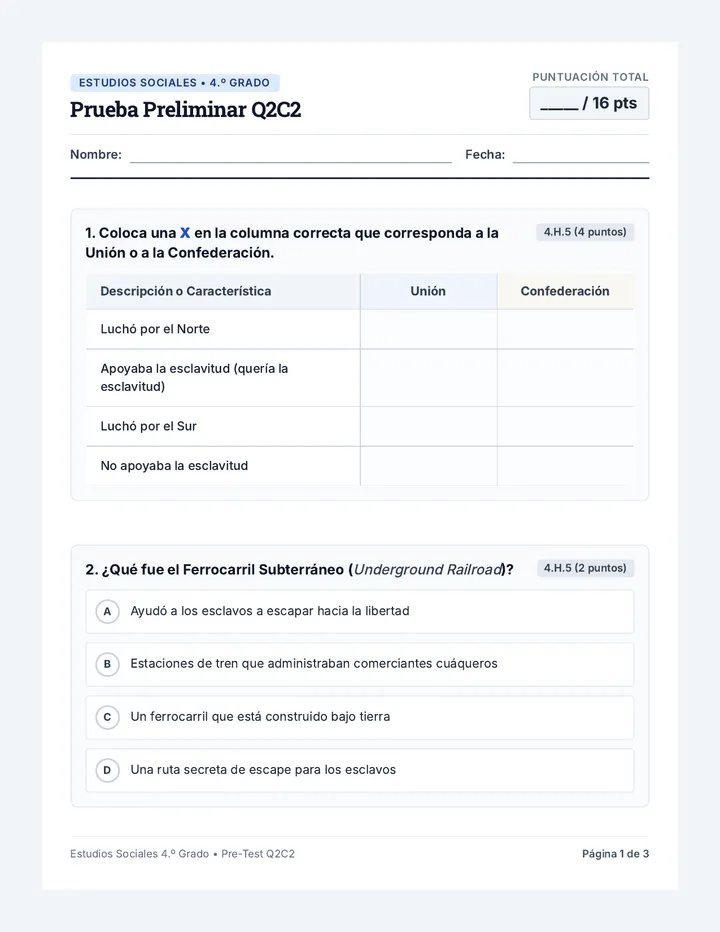
Estudios Sociales Prueba Preliminar

Estudios Sociales Prueba Preliminar

Traducción al español de la evaluación previa de Estudios Sociales de 4.º grado (Q2C2), alineada con los estándares estatales de Indiana sobre la Guerra Civil, el Ferrocarril Subterráneo y los derechos civiles. Incluye tablas comparativas, preguntas de opción múltiple, casillas de verificación y análisis de fuentes primarias y secundarias con espacio para escritura narrativa.

A

Amy.Hacker

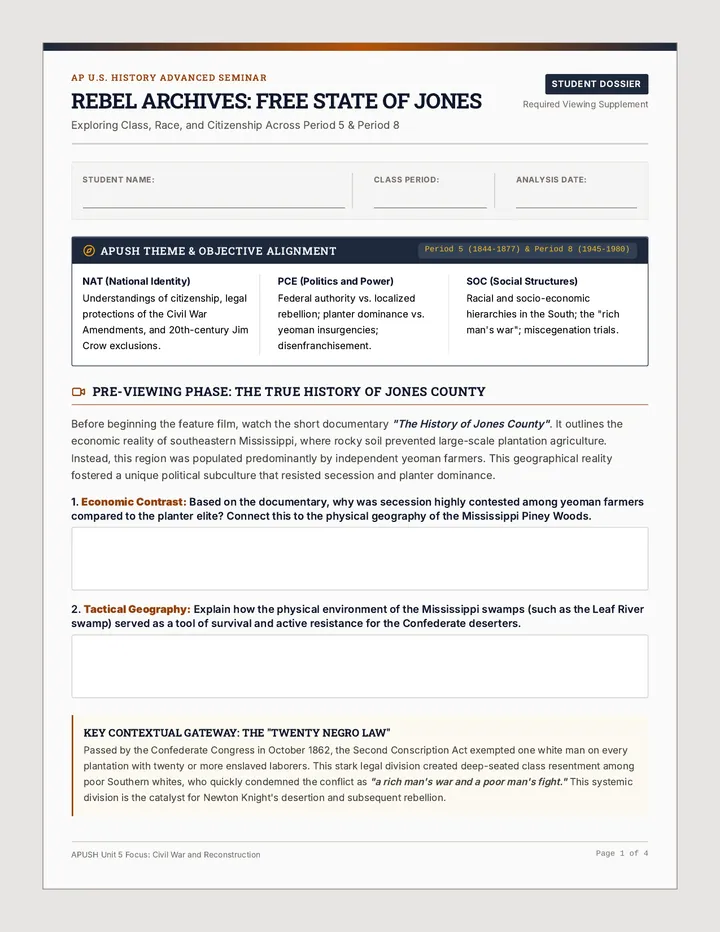
Rebel Archives Film Guide

Rebel Archives Film Guide

A highly structured, four-page AP U.S. History film study viewing guide and historical analysis packet for the movie 'Free State of Jones'. It connects Period 5 Civil War/Reconstruction themes with Period 8 20th-century Civil Rights contexts, focusing on Southern class dynamics, Unionism, and racial classification continuities.

JG

Joshua Griffith

Gilded Age Ledger Vocabulary

Gilded Age Ledger Vocabulary

A polished 6-page vocabulary packet for the Gilded Age, featuring 24 terms with a vintage ledger aesthetic. Includes a formal header on page 1, consistent secondary headers on pages 2-6, and the fully-named 'Transcontinental Railroad' term. Each item contains a definition, a framed visual plate, and dedicated note-taking space.

JR

Juan Ronco

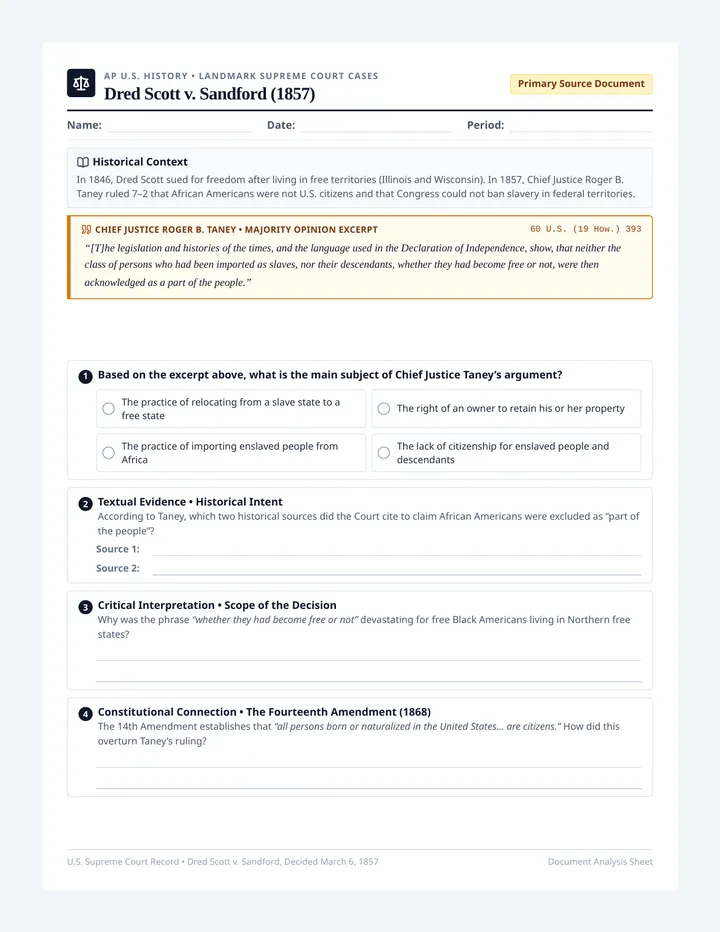
Dred Scott Analysis Worksheet

Dred Scott Analysis Worksheet

A primary source analysis worksheet focusing on the 1857 Supreme Court ruling in Dred Scott v. Sandford. Includes historical context, close-reading questions on Chief Justice Taney's majority opinion, and constitutional connections to the 14th Amendment.

Sequences

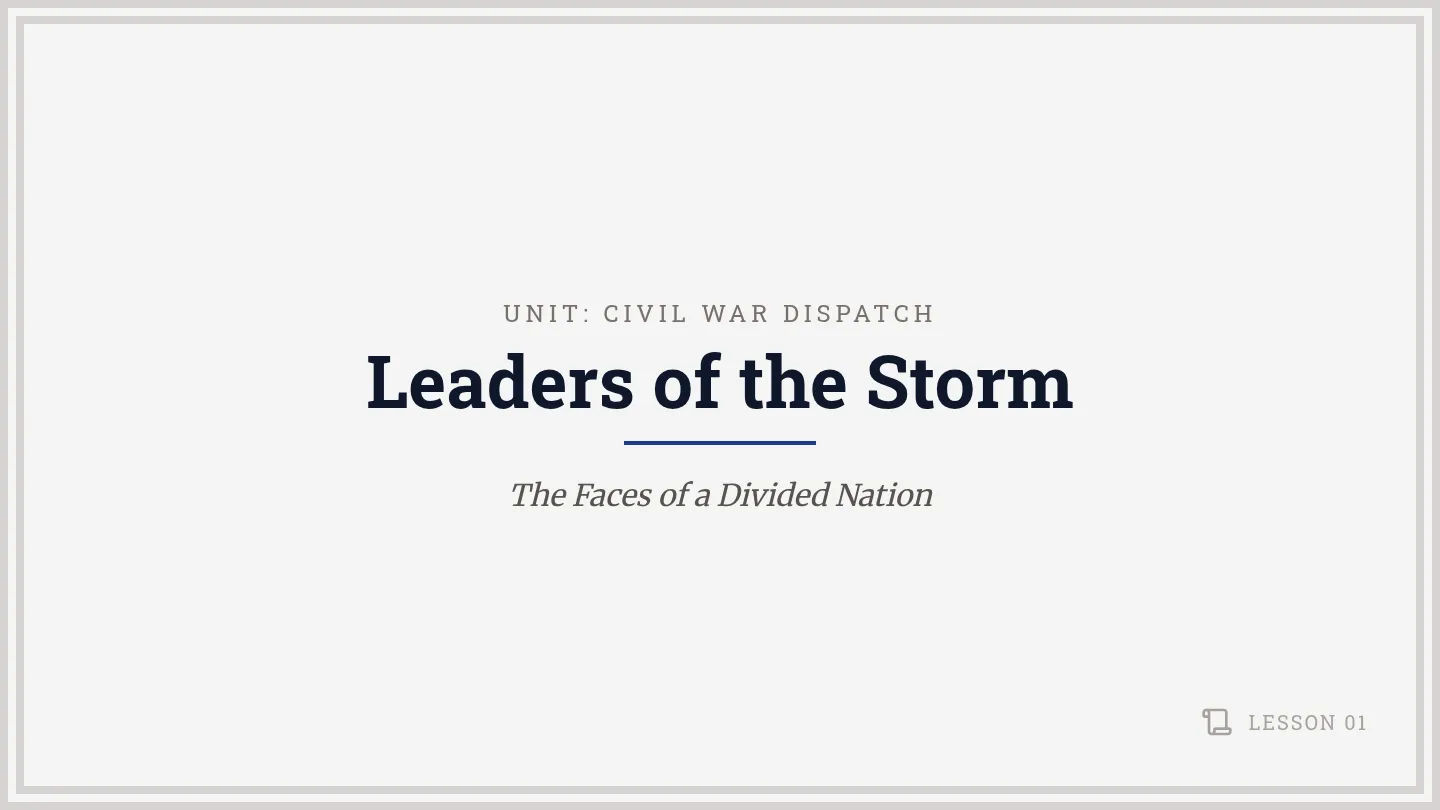
Leaders of the Storm Slides

Civil War Dispatch

A comprehensive 4-lesson unit for 5th grade exploring the pivotal figures, major conflicts, and the courageous escape routes of the American Civil War. Students engage with historical primary-source styles while learning about leadership and the quest for freedom.

IA

Isabella Adkins

12
Amendment Evolution Slides

Constitutional Crossroads

A deep dive into the foundations of American government, covering the evolution of constitutional amendments and the structure and power of the judicial system.

GM

Geneva Manus

11
Reconstruction Reckoning Worksheet

Modern America

A comprehensive journey through United States history from the aftermath of the Civil War to the contemporary era, exploring the social, political, and economic shifts that shaped the modern nation.

DP

Darren Polamalu

18
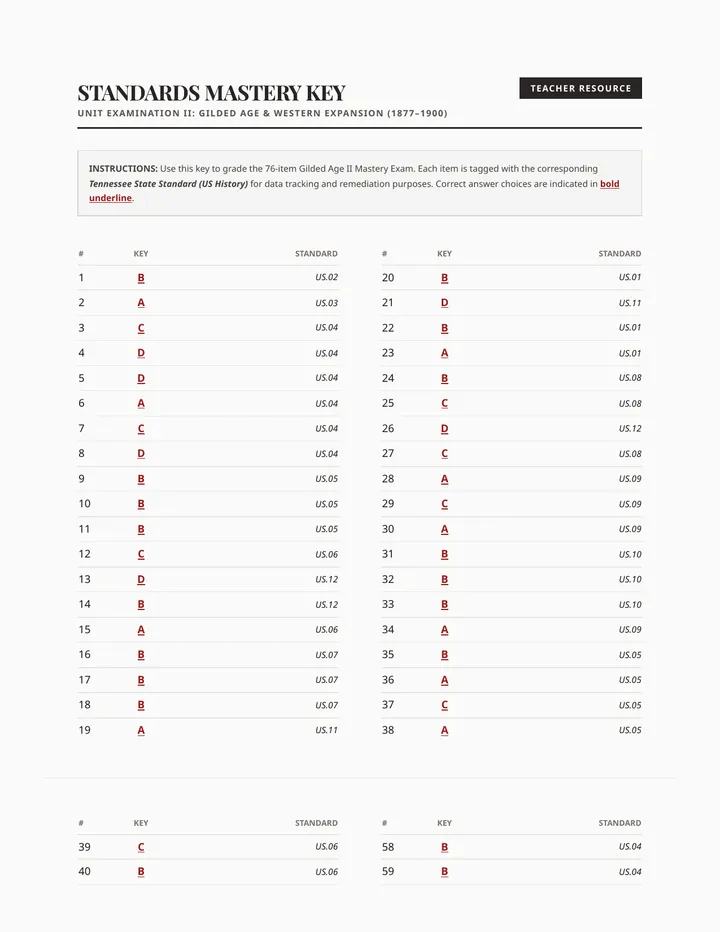
Gilded Age II Standards Key

Modern America Mastery

A comprehensive curriculum sequence covering late 19th and early 20th-century American history, focusing on economic transformation, Western expansion, global imperialism, and the impact of the Great War.

A

Andrew

29
Gilded Age WICOR Handout

History Hustle

A comprehensive US History EOC review sequence designed for AVID classrooms, utilizing WICOR strategies to master key eras from the Gilded Age through modern turning points.

ES

Erin Sims

15
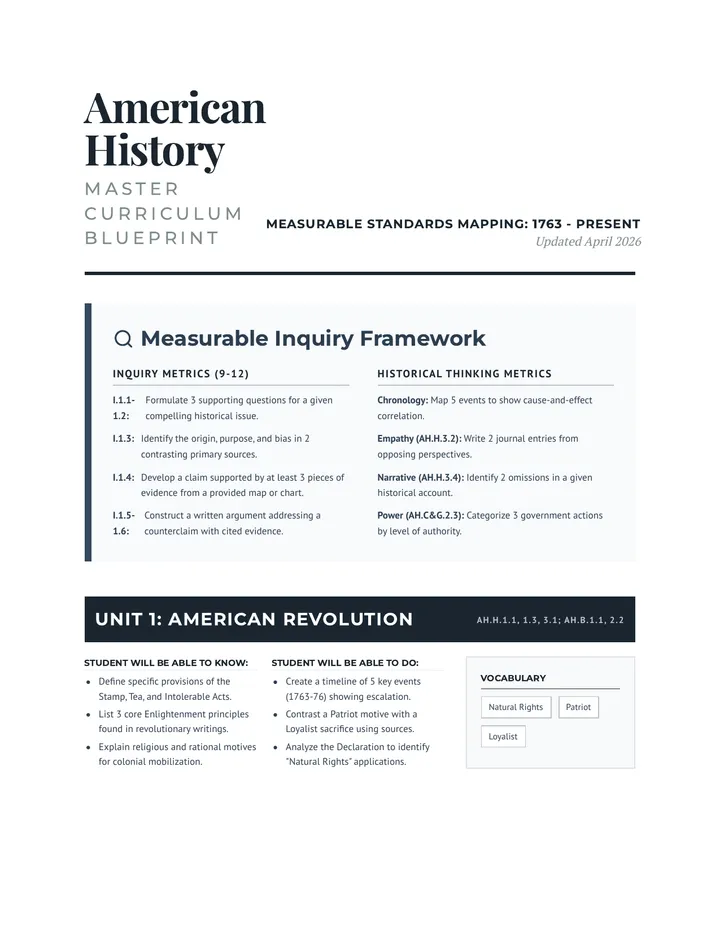
Curriculum Blueprint Document v2

History Horizon Sequence

A comprehensive high school curriculum plan for American History, covering 13 units from the American Revolution to the modern era, aligned with North Carolina Social Studies standards.

AK

Amity Kea

21

Lessons

History Sprint Pacing Guide

STAAR History Sprint

A comprehensive pacing guide and activity resource designed to cover the remaining 11th Grade US History TEKS before the STAAR test on April 16th. This lesson provides a day-by-day calendar for A/B block schedules and high-engagement activities for each remaining historical era.

BB

Bridgette Burdick

51
Black History Scavenger Hunt Lesson Plan

Black History Scavenger Hunt

A game-based lesson where students solve clues to discover significant figures and events in Black history, promoting cultural awareness and teamwork.

JH

Jade Hodge

5
Amendment Process Slides

The Living Constitution

A comprehensive lesson on the U.S. Constitution's amendment process and the Bill of Rights, featuring a chunked reader, instructional slides, and formative assessments. Students will analyze how the Constitution adapts to changing times while protecting fundamental liberties.

CE

Chelsea Elliott

5
Justice Gallery Investigation Worksheet

Justice Gallery Case Files

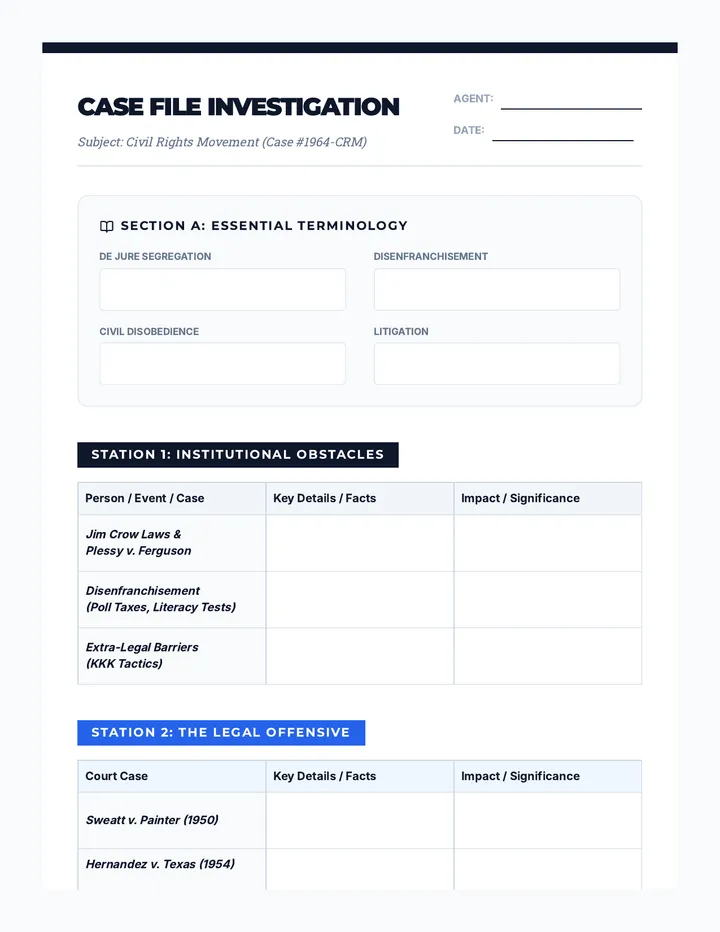
A comprehensive lesson on the Civil Rights Movement featuring gallery stations and a guided investigation worksheet. Students analyze institutional obstacles, legal strategies, non-violent and militant tactics, and the expansion of the movement to other marginalized groups.

CE

Chelsea Elliott

25
Your Vote Your Voice Lesson Plan

Your Vote Your Voice

This lesson empowers 11th-grade students to understand the impact of voting on their lives and communities, covering historical struggles for voting rights and the responsibilities of informed citizenship.

K

kylene.smith

6
Separate but Equal Reading

Equality on Trial

A deep dive into the landmark Plessy v. Ferguson case, exploring the legal arguments, the "separate but equal" doctrine, and Justice Harlan's famous dissent. Students will analyze the long-term impact of this ruling on American society.

M

matthew.hoard

12