Lenny.com
Explore
Create
ActivitiesNewMathEnglish Language ArtsScience & EngineeringSocial StudiesGlobal LanguagesHealth & Physical EducationSpecial EducationCounseling & Life SkillsArts & CreativityESL
Lenny.com
Lenny.com
Explore
Create
ActivitiesNewMathEnglish Language ArtsScience & EngineeringSocial StudiesGlobal LanguagesHealth & Physical EducationSpecial EducationCounseling & Life SkillsArts & CreativityESL
Lenny.com
Social StudiesSocial Studies PracticesLocation WordsMapsOrder EventsChronology and CausationEvaluating SourcesHistorical ThinkingGeography, Humans, & the EnvironmentAmerican Symbols and LandmarksCitiesStatesState CapitalsRegions of the United StatesGeographic SkillsPhysical GeographyHuman GeographyRegional GeographyGeography of AfricaGeography of AsiaGeography of EuropeGeography of OceaniaGeography of the AmericasSociety and Environment of EuropeSociety and Environment of AsiaSociety and Environment of The AmericasSociety and Environment of the Middle EastSociety and Environment of AfricaHistoryPrehistoryComparing Ancient River CivilizationsAncient MesopotamiaAncient Egypt and KushAncient South AsiaEarly ChinaGreeceRome and the Byzantine EmpireAncient World HistoryNative Peoples of North AmericaNative Peoples of Mesoamerica and South AmericaAfrican EmpiresMedieval AsiaMedieval EuropeThe Silk RoadMedieval HistoryIslamic EmpiresWorld ReligionsRenaissance PeriodAge of ExplorationThe Thirteen ColoniesThe American RevolutionUS History Early RepublicFounding of the United StatesUS History AntebellumUS Civil WarReconstruction PeriodThe Gilded AgeUS ImperialismWorld ImperialismWorld War IUS History 1920sGreat DepressionWorld War IIThe Cold WarUS History 1950-60sUS History 1960s-70sWorld History 20th CenturyContemporary US HistoryContemporary World HistoryHolidaysCivics and GovernmentCitizenshipGovernment FoundationsThe ConstitutionUS ConstitutionExecutive BranchLegislative BranchJudicial BranchState and LocalPolitical ParticipationPublic PolicyPolitical SystemsPower and AuthoritySocial MovementsDefining DevianceTheories of DevianceCrime and Criminal JusticeEconomicsBasic Economic PrinciplesSupply and DemandWhat is MoneyEconomic FundamentalsMicroeconomicsMacroeconomicsBanking and FinanceEconomic SystemsGlobal EconomicsCorporations and PowerThe Changing WorkplaceUnemployment and LaborClass and InequalitySocial MobilityGlobal InequalityPsychologyHistory of PsychologyPsychology as a ScienceBrain and Nervous SystemNeuroscience and BehaviorGenetics and BehaviorSleep and ConsciousnessSensory ProcessesPerceptual OrganizationClassical ConditioningOperant ConditioningObservational LearningCognitive LearningMemory ProcessesThinking and Problem SolvingLanguage and CognitionTheories of MotivationStress and CopingPrenatal and Infant DevelopmentChildhood DevelopmentAdolescent DevelopmentAdulthood and AgingSelf and IdentitySocial CognitionSocial InfluenceAttraction and RelationshipsGroup BehaviorPrejudice and DiscriminationAnxiety and Mood DisordersClinical PsychologyForensic PsychologyPhilosophy & EthicsIntroduction to PhilosophyMajor Philosophers & IdeasMind and Body ProblemFree Will vs DeterminismEthics & MoralityReligion & PhilosophyPolitical Philosophy
Lenny.com

Solutions

Lenny for EducatorsLenny for SchoolsLenny for Districts

Product

ExploreSign inCreateSupportAbout

Resources

Getting startedMTSS Acceleration Program

© 2026 Lenny Learning Inc.

TermsPrivacyAccessibility
LinkedInInstagramX
Lenny

Ancient World History

Evolution of early civilizations from Mesopotamia and Egypt through the classical eras of Greece, Rome, and Han China. Examines the development of social hierarchies, religious systems, and cross-cultural trade networks.

Videos

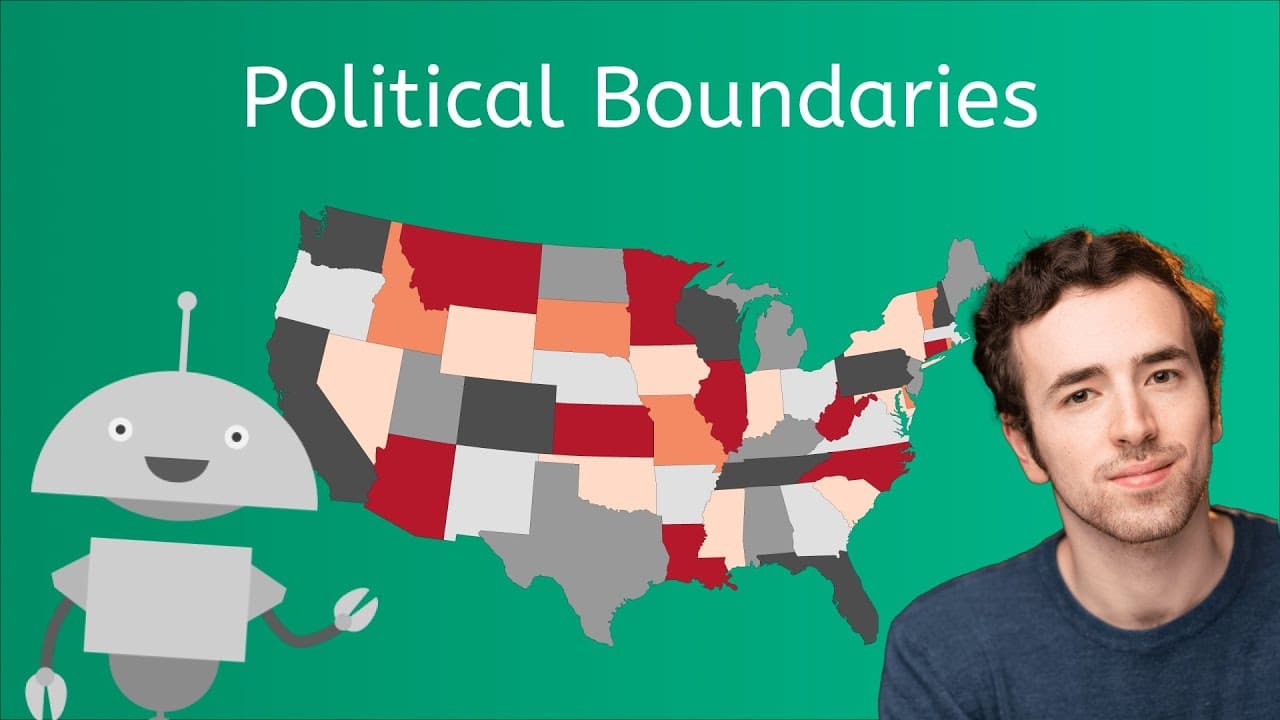
Why We Draw Lines: Understanding Political Boundaries

Why We Draw Lines: Understanding Political Boundaries

This engaging educational video explores the concept of political boundaries, using relatable analogies and historical examples to explain why humans draw lines on maps. Hosted by Justin, the lesson begins with a humorous comparison to siblings sharing a bedroom to introduce the basic idea of territory. It then travels back 4,500 years to ancient Sumer to examine the first recorded border conflict between the cities of Lagash and Umma, illustrating how resource competition and pride drive the creation of boundaries. The video breaks down the three main reasons for boundaries—resources, pride, and legal jurisdiction—using diverse examples ranging from Ancient Egypt to modern-day Russia and Ukraine. It categorizes boundaries into three types: Natural (like the Rio Grande), Geometric (like the straight lines in North Africa), and Cultural (illustrated by tribal groups that transcend political borders). Finally, the lesson clarifies complex political science terminology often confusing for students: the difference between a "Nation" (people), a "State" (political entity), and a "Nation-State," as well as the concept of "Sovereignty." Through clear definitions and real-world examples like the Kurds, the Lakota Sioux, and the dispute in the South China Sea, students gain a comprehensive understanding of political geography.

Miacademy & MiaPrep Learning ChannelMiacademy & MiaPrep Learning Channel

11mins 26s

How Cultures Connect and Change

How Cultures Connect and Change

This educational video provides a comprehensive overview of how cultures evolve and interact through the processes of diffusion, convergence, and divergence. Opening with the historical anecdote of the "Crash at Crush" train collision as a metaphor for cultural encounters, the video breaks down complex anthropological concepts into digestible lessons. It explores the origins of cultural traits in "hearths" and examines the various mechanisms—trade, invasion, colonization, and communication technology—that facilitate the spread of ideas and behaviors across the globe. The content vividly illustrates these abstract concepts with diverse historical and modern examples. Students learn about the Silk Road, the Roman Empire, and Spanish colonization to understand diffusion and assimilation. The video then pivots to modern cultural convergence, using relatable examples like global sports fandom (Super Bowl vs. World Cup) and the international popularity of Anime and Manga. Finally, it addresses cultural divergence through the poignant history of the Maori and Moriori peoples in New Zealand, demonstrating how isolation and environment shape cultural development. This resource is highly valuable for Social Studies and Geography classrooms as it connects historical events to contemporary student interests. By asking direct questions and providing pause points, it encourages active engagement and critical thinking about how students' own lives are influenced by global cultural flows. The video effectively bridges the gap between ancient history and the digital age, helping learners analyze the role of technology in accelerating cultural exchange.

Miacademy & MiaPrep Learning ChannelMiacademy & MiaPrep Learning Channel

11mins 17s

How the Study of History Has Evolved Over Time

How the Study of History Has Evolved Over Time

In the final episode of Crash Course European History, host John Green turns the lens inward to examine the discipline of history itself—a field known as historiography. Rather than recounting specific events, this video explores how the way we tell stories about the past has evolved over centuries. It traces the journey from history as a record of divine intervention and royal genealogy to the modern focus on social movements, everyday life, and global interconnectedness. The video highlights how the questions historians ask have shifted from "what did the King do?" to "how did ordinary people live, eat, and think?" Key themes include the professionalization of history in the 19th century, the role of history in legitimizing nation-states, and the crucial emergence of social history which incorporates the voices of women, the working class, and marginalized groups. It delves into complex concepts like historical revisionism—explaining it not as a distortion, but as a necessary process of updating narratives based on new evidence—and the inescapable nature of bias. The video also challenges traditional definitions of power, moving from top-down authority to a model of participatory power that flows through all members of society. For educators, this video is a powerful tool to teach critical thinking and media literacy. It helps students understand that history is not a static set of facts but an evolving argument constructed by people. It provides a framework for discussing why textbooks change, why different perspectives matter, and how students' own lives are part of the historical fabric. By introducing students to the "history of history," teachers can empower them to question sources, recognize ideology, and appreciate the complexity of the human experience.
CrashCourseCrashCourse

15mins 7s

How Disease Shaped Human History

How Disease Shaped Human History

This episode of Crash Course World History explores the profound impact of disease on human history, challenging the traditional view that history is driven solely by human decisions and actions. Host John Green argues that microorganisms have often been more influential than emperors or generals, shaping the rise and fall of civilizations from ancient river valleys to the modern era. The video covers how the development of agriculture and cities created breeding grounds for epidemics and how trade networks facilitated their spread across continents. Key historical events analyzed include the Plague of Athens, the decline of the Roman Empire, and most notably, the Black Death in medieval Europe. The video details the biological origins of the bubonic plague, its transmission via the Silk Road, and its massive demographic, economic, and religious consequences. It also addresses the "Great Dying" in the Americas following the Columbian Exchange, highlighting the devastating effect of Old World diseases on indigenous populations. For educators, this video serves as an excellent tool for teaching historical causality, human-environment interaction, and the interconnectedness of world regions. It connects biological concepts with historical events, making it suitable for interdisciplinary lessons. The "Thought Bubble" segment provides a clear case study on how demographic shifts (mass death) can lead to economic restructuring (higher wages) and cultural changes, offering tangible examples for students to analyze.

CrashCourseCrashCourse

11mins 37s

Exploring Ancient Israel and the History of the Hebrews

Exploring Ancient Israel and the History of the Hebrews

This educational video provides a comprehensive overview of Ancient Israel and the Levant, exploring how geography and history intertwined to shape the Hebrew civilization. The host uses engaging analogies, such as baking bread, to introduce the concept of the "Levant" as a rising region and a geographical crossroads between Europe, Africa, and Asia. The video details the physical landscape, including the importance of the Jordan River and the Dead Sea, and explains how early inhabitants adapted to the arid climate through innovations like cisterns.

Miacademy & MiaPrep Learning ChannelMiacademy & MiaPrep Learning Channel

10mins 40s

Mapping the World: History, Types, and Essential Skills

Mapping the World: History, Types, and Essential Skills

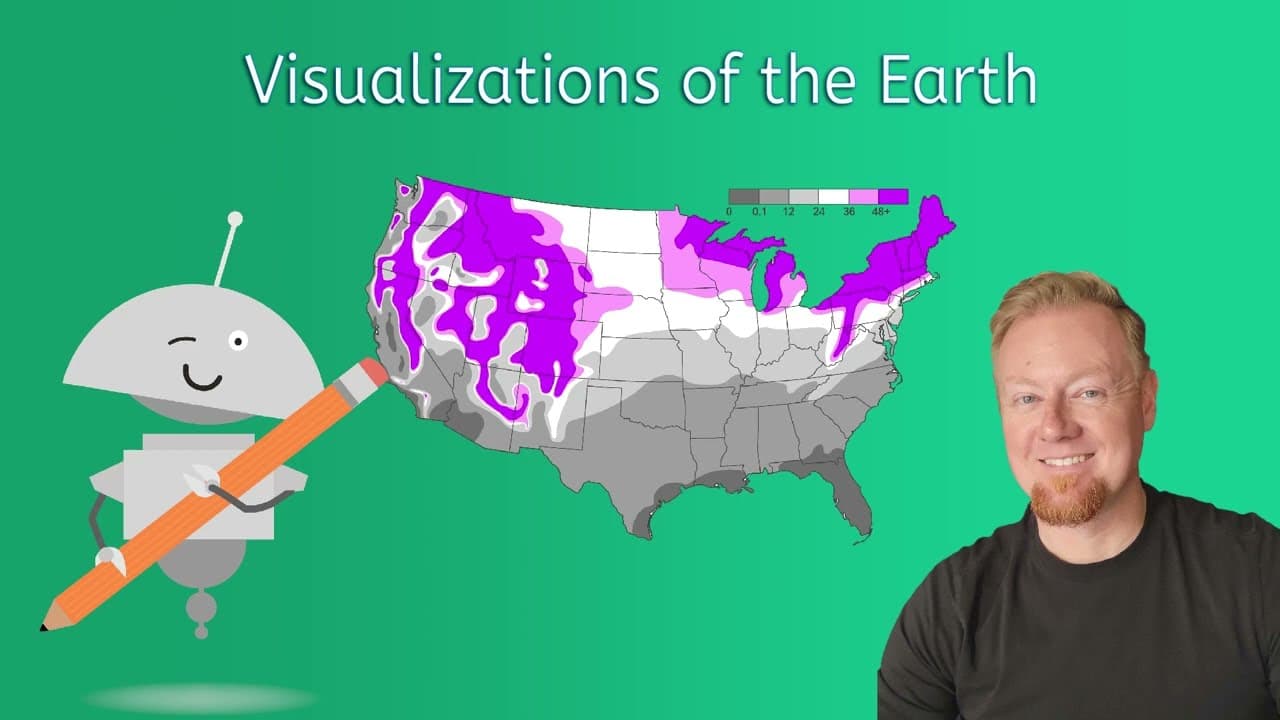
This comprehensive video introduces students to the fundamental concepts of cartography, tracing the evolution of mapmaking from ancient clay tablets to modern digital visualizations. It begins by exploring how ancient civilizations like the Babylonians, Indians, and Chinese first documented their surroundings to communicate spatial information. The narrative moves through significant historical milestones, including the "birth certificate of America" and the artistic "Leo Belgicus" map, while also sharing the fascinating story of "paper towns" used to catch copyright infringers. The video breaks down the technical aspects of geography by categorizing maps into three main types: physical, political, and special purpose. It provides clear definitions and visual examples for each category, helping students distinguish between maps that show natural features versus human-made boundaries. The instruction then shifts to essential map-reading skills, detailing critical components such as the compass rose, map keys (legends), scale ratios, and the global grid system of latitude and longitude. For educators, this resource serves as an excellent anchor for a geography unit. It combines historical context with practical skills, making it versatile for both social studies and STEM applications. Teachers can use the segment on "paper towns" to spark discussions about intellectual property, while the sections on scale and coordinates offer direct mathematical applications. The video effectively bridges the gap between viewing a map as a simple picture and understanding it as a complex data visualization tool.

Miacademy & MiaPrep Learning ChannelMiacademy & MiaPrep Learning Channel

10mins 25s

Materials

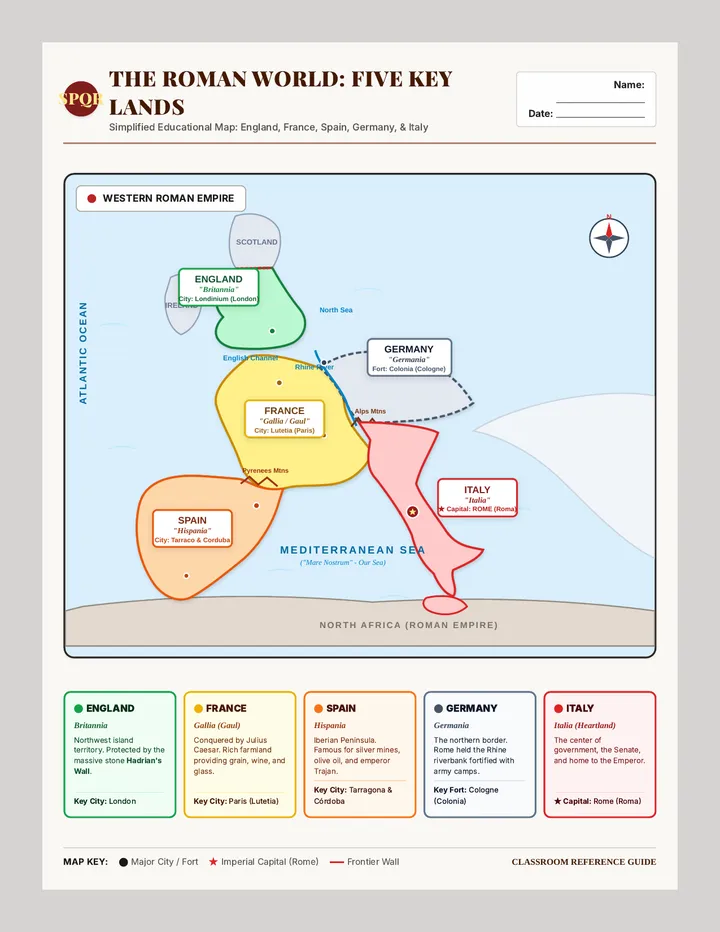
Empire Frontiers Reference Map

Empire Frontiers Reference Map

A simplified, high-clarity single-page reference map of Western Europe under Roman rule. Clearly highlights and labels Spain (Hispania), France (Gallia), England (Britannia), Germany (Germania), and Italy (Italia) with bold color coding, ancient and modern names, key capitals, and a student reference guide.

JT

Julie Teske

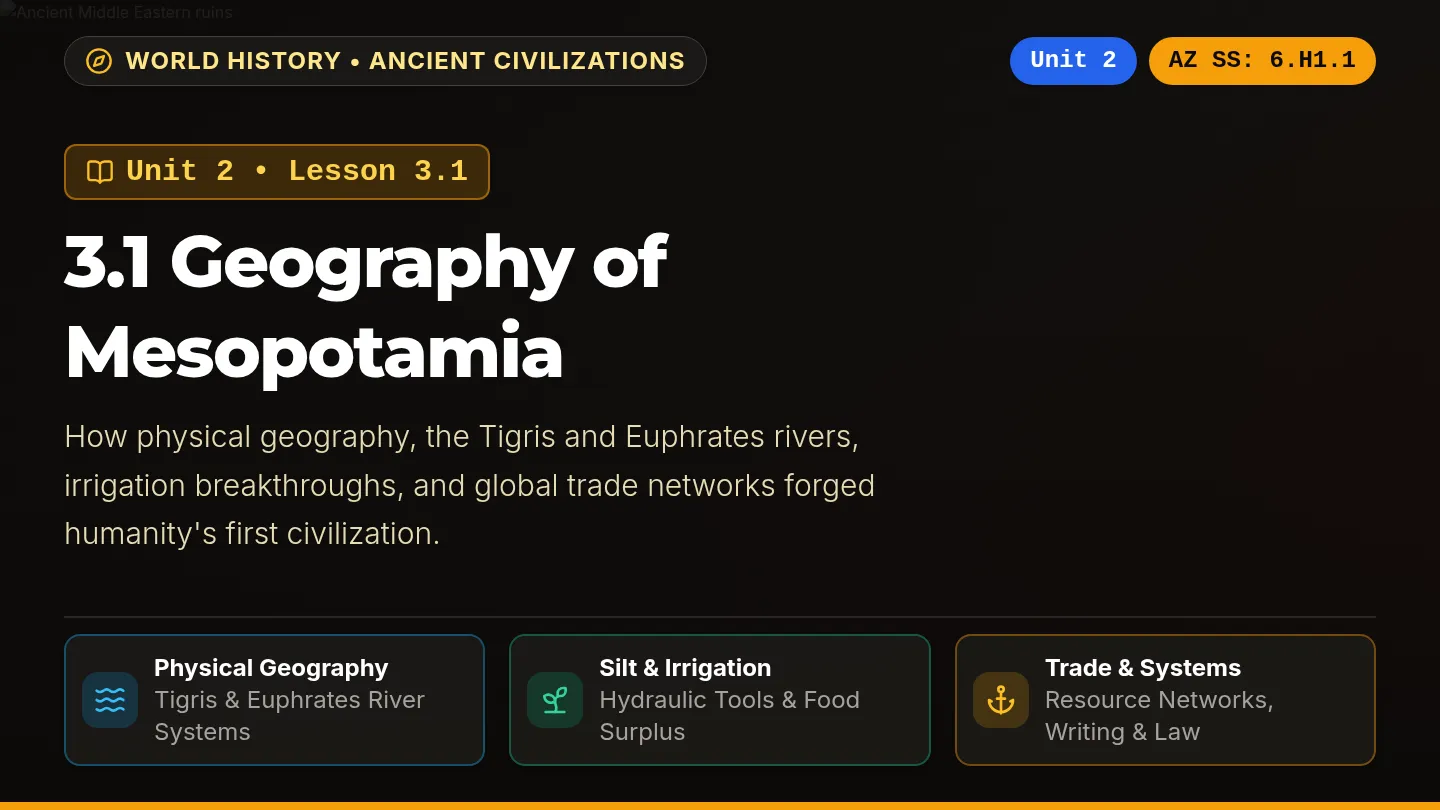
River Cradle Slides

River Cradle Slides

A dark-themed, visually vibrant classroom slide deck labeled Unit 2: Lesson 3.1 Geography of Mesopotamia, aligned with Arizona History and Social Science standards on every slide, featuring rich photography, high-contrast color-coded cards, and interactive review prompts.

SZ

Sandra Zoerhoff

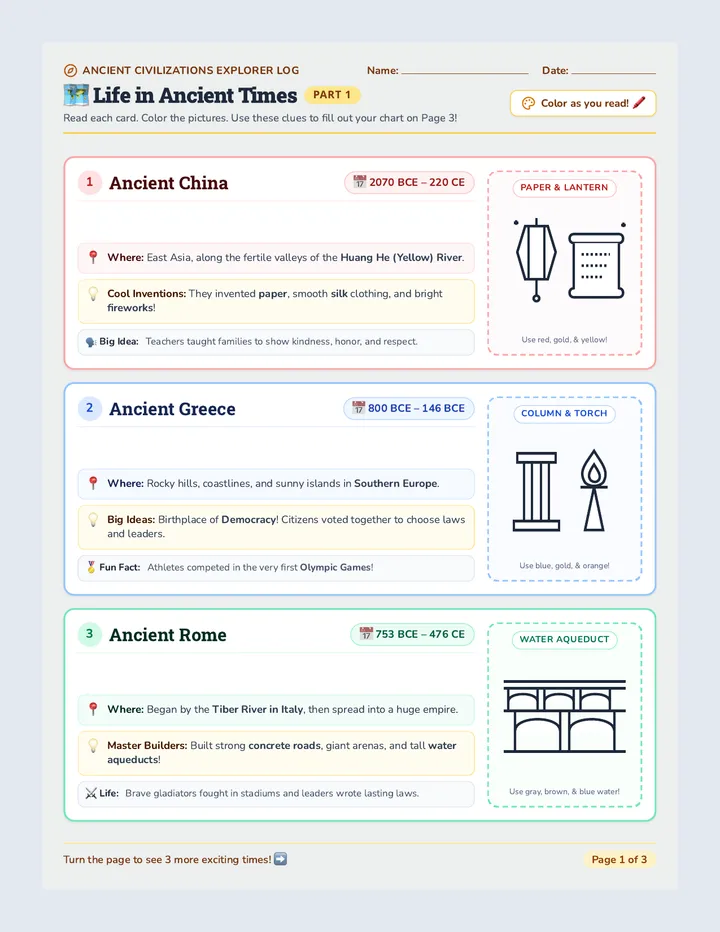
Ancient World Explorer Graphic Organizer

Ancient World Explorer Graphic Organizer

An accessible, highly visual 3-page ancient civilizations comparison activity designed for a 7th grade student reading at a 2nd grade level. Revised to eliminate awkward vertical gaps on the reading pages by expanding the cards with larger text, kid-friendly vocabulary callouts, and spacious coloring illustrations.

KC

Kasie Costopulos

Pocket Vocab Lab Activity Templates

Pocket Vocab Lab Activity Templates

A printable horizontal mini-composition notebook interactive vocabulary toolkit for Ohio 6th Grade Social Studies. Features wide horizontal inserts for dual-coding icon vaults, relational analogy engines, geographic semantic webs, and historical context decoders with cut lines and glue tabs.

MG

Mary Grose

Modern World Fall Inquiry Benchmark

Modern World Fall Inquiry Benchmark

A seven-slide model inquiry presentation demonstrating an exemplary project response for the Fall Inquiry Benchmark, featuring the user's provided composite image of Plato, Socrates, and Aristotle as the sole image on the mentorship connection slide (Slide 3).

KT

Kyle Trocolla

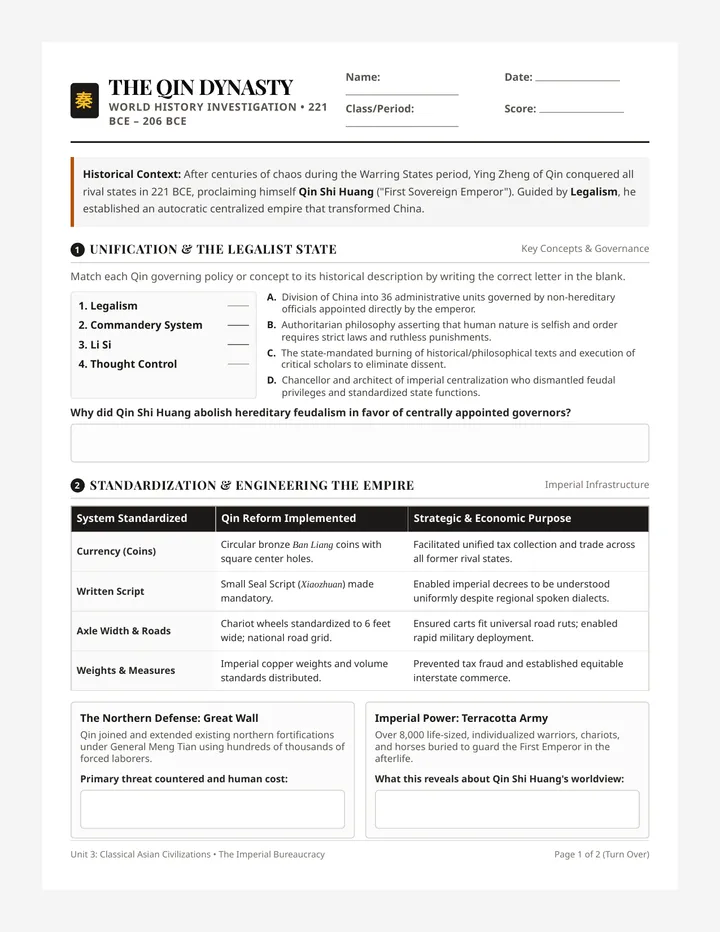
Qin Dynasty Exploration Worksheet

Qin Dynasty Exploration Worksheet

A rigorous two-page printable student worksheet on the Qin Dynasty covering Qin Shi Huang's unification, Legalism, monumental projects, standardizations, and the dynasty's collapse and lasting legacy.

AE

Alexander Eichhorn

Sequences

Master Organizer Slides

Think Like Aristotle

A four-part series for middle schoolers on Aristotelian logic and philosophy, focusing on categorization, reasoning, and ethics, with a historical tie-in to Alexander the Great.

DB

Danielle Burham

21
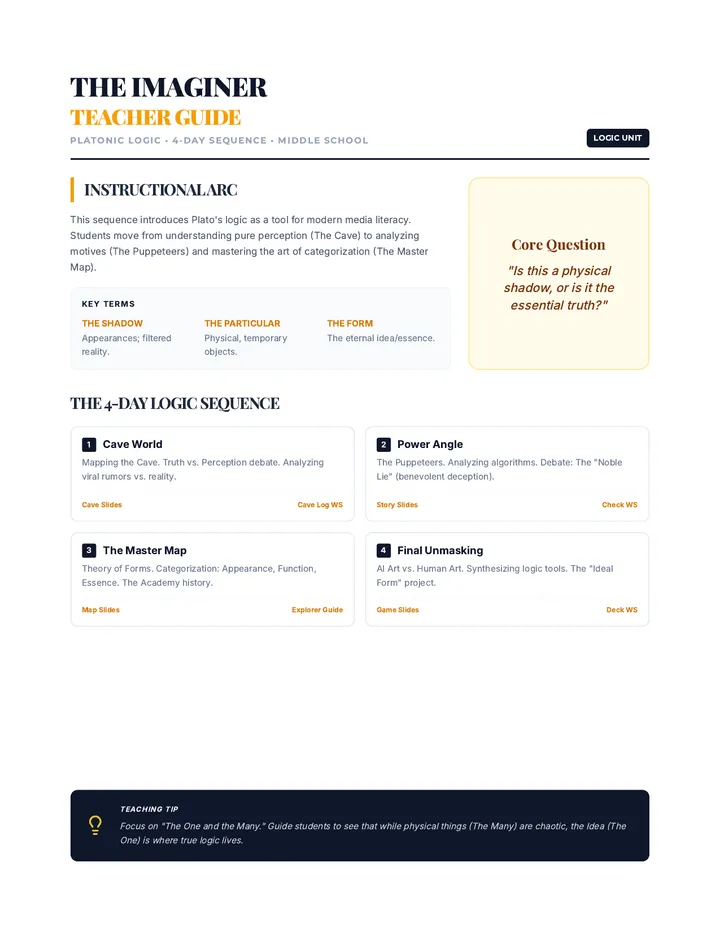
The Imaginer Teacher Guide

The Imaginer Plato Logic

A four-day introductory logic and philosophy sequence for middle schoolers focusing on Plato's 'Thinking Style.' Students explore the Allegory of the Cave, perception vs. reality, and the Theory of Forms through the lens of 'The Imaginer,' culminating in a visual analysis game.

DB

Danielle Burham

12
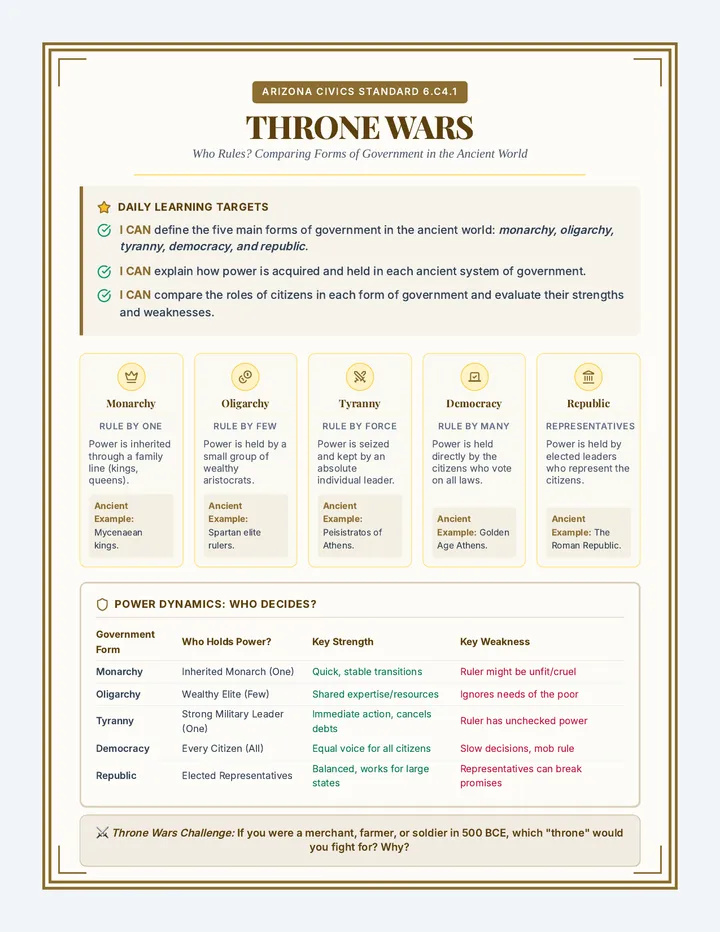
Throne Wars Anchor Chart

Rise of Civilization

A comprehensive 6th-grade social studies unit exploring the trajectory of human history, from nomadic hunter-gatherers and the cognitive evolution of early humans, to the agricultural revolution, and finally the development of structured ancient governments.

SZ

Sandy Zoerhoff

10
Spartan Stand Teacher Guide

Spartan Stand

A two-day exploration of the Battle of Thermopylae, focusing on strategic geography, historical context, and the concept of valor through evidence-based analysis and targeted vocabulary acquisition.

S

scortese

6
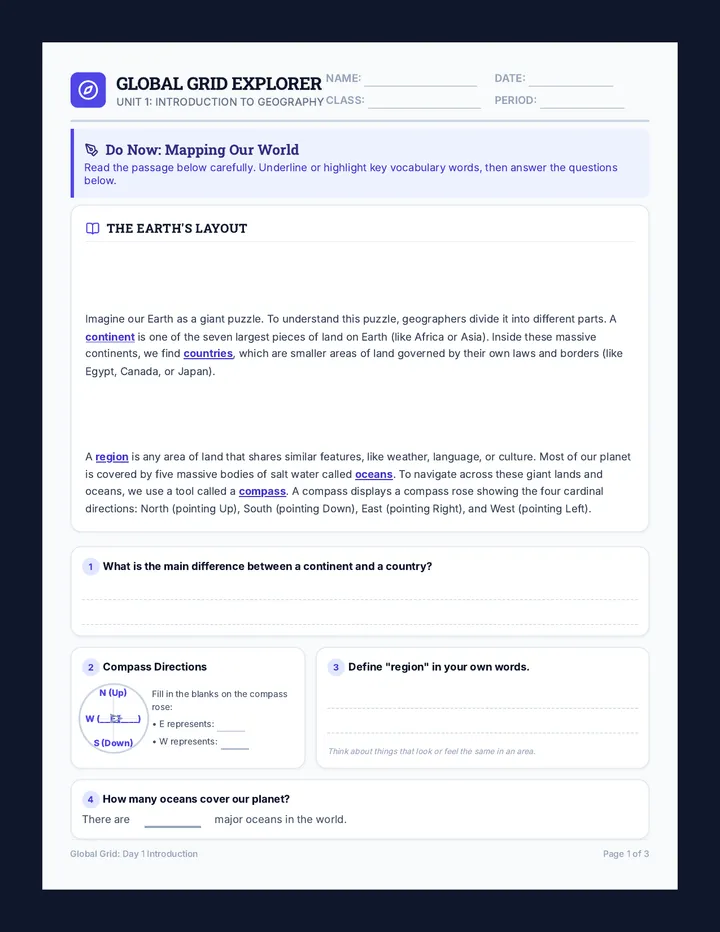
Global Grid Student Handbook

Power of Position

A 4-day introductory world history sequence exploring how geographic location, natural barriers, and famous trade routes shaped the rise, wealth, and power of global empires.

AG

Amina Gueye

14
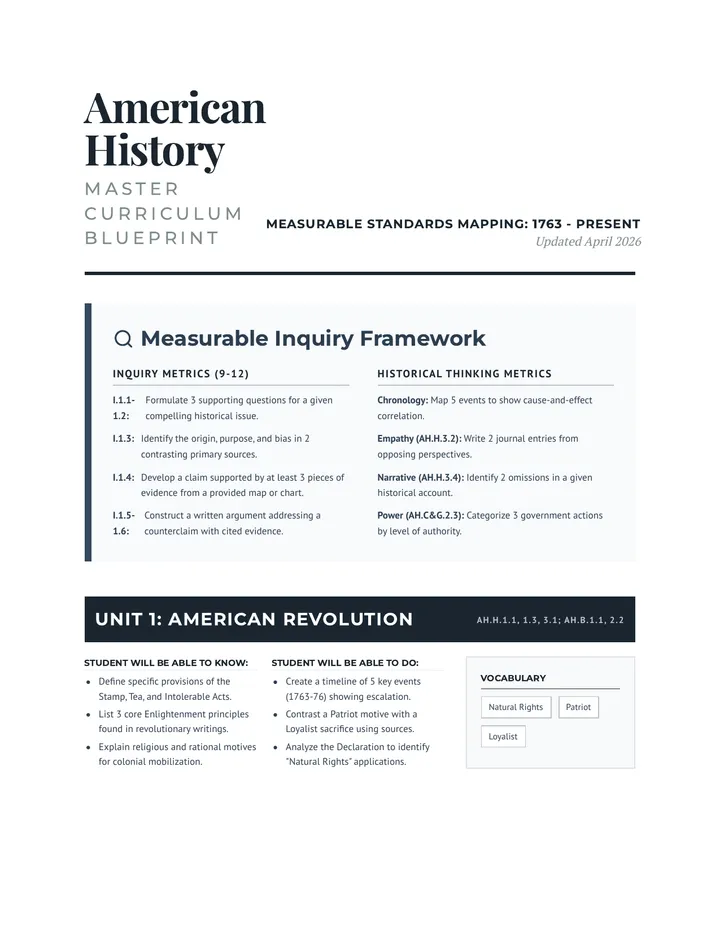
Curriculum Blueprint Document v2

History Horizon Sequence

A comprehensive high school curriculum plan for American History, covering 13 units from the American Revolution to the modern era, aligned with North Carolina Social Studies standards.

AK

Amity Kea

21

Lessons

Explorer Epochs Wall Chart

Early World Explorers

A comprehensive lesson on early world exploration from 300 BCE to 1500 CE, focusing on the geographical, cultural, and religious impacts of key explorers across different continents.

J

jcasey

14
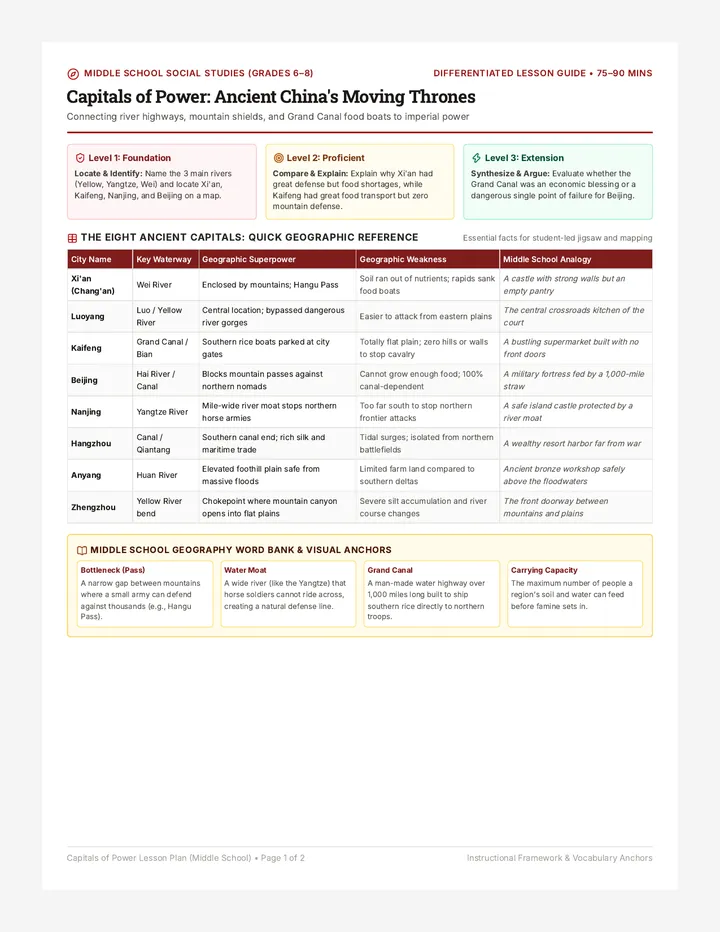
Capitals of Power Lesson Plan

Capitals of Power

An immersive geography and history investigation exploring China's eight ancient capitals, examining how river systems, mountain barriers, and agricultural heartlands dictated imperial power centers over four millennia. Students trace spatial shifts across China's major geographic zones through interactive mapping, comparative trade-off analysis, and strategic case studies.

DB

Danielle Burham

6
Royal Decree Assessment Upgrade

Cradle of Civilization

A comprehensive lesson on the rise of Mesopotamian civilization, covering geography, irrigation, the development of city-states, writing systems, and the formation of the world's first empires.

J

jedriend

9
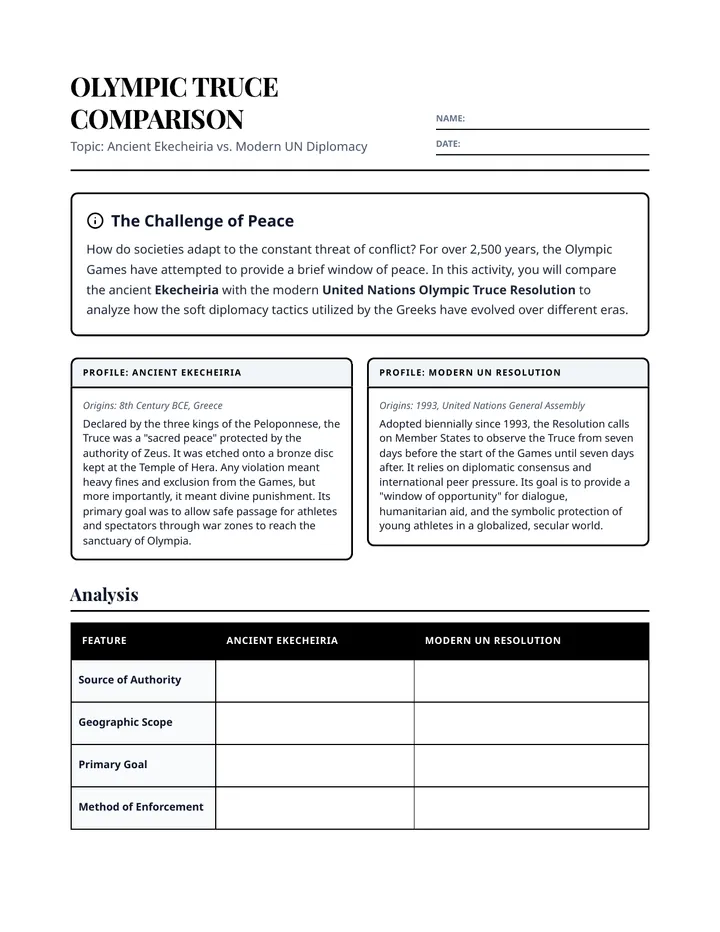
Olympic Truce Comparison Final Worksheet Final Final Expanded

Olympic Truce Diplomacy

A high school social studies lesson exploring the origins, evolution, and effectiveness of the Olympic Truce from ancient Greece to the modern United Nations era. Students analyze how this institution addresses societal and political challenges through international cooperation.

KK

Kathleen Kelsh

6
Time Cartographers Slides

Time Cartographers

An 80-minute sixth-grade lesson on understanding, building, and interpreting historical timelines, teaching BCE/CE, BC/AD, Circa, and Chronological Order, focusing on Mesopotamia, Egypt, the Indus Valley, and global history.

AA

Adam Amster

4
Agora Adventure Slides

Agora Adventure

An introductory lesson on the economy of Ancient Greece, focusing on maritime trade, agriculture, specialization, and the use of coinage through a simulated marketplace experience.

LB

Laurel Bartos

7