Lenny.com
Explore
Create
ActivitiesNewMathEnglish Language ArtsScience & EngineeringSocial StudiesGlobal LanguagesHealth & Physical EducationSpecial EducationCounseling & Life SkillsArts & CreativityESL
Lenny.com
Lenny.com
Explore
Create
ActivitiesNewMathEnglish Language ArtsScience & EngineeringSocial StudiesGlobal LanguagesHealth & Physical EducationSpecial EducationCounseling & Life SkillsArts & CreativityESL
Lenny.com
Social StudiesSocial Studies PracticesLocation WordsMapsOrder EventsChronology and CausationEvaluating SourcesHistorical ThinkingGeography, Humans, & the EnvironmentAmerican Symbols and LandmarksCitiesStatesState CapitalsRegions of the United StatesGeographic SkillsPhysical GeographyHuman GeographyRegional GeographyGeography of AfricaGeography of AsiaGeography of EuropeGeography of OceaniaGeography of the AmericasSociety and Environment of EuropeSociety and Environment of AsiaSociety and Environment of The AmericasSociety and Environment of the Middle EastSociety and Environment of AfricaHistoryPrehistoryComparing Ancient River CivilizationsAncient MesopotamiaAncient Egypt and KushAncient South AsiaEarly ChinaGreeceRome and the Byzantine EmpireAncient World HistoryNative Peoples of North AmericaNative Peoples of Mesoamerica and South AmericaAfrican EmpiresMedieval AsiaMedieval EuropeThe Silk RoadMedieval HistoryIslamic EmpiresWorld ReligionsRenaissance PeriodAge of ExplorationThe Thirteen ColoniesThe American RevolutionUS History Early RepublicFounding of the United StatesUS History AntebellumUS Civil WarReconstruction PeriodThe Gilded AgeUS ImperialismWorld ImperialismWorld War IUS History 1920sGreat DepressionWorld War IIThe Cold WarUS History 1950-60sUS History 1960s-70sWorld History 20th CenturyContemporary US HistoryContemporary World HistoryHolidaysCivics and GovernmentCitizenshipGovernment FoundationsThe ConstitutionUS ConstitutionExecutive BranchLegislative BranchJudicial BranchState and LocalPolitical ParticipationPublic PolicyPolitical SystemsPower and AuthoritySocial MovementsDefining DevianceTheories of DevianceCrime and Criminal JusticeEconomicsBasic Economic PrinciplesSupply and DemandWhat is MoneyEconomic FundamentalsMicroeconomicsMacroeconomicsBanking and FinanceEconomic SystemsGlobal EconomicsCorporations and PowerThe Changing WorkplaceUnemployment and LaborClass and InequalitySocial MobilityGlobal InequalityPsychologyHistory of PsychologyPsychology as a ScienceBrain and Nervous SystemNeuroscience and BehaviorGenetics and BehaviorSleep and ConsciousnessSensory ProcessesPerceptual OrganizationClassical ConditioningOperant ConditioningObservational LearningCognitive LearningMemory ProcessesThinking and Problem SolvingLanguage and CognitionTheories of MotivationStress and CopingPrenatal and Infant DevelopmentChildhood DevelopmentAdolescent DevelopmentAdulthood and AgingSelf and IdentitySocial CognitionSocial InfluenceAttraction and RelationshipsGroup BehaviorPrejudice and DiscriminationAnxiety and Mood DisordersClinical PsychologyForensic PsychologyPhilosophy & EthicsIntroduction to PhilosophyMajor Philosophers & IdeasMind and Body ProblemFree Will vs DeterminismEthics & MoralityReligion & PhilosophyPolitical Philosophy
Lenny.com

Solutions

Lenny for EducatorsLenny for SchoolsLenny for Districts

Product

ExploreSign inCreateSupportAbout

Resources

Getting startedMTSS Acceleration Program

Newsletters

School Funding Newsletter

© 2026 Lenny Learning Inc.

TermsPrivacyAccessibility
LinkedInInstagramX
Lenny

Crime and Criminal Justice

Constitutional foundations of the legal system, law enforcement procedures, and judicial proceedings. Addresses due process, categories of criminal offenses, and the functions of the correctional system.

Videos

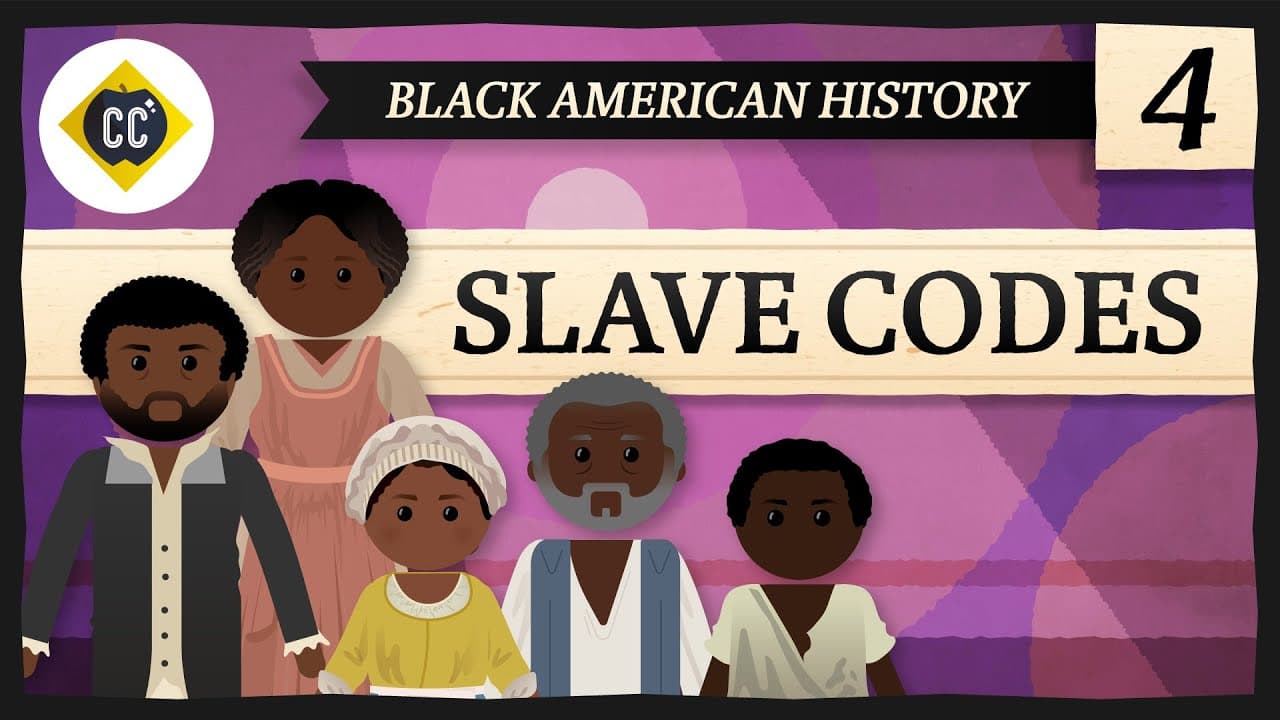
How Slave Codes Enforced Racial Hierarchy in Colonial America

How Slave Codes Enforced Racial Hierarchy in Colonial America

In this episode of Crash Course Black American History, Clint Smith explores the origins and impact of "Slave Codes"—the set of laws passed in the American colonies to legally distinct Black people (both enslaved and free) from white colonists and to cement a racial hierarchy. The video details how these laws were not merely about labor management but were designed to protect the economic "investment" of enslavers by stripping Black people of basic rights, limiting their movement, and criminalizing their independence. The video examines specific historical statutes from colonies like Virginia, Maryland, South Carolina, and New York, illustrating how the legal system evolved to make slavery hereditary and permanent. Key concepts such as "partus sequitur ventrem" (the condition of the child follows the mother) are explained to show how the law was manipulated to ensure a perpetual labor force. The narrative highlights the hypocrisy of colonists demanding liberty from Britain while simultaneously constructing a legal framework to deny liberty to Black Americans. For educators, this video serves as a crucial resource for teaching the systemic nature of racism and slavery in the United States. It moves beyond the view of slavery as just a labor system and reveals it as a legal and social structure designed to oppress. It is an excellent tool for High School US History and Civics classrooms to spark discussions about how laws can be used to enforce inequality and how the legacy of these colonial codes influences modern legal and social disparities.

CrashCourseCrashCourse

8mins 30s

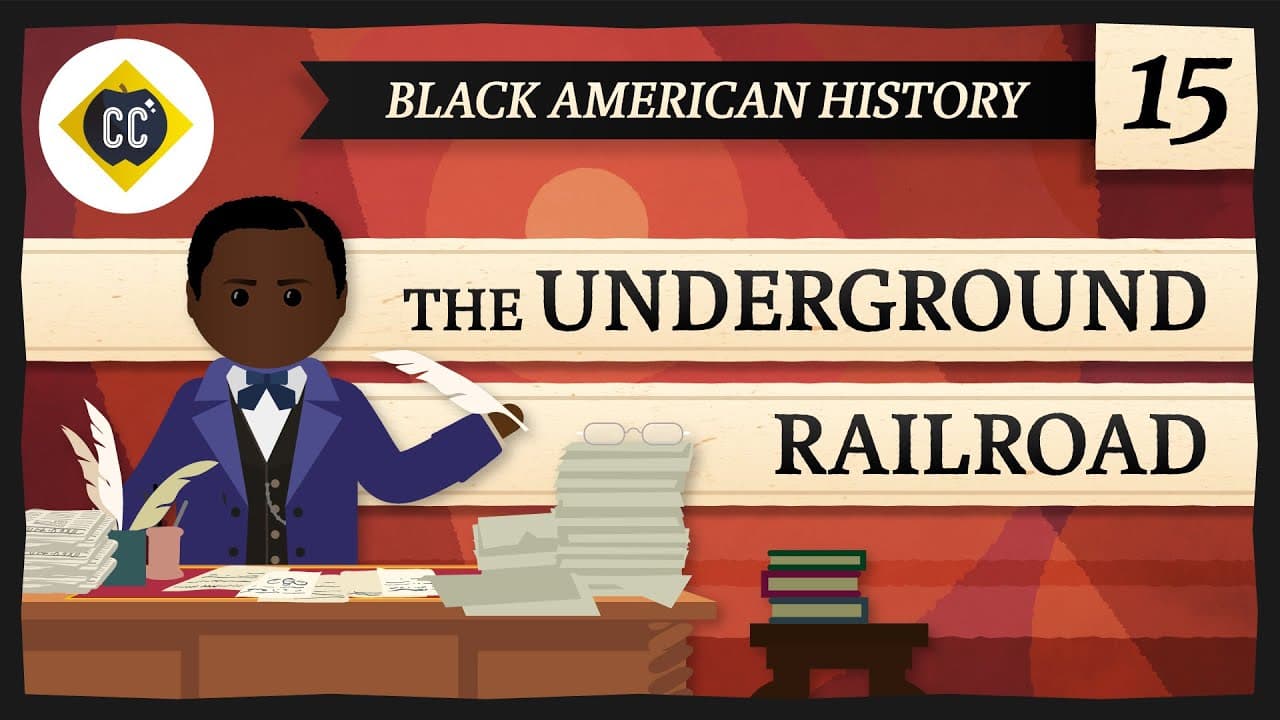
The Real Story of the Underground Railroad: Facts vs. Fiction

The Real Story of the Underground Railroad: Facts vs. Fiction

This educational video from Crash Course Black American History provides a nuanced and historically accurate examination of the Underground Railroad, dismantling common myths while highlighting the true heroism involved. Host Clint Smith explains that the railroad was not a literal train system nor a centralized organization, but rather a loose network of individuals—primarily Black abolitionists—who risked their lives to help enslaved people find freedom. The video profiles key figures like William Still, the "Father of the Underground Railroad," and examines the specific terminology used within the network, such as conductors, stations, and station masters. The content explores critical themes regarding the agency of enslaved people, correcting the historical narrative that often centers benevolent white allies. It delves into the geography of escape, revealing that freedom seekers didn't just head North to Canada, but also South to Mexico and the Caribbean. The video also tackles complex topics like the Fugitive Slave Law of 1850, the pseudoscience of "drapetomania," and the statistical reality that while the Underground Railroad was symbolically powerful, only a small fraction of the enslaved population successfully escaped, which underscores the brutality of the system rather than a lack of desire for freedom. For educators, this video is an invaluable tool for teaching critical historical thinking and source analysis. It provides opportunities to discuss how history is recorded and remembered, contrasting popular folklore with documented evidence like William Still's records. It allows teachers to facilitate deep discussions about resistance, the legal structures protecting slavery, and the diverse geography of freedom in the Americas. The video is particularly useful for moving students beyond a surface-level understanding of the Underground Railroad to a more complex appreciation of Black resistance strategies.

CrashCourseCrashCourse

12mins 45s

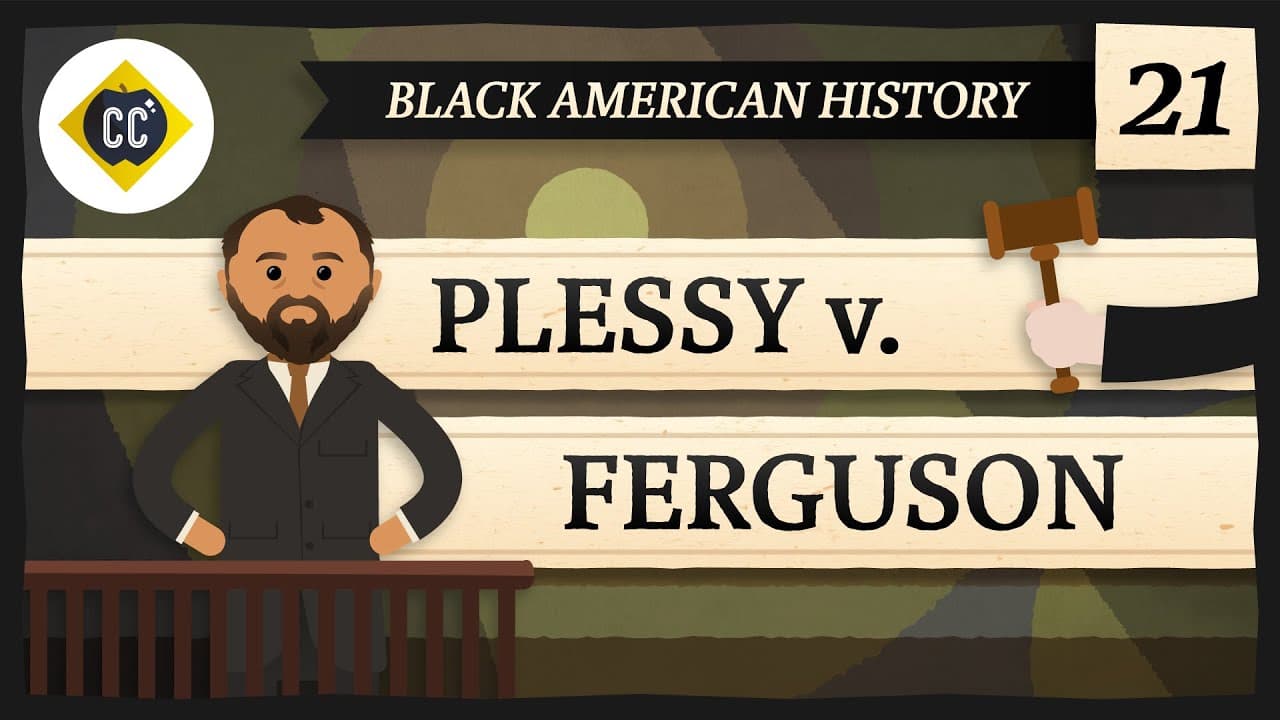
How Plessy v. Ferguson Legalized Segregation

How Plessy v. Ferguson Legalized Segregation

This educational video from Crash Course Black American History provides a comprehensive analysis of the landmark 1896 Supreme Court case, Plessy v. Ferguson. Hosted by Clint Smith, the video details the story of Homer Plessy, a mixed-race man from New Orleans who participated in a carefully orchestrated act of civil disobedience to challenge the Separate Car Act of 1890. It explains the legal arguments presented, the Supreme Court's 7-1 ruling that established the "separate but equal" doctrine, and the sole dissenting opinion that argued the Constitution should be colorblind. The video explores complex themes including the social construction of race, the "one-drop rule," and the strategic nature of civil rights activism. It highlights how the Committee of Citizens planned Plessy's arrest as a test case, debunking the myth that such events were random acts of defiance. Furthermore, it examines the devastating long-term impact of the ruling, which legalized racial segregation and ushered in the Jim Crow era that oppressed Black Americans for nearly seventy years. For educators, this resource is an invaluable tool for teaching U.S. History, Civics, and Government. It moves beyond a surface-level timeline of events to explore the mechanics of the judicial system and how laws can be used to both fight and perpetuate oppression. The video provides clear definitions of constitutional amendments and offers a nuanced look at the specific legal language used to justify segregation, making it an excellent anchor for discussions on systemic racism, legal precedent, and the history of civil rights in America.

CrashCourseCrashCourse

10mins 36s

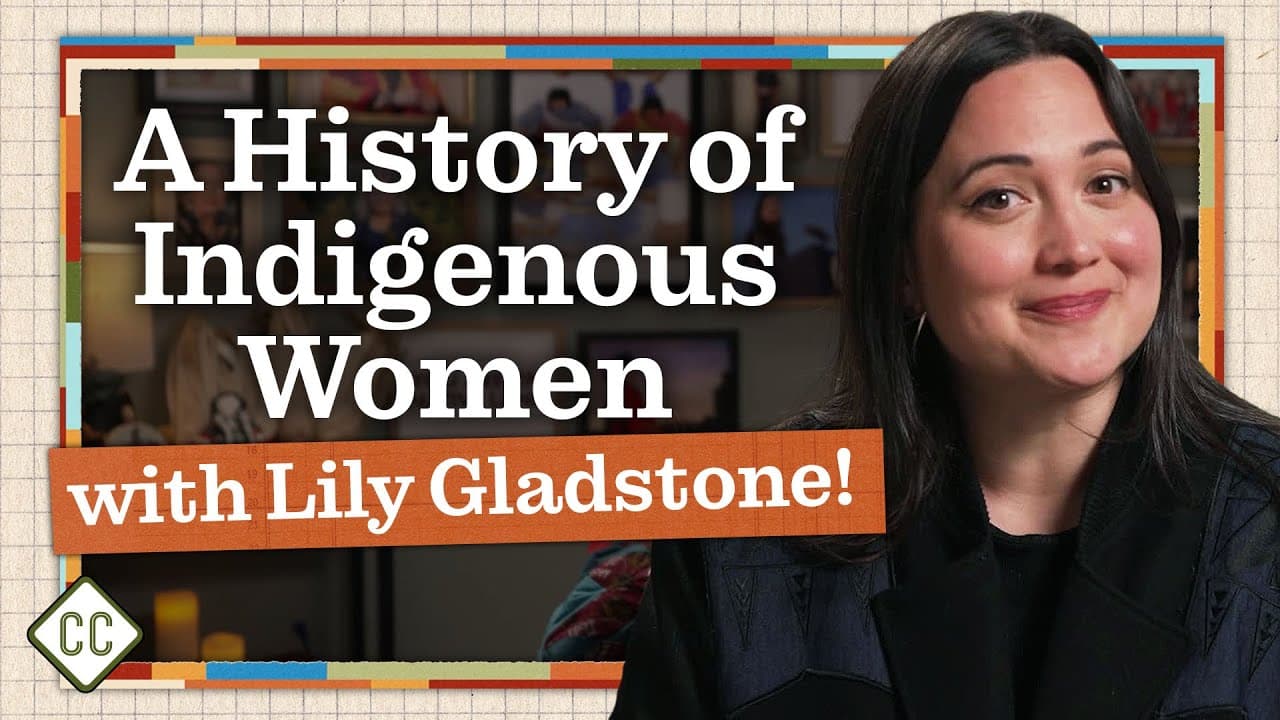
The Power, Resilience, and History of Native American Women

The Power, Resilience, and History of Native American Women

Hosted by Lily Gladstone, this episode of Crash Course Native American History explores the pivotal and diverse roles of Native women, Femmes, and Two-Spirit people from pre-contact times to the present day. It challenges the monolithic view of Native gender roles by highlighting the existence of matriarchal and matrilineal societies, such as the Diné (Navajo), where women hold significant economic and decision-making power. The video details historical figures like the warrior Buffalo Calf Road Woman and the diplomat Jikonsaseh, who helped found the Haudenosaunee Confederacy, illustrating that Native women have always served as leaders, healers, and protectors of their nations. The video also tackles the dark history of colonization and its specific targeting of Indigenous women to destabilize tribal societies. It addresses difficult topics including the imposition of European patriarchal values, the forced sterilization of thousands of Native women in the 1970s, and the ongoing crisis of Missing and Murdered Indigenous Women (MMIW). The narrative explains how settler colonialism disrupted traditional gender balances and how systemic failures in law enforcement continue to impact Native communities today. Despite these challenges, the video emphasizes resilience and modern activism. It profiles influential leaders like Elouise Cobell, who successfully sued the U.S. government for billions in mismanagement of funds, and Deb Haaland, the first Native American cabinet secretary. For the classroom, this resource is invaluable for teaching about gender studies, civil rights, and the complex legal and social history of Native Americans. It provides students with a nuanced understanding of how historical trauma and contemporary triumph coexist in Indigenous communities.
CrashCourseCrashCourse

13mins 42s

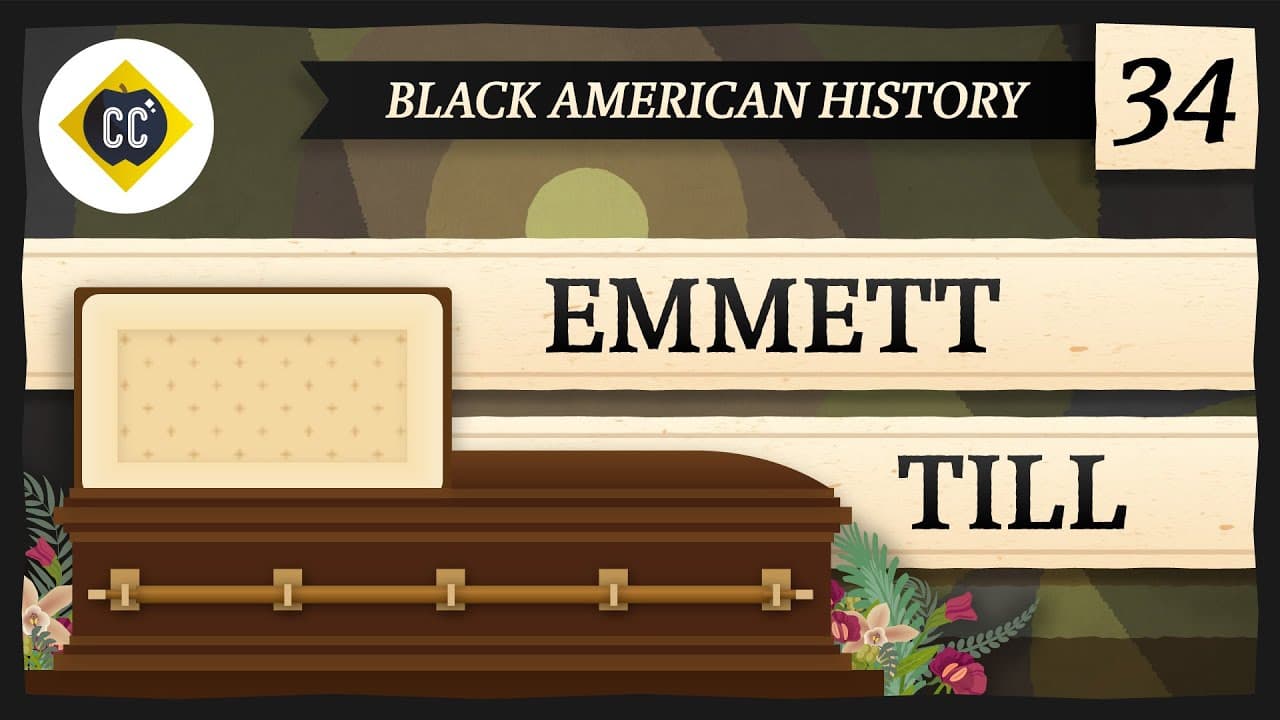
The Murder of Emmett Till: A Catalyst for the Civil Rights Movement

The Murder of Emmett Till: A Catalyst for the Civil Rights Movement

This episode of Crash Course Black American History, hosted by Clint Smith, examines the tragic 1955 murder of 14-year-old Emmett Till in Mississippi and its profound impact on the Civil Rights Movement. The video details the events leading up to his kidnapping by Roy Bryant and J.W. Milam, the brutal murder, and the subsequent trial that resulted in a hasty acquittal by an all-white jury. Central to the narrative is the courageous decision by Emmett's mother, Mamie Till, to hold an open-casket funeral, allowing the world to witness the brutality of white supremacy through the publication of photographs in Jet magazine. The video explores key themes such as the systemic failure of the justice system in the Jim Crow South, the vital role of Black-owned media (like the Chicago Defender and Jet) in exposing racial terror, and the concept of double jeopardy. It highlights how domestic terrorism was used to enforce social hierarchy and how this specific event galvanized Black Americans to mobilize for civil rights. The host also connects historical events to the present day, using a personal anecdote about visiting the National Museum of African American History and Culture to illustrate how recent this history truly is. For educators, this video serves as a powerful tool to teach about the catalyst of the modern Civil Rights Movement and the realities of life under Jim Crow. It provides a nuanced look at how legal structures protected perpetrators of racial violence and how media was used as a form of resistance. The content allows for deep discussions on the ethics of photojournalism, the limitations of the legal system, and the intergenerational trauma of racism, making it highly relevant for American History, Civics, and Social Justice curricula.

CrashCourseCrashCourse

11mins 45s

What Our Taxes Pay For: A Guide to Government Services

What Our Taxes Pay For: A Guide to Government Services

This educational video provides a comprehensive overview of how tax dollars are utilized across the three levels of government in the United States: federal, state, and local. Building upon the concept of federalism, the narrator breaks down specific services and programs funded by taxes, illustrating the tangible benefits citizens receive in exchange for their contributions. The video systematically categorizes expenditures, making the complex flow of public funds understandable for students. Key themes include the distinction between federal responsibilities (such as national defense, Social Security, and interstate highways), state responsibilities (primarily education and state law enforcement), and local responsibilities (including emergency services, libraries, and city maintenance). The video emphasizes that while taxes are often viewed negatively, they are the necessary engine behind essential services that protect and support the population. For educators, this resource serves as an excellent tool for Civics and Social Studies units on government structure and economics. It helps students connect abstract concepts of taxation to the real-world infrastructure and safety networks they encounter daily. The clear segmentation allows teachers to focus on specific levels of government or use the entire video to compare and contrast the roles of different jurisdictions.

Miacademy & MiaPrep Learning ChannelMiacademy & MiaPrep Learning Channel

7mins 37s

Materials

Mesopotamia City States Slides

Mesopotamia City States Slides

An engaging, academically rigorous 11-slide presentation on Mesopotamian city-states for 9th grade World History, covering geography, irrigation breakthroughs, urban structure, water rights, the shift from priests to warlord kings, empires, cultural diffusion, and Hammurabi's Code.

E

ebakke

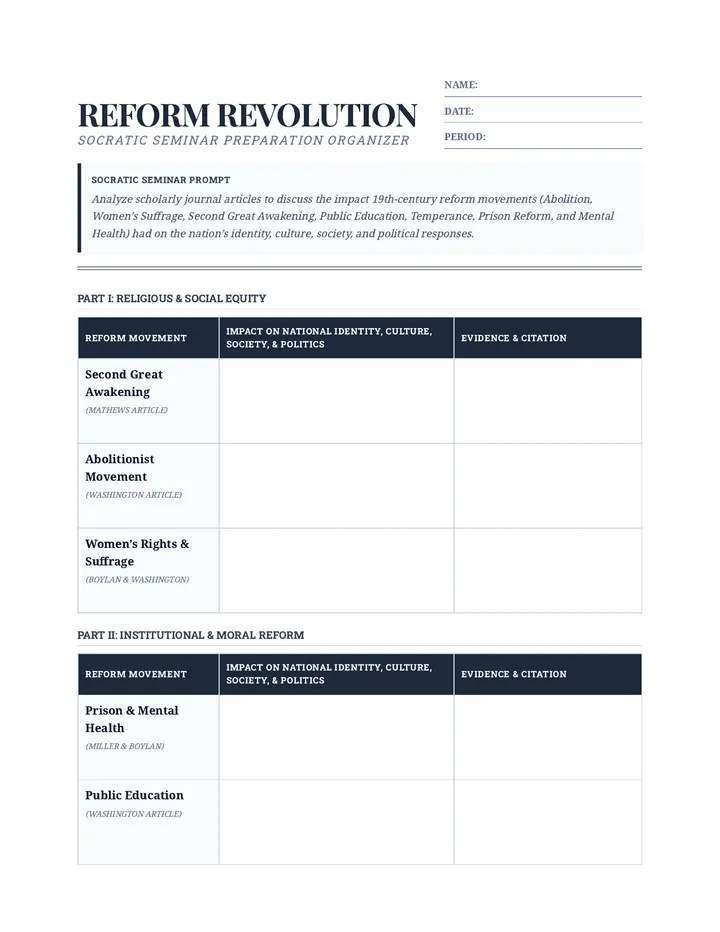
Reform Revolution Organizer

Reform Revolution Organizer

A note-taking graphic organizer for a Socratic Seminar on 19th-century social reforms. It includes dedicated sections for major movements like the Second Great Awakening, Abolition, and Prison Reform, with space for students to cite evidence from scholarly articles and synthesize their findings for discussion. Updated column headers to include culture and society impacts.

JG

Joshua Griffith

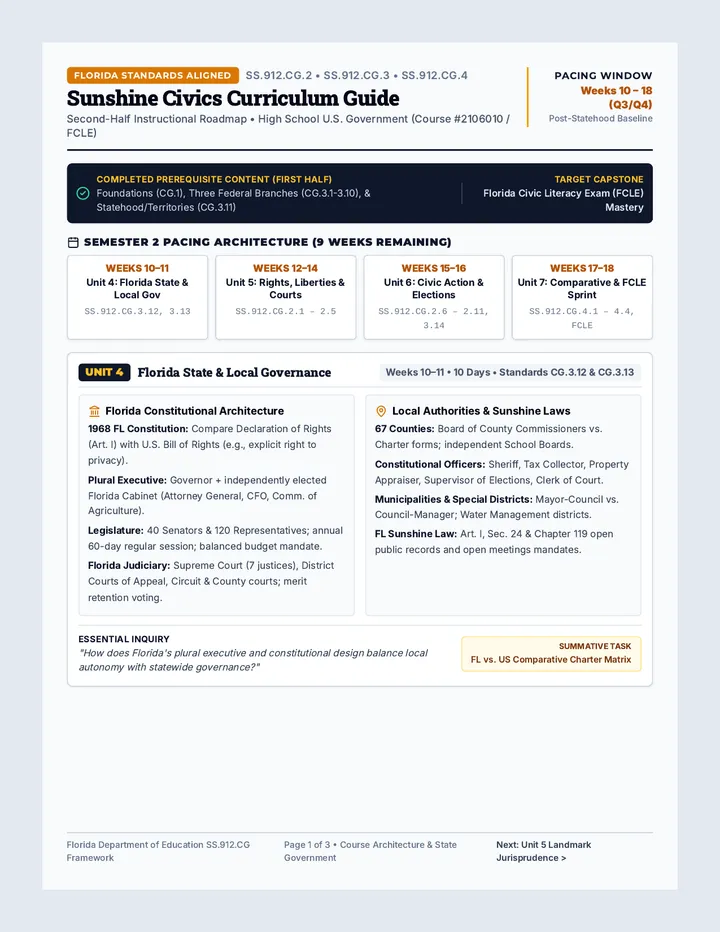
Sunshine Civics Curriculum Guide

Sunshine Civics Curriculum Guide

A comprehensive second-half curriculum map and pacing guide aligned with Florida NGSSS standards SS.912.CG for High School U.S. Government. Covers post-statehood topics including Florida state and local government, landmark Supreme Court jurisprudence, civic participation, comparative political systems, and Florida Civic Literacy Exam preparation.

FR

Frank Rodela

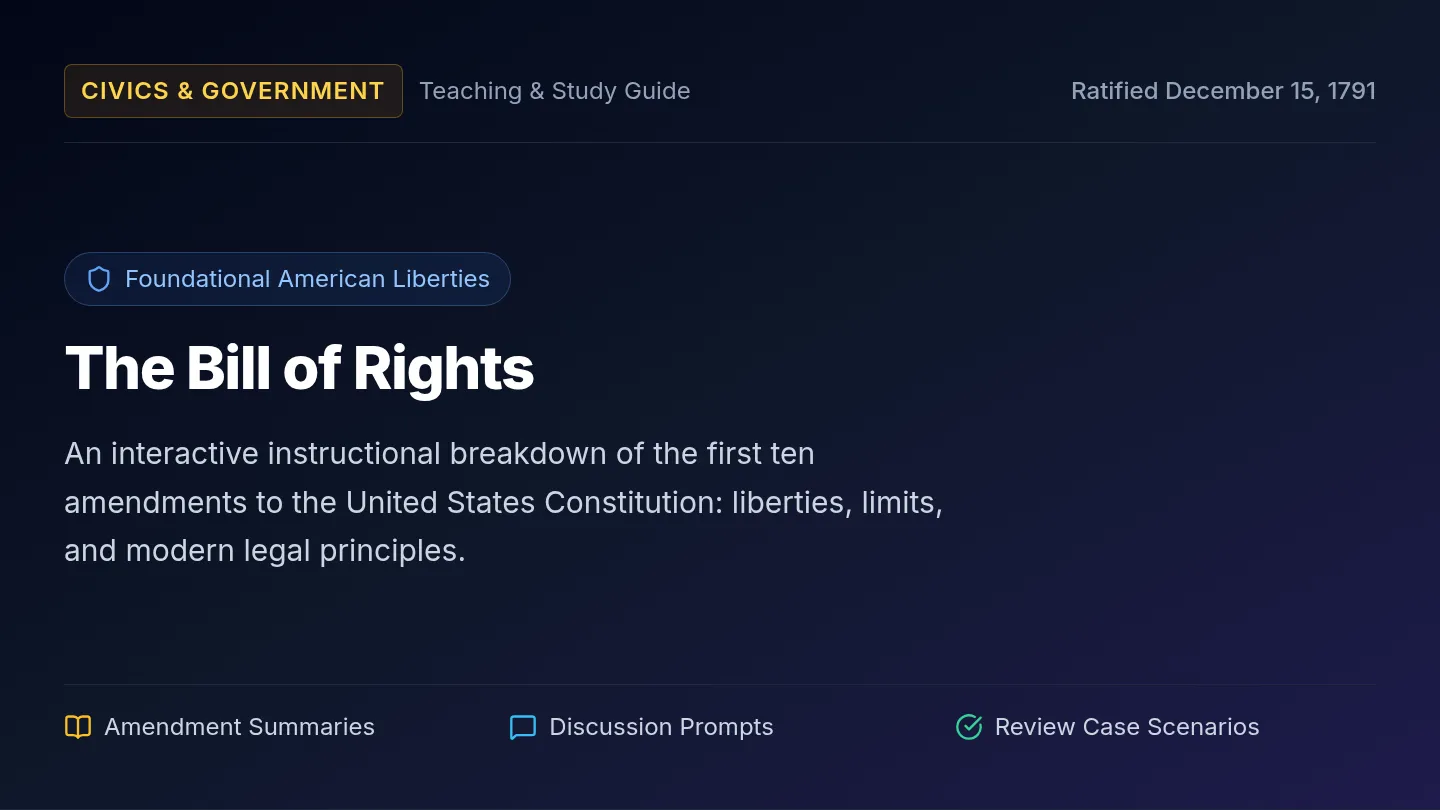
Bill of Rights Slides

Bill of Rights Slides

A comprehensive 10-slide teaching and study guide covering the first ten amendments with historical context, legal principles, classroom discussion questions, and application scenarios.

M

morgan.mcgough

Cold War Dossier Flashcards

Cold War Dossier Flashcards

A set of 20 printable two-sided flashcards covering key Cold War terms and concepts for the US History STAAR test. The cards feature a 'confidential dossier' aesthetic and are formatted for double-sided printing with terms on the front and detailed historical significance on the back.

JS

Jennifer Schoen

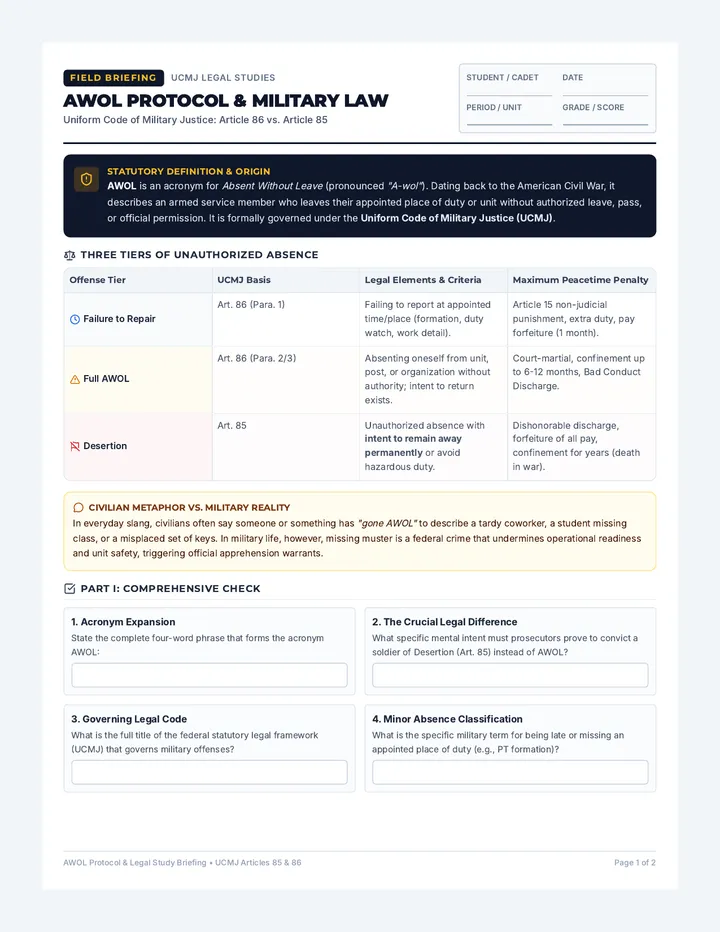
AWOL Protocol Worksheet

AWOL Protocol Worksheet

A comprehensive two-page student briefing and legal case analysis worksheet exploring the military origin, UCMJ statutory definition under Article 86, and legal distinctions between AWOL and desertion. Students examine authentic scenarios to classify offenses and reflect on how military accountability compares to modern civilian idioms.

Sequences

Conflict Cards Activity

Century Crossroads

A comprehensive assessment sequence covering the pivotal moments of 20th-century US history, from the build-up to World War II through the height of the Cold War and the diverse Civil Rights movements.

AH

Ashley Hopf

16
Reconstruction Reckoning Worksheet

Modern America

A comprehensive journey through United States history from the aftermath of the Civil War to the contemporary era, exploring the social, political, and economic shifts that shaped the modern nation.

DP

Darren Polamalu

18
Mobilization Intro Slides

Global Conflict WWII

A comprehensive 2-day unit covering World War II for 11th Grade US History, aligned with TEKS. It focuses on the transition from isolationism to total war, the home front experience, major turning points in both the European and Pacific theaters, and the strategic decisions that ended the conflict.

BB

Bridgette Burdick

17
Era of Crisis Study Guide

Superpowers and Scandals

A comprehensive unit covering United States history from 1960 to 1980, focusing on the Cold War, domestic policy, and political scandals.

AH

Ashley Hopf

5
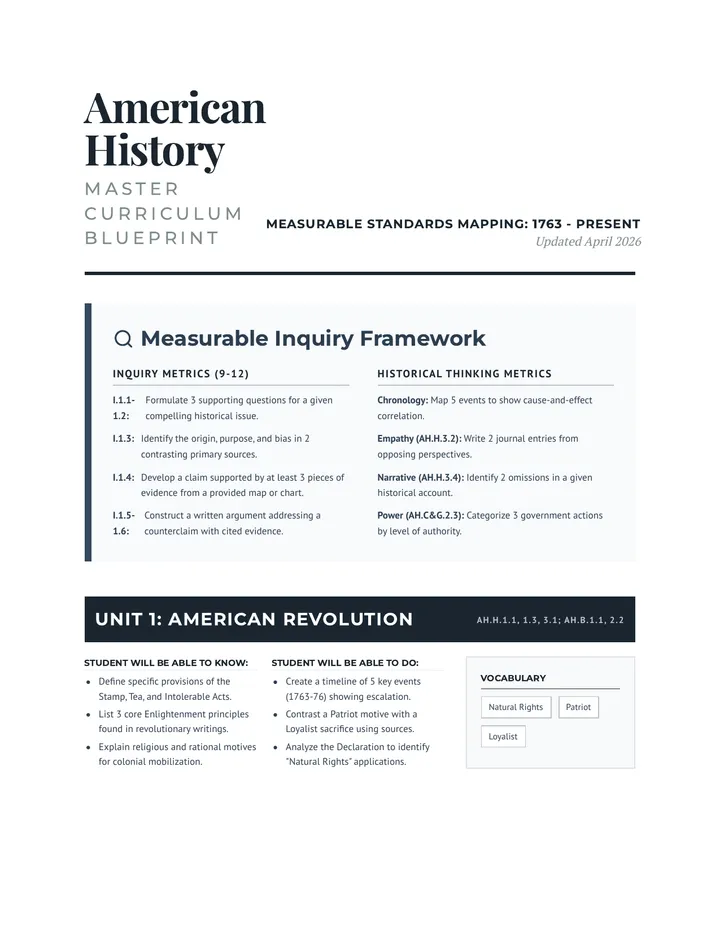
Curriculum Blueprint Document v2

History Horizon Sequence

A comprehensive high school curriculum plan for American History, covering 13 units from the American Revolution to the modern era, aligned with North Carolina Social Studies standards.

AK

Amity Kea

21
Suspicion Stops Presentation

Justice and the Constitution

This sequence explores the constitutional rights of individuals during law enforcement encounters, focusing on the Fourth, Fifth, and Sixth Amendments through landmark Supreme Court cases and modern applications.

15

Lessons

History Sprint Pacing Guide

STAAR History Sprint

A comprehensive pacing guide and activity resource designed to cover the remaining 11th Grade US History TEKS before the STAAR test on April 16th. This lesson provides a day-by-day calendar for A/B block schedules and high-engagement activities for each remaining historical era.

BB

Bridgette Burdick

51
Modern Era Reader Part 1

The Modern Ledger

A comprehensive exploration of the 1990s through the modern day, covering technological shifts, political milestones, military conflicts, and cultural evolution in the United States.

CE

Chelsea Elliott

20
Amendment Process Slides

The Living Constitution

A comprehensive lesson on the U.S. Constitution's amendment process and the Bill of Rights, featuring a chunked reader, instructional slides, and formative assessments. Students will analyze how the Constitution adapts to changing times while protecting fundamental liberties.

CE

Chelsea Elliott

5
Mission Briefing Teacher Guide

Modern Era Missions

A 100-minute station-based lesson covering pivotal events from the 1970s to the modern era, including Stagflation, the Camp David Accords, Reaganomics, and the War on Terror. Students rotate through four 20-minute missions using primary sources, political cartoons, data mapping, and manipulatives to master STAAR-aligned content.

LF

Lindsey Foulks

9
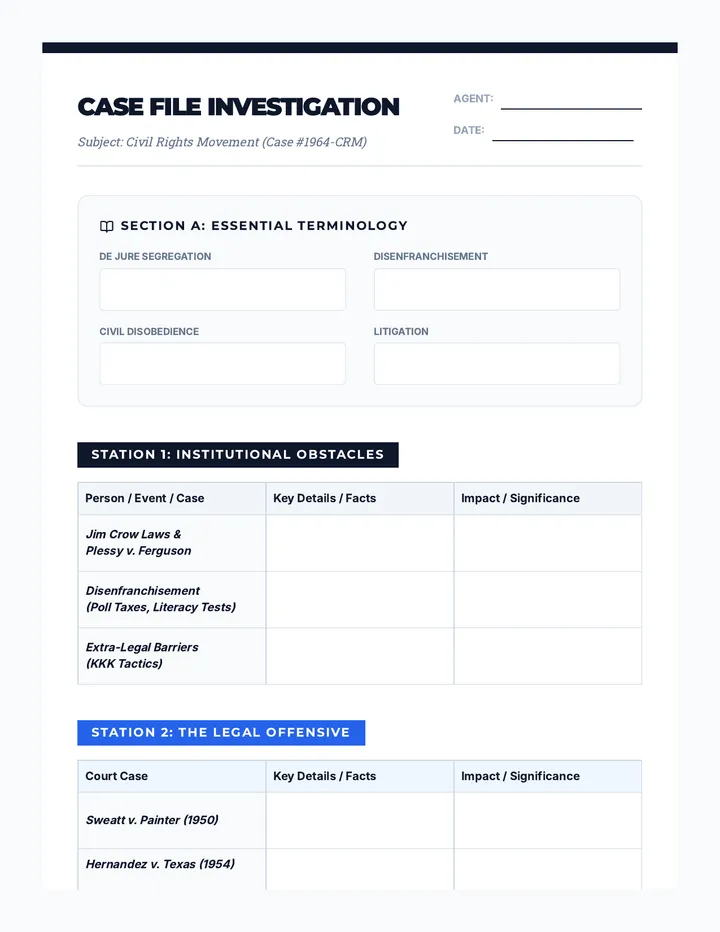
Justice Gallery Investigation Worksheet

Justice Gallery Case Files

A comprehensive lesson on the Civil Rights Movement featuring gallery stations and a guided investigation worksheet. Students analyze institutional obstacles, legal strategies, non-violent and militant tactics, and the expansion of the movement to other marginalized groups.

CE

Chelsea Elliott

25
Era Review Challenge Practice Sheet

Era Review Challenge

A quick review lesson designed to prepare students for US History STAAR assessments, focusing on four key eras: Imperialism, the Roaring 20s, the Great Depression, and WWII.

BB

Bridgette Burdick

14