Lenny.com
Explore
Create
ActivitiesNewMathEnglish Language ArtsScience & EngineeringSocial StudiesGlobal LanguagesHealth & Physical EducationSpecial EducationCounseling & Life SkillsArts & CreativityESL
Lenny.com
Lenny.com
Explore
Create
ActivitiesNewMathEnglish Language ArtsScience & EngineeringSocial StudiesGlobal LanguagesHealth & Physical EducationSpecial EducationCounseling & Life SkillsArts & CreativityESL
Lenny.com
Lenny.com

Solutions

Lenny for EducatorsLenny for SchoolsLenny for Districts

Product

ExploreSign inCreateSupportAbout

Resources

Getting startedMTSS Acceleration Program

© 2026 Lenny Learning Inc.

TermsPrivacyAccessibility
LinkedInInstagramX
Lenny

Scalars and Vectors

Distinguishes between magnitude-only scalars and directional vectors like force and velocity. Covers vector addition, resolution into components, and coordinate system representation.

Science & EngineeringLife ScienceLiving ThingsAnimalsPlantsBody SystemsTraitsAdaptationsCellsEcosystemsHeredityGenes to TraitsCell DivisionPhysicsComparing MaterialsShapes and PropertiesMagnetsMagnetismLightSoundLight and SoundMatterStates of MatterChanges of StateMixturesPhysical and Chemical ChangeHeating and CoolingHeat and Thermal EnergyEnergyForce and MotionElectrical CircuitsAtoms and MoleculesPeriodic TableMotion in One DimensionMotion in Two DimensionsScalars and VectorsForces and Laws of MotionCircular Motion and GravityMomentum and ImpulseWork, Energy, and PowerWavesElectromagnetic WavesGeometric OpticsElectricity and MagnetismSimple Harmonic MotionThermodynamicsNuclear PhysicsEarth Science & AstronomyWeatherWater CycleRocks and MineralsFossilsEarth's FeaturesEarth's ResourcesEarth's StructureWeather and ClimateEarth EventsFossils and Geologic TimePlate TectonicsHuman ImpactsAstronomyChemistryUnits and MeasurementAtomic StructurePeriodic TrendsChemical BondingNomenclatureMolecular StructureIntermolecular ForcesThe MoleStoichiometryProperties of GasesSolutionsChemical ReactionsBalancing EquationsEnergy ChangesRates of ReactionsEquilibriumAcids and BasesQuantum ModelBiologyClassificationCell StructureThe Chemistry of LifeBiomoleculesCellular TransportCell EnergyCell Growth and DivisionDNAProtein SynthesisMeiosis and Sexual ReproductionPatterns of InheritanceMulticellular OrganismsEvolutionEcologyBiodiversityComputer ScienceAlgorithms and Computational ThinkingProgramming LanguagesComputing SystemsNetworks and InternetData AnalysisCybersecurityAI and Machine LearningSoftware Design and DevelopmentBlockchainEngineering & AIDesigning ExperimentsEngineering PracticesDesign ThinkingEngineering Design ProcessMechanical EngineeringElectrical EngineeringMaterials and StructuresCAD and 3D DesignRoboticsArtificial Intelligence BasicsVibe CodingMachine LearningAI Ethics and SocietySystems ThinkingEntrepreneurship & InnovationEntrepreneurial MindsetBusiness Idea DevelopmentBusiness Plan BasicsMarketing & Customer DiscoveryFinancial Management for Startups

Videos

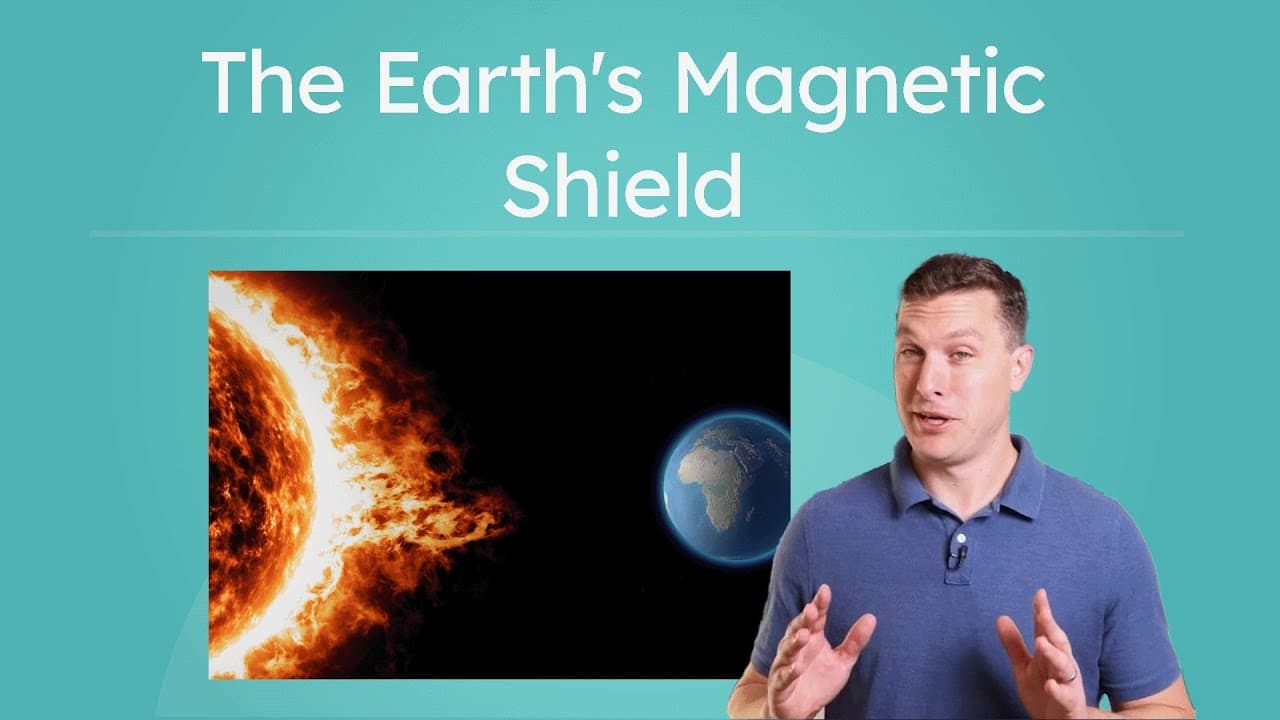
Earth's Magnetic Shield and the Right-Hand Rule

Earth's Magnetic Shield and the Right-Hand Rule

This educational video explores the critical role of Earth's magnetic field in protecting our planet from harmful solar radiation and introduces the physics concept of the Right-Hand Rule. The lesson begins by visualizing the sun as a massive nuclear reactor and explains how Earth's magnetic shield deflects solar wind, creating phenomena like the Aurora Borealis while preventing the radiation damage seen on barren worlds like the Moon and Mars. The second half of the video transitions into a practical physics tutorial on electromagnetism. It breaks down how magnetic fields exert force on moving charges and teaches students how to use the Right-Hand Rule to determine the direction of that force. The presenter uses clear, step-by-step examples with on-screen graphics to demonstrate how to position fingers to represent charge, field, and force vectors. For educators, this video serves as a bridge between Earth science and physics concepts. It provides a real-world application for abstract electromagnetic principles, making it an excellent resource for high school physics units on magnetism or earth science units on planetary habitability. The visual demonstrations of 3D spatial reasoning (using the hand) are particularly helpful for students who struggle with vector directions.

Miacademy & MiaPrep Learning ChannelMiacademy & MiaPrep Learning Channel

7mins 57s

Mastering Newton's Second Law: Force, Mass, and Acceleration

Mastering Newton's Second Law: Force, Mass, and Acceleration

This educational video provides a comprehensive guide to understanding and applying Newton's Second Law of Motion ($F_{net} = ma$). The lesson begins with relatable real-world analogies, such as gas mileage in cars and moving heavy stones, to intuitively explain the relationships between force, mass, and acceleration. It clarifies the often-confusing distinction between mass (the amount of matter) and weight (the force of gravity), demonstrating why mass remains constant throughout the universe while weight changes. The core of the video focuses on the mathematical application of the law. It explores the concepts of direct and inverse proportionality using visual examples like jet engines and semi-trucks. The narrator then transitions into step-by-step problem-solving strategies, introducing Free Body Diagrams to visualize forces. Viewers are guided through two complex word problems: one calculating the engine force of a car including friction, and another determining the thrust of individual propellers on an airplane. For educators, this video serves as an excellent bridge between conceptual physics and algebraic application. It is highly valuable for teaching students how to set up "sum of forces" equations and perform calculations involving net force. The clear, handwritten-style problem-solving section allows teachers to pause and let students attempt calculations, making it an ideal tool for direct instruction or flipped classroom models in physical science and introductory physics courses.

Miacademy & MiaPrep Learning ChannelMiacademy & MiaPrep Learning Channel

15mins 4s

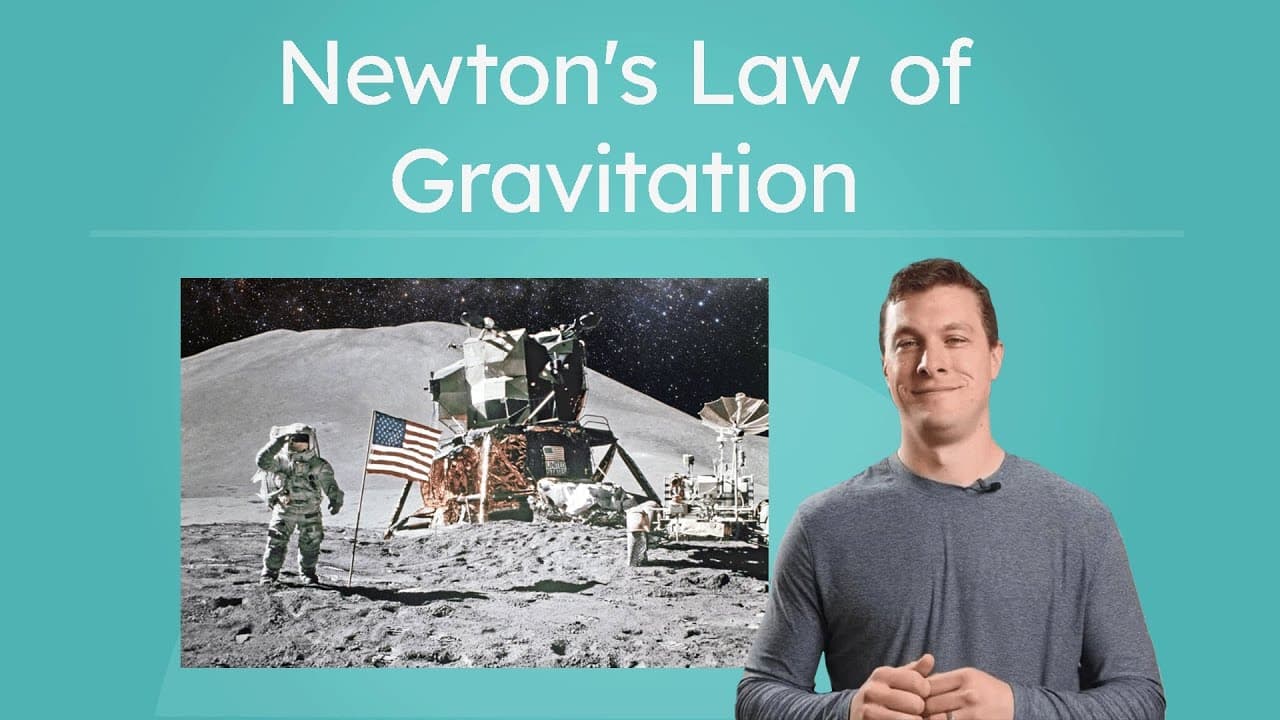
Calculating the Force of Gravity with Newton's Law

Calculating the Force of Gravity with Newton's Law

This educational video provides a comprehensive introduction to Newton's Law of Universal Gravitation, bridging conceptual understanding with mathematical application. It begins by contextualizing the universality of physical laws, explaining how the same force that causes an apple to fall also governs the motion of planets. The narrator breaks down the gravitational formula step-by-step, identifying each variable and explaining the significance of the gravitational constant (G) determined by Henry Cavendish.

Miacademy & MiaPrep Learning ChannelMiacademy & MiaPrep Learning Channel

11mins 37s

Mastering Acceleration: Definition, Units, and Calculations

Mastering Acceleration: Definition, Units, and Calculations

This educational video provides a comprehensive introduction to the physics concept of acceleration. It begins by grounding the abstract concept in physical sensation—explaining that acceleration is the motion you can actually feel, unlike constant velocity. The host guides viewers through the formal definition of acceleration as a vector quantity representing the rate of change in velocity, using clear visuals and real-world examples like motorcycles, top fuel dragsters, and space shuttles to illustrate these changes in speed and direction.

Miacademy & MiaPrep Learning ChannelMiacademy & MiaPrep Learning Channel

9mins 41s

Calculating Speed vs. Velocity: Definitions and Practice

Calculating Speed vs. Velocity: Definitions and Practice

This educational video provides a clear and comprehensive introduction to the physics concepts of speed and velocity. It begins by engaging students with examples of fast-moving objects like race cars and rockets before settling into the mathematical definitions of motion. The narrator uses real-world analogies, such as a long car trip involving both highway driving and traffic jams, to distinguish between average speed and instantaneous speed. The video then introduces the crucial distinction between scalar quantities and vector quantities, explaining how distance relates to speed while displacement relates to velocity. The content covers key themes in kinematics, specifically focusing on the difference between distance (total ground covered) and displacement (straight-line distance from start to finish). It explicitly teaches the formulas for calculating average speed (Distance/Time) and average velocity (Displacement/Time). A significant portion of the video is dedicated to step-by-step worked examples where the narrator calculates both speed and velocity for the same trip, demonstrating how the results differ numerically and conceptually—most notably that velocity requires a direction. For educators, this video is an excellent resource for middle school physical science or introductory high school physics classrooms. It moves beyond simple definitions to application, providing guided practice problems that allow students to test their understanding immediately. The use of visual maps to illustrate the path of travel versus the vector of displacement helps concrete thinkers grasp abstract concepts. Teachers can use this video to introduce motion formulas, reinforce the concept of vectors, or as a flipped classroom assignment before a lab on measuring motion.

Miacademy & MiaPrep Learning ChannelMiacademy & MiaPrep Learning Channel

7mins 42s

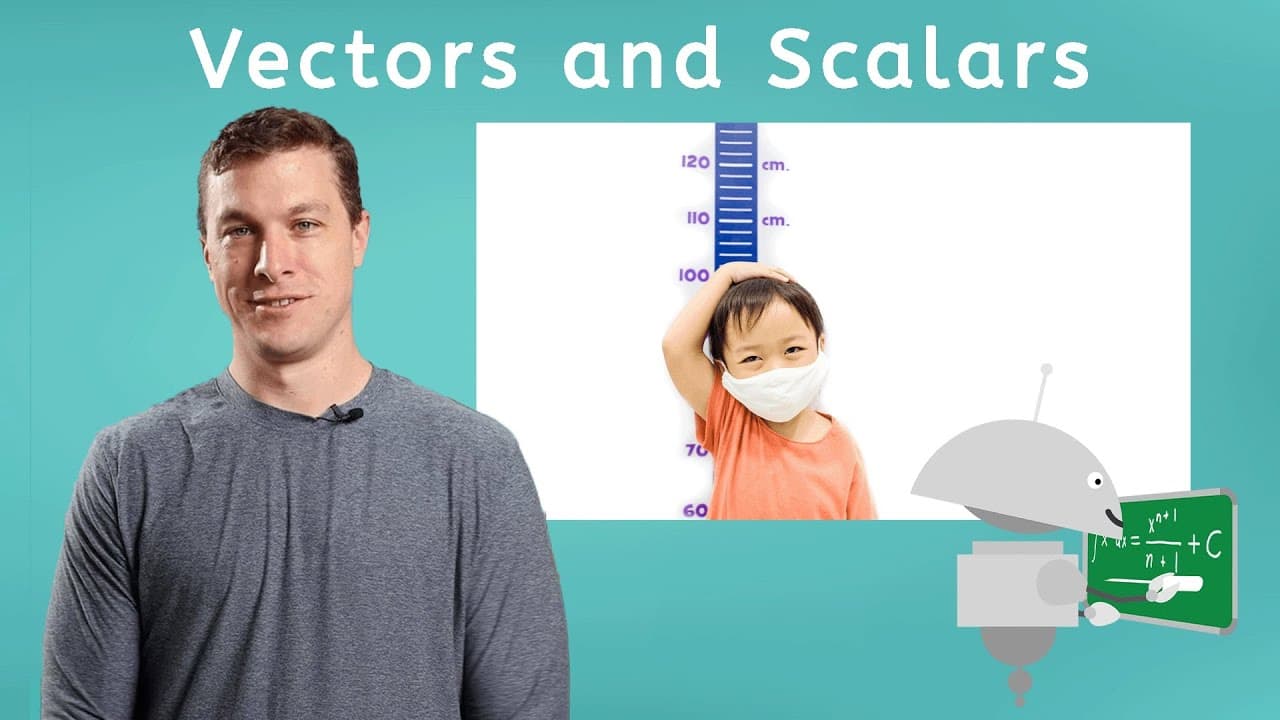
Distinguishing Between Vectors and Scalars in Physics

Distinguishing Between Vectors and Scalars in Physics

This educational video introduces the fundamental physics concepts of vectors and scalars, explaining the critical distinction between them. It begins by highlighting how physicists use language precisely, contrasting everyday synonyms like "speed" and "velocity" to illustrate that in science, these terms have distinct meanings. The video moves from a live-action introduction to clear, animated slides that define scalars as quantities with magnitude (size) and vectors as quantities with both magnitude and direction. The content is structured around defining terms, providing concrete examples, and offering interactive practice opportunities. Viewers learn that scalars, such as speed, height, and volume, are defined by a number and a unit. In contrast, vectors, such as velocity, acceleration, and magnetic fields, require a directional component. The video uses relatable visuals like car speedometers, measuring tapes, and crash test footage to ground these abstract concepts in reality. Ideally suited for middle and high school physical science classrooms, this video serves as an excellent primer or review for kinematics units. It features built-in "pause and think" moments where students are challenged to identify scalars on a dashboard or classify a list of measurements as vectors, scalars, or neither. Teachers can use this resource to clarify misconceptions about speed versus velocity and to practice identifying the components of scientific measurements.
Miacademy & MiaPrep Learning ChannelMiacademy & MiaPrep Learning Channel

6mins 47s

Materials

Coulomb Law Answer Key Document

Coulomb Law Answer Key Document

A comprehensive teacher answer key for the Coulomb Law Workshop, featuring step-by-step mathematical derivations, final answers highlighted for quick grading, and detailed sidebars for common student misconceptions and unit conversion reminders.

CB

Chloe Brown

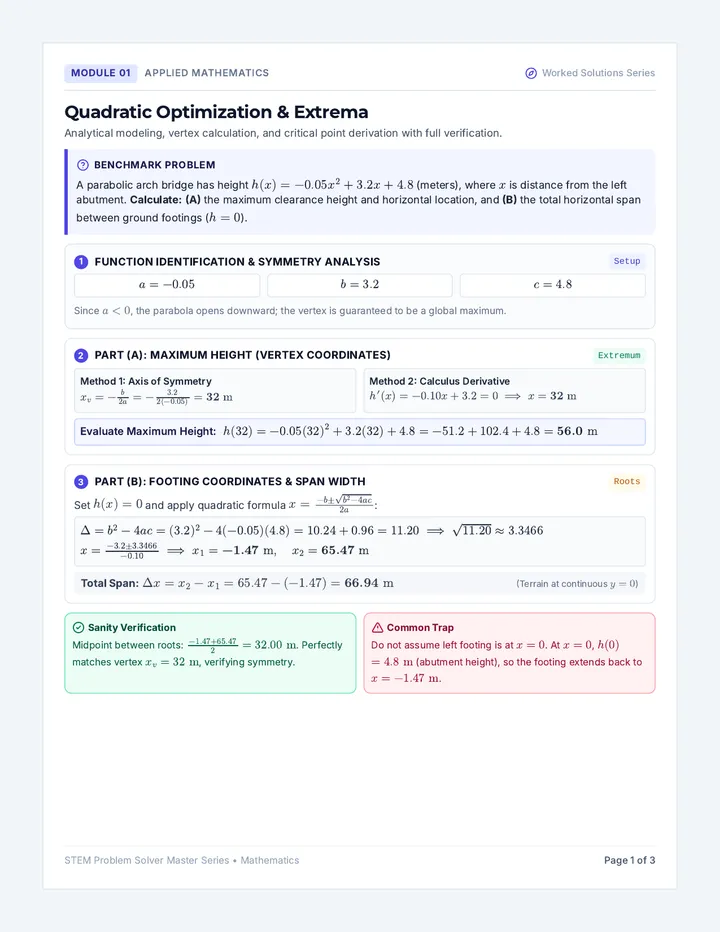
STEM Master Solver Guide

STEM Master Solver Guide

A comprehensive three-part STEM worked-example guide providing detailed, step-by-step solutions for benchmark problems in mathematics, physics, and chemistry. Each page breaks down problem setup, conceptual modeling, algebraic derivation, and rigorous verification techniques.

CZ

Claire Zietsman

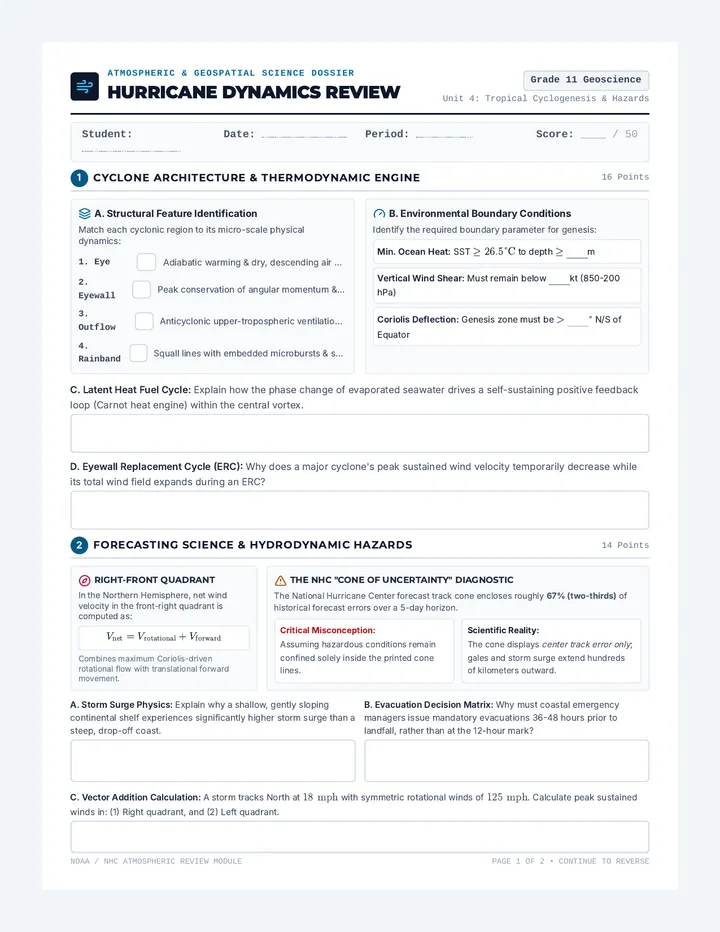
Hurricane Dynamics Review Worksheet

Hurricane Dynamics Review Worksheet

An advanced 11th-grade geoscience review worksheet covering tropical cyclone anatomy, thermodynamic formation engines, NHC cone of uncertainty interpretation, storm surge physics, and empirical data analysis from Hurricane Ian.

ME

Mary Ellen Goodrow

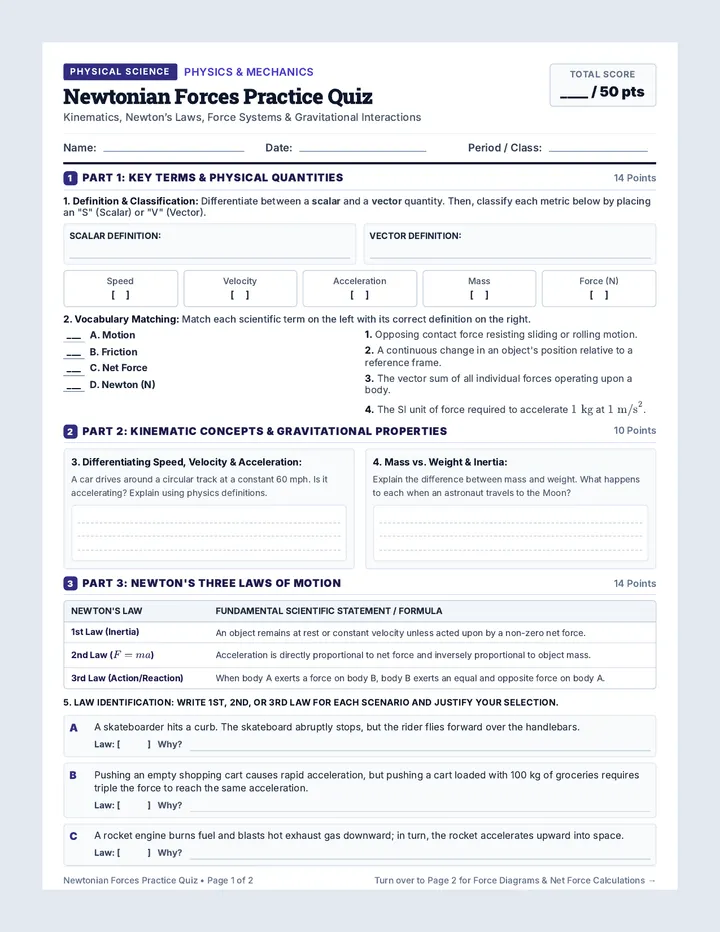
Newtonian Forces Practice Quiz

Newtonian Forces Practice Quiz

A comprehensive two-page physics practice quiz covering Newton's three laws of motion, force calculations, free-body diagrams, gravity, mass versus weight, and vector versus scalar quantities.

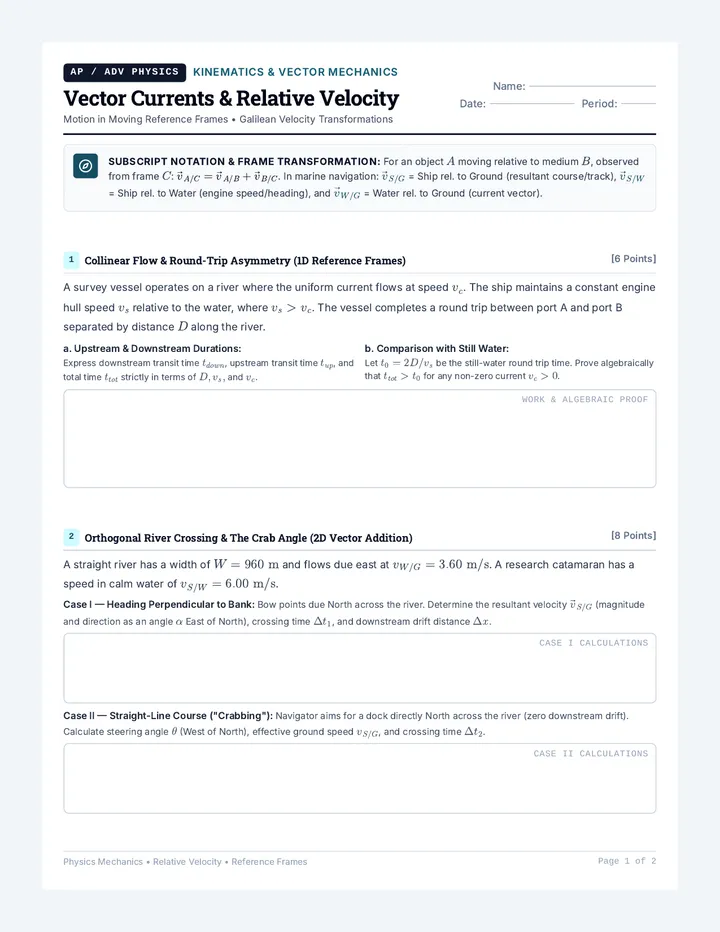
Vector Currents Worksheet

Vector Currents Worksheet

An advanced physics worksheet exploring relative velocity and reference-frame transformations through marine navigation, featuring collinear river transit, 2D vector decomposition, drift optimization, and moving-frame target interception.

Sequences

Naval Architect Challenge Answer Key

Fluid Dynamics

A series of lessons exploring the physics of fluids, including buoyancy, pressure, and fluid flow.

CM

Chuguna Murugesan

28
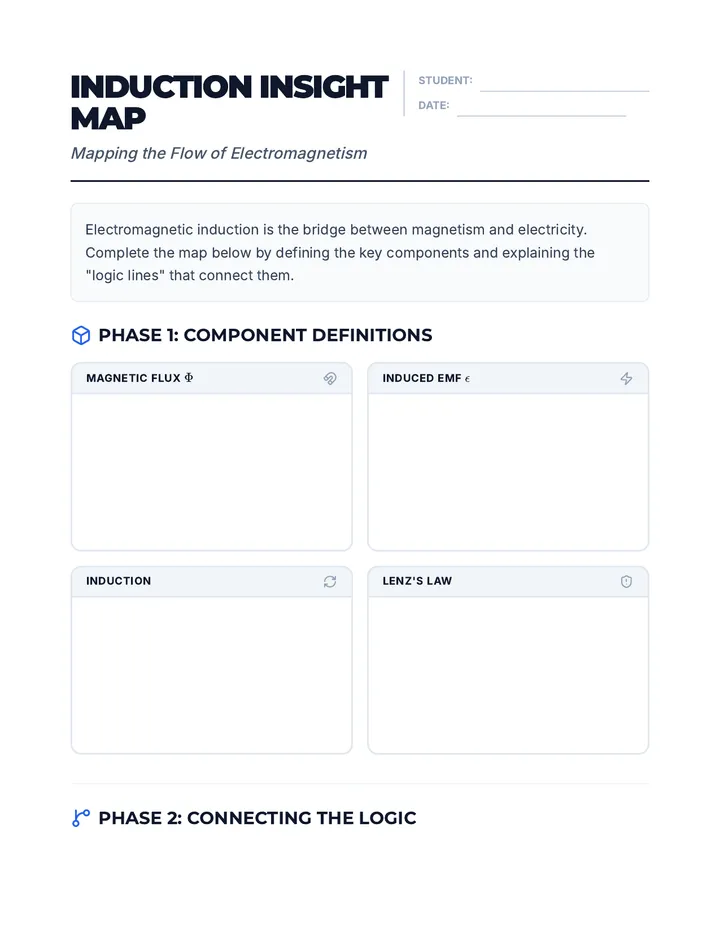
Induction Insight Map Handout

Magnetic Forces Investigation

A 5-day intensive exploration of magnetic forces and fields, focusing on atomic-level causes, field interactions, and mathematical modeling of forces on charged particles. Students progress from anchoring phenomena to complex mathematical applications and a comprehensive unit review.

OM

Olutoyin Makinde

68
Power Parade Slides

The Grid Powering the Future

A comprehensive 2-week unit on electricity and circuits, covering electric potential, power generation, Ohm's law, and circuit analysis. Students move from the fundamental physics of voltage to the design of complex grid systems.

OM

Olutoyin Makinde

30
Momentum Mission Worksheet

Momentum Mechanics

A comprehensive unit on momentum and collisions for 9th grade physics, covering the basic equation, collision types, conservation laws, and Newton's Third Law through real-world examples like vehicle safety and sports.

C

ckroeker

9
Spin Cycle Reading Guide Updated v4

Spin Cycle Unit

A comprehensive unit on rotational mechanics, mapping the transition from linear motion to angular dynamics through technical analysis and real-world applications.

CM

Chuguna Murugesan

34
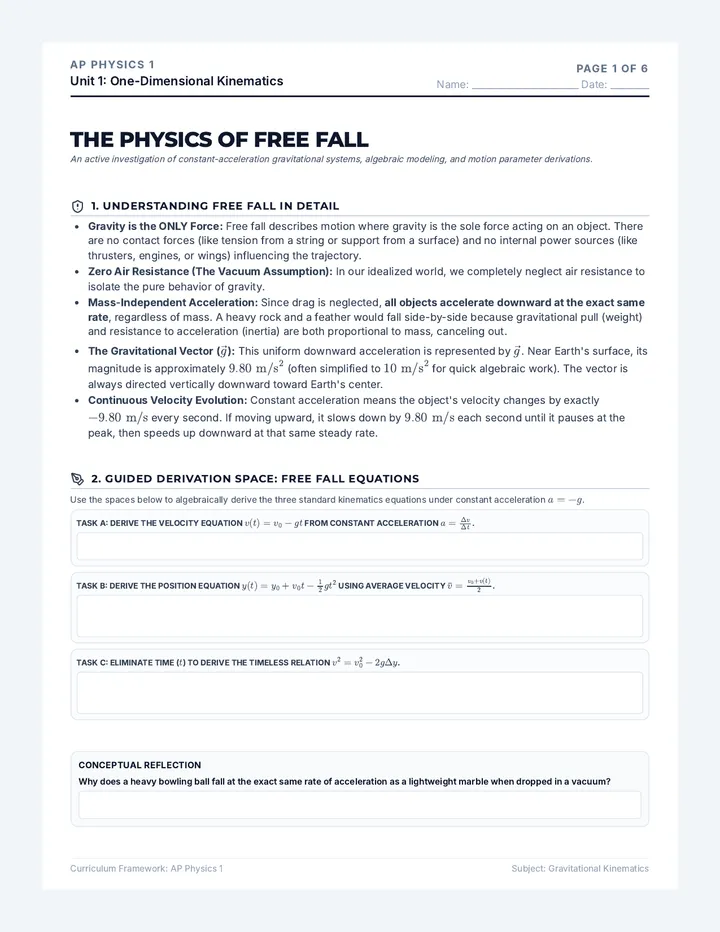
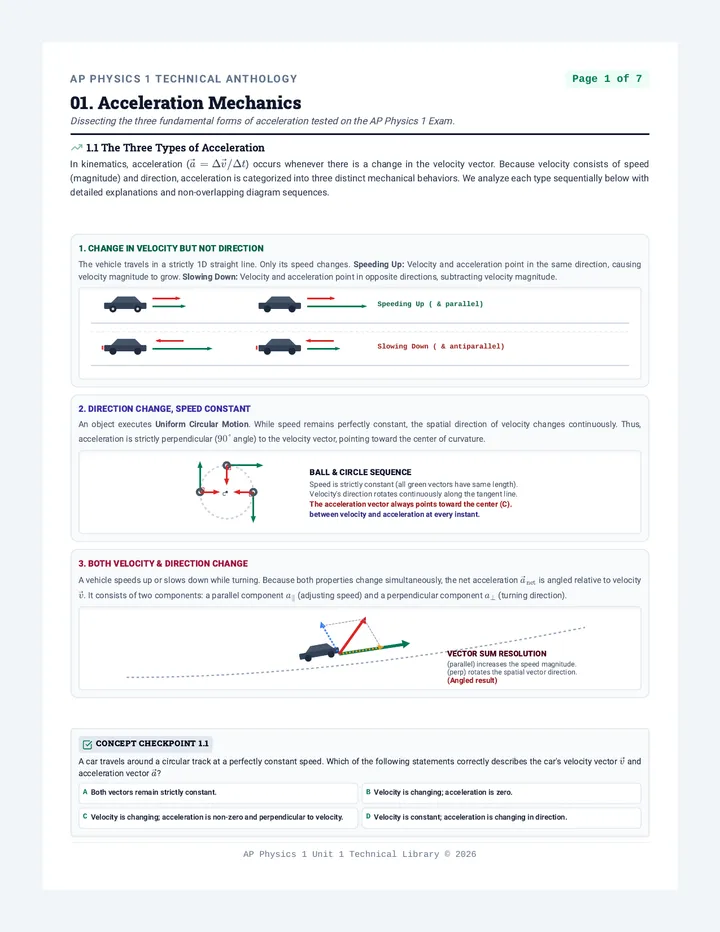
Gravitational Kinematics Reading Packet

AP Kinematics Unit

A comprehensive AP Physics 1 unit on one-dimensional and two-dimensional kinematics, covering free fall vertical motion, horizontal projectile pathways, experimental lab designs, and graphical signature analysis.

CM

Chuguna Murugesan

6

Lessons

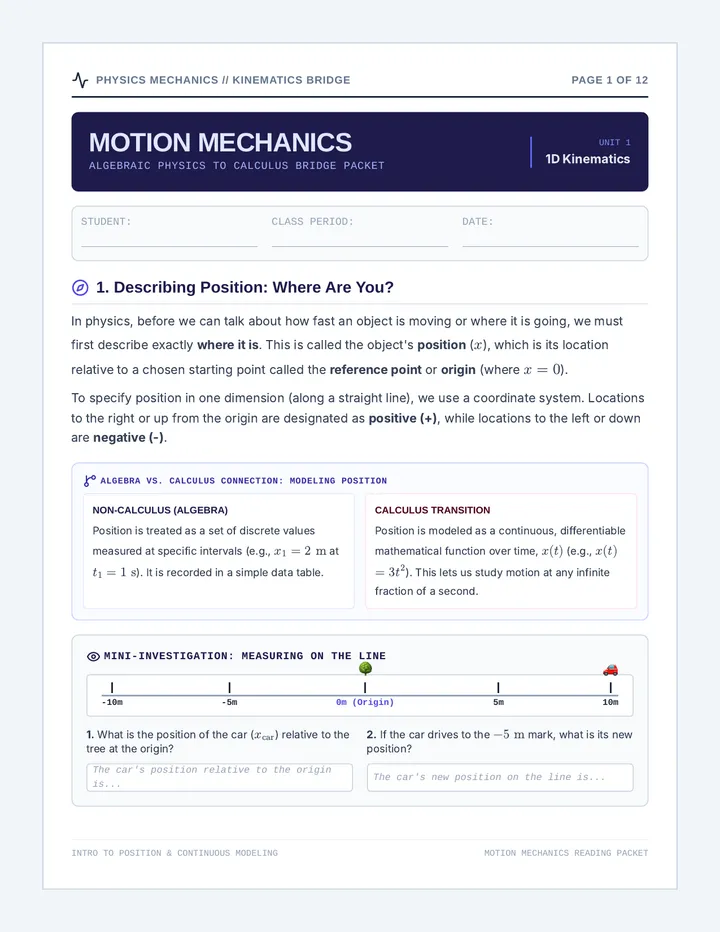
Motion Mechanics Reading Packet

Motion Mechanics

A comprehensive physics lesson bridging algebraic kinematics to introductory calculus. Includes a 12-page side-by-side reading packet, 13 instructional presentation slides, active learning Think-Pair-Share worksheets, a conceptual transition workbook, and a detailed teacher guide with full answer keys.

CM

Chuguna Murugesan

24
Flow State Reading Guide Expanded

Flow State

This lesson explores the fundamental properties of fluids, including the molecular differences between solids, liquids, and gases, the concept of density, and the characteristics of ideal fluids. Students will learn to distinguish states of matter through atomic interactions and apply the density formula to various substances.

CM

Chuguna Murugesan

33
Motion Mechanics Anthology

Motion Mechanics

An AP Physics 1 lesson focusing on the advanced graphical, algebraic, and vector representations of velocity and acceleration. Includes a comprehensive 12-page reading anthology and a matching 12-page student analysis packet.

CM

Chuguna Murugesan

14
Oscillation Station Slides

SHM Fundamentals

A comprehensive introduction to Simple Harmonic Motion, covering restoring forces, kinematics, and energy conservation in oscillating systems.

CM

Chuguna Murugesan

42
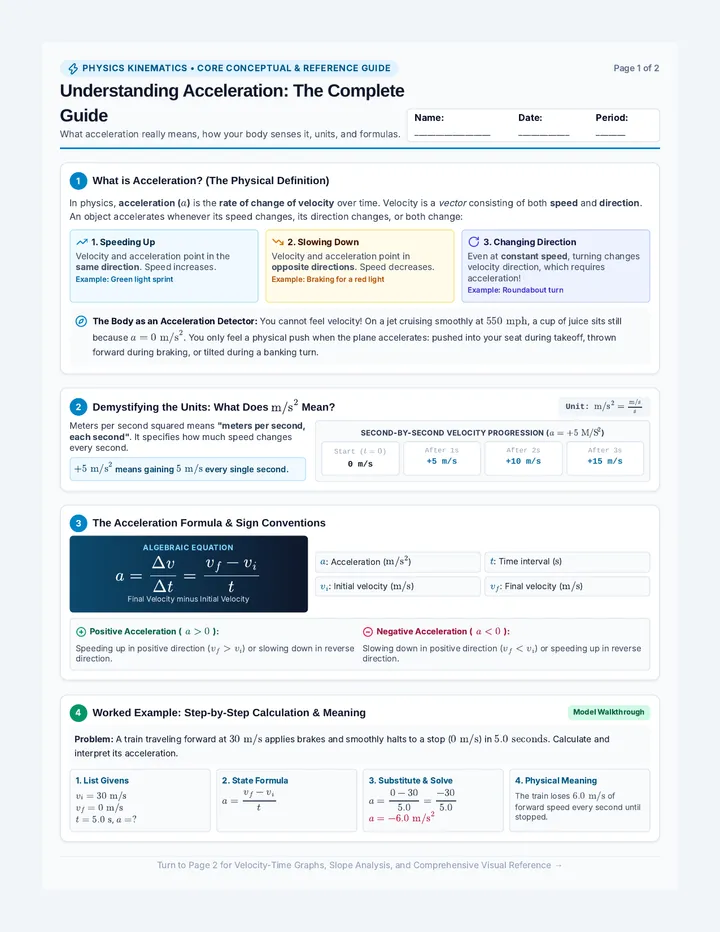
Acceleration Fundamentals Handout

Speed Shift Science

A comprehensive physics lesson focused on understanding acceleration as the rate of change of velocity, calculating acceleration using kinematic formulas, and determining acceleration from the slope of velocity-time graphs.

CM

Chuguna Murugesan

13
Mechanics Mastery Reading

Newtonian Mechanics Mastery

An in-depth, algebra-based investigation of forces, friction, and coupled systems designed for AP Physics 1. This lesson develops physical intuition, vector decomposition skills, and systemic problem-solving using Newton's Laws.

CM

Chuguna Murugesan

13