A comprehensive teacher answer key for the Coulomb Law Workshop, featuring step-by-step mathematical derivations, final answers highlighted for quick grading, and detailed sidebars for common student misconceptions and unit conversion reminders.
A comprehensive answer key and scoring guide for the Matter Mechanics diagnostic, updated with two additional calculation problems and solutions.
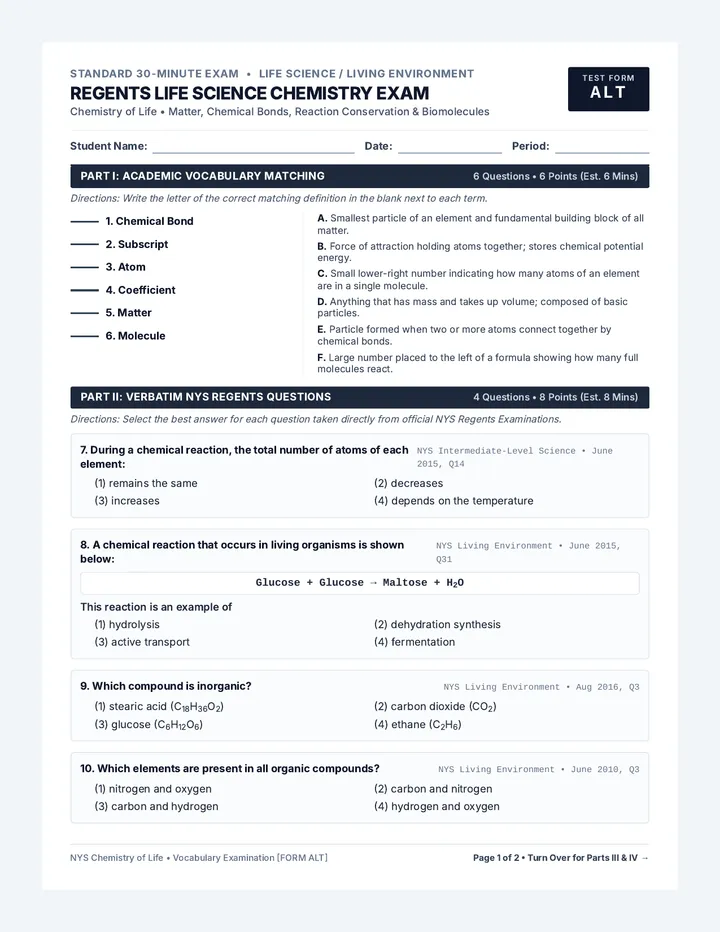
A two-page diagnostic assessment for 9th-grade students covering physical/chemical properties, states of matter, and density calculations. Revised to include four calculation problems in Part 3 and better page balance.
Teacher answer key for the Stopping Power Worksheet, focusing on conceptual explanations for reaction time, kinetic energy, and safety buffers. Providing qualitative solutions instead of complex mathematical derivations. Corrected logic for reaction distance.
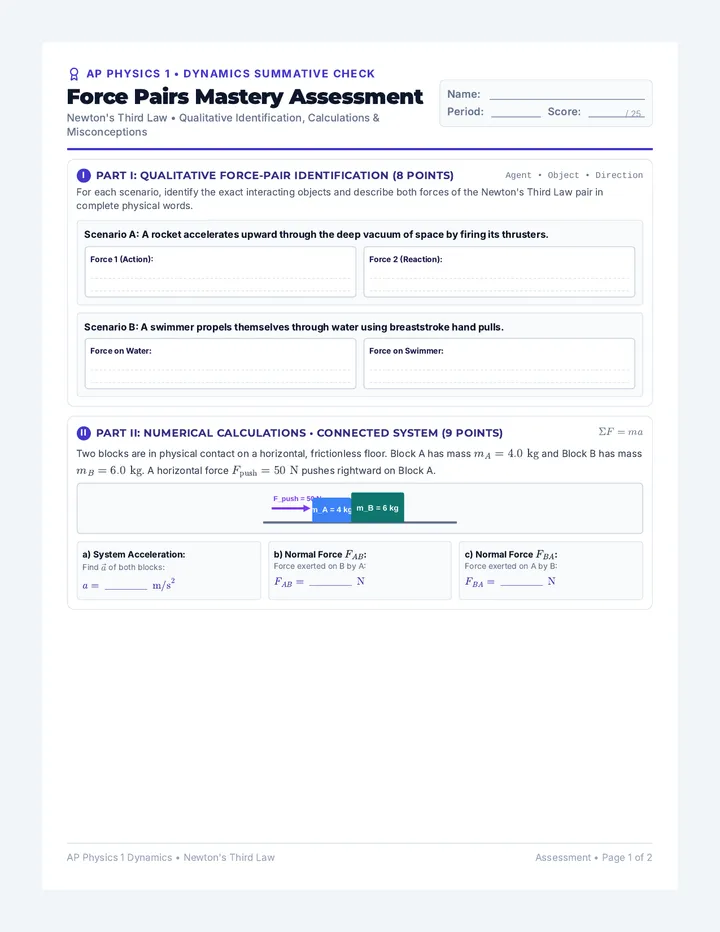
A conceptually-focused worksheet for students to complete while other half of the class is in the lab. Focuses on the relationship between speed, reaction time, and braking distance using qualitative scenarios and the "Speed Rule" instead of complex formulas. Fixes page breaks and workspace heights.
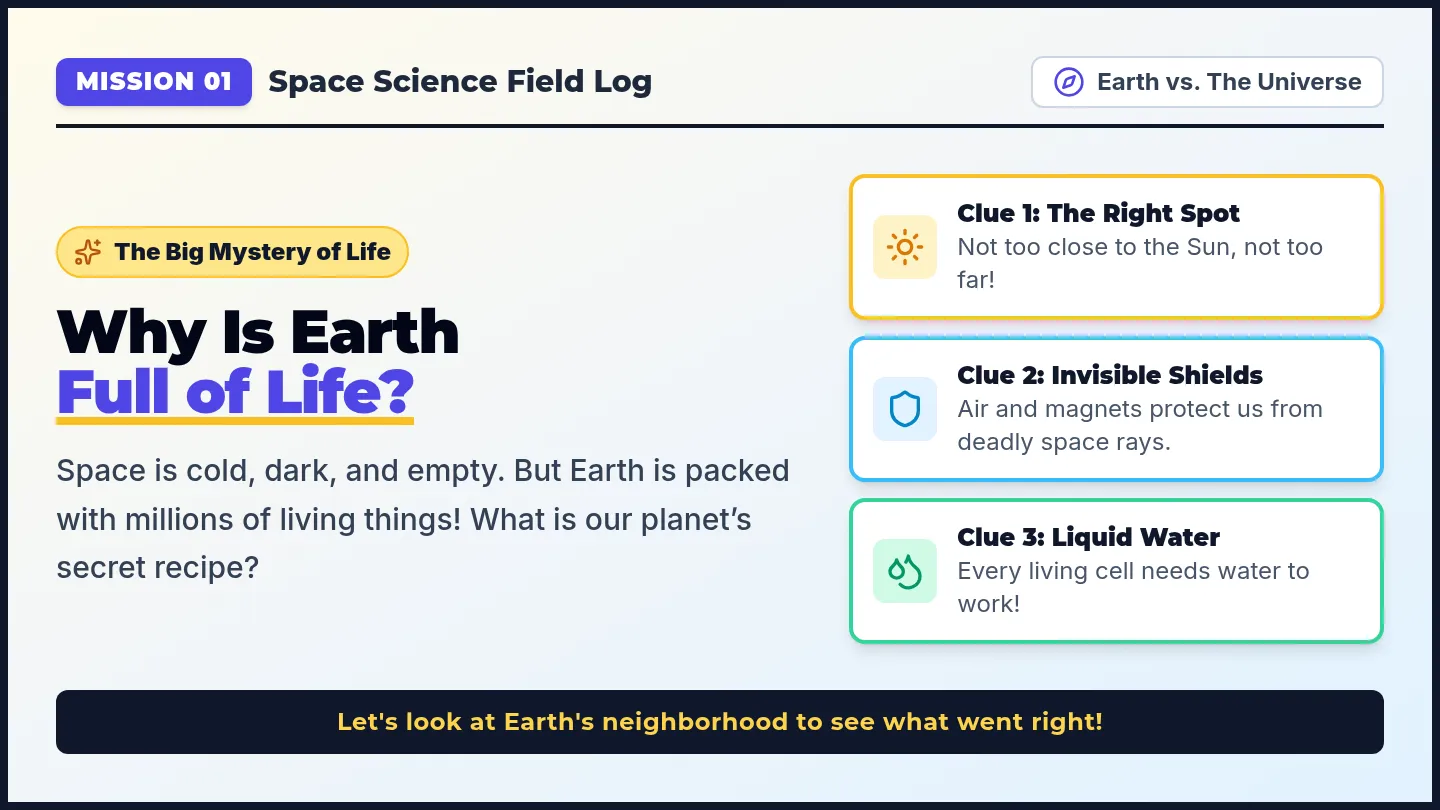
Instructional slides for the Survival Strategies lesson, covering ecological niches, traits of generalists and specialists, and their respective survival outcomes in changing vs. stable environments. Includes field vocabulary and conservation risks.
Revised teacher answer key for the Survival Strategies worksheet. Compact design to fit on a single page with improved visual alignment.
Revised Survival Strategies worksheet featuring a new 'Field Vocabulary' section, an expanded reading passage about generalist and specialist niches, new 'Check Your Understanding' short-answer questions, and a streamlined tracker and quiz layout.
An extensive, 7-page student research journal for juniors. Features a 10-day roadmap, a detailed Oxygen model example, physical property logs, historical discovery deep dives, presentation scripting tools, and a teacher rubric. Includes clear, detailed directions for independent work.
A complete, 5-page student project packet for seniors, featuring a 5-day roadmap, a detailed Helium model example, step-by-step scientific research guides, and a teacher rubric. Includes clear directions for independent work and slide deck planning.
Complete teacher answer key for the Atomic Blueprint Packet with step-by-step solutions and highlighted answers.
A 6-page independent practice packet for special education students updated for high-contrast printing, featuring integrated notes from slides and a clean, light-background layout.
Answer key for the Penny Genetics Lab, providing Punnett square solutions, expected ratios, and sample answers for the analysis questions.
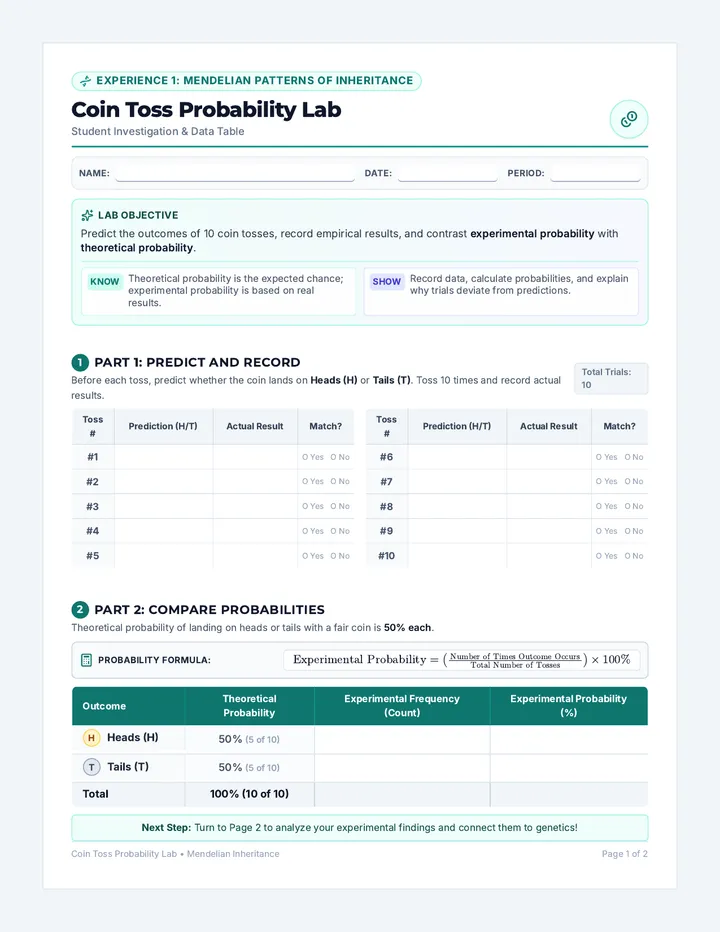
A redesigned 3-page student lab worksheet for the Penny Genetics activity. It includes space for Punnett square predictions, 100 coin-flip tallies, comparison charts, and analysis questions.
Slide deck for the Penny Genetics lesson, covering the science of chance, lab setup instructions, and the importance of sample size.
Teacher lesson plan for the Penny Genetics Lab, detailing the 60-minute class structure, required materials, and discussion prompts. Updated with MA State Standards, Learning Objectives, and Language Objectives.
A comprehensive answer key for both the standard and support versions of the genetics quiz, including teacher tips for implementation.
A differentiated genetics quiz featuring simplified language, visual icons, guided Punnett square setup, and a word bank to support diverse learners.
A standard level genetics quiz covering Mendelian vocabulary, basic inheritance concepts, and Punnett square application.
A visual reference sheet for students that defines key genetics vocabulary and provides a step-by-step guide to filling out Punnett squares.
A complete answer key for the Mendelian Genetics Quiz, featuring the multiple-choice solutions and fully detailed Punnett squares for the problem-solving section.
An honors-level Mendelian genetics quiz featuring 15 multiple-choice questions on vocabulary and probability, followed by two Punnett square analysis problems focusing on monohybrid crosses.
A visual review slide deck for teaching carrying capacity, limiting factors, and human environmental impact. Includes high-impact graphics, clear definitions, and a case study prompt. Revised for clarity and corrected typos.
An answer key for the Population Peak exit ticket, providing correct graph placement, limiting factor classifications, and a sample high-quality response for the human impact question.
A set of two printable exit tickets on a single page designed to review carrying capacity. It includes a graph interpretation task, a sorting activity for biotic and abiotic limiting factors, and a short response question on human environmental impact. Revised for strict height constraints to ensure both fit on one page.
An answer key for the Succession Snap Exit Ticket, providing correct responses and sample explanations.
A four-per-page exit ticket for a quick formative assessment on ecological succession types and key vocabulary. Corrected for readability and text size.
An answer key for the Succession Shuffle Bell Ringer, providing the correct numerical order for primary and secondary succession stages. Optimized for single-page printing.
A double-up printable worksheet containing two half-sheet bell ringers. Students order the stages of primary and secondary succession. Corrected layout for single-page printing.
A visual presentation exploring the differences between generalist and specialist species. Includes comparisons for Raccoons vs. Koalas, Coyotes vs. Pandas, and Rats vs. Polar Bears.
The teacher answer key for the Survival Showdown worksheet, providing sample responses for open-ended questions and correct choices for the multiple-choice quiz. Optimized for one-page reference.
A comprehensive worksheet exploring the survival strategies of generalist and specialist species through three animal pairings. Includes a comparison chart with word bank, detailed case studies with sentence starters, and a multiple-choice assessment. Condensed to fit comfortably within a 3-page printable format.
A comprehensive teacher answer key for the Wave Blueprint worksheet. Provides step-by-step calculations for wavelength, wave number, and angular frequency, along with the final mathematical wave functions for three different speaker scenarios. Revised for consistency and clarity.
A worksheet designed to guide students through constructing mathematical representations (wave functions) of sound waves. Includes a guided problem using speaker frequency and amplitude, followed by independent practice problems in different scenarios like subwoofers and underwater pingers. Revised for better page flow, contrast, and formula rendering.
A comprehensive teacher answer key for the Sonar Scouts worksheet, including full step-by-step solutions for all four problems, unit conversion checks, and pedagogical tips for addressing common student errors. Now includes rationales for each problem. Revised for better page flow and detail.
A scaffolded physics worksheet focused on sonar calculations. Every question is now broken down into logical steps with "Nav Logic" rationales explaining the scientific purpose of each calculation. Revised for better page flow.
A teacher resource providing setup instructions, materials lists, and expected answers for the Sound Properties Lab. Includes pedagogical tips and explanations for sound wave properties. Revised with the new title.
A student-facing lab activity document focused on investigating pitch, loudness, and medium of sound waves. Includes a new background section on the "Salt Drum" technology used in Station 2. Revised for better page flow and detail.
A comprehensive teacher answer key for the Wave Racer CER Bellringer. Includes the correct claim, supporting evidence from the scenario, and a mathematical and conceptual reasoning breakdown of the inverse relationship between frequency and wavelength. Revised for better contrast and single-page layout.