A (Left) B (Right)
Show Calculations Here:
PART 3: REAL-WORLD DYNAMICS CHALLENGES
Puzzle 1: The Pushed Sled on Flat Ice
A block with a mass of \(m = 5.0 \, \text{kg}\) is pushed along horizontal ice. A user applies a push force of \(32.0 \, \text{N}\) to the right. The horizontal contact friction force between the block and the ice is \(12.0 \, \text{N}\) acting to the left.
Work area for Puzzle 1 (Show all math steps):
Puzzle 2: Hanging Classroom Sign
A heavy decorative classroom sign of mass \(m = 4.0 \, \text{kg}\) is hung statically using two vertical ropes. Each rope exerts an upward tension pull of \(20.0 \, \text{N}\). The downward gravity field force on the sign is \(F_g = 40.0 \, \text{N}\).
Work area for Puzzle 2 (Show all math steps):
INTRODUCING FORCES // AP PHYSICS 1 PAGE 2 OF 4
AP PHYSICS 1 DYNAMICS WORKBOOK
WORKSPACE // 02
Apply collinear coordinate conventions (\(+y\) upward, \(+x\) rightward) to combine multiple applied, frictional, and gravitational forces into a single resultant net force.
PUZZLE 3: THE ACCELERATING ELEVATOR CAB VERTICAL 1D SUMMATION
Physical Setup & Scenario Data
A loaded service elevator cab has a total mass of \(m = 1200 \, \text{kg}\). The motorized overhead cable pulls directly upward with a tension force of \(F_T = 14{,}400 \, \text{N}\). The downward gravitational force acting on the elevator is \(F_g = 11{,}760 \, \text{N}\) (taking \(g = 9.8 \, \text{m/s}^2\)).
Cab (1200 kg) F_T = 14.4 kN F_g = 11.76 kN
Work area for Puzzle 3 (Show net force substitution and acceleration calculation):
PUZZLE 4: WAREHOUSE CRATE THREE-FORCE SUMMATION MULTI-FORCE HORIZONTAL 1D
Physical Setup & Scenario Data
A crate of mass \(m = 80.0 \, \text{kg}\) is moved across a concrete floor. Worker 1 pushes horizontally with \(F_1 = 160 \, \text{N}\) to the right. Worker 2 assists by pushing with \(F_2 = 140 \, \text{N}\) to the right. Meanwhile, kinetic friction between the crate and concrete exerts an opposing force of \(f_k = 180 \, \text{N}\) to the left.
Crate 80 kg F₁ = 160 N F₂ = 140 N f_k = 180 N
Work area for Puzzle 4 (Show forward force sum, net force subtraction, and acceleration):
INTRODUCING FORCES // AP PHYSICS 1 PAGE 3 OF 4
AP PHYSICS 1 DYNAMICS WORKBOOK
WORKSPACE // 02
Explore complex interactions involving field forces (gravity) alongside fluid contact drag and engine thrust. Analyze both magnitudes and kinematic consequences of non-zero net force.
PUZZLE 5: PARACHUTE DEPLOYMENT & DECELERATION DRAG VS. GRAVITATIONAL FIELD
Physical Setup & Scenario Data
A skydiver of total mass \(m = 75.0 \, \text{kg}\) falls downwards. Immediately after opening the parachute canopy, the upward air resistance drag force spikes to \(F_{\text{drag}} = 1035 \, \text{N}\). The downward gravitational field force is \(F_g = mg = (75.0 \, \text{kg})(9.8 \, \text{m/s}^2) = 735 \, \text{N}\).
F_drag = 1035 N F_g = 735 N
Work area for Puzzle 5 (Show net force calculation, acceleration, and physical reasoning):
PUZZLE 6: SOUNDING ROCKET VERTICAL ASCENT THREE-FORCE PROPULSION SYSTEM
Physical Setup & Scenario Data
A scientific sounding rocket of total mass \(m = 400 \, \text{kg}\) launches vertically upward. Its solid-fuel motor delivers an upward thrust force of \(F_{\text{thrust}} = 6800 \, \text{N}\). Gravity pulls downward with \(F_g = mg = 3920 \, \text{N}\), and atmospheric air drag resists upward ascent with a downward contact force of \(F_{\text{drag}} = 480 \, \text{N}\).
F_thrust = 6.8 kN F_g=3.92 kN F_drag=480 N
Work area for Puzzle 6 (Show downward total, net vertical summation, and acceleration):
INTRODUCING FORCES // AP PHYSICS 1 PAGE 4 OF 4
Worker's Package Mass = 4.0 kg
(b) [5 points] Write the vertical force summation equation (\(\sum F_y\)) for the package. Show how the upward normal force (\(F_N\)) relates to the downward gravitational force (\(F_g\)), and calculate the numerical value of the normal force in Newtons.
(c) [5 points] Write the horizontal force summation equation (\(\sum F_x\)) for the package. Calculate the horizontal net force acting on the package, and use it to determine the horizontal acceleration of the package.
INTRODUCING FORCES // AP PHYSICS 1 PAGE 2 OF 3
AP PHYSICS 1 EXAM ANSWER KEY
DETAILED SOLUTIONS // 04
1. Multiple Choice Key
Q1: Correct Option (B). Because Worker A and Worker B are pushing in the same direction (East), we add their forces: \(F_{\text{push}} = 150\,\text{N} + 100\,\text{N} = 250\,\text{N}\) (East). Friction acts in the opposite direction (West), so we subtract it from the push force: \(F_{\text{net}} = F_{\text{push}} - f = 250\,\text{N} - 40\,\text{N} = 210\,\text{N}\). Since the east forces were larger, the net force is directed to the East.
Q2: Correct Option (C). An object in static equilibrium (hovering in place at a constant altitude) has an acceleration of zero. According to Newton's First Law, the net force must be exactly zero: \(\sum F_y = F_{\text{up}} - F_{\text{down}} = 0 \implies F_{\text{up}} = F_{\text{down}}\). Therefore, the downward force of gravity must exactly equal the upward rotor force of \(12,000\,\text{N}\).
Q3: Correct Option (A). We define the upward direction as positive. The horizontal/vertical net force is the difference between the upward tension pull and downward gravity: \(\sum F_y = T - F_g = 65\,\text{N} - 50\,\text{N} = 15\,\text{N}\) (pointing upward). Using Newton's Second Law to solve for acceleration: \(a_y = \frac{\sum F_y}{m} = \frac{15\,\text{N}}{5.0\,\text{kg}} = 3.0 \, \text{m/s}^2\) (directed upward).
2. Free Response Key & Rubric
Part (a): Drawing Force Arrows [5 points]. 1 point for drawing an arrow pointing straight down, labeled Gravity Force (\(F_g\)) or similar. 1 point for drawing an arrow pointing straight up, labeled Normal Force (\(F_N\)). 1 point for drawing an arrow pointing horizontally to the right, labeled Tension (\(T\)). 1 point for drawing an arrow pointing horizontally to the left, labeled Friction (\(f_k\)). 1 point for ensuring arrows originate correctly from the box and point in clean, correct coordinate directions.
Part (b): Vertical Summation [5 points]. 1 point for writing the vertical equilibrium equation: \(\sum F_y = F_N - F_g = 0\). 2 points for algebraically proving that the upward normal force equals the gravity force: \(F_N = F_g\). 2 points for substituting the gravity force value to find the normal force: \(F_N = 40 \, \text{N}\).
Part (c): Horizontal Summation & Acceleration [5 points]. 1 point for writing the horizontal net force equation: \(\sum F_x = T - f_k\). 1 point for calculating the net horizontal force magnitude: \(\sum F_x = 30 \, \text{N} - 10 \, \text{N} = 20 \, \text{N}\). 1 point for stating Newton's Second Law: \(a_x = \frac{\sum F_x}{m}\). 2 points for solving for acceleration: \(a_x = \frac{20 \, \text{N}}{4.0 \, \text{kg}} = 5.0 \, \text{m/s}^2\) to the right.
INTRODUCING FORCES // AP PHYSICS 1 PAGE 3 OF 3
\[ \vec{a} = \frac{\vec{F}_{\text{net}}}{m} \quad \text{or} \quad \vec{F}_{\text{net}} = m\vec{a} \]
One Newton (\(1\,\text{N}\)) is defined as the force required to accelerate a \(1.0\,\text{kg}\) mass at a rate of \(1.0\,\text{m/s}^2\). Thus, \(1\,\text{N} = 1\,\text{kg}\cdot\text{m/s}^2\).
Inertial vs. Gravitational Mass: In physics, mass has two distinct definitions. Inertial mass is an object's resistance to acceleration when a net force is applied (the \(m\) in \(F=ma\)). Gravitational mass is an object's susceptibility to gravitational attraction (the \(m\) in \(F_g = mg\)). Extensive experimental testing shows these two values are perfectly equivalent, a deep truth that underlies Einstein's general theory of relativity.
Figure 2.1: Acceleration, Force, and Mass Relationships Proportionality Key
Mass m Force F Acceleration a (Large) Mass 2m Force F Acceleration a/2 (Small)
Stop & Jot (Solution)
Slope of F_net vs. Acceleration graph...
Since \(F_{\text{net}} = m \cdot a\), the equation has the linear form \(y = mx\). Plotting \(F_{\text{net}}\) on y and \(a\) on x means the slope of the linear fit is exactly the mass \(m\) of the system (in kg).
Think-Pair-Share (Solution)
Triple force and triple mass...
Sentence Stem Solution:
"The acceleration will remain exactly the same because tripling the force acts to triple acceleration, but tripling the mass acts to divide acceleration by three, completely canceling out the effect (\(a = \frac{3F}{3m} = \frac{F}{m}\))."
INTRODUCING FORCES // AP PHYSICS 1 PAGE 2 OF 5
AP PHYSICS 1 // KEY TEACHER COPY // READING SOLUTIONS
INTRODUCING FORCES KEY
Active Practice Problem: Pushing a Heavy Sled
A heavy snow sled with a mass of \(m = 10.0 \, \text{kg}\) is pulled across flat ice. A student pulls the sled to the right with a constant horizontal tension force of \(F_{\text{pull}} = 35.0 \, \text{N}\). A kinetic friction force of \(f_k = 15.0 \, \text{N}\) opposes the pull by acting to the left.
Overlaid solutions are indicated below in red.
Part (a): Calculate the horizontal net force (\(F_{\text{net}, x}\))
CORRECT SOLUTION OVERLAY \[ F_{\text{net}, x} = F_{\text{pull}} - f_k \] \[ F_{\text{net}, x} = 35.0 \, \text{N} - 15.0 \, \text{N} = \mathbf{20.0 \, \text{N}} \quad (\text{to the right}) \]
Part (b): Determine the horizontal acceleration of the sled (\(a_x\))
CORRECT SOLUTION OVERLAY \[ a_x = \frac{F_{\text{net}, x}}{m} \] \[ a_x = \frac{20.0 \, \text{N}}{10.0 \, \text{kg}} = \mathbf{2.00 \, \text{m/s}^2} \quad (\text{to the right}) \]
Active Stop & Jot Checkpoint (Solution)
If friction increases to equal the pull force...
"If the friction increases to equal the pull force, the horizontal net force becomes 0 N, which means the sled's speed will remain constant (it continues sliding forward with a constant speed of 2.00 m/s with zero acceleration according to Newton's First Law)."
INTRODUCING FORCES // AP PHYSICS 1 PAGE 3 OF 5
AP PHYSICS 1 // KEY TEACHER COPY // READING SOLUTIONS
INTRODUCING FORCES KEY
Most students can state Newton's Third Law of Motion from memory: For every action, there is an equal and opposite reaction. However, this law is often conceptually misunderstood. A more precise scientific phrasing is: Whenever one object exerts a force on a second object, the second object exerts an equal and opposite force on the first object.
Mathematically, if Object A exerts a force on Object B (\(\vec{F}_{\text{A on B}}\)), Object B simultaneously exerts force (\(\vec{F}_{\text{B on A}}\)) on Object A:
\[ \vec{F}_{\text{A on B}} = -\vec{F}_{\text{B on A}} \]
The Cancellation Fallacy: If action and reaction forces are always equal in magnitude and opposite in direction, why do they not cancel each other out, preventing any acceleration from ever occurring? The answer is simple: action-reaction forces always act on different objects.
When you push on a wall, the wall pushes back on you. Your push acts on the wall, while the wall's push acts on you. Because they act on separate bodies, they never appear on the same object's force equation, and they do not cancel.
Figure 4.1: The Mechanics of Walking Action-Reaction Key
Shoe / Foot F_foot-on-ground (Backward) F_ground-on-foot (Forward)
Stop & Jot (Solution)
Does the apple pull upward on the Earth?
Yes! According to Newton's Third Law, force pairs are always identical in size. The apple pulls upward on the Earth with exactly \(2\,\text{N}\) of force. The Earth's acceleration is simply too small to observe because of its massive mass (\(a = 2\,\text{N} / M_{\text{Earth}} \approx 0\)).
Think-Pair-Share (Solution)
Classmate high-five hand force...
Sentence Stem Solution:
"The forces are exactly equal in magnitude and opposite in direction because Newton's Third Law dictates that hands cannot make contact without exerting equal and opposite force on each other, regardless of who swung harder."
INTRODUCING FORCES // AP PHYSICS 1 PAGE 4 OF 5
AP PHYSICS 1 // KEY TEACHER COPY // READING SOLUTIONS
NEWTON'S THREE LAWS KEY
In AP Physics 1, we often analyze coupled systems, where multiple objects are connected by ropes and pulleys, forcing them to move together with a shared acceleration magnitude.
The classic Modified Atwood Machine features Block A resting on a frictionless table connected via a light string to hanging Block B. To solve this system:
Figure 5.1: Frictionless Modified Atwood Machine Coupled Mechanics
Block A Block B Tension T T M_B g
Think-Pair-Share: Atwood Limits (Solutions)
If Block A's mass is extremely large compared to Block B...
Sentence Stem Solution:
"If Block A's mass is extremely large, the system acceleration will approach zero (0 m/s²) because as \(M_A \to \infty\), the denominator of the acceleration fraction \(M_A + M_B\) becomes infinitely large, making the system acceleration fraction approach zero, as Block A's inertia is too massive to move."
INTRODUCING FORCES // AP PHYSICS 1 PAGE 5 OF 5
DYNAMICS ASSESSMENT KEY
Problem 1 (15 points): A cardboard package of mass \(m = 4.0 \, \text{kg}\) is pulled along a flat conveyor belt. A worker pulls the package horizontally to the right with a constant rope tension of \(T = 30 \, \text{N}\). A kinetic friction force of \(f_k = 10 \, \text{N}\) opposes the pull by acting to the left. The vertical gravitational force acting on the package is \(F_g = 40 \, \text{N}\). Correct answers are in red overlay.
(a) [5 points] On the diagram of the package below, draw and label individual force arrows representing the four real-world forces acting on the package (Tension, Friction, Normal Force, and Gravity). Make sure your arrows point in the correct directions!
Worker's Package (Solutions Overlaid) Mass = 4.0 kg Normal Force (F_N) Gravity (F_g = mg) Tension (T) Friction (f_k)
(b) [5 points] Write the vertical force summation equation (\(\sum F_y\)) for the package. Show how the upward normal force (\(F_N\)) relates to the downward gravitational force (\(F_g\)), and calculate the numerical value of the normal force in Newtons.
Correct Solution Overlay:
1. Vertical Equilibrium: \(\sum F_y = F_N - F_g = 0\) (since there is no vertical acceleration, \(a_y = 0\)).
2. Relate forces: \(F_N = F_g\)
3. Substitute given value: \(F_N = 40.0 \, \text{N}\)
(c) [5 points] Write the horizontal force summation equation (\(\sum F_x\)) for the package. Calculate the horizontal net force acting on the package, and use it to determine the horizontal acceleration of the package.
Correct Solution Overlay:
1. Horizontal Equation: \(\sum F_x = T - f_k = m a_x\)
2. Calculate Net Force: \(F_{\text{net}, x} = 30 \, \text{N} - 10 \, \text{N} = 20 \, \text{N}\) to the right.
3. Determine Acceleration: \(a_x = \frac{F_{\text{net}, x}}{m} = \frac{20 \, \text{N}}{4.0 \, \text{kg}} = \mathbf{5.0 \, \text{m/s}^2}\) to the right.
INTRODUCING FORCES // AP PHYSICS 1 PAGE 2 OF 3
AP PHYSICS 1 // KEY TEACHER COPY // GRADING GUIDELINES
DYNAMICS ASSESSMENT KEY
1. Multiple Choice Scoring Guide
Q1: Correct Option (B). 1 point for adding collinear horizontal push forces to find a total push of \(250\,\text{N}\). 1 point for subtracting the opposing friction force to find a horizontal net force of \(210\,\text{N}\) directed east.
Common Student Trap: Adding all magnitudes blindly (\(150 + 100 + 40 = 290\,\text{N}\)) neglecting direction.
Q2: Correct Option (C). 1 point for recognizing that hovering implies static vertical equilibrium (\(a_y = 0\)). 1 point for applying Newton's First Law to conclude that the vertical forces are balanced, meaning downward gravity matches upward lift exactly.
Common Student Trap: Selecting "less than \(12,000\,\text{N}\)" due to the misconception that moving or staying aloft requires more upward force than downward force.
Q3: Correct Option (A). 1 point for calculating net force as tension minus gravity (\(65 - 50 = 15\,\text{N}\) upward). 1 point for dividing net force by mass (\(15 / 5 = 3.0\,\text{m/s}^2\)).
Common Student Trap: Dividing only tension by mass (\(65 / 5 = 13\,\text{m/s}^2\)) neglecting the gravity force vector.
2. Free Response Rubric (15 Points Total)
Part (a) [5 points]:
• 1 point for a clean upward normal vector originating from the package.
• 1 point for a clean downward gravity vector originating from the package.
• 1 point for a rightward tension vector, and 1 point for a leftward friction vector.
• 1 point for ensuring all vectors are properly labeled and do not contain decomposed components.
Part (b) [5 points]:
• 1 point for setting up vertical Newton's law: \(\sum F_y = F_N - F_g\).
• 2 points for setting the vertical summation equal to zero and stating \(F_N = F_g\).
• 2 points for calculating the normal force value correctly as \(40 \, \text{N}\).
Part (c) [5 points]:
• 1 point for writing the horizontal summation equation: \(\sum F_x = T - f_k\).
• 2 points for calculating the horizontal net force correctly as \(20 \, \text{N}\).
• 2 points for applying Newton's Second Law (\(a = F_{\text{net}}/m\)) and solving to find \(a = 5.0 \, \text{m/s}^2\) directed right.
INTRODUCING FORCES // AP PHYSICS 1 PAGE 3 OF 3
Two students pull opposite directions on a light plastic rope. Student A pulls to the left with a horizontal force of \(F_A = 120 \, \text{N}\). Student B pulls to the right with a horizontal force of \(F_B = 145 \, \text{N}\).
Question: State if we should add or subtract. Calculate the net force and direction.
A (Left) B (Right)
Correct Solution:
Forces act in opposite directions, so we subtract: \(F_{\text{net}} = F_B - F_A = 145\,\text{N} - 120\,\text{N} = \mathbf{25\,\text{N}}\) to the right.
PART 3: REAL-WORLD DYNAMICS CHALLENGES (SOLUTIONS)
Puzzle 1: The Pushed Sled on Flat Ice
A block with a mass of \(m = 5.0 \, \text{kg}\) is pushed along horizontal ice. A user applies a push force of \(32.0 \, \text{N}\) to the right. The horizontal contact friction force between the block and the ice is \(12.0 \, \text{N}\) acting to the left.
Work Details: \(\sum F_x = F_{\text{push}} - f_k = 32.0 - 12.0 = 20.0\,\text{N}\). Then \(a = F_{\text{net}}/m = 20.0/5.0 = 4.0\,\text{m/s}^2\).
Puzzle 2: Hanging Classroom Sign
A heavy decorative classroom sign of mass \(m = 4.0 \, \text{kg}\) is hung statically using two vertical ropes. Each rope exerts an upward tension pull of \(20.0 \, \text{N}\). The downward gravity field force on the sign is \(F_g = 40.0 \, \text{N}\).
Work Details: \(\sum F_y = T_1 + T_2 - F_g = 20 + 20 - 40 = 0\,\text{N}\). Net force is zero, verifying static balance.
INTRODUCING FORCES // AP PHYSICS 1 PAGE 2 OF 4
AP PHYSICS 1 // KEY TEACHER COPY // WORKSPACE SOLUTIONS
DYNAMICS WORKSPACE KEY
Apply collinear coordinate conventions (\(+y\) upward, \(+x\) rightward) to combine multiple applied, frictional, and gravitational forces into a single resultant net force.
PUZZLE 3: THE ACCELERATING ELEVATOR CAB (SOLUTIONS) VERTICAL 1D SUMMATION
Physical Setup & Scenario Data
A loaded service elevator cab has a total mass of \(m = 1200 \, \text{kg}\). The motorized overhead cable pulls directly upward with a tension force of \(F_T = 14{,}400 \, \text{N}\). The downward gravitational force acting on the elevator is \(F_g = 11{,}760 \, \text{N}\) (taking \(g = 9.8 \, \text{m/s}^2\)).
Cab (1200 kg) F_T = 14.4 kN F_g = 11.76 kN
Work Details: \(\Sigma F_y = F_T - F_g = 14400 - 11760 = +2640\,\text{N}\). Then \(a_y = \frac{\Sigma F_y}{m} = \frac{2640\,\text{N}}{1200\,\text{kg}} = +2.2\,\text{m/s}^2\). Since net force is upward, the elevator accelerates upward.
PUZZLE 4: WAREHOUSE CRATE THREE-FORCE SUMMATION (SOLUTIONS) MULTI-FORCE HORIZONTAL 1D
Physical Setup & Scenario Data
A crate of mass \(m = 80.0 \, \text{kg}\) is moved across a concrete floor. Worker 1 pushes horizontally with \(F_1 = 160 \, \text{N}\) to the right. Worker 2 assists by pushing with \(F_2 = 140 \, \text{N}\) to the right. Meanwhile, kinetic friction between the crate and concrete exerts an opposing force of \(f_k = 180 \, \text{N}\) to the left.
Crate 80 kg F₁ = 160 N F₂ = 140 N f_k = 180 N
Work Details: Combined push: \(160 + 140 = 300\,\text{N}\). Opposing friction: \(-180\,\text{N}\). Net force \(\Sigma F_x = +120\,\text{N}\). Acceleration \(a = \frac{120}{80.0} = 1.5\,\text{m/s}^2\) to the right.
INTRODUCING FORCES // AP PHYSICS 1 PAGE 3 OF 4
AP PHYSICS 1 // KEY TEACHER COPY // WORKSPACE SOLUTIONS
DYNAMICS WORKSPACE KEY
Explore complex interactions involving field forces (gravity) alongside fluid contact drag and engine thrust. Analyze both magnitudes and kinematic consequences of non-zero net force.
PUZZLE 5: PARACHUTE DEPLOYMENT & DECELERATION (SOLUTIONS) DRAG VS. GRAVITATIONAL FIELD
Physical Setup & Scenario Data
A skydiver of total mass \(m = 75.0 \, \text{kg}\) falls downwards. Immediately after opening the parachute canopy, the upward air resistance drag force spikes to \(F_{\text{drag}} = 1035 \, \text{N}\). The downward gravitational field force is \(F_g = mg = (75.0 \, \text{kg})(9.8 \, \text{m/s}^2) = 735 \, \text{N}\).
F_drag = 1035 N F_g = 735 N
Work Details: \(\Sigma F_y = +1035 - 735 = +300\,\text{N}\). \(a = \frac{+300\,\text{N}}{75.0\,\text{kg}} = +4.0\,\text{m/s}^2\). When acceleration and velocity point in opposite directions, the object's speed decreases.
PUZZLE 6: SOUNDING ROCKET VERTICAL ASCENT (SOLUTIONS) THREE-FORCE PROPULSION SYSTEM
Physical Setup & Scenario Data
A scientific sounding rocket of total mass \(m = 400 \, \text{kg}\) launches vertically upward. Its solid-fuel motor delivers an upward thrust force of \(F_{\text{thrust}} = 6800 \, \text{N}\). Gravity pulls downward with \(F_g = mg = 3920 \, \text{N}\), and atmospheric air drag resists upward ascent with a downward contact force of \(F_{\text{drag}} = 480 \, \text{N}\).
F_thrust = 6.8 kN F_g=3.92 kN F_drag=480 N
Work Details: Sum of downward resisting forces: \(3920 + 480 = 4400\,\text{N}\). Net vertical force: \(6800 - 4400 = +2400\,\text{N}\). Acceleration: \(a_y = \frac{2400}{400} = +6.0\,\text{m/s}^2\).
INTRODUCING FORCES // AP PHYSICS 1 PAGE 4 OF 4
The acceleration of an object is directly proportional to the net force acting on it, points in the same direction as the net force, and is inversely proportional to the object's mass. Mathematically:
\[ \vec{a} = \frac{\vec{F}_{\text{net}}}{m} \quad \text{or} \quad \vec{F}_{\text{net}} = m\vec{a} \]
One Newton (\(1\,\text{N}\)) is defined as the force required to accelerate a \(1.0\,\text{kg}\) mass at a rate of \(1.0\,\text{m/s}^2\). Thus, \(1\,\text{N} = 1\,\text{kg}\cdot\text{m/s}^2\).
Inertial vs. Gravitational Mass: In physics, mass has two distinct definitions. Inertial mass is an object's resistance to acceleration when a net force is applied (the \(m\) in \(F=ma\)). Gravitational mass is an object's susceptibility to gravitational attraction (the \(m\) in \(F_g = mg\)). Extensive experimental testing shows these two values are perfectly equivalent, a deep truth that underlies Einstein's general theory of relativity.
Figure 2.1: Acceleration, Force, and Mass Relationships Proportionality Laws
Mass m Force F Acceleration a (Large) Mass 2m Force F Acceleration a/2 (Small)
Physical Analysis: Pushing a box of mass \(m\) with force \(F\) produces a large acceleration. When pushing a box of double mass (\(2m\)) with the same force \(F\), the resulting acceleration is cut in half (\(a/2\)), demonstrating that acceleration is inversely proportional to mass.
Stop & Jot: Graphing F vs A
If you sketch a graph of Net Force (\(F_{\text{net}}\)) on the y-axis vs. Acceleration (\(a\)) on the x-axis for a constant mass, what is the physical meaning of the graph's slope?
Think-Pair-Share: Mass vs Acceleration
If you triple the net force acting on a block, but also triple its mass, what happens to its resulting acceleration? Discuss.
Sentence Stem: "The acceleration will ____________ because ____________."
INTRODUCING FORCES // AP PHYSICS 1 PAGE 2 OF 6
AP PHYSICS 1 TEXTBOOK SERIES // UNIT 2
NEWTON'S THREE LAWS
Active Practice Problem: Pushing a Heavy Sled
A heavy snow sled with a mass of \(m = 10.0 \, \text{kg}\) is pulled across flat ice. A student pulls the sled to the right with a constant horizontal tension force of \(F_{\text{pull}} = 35.0 \, \text{N}\). A kinetic friction force of \(f_k = 15.0 \, \text{N}\) opposes the pull by acting to the left.
Directions: Apply Newton's Second Law algebraically to solve each part. Show your work in the blank workspaces.
Part (a): Calculate the horizontal net force (\(F_{\text{net}, x}\))
Show subtraction: F_net = F_pull - f_k
Part (b): Determine the horizontal acceleration of the sled (\(a_x\))
Apply: a_x = F_net / m
Active Stop & Jot Checkpoint
Conceptual Extension: Imagine the friction force between the sled and the ice suddenly increased to exactly \(35.0\,\text{N}\) due to rough patches. Complete the sentence stem below:
"If the friction increases to equal the pull force, the horizontal net force becomes ____________, which means the sled's speed will ____________."
INTRODUCING FORCES // AP PHYSICS 1 PAGE 3 OF 6
AP PHYSICS 1 TEXTBOOK SERIES // UNIT 2
NEWTON'S THREE LAWS
Most students can state Newton's Third Law of Motion from memory: For every action, there is an equal and opposite reaction. A more rigorous AP Physics phrasing is: Whenever object A exerts a force on object B (\(\vec{F}_{\text{A on B}}\)), object B simultaneously exerts an equal in magnitude, opposite in direction force on object A (\(\vec{F}_{\text{B on A}} = -\vec{F}_{\text{A on B}}\)).
The Cancellation Fallacy: Why don't action-reaction pairs cancel each other out to produce zero acceleration? Because action-reaction forces act on entirely different objects. They never appear on the same object's Free-Body Diagram!
Figure 4.1: Action-Reaction Mechanics during Forward Push-Off Newton's 3rd Law Pair
Earth / Ground Surface (Object 2) Forward Motion v & a_runner → Shoe (Object 1) F_shoe-on-ground (ACTION) Acts ON Ground ← (Pushes Back) F_ground-on-shoe (REACTION) Acts ON Shoe → (Propels Forward) |F_shoe on ground| = |F_ground on shoe|
Physical Analysis: When walking or sprinting, the flexed runner's shoe pushes backward against the track (\(\vec{F}_{\text{shoe on ground}}\)). Simultaneously, the ground exerts an equal in magnitude, opposite in direction static friction force forward on the shoe (\(\vec{F}_{\text{ground on shoe}}\)). Because these two forces act on different bodies (the ground vs. the runner), they do not cancel—the forward reaction force is what accelerates the runner forward.
Stop & Jot: Falling Apple
If Earth's gravity pulls down on a falling apple with \(2\,\text{N}\) of force, does the apple pull upward on the Earth? Explain.
Think-Pair-Share: High-Five
If you high-five a classmate, discuss with a partner whose hand feels more force.
Sentence Stem: "The forces are ____________ because ____________."
INTRODUCING FORCES // AP PHYSICS 1 PAGE 4 OF 6
AP PHYSICS 1 TEXTBOOK SERIES // UNIT 2
NEWTON'S THREE LAWS
Newton's Third Law is particularly useful when analyzing objects in direct physical contact. A contact force (such as a normal support, a friction slide resistance, or an applied hand push) always occurs in action-reaction pairs.
When Block 1 is pushed directly against Block 2, Block 1 exerts a contact applied force to the right on Block 2 (\(\vec{F}_{1 \text{ on } 2}\)). Simultaneously, Block 2 exerts an equal in magnitude, opposite in direction contact reaction force to the left on Block 1 (\(\vec{F}_{2 \text{ on } 1}\)).
Figure 5.1: Action-Reaction in Pushed Contact Blocks Contact Couples
Block 1 Block 2 F_1on2 F_2on1
The Contact Rule: Whenever physical touch initiates a force, a molecular-level action-reaction pair is born. The molecules of each object push against each other because of electrostatic atomic repulsion. Ropes transmit this as tension pairs, surfaces as normal support/friction pairs, and directly touching bodies as applied force pairs. Always write out force labels with subscripts (e.g. \(F_{\text{Object A on Object B}}\)) to keep track of this physical relationship.
INTRODUCING FORCES // AP PHYSICS 1 PAGE 5 OF 6
AP PHYSICS 1 TEXTBOOK SERIES // UNIT 2
NEWTON'S THREE LAWS
Directions: For each real-world contact force scenario below, write out the explicit Action Force and Reaction Force components using proper subscripts. Include the category of force (normal, friction, tension, or applied) in your descriptions.
Scenario 1: A horse pulling a heavy cargo cart forward
Action Force (\(F_{\text{horse on cart}}\)):
Example: The horse pulls forward...
Reaction Force (\(F_{\text{cart on horse}}\)):
Example: The cart pulls backward...
Scenario 2: Your hand directly pushing a heavy chemistry textbook
Action Force (\(F_{\text{hand on book}}\)):
Write Action here...
Reaction Force (\(F_{\text{book on hand}}\)):
Write Reaction here...
Scenario 3: A metal painter's ladder leaning diagonally against a brick wall
Action Force (\(F_{\text{ladder on wall}}\)):
Write Action here...
Reaction Force (\(F_{\text{wall on ladder}}\)):
Write Reaction here...
Scenario 4: An athlete's rubber-cleated shoe sprinting forward off the turf
Action Force (\(F_{\text{cleats on turf}}\)):
Write Action here...
Reaction Force (\(F_{\text{turf on cleats}}\)):
Write Reaction here...
INTRODUCING FORCES // AP PHYSICS 1 PAGE 6 OF 6
\[ \vec{a} = \frac{\vec{F}_{\text{net}}}{m} \quad \text{or} \quad \vec{F}_{\text{net}} = m\vec{a} \]
One Newton (\(1\,\text{N}\)) is defined as the force required to accelerate a \(1.0\,\text{kg}\) mass at a rate of \(1.0\,\text{m/s}^2\). Thus, \(1\,\text{N} = 1\,\text{kg}\cdot\text{m/s}^2\).
Inertial vs. Gravitational Mass: In physics, mass has two distinct definitions. Inertial mass is an object's resistance to acceleration when a net force is applied (the \(m\) in \(F=ma\)). Gravitational mass is an object's susceptibility to gravitational attraction (the \(m\) in \(F_g = mg\)). Extensive experimental testing shows these two values are perfectly equivalent, a deep truth that underlies Einstein's general theory of relativity.
Figure 2.1: Acceleration, Force, and Mass Relationships Proportionality Key
Mass m Force F Acceleration a (Large) Mass 2m Force F Acceleration a/2 (Small)
Stop & Jot (Solution)
Slope of F_net vs. Acceleration graph...
Since \(F_{\text{net}} = m \cdot a\), the equation has the linear form \(y = mx\). Plotting \(F_{\text{net}}\) on y and \(a\) on x means the slope of the linear fit is exactly the mass \(m\) of the system (in kg).
Think-Pair-Share (Solution)
Triple force and triple mass...
Sentence Stem Solution:
"The acceleration will remain exactly the same because tripling the force acts to triple acceleration, but tripling the mass acts to divide acceleration by three, completely canceling out the effect (\(a = \frac{3F}{3m} = \frac{F}{m}\))."
INTRODUCING FORCES // AP PHYSICS 1 PAGE 2 OF 6
AP PHYSICS 1 // KEY TEACHER COPY // READING SOLUTIONS
INTRODUCING FORCES KEY
Active Practice Problem: Pushing a Heavy Sled
A heavy snow sled with a mass of \(m = 10.0 \, \text{kg}\) is pulled across flat ice. A student pulls the sled to the right with a constant horizontal tension force of \(F_{\text{pull}} = 35.0 \, \text{N}\). A kinetic friction force of \(f_k = 15.0 \, \text{N}\) opposes the pull by acting to the left.
Overlaid solutions are indicated below in red.
Part (a): Calculate the horizontal net force (\(F_{\text{net}, x}\))
CORRECT SOLUTION OVERLAY \[ F_{\text{net}, x} = F_{\text{pull}} - f_k \] \[ F_{\text{net}, x} = 35.0 \, \text{N} - 15.0 \, \text{N} = \mathbf{20.0 \, \text{N}} \quad (\text{to the right}) \]
Part (b): Determine the horizontal acceleration of the sled (\(a_x\))
CORRECT SOLUTION OVERLAY \[ a_x = \frac{F_{\text{net}, x}}{m} \] \[ a_x = \frac{20.0 \, \text{N}}{10.0 \, \text{kg}} = \mathbf{2.00 \, \text{m/s}^2} \quad (\text{to the right}) \]
Active Stop & Jot Checkpoint (Solution)
If friction increases to equal the pull force...
"If the friction increases to equal the pull force, the horizontal net force becomes 0 N, which means the sled's speed will remain constant (it continues sliding forward with a constant speed of 2.00 m/s with zero acceleration according to Newton's First Law)."
INTRODUCING FORCES // AP PHYSICS 1 PAGE 3 OF 6
AP PHYSICS 1 // KEY TEACHER COPY // READING SOLUTIONS
NEWTON'S THREE LAWS KEY
Most students can state Newton's Third Law of Motion from memory: For every action, there is an equal and opposite reaction. A more rigorous AP Physics phrasing is: Whenever object A exerts a force on object B (\(\vec{F}_{\text{A on B}}\)), object B simultaneously exerts an equal in magnitude, opposite in direction force on object A (\(\vec{F}_{\text{B on A}} = -\vec{F}_{\text{A on B}}\)).
The Cancellation Fallacy: Why don't action-reaction pairs cancel each other out to produce zero acceleration? Because action-reaction forces act on entirely different objects. They never appear on the same object's Free-Body Diagram!
Figure 4.1: Action-Reaction Mechanics during Forward Push-Off Action-Reaction Key
Earth / Ground Surface (Object 2) Forward Motion v & a_runner → Shoe (Object 1) F_shoe-on-ground (ACTION) Acts ON Ground ← (Pushes Back) F_ground-on-shoe (REACTION) Acts ON Shoe → (Propels Forward) |F_shoe on ground| = |F_ground on shoe|
Stop & Jot (Solution)
Does the apple pull upward on the Earth?
Yes! According to Newton's Third Law, force pairs are always identical in size. The apple pulls upward on the Earth with exactly \(2\,\text{N}\) of force. The Earth's acceleration is simply too small to observe because of its massive mass (\(a = 2\,\text{N} / M_{\text{Earth}} \approx 0\)).
Think-Pair-Share (Solution)
Classmate high-five hand force...
Sentence Stem Solution:
"The forces are exactly equal in magnitude and opposite in direction because Newton's Third Law dictates that hands cannot make contact without exerting equal and opposite force on each other, regardless of who swung harder."
INTRODUCING FORCES // AP PHYSICS 1 PAGE 4 OF 6
AP PHYSICS 1 // KEY TEACHER COPY // READING SOLUTIONS
NEWTON'S THREE LAWS KEY
Newton's Third Law is particularly useful when analyzing objects in direct physical contact. A contact force (such as a normal support, a friction slide resistance, or an applied hand push) always occurs in action-reaction pairs.
When Block 1 is pushed directly against Block 2, Block 1 exerts a contact applied force to the right on Block 2 (\(\vec{F}_{1 \text{ on } 2}\)). Simultaneously, Block 2 exerts an equal in magnitude, opposite in direction contact reaction force to the left on Block 1 (\(\vec{F}_{2 \text{ on } 1}\)).
Figure 5.1: Action-Reaction in Pushed Contact Blocks Contact Key
Block 1 Block 2 F_1on2 F_2on1
The Contact Rule: Whenever physical touch initiates a force, a molecular-level action-reaction pair is born. The molecules of each object push against each other because of electrostatic atomic repulsion. Ropes transmit this as tension pairs, surfaces as normal support/friction pairs, and directly touching bodies as applied force pairs. Always write out force labels with subscripts (e.g. \(F_{\text{Object A on Object B}}\)) to keep track of this physical relationship.
INTRODUCING FORCES // AP PHYSICS 1 PAGE 5 OF 6
AP PHYSICS 1 // KEY TEACHER COPY // READING SOLUTIONS
NEWTON'S THREE LAWS KEY
Directions: For each real-world contact force scenario below, write out the explicit Action and Reaction force pair components. solutions are in red.
Scenario 1: A horse pulling a heavy cargo cart forward
Action Force (\(F_{\text{horse on cart}}\)):
Horse pulls cart forward (Tension)
Reaction Force (\(F_{\text{cart on horse}}\)):
Cart pulls horse backward (Tension)
Scenario 2: Your hand directly pushing a heavy chemistry textbook
Action Force (\(F_{\text{hand on book}}\)):
Hand pushes book forward (Applied Force)
Reaction Force (\(F_{\text{book on hand}}\)):
Book pushes hand backward (Normal Force)
Scenario 3: A metal painter's ladder leaning diagonally against a brick wall
Action Force (\(F_{\text{ladder on wall}}\)):
Ladder pushes wall rightward (Normal Force)
Reaction Force (\(F_{\text{wall on ladder}}\)):
Wall pushes ladder leftward (Normal Force)
Scenario 4: An athlete's rubber-cleated shoe sprinting forward off the turf
Action Force (\(F_{\text{cleats on turf}}\)):
Cleats push turf backward (Friction Force)
Reaction Force (\(F_{\text{turf on cleats}}\)):
Turf pushes cleats forward (Friction Force)
INTRODUCING FORCES // AP PHYSICS 1 PAGE 6 OF 6
Definition Ratio \(\mu = \frac{f}{F_N}\)
Static Maximum \(f_{s,\text{max}} = \mu_s F_N\)
Kinetic Sliding \(f_k = \mu_k F_N\)
1. Roughness Dependence
A higher \(\mu\) reflects rougher microscopic textures, deeper asperity interlocking, and stronger atomic cold welds. Lower \(\mu\) indicates smooth, polished, or lubricated surfaces.
2. Dimensionless Nature
Because \(\mu\) is a ratio of force over force (\(\text{N}/\text{N}\)), \(\mu\) has NO units. It is a pure dimensionless scalar quantity.
3. Value Range (\(\mu < 1\))
For nearly all everyday materials, \(\mu\) is strictly less than 1.0 (e.g. wood on wood \(\approx 0.4\), ice on steel \(\approx 0.03\)). Only specialized sticky rubbers exceed 1.0.
Static Friction (\(f_s\)) is Self-Adjusting: Unlike kinetic friction, static friction is not a fixed single number. It is an inequality (\(f_s \le \mu_s F_N\)). If an object is resting on a floor and you don't push it, static friction is exactly \(0\,\text{N}\). If you push gently with \(10\,\text{N}\), static friction pushes back with exactly \(10\,\text{N}\). It only reaches its maximum peak threshold (\(f_{s,\text{max}} = \mu_s F_N\)) at the exact instant before sliding begins (impending motion).
Figure 2.1: One-by-One Progression of Static Friction up to the Breakaway Peak Step-by-Step Dynamics
STEP 1: AT REST F_app = 0 N m = 5 kg No push ⇒ f_s = 0 N Equilibrium: No tendency to move STEP 2: GENTLE PUSH F_app = 10 N m = 5 kg F_app = 10 N f_s = 10 N f_s matches F_app exactly (a = 0) STEP 3: MAX LIMIT f_s,max = μ_s F_N m = 5 kg F_app = 25 N f_s,max = 25 N Impending Motion: verge of slipping STEP 4: SLIDING f_k = μ_k F_N m = 5 kg F_app = 35 N f_k = 18 N Accelerating: a = (35-18)/5 = 3.4 m/s²
FRICTION DYNAMICS // AP PHYSICS 1 PAGE 2 OF 6
AP PHYSICS 1 TEXTBOOK SERIES // UNIT 2
Friction Mechanics
The plot of Friction Force (\(f\)) versus Applied Pushing Force (\(F_{\text{applied}}\)) is a foundational graph in AP Physics 1 dynamics.
Figure 3.1: Friction Force \(f\) vs. Applied Force \(F_{\text{app}}\) AP Exam Classic
Applied Pushing Force F_applied → Friction Force f STATIC REGION (f_s = F_app) KINETIC REGION (f_k = μ_k F_N) f_s,max = μ_s F_N Breakaway Threshold f_k = μ_k F_N Slope = 1.00 (f_s = F_app) F_net = F_app - f_k > 0 a = (F_app - f_k) / m
Conceptual Deep Dive 1: The "Breakaway Sensation"
When trying to slide a heavy sofa across a carpet, you have to push with maximum effort initially. But the instant the sofa starts moving, it feels much easier to keep it moving. Explain this phenomenon using Figure 3.1.
Sentence Stem: "The sofa feels easier to move once sliding because the static friction peak \(f_{s,\text{max}} = \mu_s F_N\) is ____________ than the kinetic friction \(f_k = \mu_k F_N\), meaning the net force required to maintain motion ____________."
Conceptual Deep Dive 2: Mathematical Meaning of the 45-Degree Slope
Why must the static region of the friction graph have a slope of exactly \(1.00\) (\(45^\circ\)) regardless of the object's mass or the coefficient of friction?
Sentence Stem: "The slope must be exactly 1.0 because in static equilibrium (\(a = 0\)), Newton's First Law requires that \(f_s\) must ____________ \(F_{\text{applied}}\), regardless of ____________."
AP Exam Common Pitfall: The Maximum Trap
A \(10\,\text{kg}\) box (\(F_g = 100\,\text{N}\), \(\mu_s = 0.40\)) rests on a floor (\(f_{s,\text{max}} = 40\,\text{N}\)). A student pushes with \(F_{\text{app}} = 15\,\text{N}\). A novice answers that friction is \(40\,\text{N}\). Why is this answer physically impossible?
Sentence Stem: "If static friction were 40 N when pushed with 15 N, the net force would be ____________ to the left, which would cause the stationary box to ____________, violating Newton's Laws."
FRICTION DYNAMICS // AP PHYSICS 1 PAGE 3 OF 6
AP PHYSICS 1 TEXTBOOK SERIES // UNIT 2
Friction Mechanics
In the standard Coulomb model of friction used in AP Physics 1, friction depends strictly on two physical factors and is completely independent of two common intuitive misconceptions. Let us analyze each factor sequentially:
1 Factor Friction DEPENDS On: The Normal Force (\(F_N\))
The normal force measures how firmly the two surfaces are pressed together perpendicular to their contact interface. Because friction arises from interlocking asperities, increasing \(F_N\) forces the microscopic peaks deeper into mutual contact, expanding the true microscopic contact area and forming more cold-welded atomic bonds. Friction is directly proportional to \(F_N\): doubling the perpendicular force doubles the frictional resistance.
2 Factor Friction DEPENDS On: Material Pair Nature & Roughness (\(\mu\))
The coefficient of friction (\(\mu\)) is an intrinsic property of the pair of touching materials. It depends on chemical composition, molecular adhesive properties, microscopic hardness, and surface cleanliness (e.g., rubber on dry asphalt has \(\mu \approx 0.9\), steel on ice has \(\mu \approx 0.03\), and Teflon on steel has \(\mu \approx 0.04\)).
3 Factor Friction DOES NOT Depend On: Apparent Surface Contact Area
Placing a rectangular brick flat or turning it onto its narrow edge produces the exact same friction force! When oriented on its narrow edge, the macroscopic area decreases, but the pressure (\(P = F_N/A\)) increases proportionally, compressing the fewer asperities with greater intensity. The total true atomic contact area remains unchanged.
4 Factor Friction DOES NOT Depend On: Sliding Velocity (\(v\))
Over typical operational velocities encountered in AP Physics problems (from \(0.1\,\text{m/s}\) to \(20\,\text{m/s}\)), kinetic friction remains virtually constant. The rate at which cold welds form and break is steady across moderate speed variations.
Figure 4.1: The Surface Area Independence Paradox
Flat Brick (Mass m) Area A | Pressure P f_k = 15 N = IDENTICAL f_k On Edge Area A/3 | Pressure 3P f_k = 15 N
Sentence Stem: Surface Orientation
"When turning a brick on its side, friction remains unchanged because although the apparent area decreases, the contact pressure ____________, causing the true atomic contact area to ____________."
Sentence Stem: Pressing Against a Wall
"When pushing a book against a vertical wall, increasing your horizontal push increases static friction limit because it directly increases the ____________ force, which is perpendicular to the wall."
FRICTION DYNAMICS // AP PHYSICS 1 PAGE 4 OF 6
AP PHYSICS 1 TEXTBOOK SERIES // UNIT 2
Friction Mechanics
1 Static Method: Incline Tilt Test (\(\mu_s = \tan\theta\))
Static Protocol
Procedure: Place a block on an adjustable incline. Slowly elevate the angle until the block reaches the verge of slipping (impending motion). Record the slip angle \(\theta\). The coefficient of static friction \(\mu_s\) is calculated directly from the tangent of the slip angle: \(\mathbf{\mu_s = \tan\theta}\).
θ ANGLE SENSOR Slip Angle θ = 24.0° μ_s = tan(24.0°) = 0.45 Block F_N f_s,max Downhill Pull
2 Kinetic Method: Constant Velocity Drag & Student Model Graph (\(\text{Slope} = \mu_k\))
Kinetic Protocol
Procedure & Graphing: Pull a block horizontally at constant velocity (\(a=0\)). In equilibrium, the force sensor reads \(F_{\text{pull}} = f_k\). Vary the added mass to test multiple normal forces (\(F_N = mg\)). Plot \(f_k\) on the y-axis vs. \(F_N\) on the x-axis. The slope of the best-fit line is \(\mu_k\)!
EXPERIMENTAL DRAG RIG +m Block F_sensor v = const → f_k ← a = 0 ⇒ F_sensor = f_k MODEL GRAPH: KINETIC FRICTION vs. NORMAL FORCE Normal Force F_N (N) → f_k (N) 0 10 20 30 40 ΔF_N Δf_k SLOPE = μ_k Δf_k / ΔF_N = 0.35
Active Synthesis: Experimental Protocols
Why can the static coefficient \(\mu_s\) be determined simply from the slip angle \(\theta\) using \(\mu_s = \tan\theta\), whereas determining \(\mu_k\) accurately uses a linear graph of \(f_k\) vs. \(F_N\)?
Sentence Stem: "The static coefficient \(\mu_s\) is found directly from \(\mu_s = \tan\theta\) because the critical angle depends only on the surface interface, while plotting \(f_k\) vs. \(F_N\) minimizes random measurement errors through ____________."
FRICTION DYNAMICS // AP PHYSICS 1 PAGE 5 OF 6
AP PHYSICS 1 TEXTBOOK SERIES // UNIT 2
Friction Mechanics
Directions: Apply your understanding of static and kinetic friction to solve each scenario below. Show all equations and calculations.
Scenario 1: Horizontal Push on a Heavy Crate m = 20.0 kg | μ_s = 0.50 | μ_k = 0.35 | g = 9.8 m/s²
A horizontal applied force \(F_{\text{app}}\) pushes against the crate resting on a flat concrete floor (\(F_N = mg = 196\,\text{N}\)).
(a) Calculate \(f_{s,\text{max}}\) and \(f_k\):
f_s,max = μ_s F_N ; f_k = μ_k F_N
(b) If pushed with \(F_{\text{app}} = 60.0\,\text{N}\), find \(f\) and \(a\):
Compare F_app to f_s,max
(c) If pushed with \(F_{\text{app}} = 120.0\,\text{N}\), determine resulting acceleration \(a\):
a = (F_app - f_k) / m
Scenario 2: Conceptual Mastery Checkpoint
1. A block is pressed horizontally against a vertical wall with force \(F_{\text{push}}\). Which force directly balances gravity to keep the block from sliding down?
Write your answer and justify using Newton's laws...
2. An open pickup truck bed carries an unsecured heavy crate. When the truck accelerates forward, what force accelerates the crate forward with the truck?
Identify the direction and category of friction acting on the crate...
FRICTION DYNAMICS // AP PHYSICS 1 PAGE 6 OF 6
Definition Ratio \(\mu = \frac{f}{F_N}\)
Static Maximum \(f_{s,\text{max}} = \mu_s F_N\)
Kinetic Sliding \(f_k = \mu_k F_N\)
1. Roughness Dependence
A higher \(\mu\) reflects rougher microscopic textures, deeper asperity interlocking, and stronger atomic cold welds. Lower \(\mu\) indicates smooth, polished, or lubricated surfaces.
2. Dimensionless Nature
Because \(\mu\) is a ratio of force over force (\(\text{N}/\text{N}\)), \(\mu\) has NO units. It is a pure dimensionless scalar quantity.
3. Value Range (\(\mu < 1\))
For nearly all everyday materials, \(\mu\) is strictly less than 1.0 (e.g. wood on wood \(\approx 0.4\), ice on steel \(\approx 0.03\)). Only specialized sticky rubbers exceed 1.0.
Static Friction (\(f_s\)) is Self-Adjusting: Unlike kinetic friction, static friction is not a fixed single number. It is an inequality (\(f_s \le \mu_s F_N\)). If an object is resting on a floor and you don't push it, static friction is exactly \(0\,\text{N}\). If you push gently with \(10\,\text{N}\), static friction pushes back with exactly \(10\,\text{N}\). It only reaches its maximum peak threshold (\(f_{s,\text{max}} = \mu_s F_N\)) at the exact instant before sliding begins (impending motion).
Figure 2.1: One-by-One Progression of Static Friction up to the Breakaway Peak Step-by-Step Dynamics Key
STEP 1: AT REST F_app = 0 N m = 5 kg No push ⇒ f_s = 0 N Equilibrium: No tendency to move STEP 2: GENTLE PUSH F_app = 10 N m = 5 kg F_app = 10 N f_s = 10 N f_s matches F_app exactly (a = 0) STEP 3: MAX LIMIT f_s,max = μ_s F_N m = 5 kg F_app = 25 N f_s,max = 25 N Impending Motion: verge of slipping STEP 4: SLIDING f_k = μ_k F_N m = 5 kg F_app = 35 N f_k = 18 N Accelerating: a = (35-18)/5 = 3.4 m/s²
FRICTION DYNAMICS // AP PHYSICS 1 PAGE 2 OF 6
AP PHYSICS 1 // KEY TEACHER COPY // READING SOLUTIONS
Friction Mechanics Key
Figure 3.1: Friction Force \(f\) vs. Applied Force \(F_{\text{app}}\) Curve Solutions
Applied Pushing Force F_applied → Friction Force f STATIC REGION (f_s = F_app) KINETIC REGION (f_k = μ_k F_N) f_s,max = μ_s F_N Breakaway Threshold f_k = μ_k F_N Slope = 1.00 (f_s = F_app) F_net = F_app - f_k > 0 a = (F_app - f_k) / m
Conceptual Deep Dive 1 (Solution)
Breakaway Sensation when moving a heavy sofa...
Sentence Stem Solution:
"The sofa feels easier to move once sliding because the static friction peak \(f_{s,\text{max}} = \mu_s F_N\) is significantly greater than the kinetic friction \(f_k = \mu_k F_N\), meaning the net force required to maintain motion drops immediately once the microscopic cold welds are broken."
Conceptual Deep Dive 2 (Solution)
Why the static region slope is exactly 1.00...
Sentence Stem Solution:
"The slope must be exactly 1.0 because in static equilibrium (\(a = 0\)), Newton's First Law requires that \(f_s\) must equal and directly cancel \(F_{\text{applied}}\) (\(f_s = F_{\text{app}}\)), regardless of the object's mass or coefficient of friction."
AP Exam Common Pitfall: The Maximum Trap (Solution)
Box with \(f_{s,\text{max}} = 40\,\text{N}\) pushed with \(15\,\text{N}\)...
Sentence Stem Solution:
"If static friction were 40 N when pushed with 15 N, the net force would be 25 N to the left, which would cause the stationary box to spontaneously accelerate backward toward the pusher, violating Newton's Laws."
FRICTION DYNAMICS // AP PHYSICS 1 PAGE 3 OF 6
AP PHYSICS 1 // KEY TEACHER COPY // READING SOLUTIONS
Friction Mechanics Key
In the standard Coulomb model of friction used in AP Physics 1, friction depends strictly on two physical factors and is completely independent of two common intuitive misconceptions. Let us analyze each factor sequentially:
1 Factor Friction DEPENDS On: The Normal Force (\(F_N\))
The normal force measures how firmly the two surfaces are pressed together perpendicular to their contact interface. Because friction arises from interlocking asperities, increasing \(F_N\) forces the microscopic peaks deeper into mutual contact, expanding the true microscopic contact area and forming more cold-welded atomic bonds. Friction is directly proportional to \(F_N\): doubling the perpendicular force doubles the frictional resistance.
2 Factor Friction DEPENDS On: Material Pair Nature & Roughness (\(\mu\))
The coefficient of friction (\(\mu\)) is an intrinsic property of the pair of touching materials. It depends on chemical composition, molecular adhesive properties, microscopic hardness, and surface cleanliness.
3 Factor Friction DOES NOT Depend On: Apparent Surface Contact Area
Placing a rectangular brick flat or turning it onto its narrow edge produces the exact same friction force! When oriented on its narrow edge, the macroscopic area decreases, but the pressure (\(P = F_N/A\)) increases proportionally, compressing the fewer asperities with greater intensity. The total true atomic contact area remains unchanged.
4 Factor Friction DOES NOT Depend On: Sliding Velocity (\(v\))
Over typical operational velocities encountered in AP Physics problems (from \(0.1\,\text{m/s}\) to \(20\,\text{m/s}\)), kinetic friction remains virtually constant.
Figure 4.1: The Surface Area Independence Paradox
Flat Brick (Mass m) Area A | Pressure P f_k = 15 N = IDENTICAL f_k On Edge Area A/3 | Pressure 3P f_k = 15 N
Sentence Stem Solution: Surface Orientation
"When turning a brick on its side, friction remains unchanged because although the apparent area decreases, the contact pressure increases proportionally, causing the true atomic contact area to remain exactly identical."
Sentence Stem Solution: Pressing Against a Wall
"When pushing a book against a vertical wall, increasing your horizontal push increases static friction limit because it directly increases the normal support force, which is perpendicular to the wall."
FRICTION DYNAMICS // AP PHYSICS 1 PAGE 4 OF 6
AP PHYSICS 1 // KEY TEACHER COPY // READING SOLUTIONS
Friction Mechanics Key
1 Static Method: Incline Tilt Test (\(\mu_s = \tan\theta\))
Static Key
Procedure: Place a block on an adjustable incline. Slowly elevate the angle until the block reaches the verge of slipping (impending motion). Record the slip angle \(\theta\). The coefficient of static friction \(\mu_s\) is calculated directly from the tangent of the slip angle: \(\mathbf{\mu_s = \tan\theta}\).
θ ANGLE SENSOR Slip Angle θ = 24.0° μ_s = tan(24.0°) = 0.45 Block F_N f_s,max Downhill Pull
2 Kinetic Method: Constant Velocity Drag & Student Model Graph (\(\text{Slope} = \mu_k\))
Kinetic Key
Procedure & Graphing: Pull a block horizontally at constant velocity (\(a=0\)). In equilibrium, the force sensor reads \(F_{\text{pull}} = f_k\). Vary the added mass to test multiple normal forces (\(F_N = mg\)). Plot \(f_k\) on the y-axis vs. \(F_N\) on the x-axis. The slope of the best-fit line is \(\mu_k\)!
EXPERIMENTAL DRAG RIG +m Block F_sensor v = const → f_k ← a = 0 ⇒ F_sensor = f_k MODEL GRAPH: KINETIC FRICTION vs. NORMAL FORCE Normal Force F_N (N) → f_k (N) 0 10 20 30 40 ΔF_N Δf_k SLOPE = μ_k Δf_k / ΔF_N = 0.35
Active Synthesis (Solution)
Why static uses single angle \(\theta\) while kinetic uses a linear graph...
Sentence Stem Solution:
"The static coefficient \(\mu_s\) is found directly from \(\mu_s = \tan\theta\) because the critical angle depends only on the surface interface, while plotting \(f_k\) vs. \(F_N\) minimizes random measurement errors through averaging multiple data points across a linear regression best-fit slope."
FRICTION DYNAMICS // AP PHYSICS 1 PAGE 5 OF 6
AP PHYSICS 1 // KEY TEACHER COPY // READING SOLUTIONS
Friction Mechanics Key
Complete step-by-step solutions are overlaid below in red text.
Scenario 1: Horizontal Push on a Heavy Crate (Solutions) m = 20.0 kg | μ_s = 0.50 | μ_k = 0.35 | g = 9.8 m/s²
A horizontal applied force \(F_{\text{app}}\) pushes against the crate resting on a flat concrete floor (\(F_N = mg = 20.0 \times 9.8 = \mathbf{196\,\text{N}}\)).
(a) Calculate \(f_{s,\text{max}}\) and \(f_k\):
\[ f_{s,\text{max}} = \mu_s F_N = 0.50 \times 196\,\text{N} = \mathbf{98.0 \, \text{N}} \] \[ f_k = \mu_k F_N = 0.35 \times 196\,\text{N} = \mathbf{68.6 \, \text{N}} \]
(b) If pushed with \(F_{\text{app}} = 60.0\,\text{N}\), find \(f\) and \(a\):
Because \(F_{\text{app}} = 60\,\text{N} < f_{s,\text{max}} = 98\,\text{N}\), the crate does NOT slip!
\[ f = f_s = F_{\text{app}} = \mathbf{60.0 \, \text{N}} \quad (\text{leftward}) \] \[ a = \mathbf{0.0 \, \text{m/s}^2} \quad (\text{equilibrium}) \]
(c) If pushed with \(F_{\text{app}} = 120.0\,\text{N}\), determine resulting acceleration \(a\):
Since \(F_{\text{app}} = 120.0\,\text{N} > f_{s,\text{max}}\), the crate breaks free and kinetic friction acts (\(f_k = 68.6\,\text{N}\)):
\[ F_{\text{net}} = F_{\text{app}} - f_k = 120.0\,\text{N} - 68.6\,\text{N} = 51.4\,\text{N} \] \[ a = \frac{F_{\text{net}}}{m} = \frac{51.4\,\text{N}}{20.0\,\text{kg}} = \mathbf{2.57 \, \text{m/s}^2} \quad (\text{to the right}) \]
Scenario 2: Conceptual Mastery Checkpoint (Solutions)
1. A block is pressed horizontally against a vertical wall with force \(F_{\text{push}}\). Which force directly balances gravity to keep the block from sliding down?
Vertical Static Friction (\(f_s = mg\)) directly balances gravity upward. The horizontal push provides the normal force (\(F_N = F_{\text{push}}\)), which sets the maximum holding threshold (\(f_{s,\text{max}} = \mu_s F_{\text{push}} \ge mg\)).
2. An open pickup truck bed carries an unsecured heavy crate. When the truck accelerates forward, what force accelerates the crate forward with the truck?
Forward Static Friction (\(f_s = m \cdot a_{\text{truck}}\)) exerted by the truck bed floor onto the bottom of the crate. As long as \(a_{\text{truck}} \le \mu_s g\), static friction provides the necessary forward force to accelerate the crate at the same rate.
FRICTION DYNAMICS // AP PHYSICS 1 PAGE 6 OF 6
PART 4: PROPORTIONAL REASONING & SCALING MATRIX F_NET = M * A
An initial net force \(F_0\) acting on mass \(m_0\) produces an initial acceleration \(a_0\). Determine the new resulting acceleration in terms of \(a_0\) for each hypothetical modification.
| Case | Net Force Alteration | Object Mass Alteration | New Acceleration | Factor of Change |
|---|---|---|---|---|
| 1 | Force doubled (\(2F_0\)) | Mass unchanged (\(m_0\)) | \(a = \) ____________ | Increased by factor of ____ |
| 2 | Force unchanged (\(F_0\)) | Mass tripled (\(3m_0\)) | \(a = \) ____________ | Decreased by factor of ____ |
| 3 | Force quadrupled (\(4F_0\)) | Mass doubled (\(2m_0\)) | \(a = \) ____________ | Changed by factor of ____ |
| 4 | Force cut in half (\(\frac{1}{2}F_0\)) | Mass quadrupled (\(4m_0\)) | \(a = \) ____________ | Changed by factor of ____ |
PART 5: LINEARIZING DYNAMICS DATA (GRAPHS) AP LAB FOCUS
Graph 1: Net Force vs. Acceleration
F_net (N) a (m/s²)
What does the slope of this line represent physically? State its SI units: __________________________________________________
Graph 2: Acceleration vs. Inverse Mass
a (m/s²) 1/m (kg⁻¹)
What does the slope of this linearized plot represent physically? State its SI units: __________________________________________________
PART 6: 1D MULTI-FORCE CALCULATION WORKSPACE QUANTITATIVE SYNTHESIS
Problem: Sled Braking with Kinetic Friction and Wind Resistance
A loaded transport sled with total mass \(m = 50.0\,\text{kg}\) travels across flat snow. An expedition worker pulls forward with a constant horizontal rope tension of \(F_{\text{pull}} = 185\,\text{N}\). A kinetic snow friction force of \(f_k = 65\,\text{N}\) opposes motion. A strong headwind exerts an additional opposing drag force of \(F_{\text{drag}} = 45\,\text{N}\).
INTRODUCING FORCES // AP PHYSICS 1 PAGE 2 OF 4
AP PHYSICS 1 DYNAMICS WORKBOOK
WORKSPACE // 03
Objective: Deconstruct Newton's Third Law interaction pairs, debunk the "cancellation fallacy", and rigorously resolve classic dynamics paradoxes such as the horse-and-cart.
PART 7: ACTION-REACTION FORCE PAIR MATRIX F_(A on B) = -F_(B on A)
Directions: Complete the table below for each interaction. Clearly state the exact action and reaction forces using explicit subscript notation (\(F_{\text{X on Y}}\)) and specify the category of force.
| Physical Interaction | Action Force Description | Reaction Force Description | Force Category |
|---|---|---|---|
| 1. Satellite orbiting Earth | Earth pulls downward on satellite (\(F_{\text{E on S}}\)) | ______________________ | Gravitational |
| 2. Swimmer pushing off pool wall | ______________________ | Wall pushes forward on swimmer's feet (\(F_{\text{W on S}}\)) | Normal (Contact) |
| 3. Baseball bat striking a baseball | Bat exerts forward force on ball (\(F_{\text{Bat on Ball}}\)) | ______________________ | Normal (Contact) |
| 4. Car tire driving on road | Tire tread pushes backward on road (\(F_{\text{T on R}}\)) | ______________________ | Friction (Static) |
PART 8: DEBUNKING THE HORSE-AND-CART PARADOX AP CONCEPTUAL FRQ ESSENTIAL
The Paradox Dilemma:
A frustrated horse argues with its driver: "According to Newton's Third Law, if I pull forward on the cart with force \(F\), the cart pulls backward on me with an equal force \(-F\). These forces are equal and opposite, so they cancel to zero. Therefore, I can never accelerate the cart!"
Identify the scientific fallacy in the horse's argument. Why do action-reaction pairs NEVER cancel each other out?
Cart Horse F_H on C → ← F_C on H
1. FBD Analysis: Why the CART accelerates
Identify all horizontal forces acting ON THE CART alone:
2. FBD Analysis: Why the HORSE accelerates
Identify all horizontal forces acting ON THE HORSE alone:
INTRODUCING FORCES // AP PHYSICS 1 PAGE 3 OF 4
AP PHYSICS 1 DYNAMICS WORKBOOK
WORKSPACE // 03
Objective: Analyze multi-body contact systems using system vs. internal object analysis, and craft an AP Physics 1 coherent paragraph-length argument response.
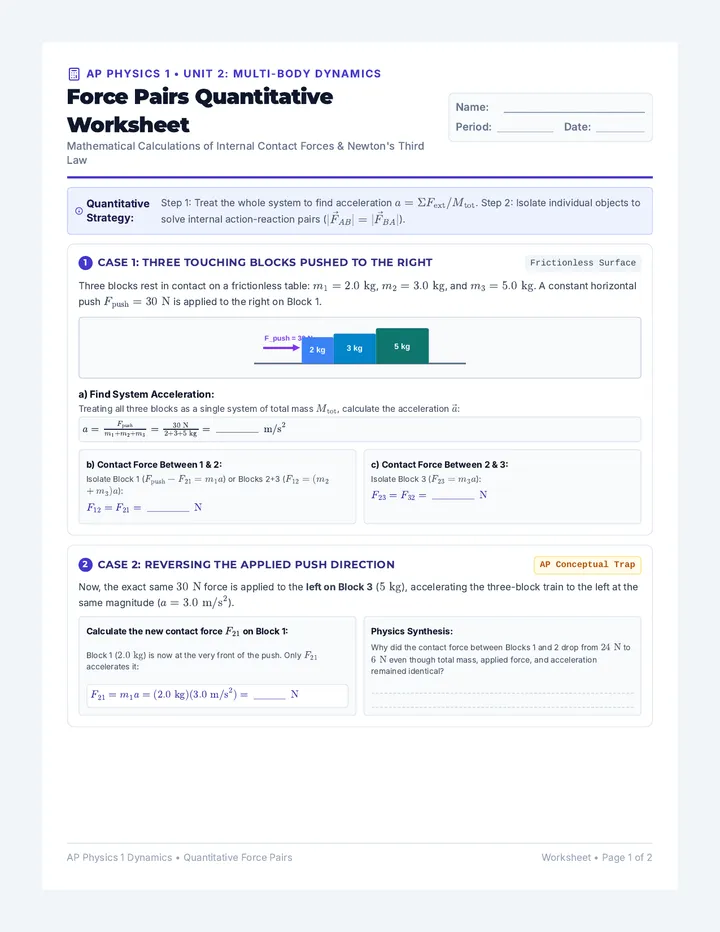
PART 9: TWO-BLOCK CONTACT SYSTEM DYNAMICS AP CLASSIC MULTI-BODY SYSTEM
Physical Setup:
Two blocks rest in direct physical contact on a horizontal, frictionless table. Block A has mass \(m_A = 6.0\,\text{kg}\), and Block B has mass \(m_B = 4.0\,\text{kg}\). A constant horizontal applied force \(F_{\text{app}} = 30.0\,\text{N}\) pushes Block A to the right, which accelerates both blocks together.
F_app = 30 N A (6 kg) B (4 kg)
(a) System Acceleration: Treat both blocks as a single combined system (\(m_{\text{sys}} = m_A + m_B\)). Calculate the acceleration \(a_x\):
(b) Internal Contact Force: Draw a free-body diagram for Block B alone. Apply \(\Sigma F_x = m_B a_x\) to calculate the magnitude of the contact force exerted by Block A on Block B (\(F_{\text{A on B}}\)):
(c) Reversal Comparison: If the same \(30.0\,\text{N}\) force is applied from the right pushing Block B to the left, does the contact force between the blocks increase, decrease, or remain the same? Calculate the new contact force to justify:
PART 10: AP PHYSICS 1 PARAGRAPH-LENGTH ARGUMENT AP EXAM FRQ PRACTICE
Scenario & Student Claim: A heavy freight semi-truck (\(m_{\text{truck}} = 15{,}000\,\text{kg}\)) collides head-on with a compact passenger car (\(m_{\text{car}} = 1{,}000\,\text{kg}\)). A physics student states: "The semi-truck exerts a significantly larger collision force on the car because of its massive size, which is why the compact car undergoes severe crushing damage while the semi-truck barely gets scratched."
In a clear, coherent, paragraph-length response that may include equations and diagrams, evaluate the student's claim. Address both the magnitude of the impact forces (Newton's 3rd Law) and the acceleration/damage consequences for each vehicle (Newton's 2nd Law).
INTRODUCING FORCES // AP PHYSICS 1 PAGE 4 OF 4
Explain this motion from the perspective of an observer standing on the sidewalk (an inertial frame of reference). Did an invisible forward force push the cup?
v_initial → a_bus ←
Key Explanation: From the sidewalk (inertial frame), NO forward force acted on the mug. The mug had forward velocity of \(18\,\text{m/s}\). When brakes engaged, the bus slowed beneath the mug. With negligible friction on the tray, the mug simply maintained its constant forward speed by Newton's 1st Law until falling.
INTRODUCING FORCES // AP PHYSICS 1 PAGE 1 OF 4
TEACHER KEY DYNAMICS WORKBOOK // OVERLAY KEY
SOLUTION KEY // 03
Objective: Master proportional reasoning with \(\vec{a} = \vec{F}_{\text{net}}/m\), interpret graphical relationships, and calculate unknown dynamic variables in 1D multi-force problems.
PART 4: PROPORTIONAL REASONING & SCALING MATRIX ANSWER KEY
An initial net force \(F_0\) acting on mass \(m_0\) produces an initial acceleration \(a_0\). Determine the new resulting acceleration in terms of \(a_0\) for each hypothetical modification.
| Case | Net Force Alteration | Object Mass Alteration | New Acceleration | Factor of Change |
|---|---|---|---|---|
| 1 | Force doubled (\(2F_0\)) | Mass unchanged (\(m_0\)) | \(a = 2a_0\) | Increased by factor of 2 |
| 2 | Force unchanged (\(F_0\)) | Mass tripled (\(3m_0\)) | \(a = \frac{1}{3}a_0\) | Decreased by factor of 3 |
| 3 | Force quadrupled (\(4F_0\)) | Mass doubled (\(2m_0\)) | \(a = 2a_0\) | Increased by factor of 2 |
| 4 | Force cut in half (\(\frac{1}{2}F_0\)) | Mass quadrupled (\(4m_0\)) | \(a = \frac{1}{8}a_0\) | Decreased by factor of 8 |
PART 5: LINEARIZING DYNAMICS DATA (GRAPHS) ANSWER KEY
Graph 1: Net Force vs. Acceleration
F_net (N) a (m/s²)
What does the slope of this line represent physically? State its SI units:
Slope = \(\Delta F / \Delta a = m\) (Inertial mass); Units: \(\text{N}/(\text{m/s}^2) = \text{kg}\).
Graph 2: Acceleration vs. Inverse Mass
a (m/s²) 1/m (kg⁻¹)
What does the slope of this linearized plot represent physically? State its SI units:
Slope = \(\Delta a / \Delta (1/m) = a \cdot m = F_{\text{net}}\) (Net Force); Units: \(\text{kg}\cdot\text{m/s}^2 = \text{N}\).
PART 6: 1D MULTI-FORCE CALCULATION WORKSPACE ANSWER KEY
Problem: Sled Braking with Kinetic Friction and Wind Resistance
A loaded transport sled with total mass \(m = 50.0\,\text{kg}\) travels across flat snow. An expedition worker pulls forward with a constant horizontal rope tension of \(F_{\text{pull}} = 185\,\text{N}\). A kinetic snow friction force of \(f_k = 65\,\text{N}\) opposes motion. A strong headwind exerts an additional opposing drag force of \(F_{\text{drag}} = 45\,\text{N}\).
Full Worked Solution:
(1) \(\Sigma F_x = F_{\text{pull}} - (f_k + F_{\text{drag}}) = 185\,\text{N} - (65\,\text{N} + 45\,\text{N}) = 185 - 110 = +75.0\,\text{N}\).
(2) \(a_x = \Sigma F_x / m = +75.0\,\text{N} / 50.0\,\text{kg} = \mathbf{+1.50\,\text{m/s}^2}\) (in direction of pull).
(3) When \(F_{\text{pull}} = 0\), \(\Sigma F_x = -65 - 45 = -110\,\text{N}\). \(a_x = -110\,\text{N} / 50.0\,\text{kg} = \mathbf{-2.20\,\text{m/s}^2}\) (magnitude \(2.20\,\text{m/s}^2\) leftward).
INTRODUCING FORCES // AP PHYSICS 1 PAGE 2 OF 4
TEACHER KEY DYNAMICS WORKBOOK // OVERLAY KEY
SOLUTION KEY // 03
Objective: Deconstruct Newton's Third Law interaction pairs, debunk the "cancellation fallacy", and rigorously resolve classic dynamics paradoxes such as the horse-and-cart.
PART 7: ACTION-REACTION FORCE PAIR MATRIX ANSWER KEY
Directions: Complete the table below for each interaction. Clearly state the exact action and reaction forces using explicit subscript notation (\(F_{\text{X on Y}}\)) and specify the category of force.
| Physical Interaction | Action Force Description | Reaction Force Description | Force Category |
|---|---|---|---|
| 1. Satellite orbiting Earth | Earth pulls downward on satellite (\(F_{\text{E on S}}\)) | Satellite pulls upward on Earth (\(F_{\text{S on E}}\)) | Gravitational |
| 2. Swimmer pushing off pool wall | Swimmer's feet push backward on wall (\(F_{\text{S on W}}\)) | Wall pushes forward on swimmer's feet (\(F_{\text{W on S}}\)) | Normal (Contact) |
| 3. Baseball bat striking a baseball | Bat exerts forward force on ball (\(F_{\text{Bat on Ball}}\)) | Ball exerts backward force on bat (\(F_{\text{Ball on Bat}}\)) | Normal (Contact) |
| 4. Car tire driving on road | Tire tread pushes backward on road (\(F_{\text{T on R}}\)) | Road pushes forward on tire tread (\(F_{\text{R on T}}\)) | Friction (Static) |
PART 8: DEBUNKING THE HORSE-AND-CART PARADOX ANSWER KEY
The Paradox Dilemma:
A frustrated horse argues with its driver: "According to Newton's Third Law, if I pull forward on the cart with force \(F\), the cart pulls backward on me with an equal force \(-F\). These forces are equal and opposite, so they cancel to zero. Therefore, I can never accelerate the cart!"
Identify the scientific fallacy in the horse's argument. Why do action-reaction pairs NEVER cancel each other out?
Cart Horse F_H on C → ← F_C on H
1. FBD Analysis: Why the CART accelerates
Identify all horizontal forces acting ON THE CART alone:
Forces on CART:
+ Forward pull from horse (\(F_{\text{H on C}}\))
- Backward ground rolling friction (\(f_{\text{cart}}\))
If \(F_{\text{H on C}} > f_{\text{cart}}\), the cart experiences a net forward force and accelerates forward!
2. FBD Analysis: Why the HORSE accelerates
Identify all horizontal forces acting ON THE HORSE alone:
Forces on HORSE:
+ Forward static friction from ground (\(f_{\text{ground on hooves}}\))
- Backward pull from cart (\(F_{\text{C on H}}\))
If the horse pushes back hard enough against Earth, \(f_{\text{ground}} > F_{\text{C on H}}\), so the horse accelerates!
INTRODUCING FORCES // AP PHYSICS 1 PAGE 3 OF 4
TEACHER KEY DYNAMICS WORKBOOK // OVERLAY KEY
SOLUTION KEY // 03
Objective: Analyze multi-body contact systems using system vs. internal object analysis, and craft an AP Physics 1 coherent paragraph-length argument response.
PART 9: TWO-BLOCK CONTACT SYSTEM DYNAMICS ANSWER KEY
Physical Setup:
Two blocks rest in direct physical contact on a horizontal, frictionless table. Block A has mass \(m_A = 6.0\,\text{kg}\), and Block B has mass \(m_B = 4.0\,\text{kg}\). A constant horizontal applied force \(F_{\text{app}} = 30.0\,\text{N}\) pushes Block A to the right, which accelerates both blocks together.
F_app = 30 N A (6 kg) B (4 kg)
(a) System Acceleration: Treat both blocks as a single combined system (\(m_{\text{sys}} = m_A + m_B\)). Calculate the acceleration \(a_x\):
\(m_{\text{sys}} = 6.0\,\text{kg} + 4.0\,\text{kg} = 10.0\,\text{kg}\).
\(a_x = \frac{\Sigma F_{\text{ext}}}{m_{\text{sys}}} = \frac{30.0\,\text{N}}{10.0\,\text{kg}} = \mathbf{3.0\,\text{m/s}^2}\) (to the right).
(b) Internal Contact Force: Draw a free-body diagram for Block B alone. Apply \(\Sigma F_x = m_B a_x\) to calculate the magnitude of the contact force exerted by Block A on Block B (\(F_{\text{A on B}}\)):
Only horizontal force on B is contact push: \(\Sigma F_x = F_{\text{A on B}} = m_B a_x\).
\(F_{\text{A on B}} = (4.0\,\text{kg})(3.0\,\text{m/s}^2) = \mathbf{12.0\,\text{N}}\) (to the right).
(c) Reversal Comparison: If the same \(30.0\,\text{N}\) force is applied from the right pushing Block B to the left, does the contact force between the blocks increase, decrease, or remain the same? Calculate the new contact force to justify:
Contact force INCREASES to 18.0 N. System acceleration is still \(3.0\,\text{m/s}^2\), but the interface now accelerates Block A alone: \(F_{\text{contact}} = m_A a_x = (6.0\,\text{kg})(3.0\,\text{m/s}^2) = \mathbf{18.0\,\text{N}}\).
PART 10: AP PHYSICS 1 PARAGRAPH-LENGTH ARGUMENT SAMPLE 5/5 ARGUMENT
Scenario & Student Claim: A heavy freight semi-truck (\(m_{\text{truck}} = 15{,}000\,\text{kg}\)) collides head-on with a compact passenger car (\(m_{\text{car}} = 1{,}000\,\text{kg}\)). A physics student states: "The semi-truck exerts a significantly larger collision force on the car because of its massive size, which is why the compact car undergoes severe crushing damage while the semi-truck barely gets scratched."
Model AP Paragraph Response: The student's claim is incorrect regarding the forces. According to Newton's Third Law, any contact interaction consists of an action-reaction pair that is strictly equal in magnitude and opposite in direction: \(|\vec{F}_{\text{truck on car}}| = |\vec{F}_{\text{car on truck}}|\), regardless of vehicle mass or speed. The severe damage to the car is governed by Newton's Second Law (\(a = F_{\text{net}} / m\)). Because both vehicles experience identical collision forces (\(F\)), the car with its 15-fold smaller mass experiences an acceleration 15 times greater than that of the truck (\(a_{\text{car}} = F/1000 = 15 \cdot a_{\text{truck}}\)). This extreme acceleration difference causes rapid crushing deformation and catastrophic kinetic energy dissipation in the lightweight car structure.
INTRODUCING FORCES // AP PHYSICS 1 PAGE 4 OF 4