Lenny.com
Explore
Create
ActivitiesNewMathEnglish Language ArtsScience & EngineeringSocial StudiesGlobal LanguagesHealth & Physical EducationSpecial EducationCounseling & Life SkillsArts & CreativityESL
Lenny.com
Lenny.com
Explore
Create
ActivitiesNewMathEnglish Language ArtsScience & EngineeringSocial StudiesGlobal LanguagesHealth & Physical EducationSpecial EducationCounseling & Life SkillsArts & CreativityESL
Lenny.com
Lenny.com

Solutions

Lenny for EducatorsLenny for SchoolsLenny for Districts

Product

ExploreSign inCreateSupportAbout

Resources

Getting startedMTSS Acceleration Program

© 2026 Lenny Learning Inc.

TermsPrivacyAccessibility
LinkedInInstagramX
Lenny

Energy Changes

Exothermic and endothermic reactions, enthalpy changes, and the law of conservation of energy. Examines bond energies and calorimetry to quantify heat transfer in chemical processes.

Science & EngineeringLife ScienceLiving ThingsAnimalsPlantsBody SystemsTraitsAdaptationsCellsEcosystemsHeredityGenes to TraitsCell DivisionPhysicsComparing MaterialsShapes and PropertiesMagnetsMagnetismLightSoundLight and SoundMatterStates of MatterChanges of StateMixturesPhysical and Chemical ChangeHeating and CoolingHeat and Thermal EnergyEnergyForce and MotionElectrical CircuitsAtoms and MoleculesPeriodic TableMotion in One DimensionMotion in Two DimensionsScalars and VectorsForces and Laws of MotionCircular Motion and GravityMomentum and ImpulseWork, Energy, and PowerWavesElectromagnetic WavesGeometric OpticsElectricity and MagnetismSimple Harmonic MotionThermodynamicsNuclear PhysicsEarth Science & AstronomyWeatherWater CycleRocks and MineralsFossilsEarth's FeaturesEarth's ResourcesEarth's StructureWeather and ClimateEarth EventsFossils and Geologic TimePlate TectonicsHuman ImpactsAstronomyChemistryUnits and MeasurementAtomic StructurePeriodic TrendsChemical BondingNomenclatureMolecular StructureIntermolecular ForcesThe MoleStoichiometryProperties of GasesSolutionsChemical ReactionsBalancing EquationsEnergy ChangesRates of ReactionsEquilibriumAcids and BasesQuantum ModelBiologyClassificationCell StructureThe Chemistry of LifeBiomoleculesCellular TransportCell EnergyCell Growth and DivisionDNAProtein SynthesisMeiosis and Sexual ReproductionPatterns of InheritanceMulticellular OrganismsEvolutionEcologyBiodiversityComputer ScienceAlgorithms and Computational ThinkingProgramming LanguagesComputing SystemsNetworks and InternetData AnalysisCybersecurityAI and Machine LearningSoftware Design and DevelopmentBlockchainEngineering & AIDesigning ExperimentsEngineering PracticesDesign ThinkingEngineering Design ProcessMechanical EngineeringElectrical EngineeringMaterials and StructuresCAD and 3D DesignRoboticsArtificial Intelligence BasicsVibe CodingMachine LearningAI Ethics and SocietySystems ThinkingEntrepreneurship & InnovationEntrepreneurial MindsetBusiness Idea DevelopmentBusiness Plan BasicsMarketing & Customer DiscoveryFinancial Management for Startups

Videos

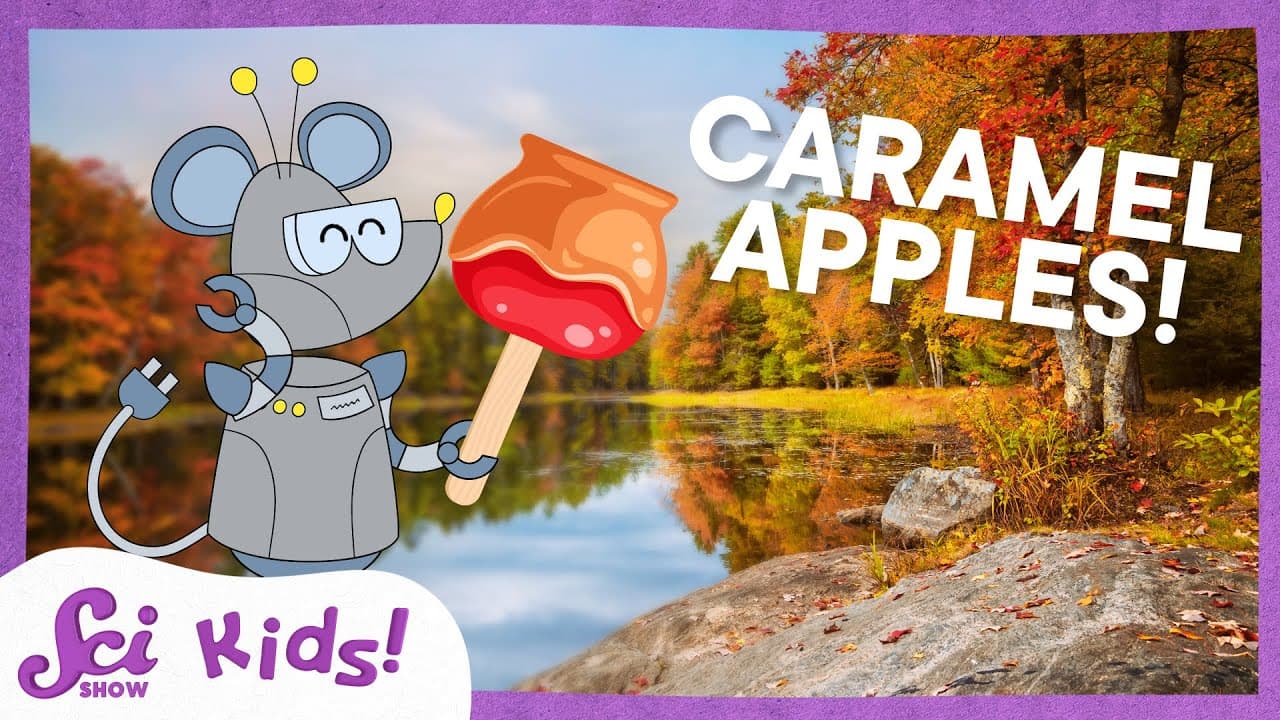
How to Make Caramel Apples and Learn Chemistry

How to Make Caramel Apples and Learn Chemistry

In this engaging episode of Sci Kids!, host Jessi and her puppet friend Sam explore the chemistry behind cooking by making caramel apples. The video introduces the concept of the Maillard reaction, a chemical process responsible for the browning and flavor development in cooked foods. Through the practical application of making caramel, students learn that cooking is essentially a form of edible science that requires specific ingredients (proteins and sugars) and conditions (heat) to work.

SciShow KidsSciShow Kids

7mins 1s

How Heat and Work Change Energy

How Heat and Work Change Energy

This engaging video lesson provides a clear and practical introduction to the First Law of Thermodynamics, using real-world examples like the SR-71 Blackbird spy plane and hot air balloons to ground abstract physics concepts. The narrator explains the fundamental relationship between heat ($q$), work ($w$), and the change in internal energy ($ΔE$), demonstrating that energy is conserved and can only be transferred, not created or destroyed. The video breaks down the mathematical formula $ΔE = q + w$ and provides specific rules for determining positive and negative signs based on whether a system gains or loses energy. Key themes explored include the definitions of thermodynamic systems and surroundings, the conversion of heat into mechanical work, and the principle of conservation of energy. The video specifically focuses on the crucial skill of identifying sign conventions—understanding when heat and work values should be positive or negative in calculations. It walks students through multiple practice problems, moving from conceptual identification to calculating energy changes in kilojoules. For educators, this video is an excellent resource for high school chemistry or physics units on thermodynamics. It bridges the gap between conceptual understanding and mathematical application. The step-by-step problem-solving sections allow for natural pause points where students can attempt calculations before seeing the solution, making it ideal for direct instruction or flipped classroom models. The use of the SR-71 Blackbird as a hook effectively demonstrates how thermodynamic principles solve real engineering problems.

Miacademy & MiaPrep Learning ChannelMiacademy & MiaPrep Learning Channel

12mins 34s

Exploring Energy Transformations in Everyday Life

Exploring Energy Transformations in Everyday Life

This educational video provides a clear and visually engaging introduction to the concept of energy transformations. It defines energy as a pervasive force that shifts forms and systematically explores various types of conversions, such as chemical to thermal, thermal to chemical, light to chemical, and the interplay between kinetic and potential energy (elastic and gravitational). Through high-quality demonstrations involving everyday items like candles, cooking eggs, glow sticks, and toys, the video makes abstract physics concepts concrete and observable. Key themes include the law of conservation of energy (demonstrated through transformation), the specific mechanics of potential versus kinetic energy, and the role of energy in biological processes like photosynthesis. The video breaks down complex interactions—such as how the mechanical action of snapping a glow stick initiates a chemical reaction—into easy-to-understand segments labeled with clear text overlays. It covers a wide spectrum of energy types including thermal, chemical, light, elastic, kinetic, and gravitational potential energy. For educators, this resource serves as an excellent visual anchor for units on physics and matter. It is particularly useful for bridging the gap between textbook definitions and real-world phenomena. Teachers can use the segmented examples to introduce specific energy types or as a review tool to check student understanding of how energy changes form. The varied examples, from archery to cooking, ensure that the content appeals to diverse student interests and provides multiple entry points for discussion.
Next Generation ScienceNext Generation Science

5mins 1s

Everyday Chemical Reactions: From Cooking to Fireworks

Everyday Chemical Reactions: From Cooking to Fireworks

This engaging educational video introduces students to the concept of chemical reactions by exploring how they occur in everyday life. Through relatable examples like cooking an egg, baking a cake, and watching fireworks, the narration explains how substances combine and transform into something new. The video breaks down complex chemical processes into observable phenomena, highlighting the key indicators of reactions such as color changes, gas production (bubbles), heat, and light. The content covers a wide range of scientific themes, including physical vs. chemical changes, the role of heat in reactions, biological processes like digestion and photosynthesis, and oxidation (rusting). It specifically addresses how distinct elements like oxygen, carbon dioxide, and various metals play roles in these transformations. The video creates connections between the chemistry laboratory and the real world, showing that science is happening constantly in our bodies and environments. For educators, this resource serves as an excellent introduction or review tool for a unit on matter and chemical changes. The visual demonstrations provide concrete evidence for abstract concepts, making them accessible to elementary and middle school students. The video concludes with a comprehensive 12-question quiz, making it a ready-to-use lesson that includes direct assessment of student understanding.

Next Generation ScienceNext Generation Science

6mins 54s

How to Make Homemade Ice Cream Using Science

How to Make Homemade Ice Cream Using Science

In this engaging episode of SciShow Kids, host Jessi and her robot mouse friend Squeaks demonstrate how to make homemade ice cream using basic kitchen ingredients and the power of chemistry. The video guides viewers through a hands-on experiment that transforms liquid cream into solid ice cream without using a freezer, relying instead on a chemical reaction between ice and salt. The content focuses heavily on the scientific concepts of states of matter and freezing point depression. It explains in accessible terms why salt is added to ice (similar to salting icy roads in winter) and how this process lowers the freezing temperature of water. The video uses clear animations to visualize how melting ice draws heat away from the cream mixture, allowing it to freeze rapidly. This video is an excellent resource for elementary science classrooms as it combines a fun, edible reward with rigorous scientific inquiry. It provides a perfect practical application for lessons on phase changes, temperature, and following procedural texts. Teachers can use this video to introduce thermodynamics or simply as a guide for a beloved classroom activity that reinforces measuring skills and observation.

SciShow KidsSciShow Kids

4mins 10s

Kitchen Chemistry: Identifying Chemical Changes

Kitchen Chemistry: Identifying Chemical Changes

This educational video from Crash Course Kids uses the relatable context of baking to explain the scientific concept of chemical changes. Host Sabrina Cruz introduces chemistry as the science of matter and how it changes, distinguishing between simple mixtures (like a fruit salad) that can be separated and chemical changes that create entirely new substances. The video defines a chemical change as the rearrangement of particles to form a new substance, a process that is typically irreversible. The content explores specific evidence that indicates a chemical change has occurred, using two primary examples: a burning match and a baking cake. Through these examples, students learn to identify key indicators such as color change, the release of smells, the production of light or gases, and the absorption or release of heat. The video specifically highlights how the holes in a sponge cake are evidence of carbon dioxide gas released during the baking process. This resource is highly valuable for elementary and middle school science classrooms as it bridges the gap between abstract chemical concepts and everyday experiences. It provides a clear, visual framework for students to distinguish between physical and chemical changes. Teachers can use this video to launch units on properties of matter, to support hands-on kitchen chemistry experiments, or as a visual aid to reinforce the indicators of chemical reactions.

Crash Course KidsCrash Course Kids

3mins 51s

Materials

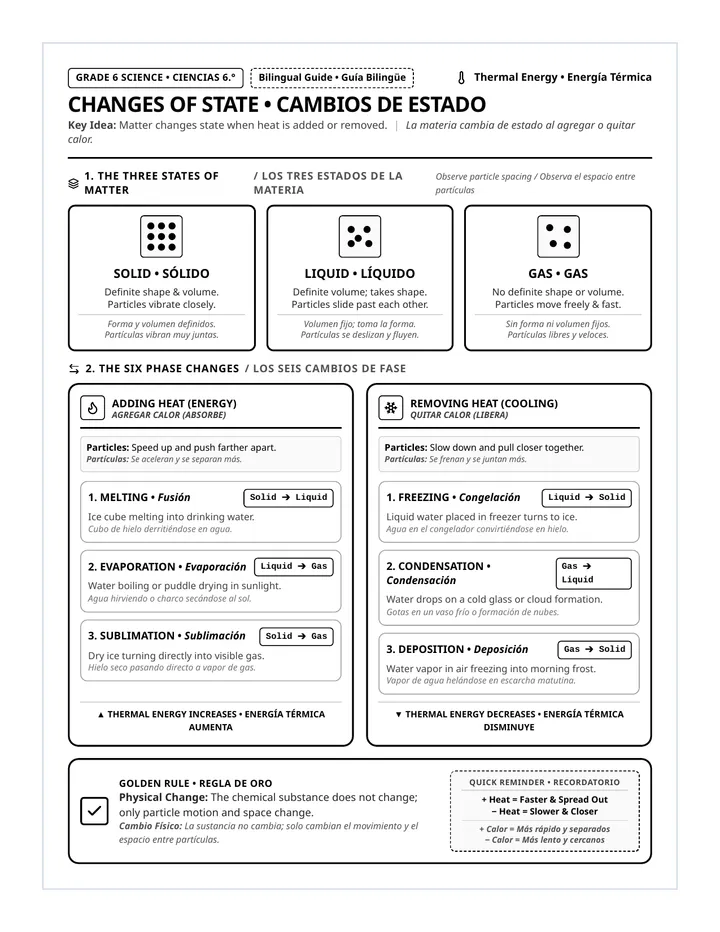
State Changes Anchor Chart

State Changes Anchor Chart

A black-and-white, printer-friendly bilingual (English-Spanish) anchor chart visual for 6th-grade science with no code switching in the quick reminder section.

AA

Aline Araujo Teixeira

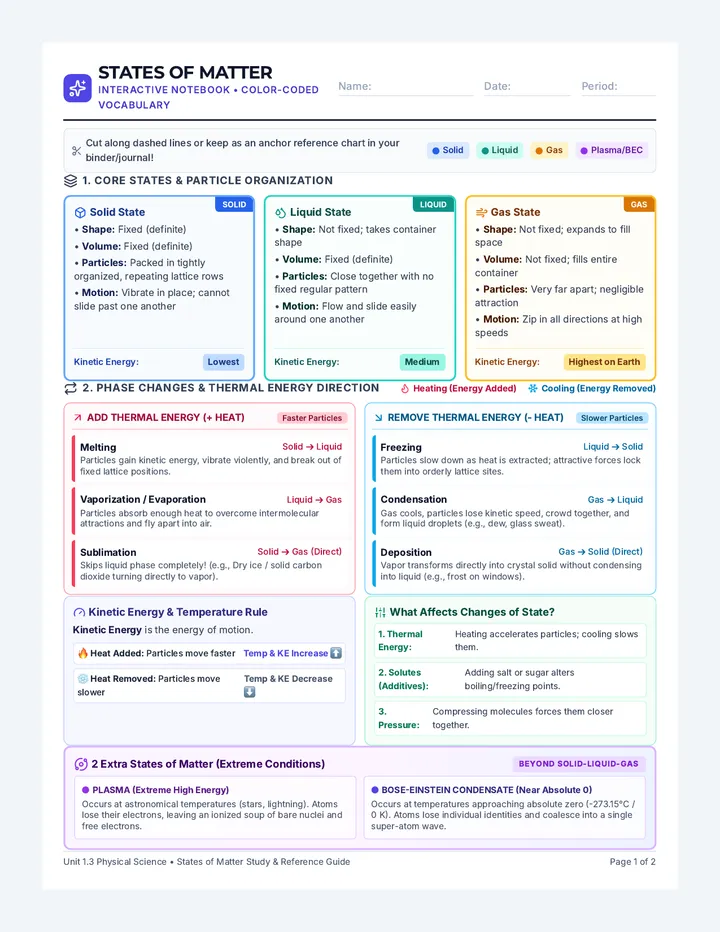
Matter Models Interactive Notebook

Matter Models Interactive Notebook

A 2-page interactive science notebook resource featuring color-coded vocabulary in distinct dotted cut-out sections and a unified single-tab 3-flap states of matter particle foldable with increasing energy progression.

RL

RMS Lenny

Quimica de la Vida Examen

Quimica de la Vida Examen

Examen de química de la vida para 8.º grado con el título en inglés seguido de la indicación 'Spanish Translation' (Chemistry of Life Vocabulary Exam — Spanish Translation), manteniendo el encabezado institucional en inglés y el contenido íntegramente en español.

JE

Jeffrey Elterman

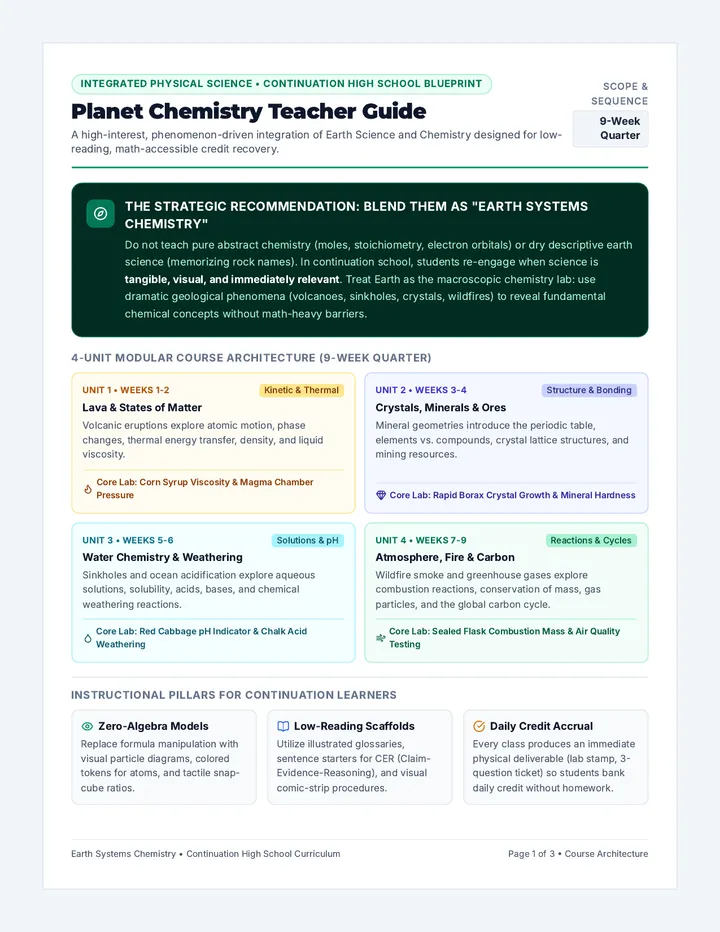
Planet Chemistry Teacher Guide

Planet Chemistry Teacher Guide

A comprehensive curriculum blueprint integrating chemistry and earth science specifically tailored for continuation high school students. Features four accessible, hands-on units, low-math lab investigations, and structured literacy supports for credit recovery.

MH

Meagan Hudson

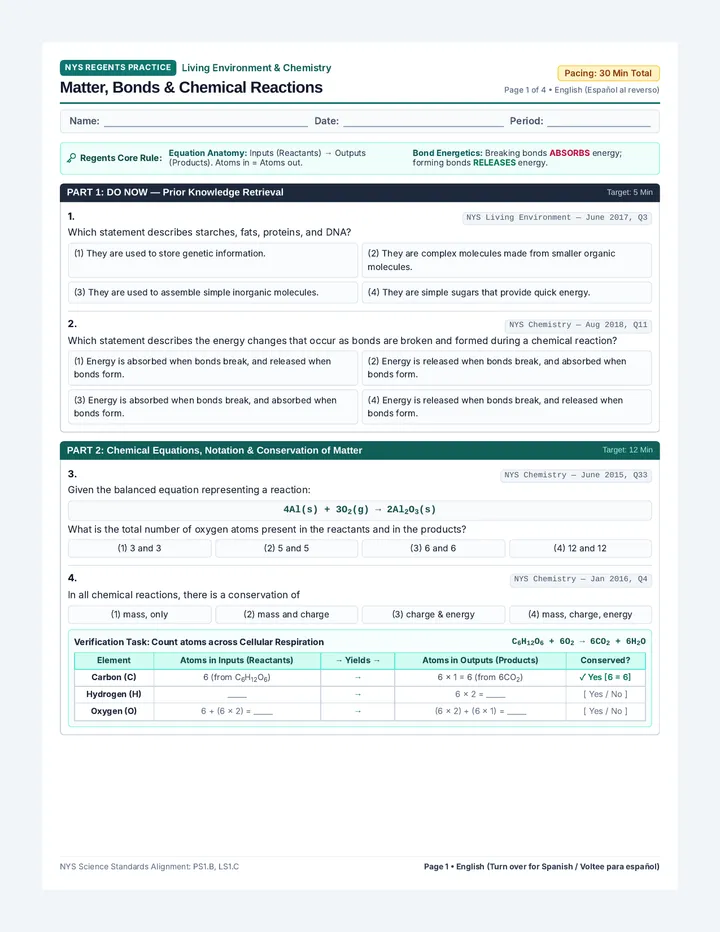
Regents Reaction Chemistry Worksheet

Regents Reaction Chemistry Worksheet

A 30-minute NYS Regents practice worksheet featuring verbatim Living Environment and Chemistry exam questions on atoms, biomolecules, chemical equations, conservation of matter, and bond energy. Includes an integrated Do Now, Exit Slip, and synchronized page-by-page Spanish translations designed for duplex printing.

JE

Jeffrey Elterman

Phase Change Triangle Worksheet

Phase Change Triangle Worksheet

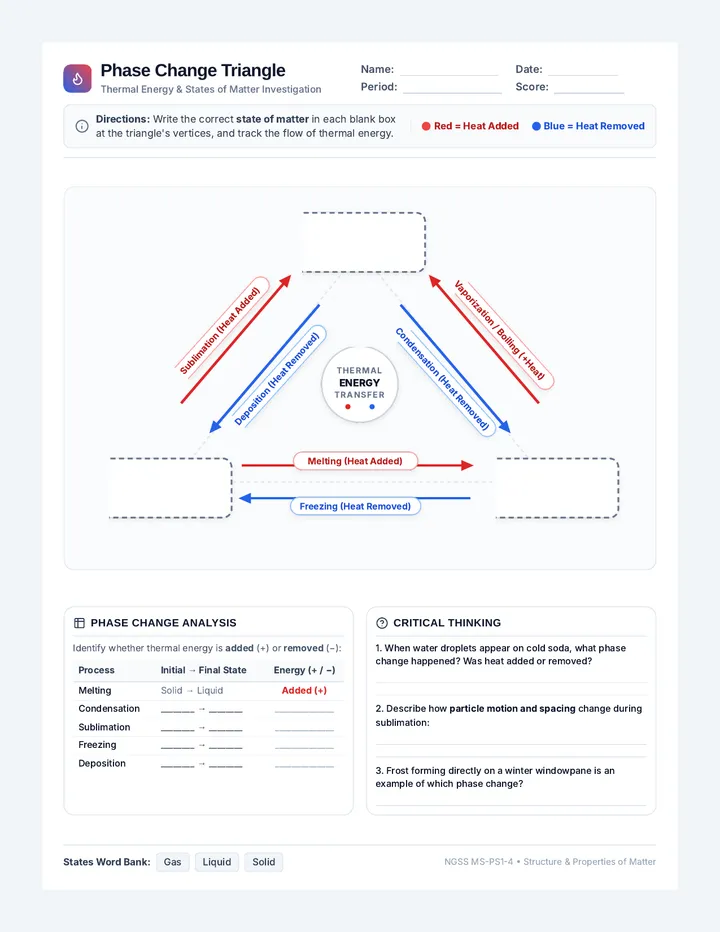
A science worksheet featuring a phase change triangle diagram with red arrows for heat added, blue arrows for heat removed, process labels, and blank boxes for students to write the three states of matter.

LN

Leah Nickols

Sequences

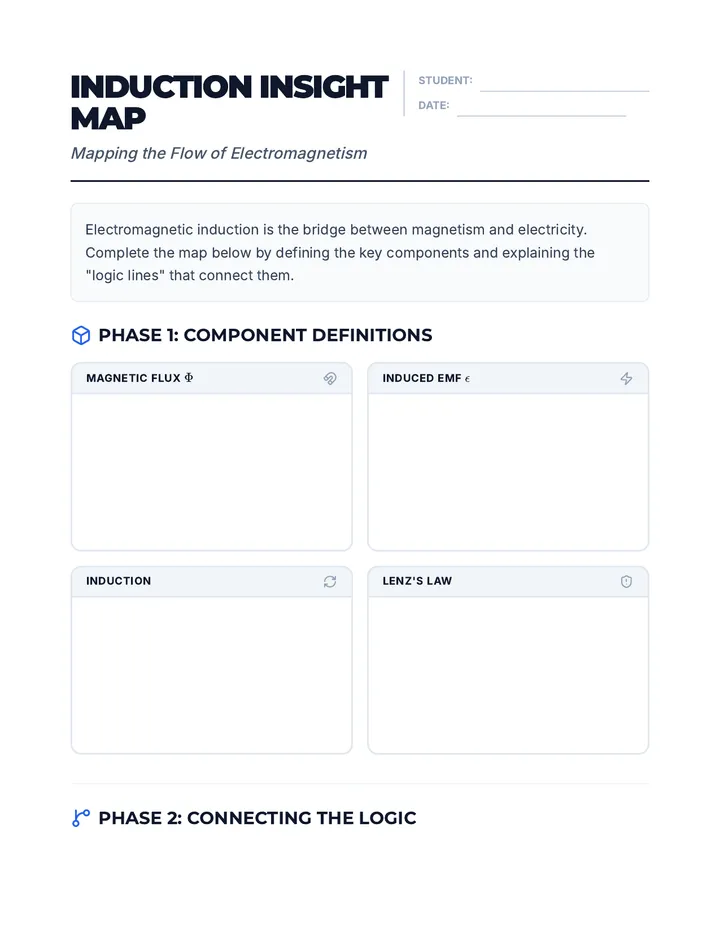
Induction Insight Map Handout

Magnetic Forces Investigation

A 5-day intensive exploration of magnetic forces and fields, focusing on atomic-level causes, field interactions, and mathematical modeling of forces on charged particles. Students progress from anchoring phenomena to complex mathematical applications and a comprehensive unit review.

OM

Olutoyin Makinde

68
Mission Scoring Rubric

Physics Frontiers Research Project

A partner-based research project for 9th-grade conceptual physics students focusing on diverse topics from celestial mechanics to the physics of dance. Students move through a structured research process with mandatory teacher checkpoints for source reliability.

C

ckroeker

13
Hess Pathfinders Slides

Energy in Chemical Bonds

A five-day high school chemistry unit exploring thermochemistry, collision theory, enthalpy diagrams, and calorimetry through the lens of body heat and chemical reactions. Students investigate the anchoring phenomenon of exercise-induced heat while mastering TEKS C.13 standards.

OM

Olutoyin Makinde

48
Pressure Poster Workshop Handout

Pressure Power

A comprehensive 5-day chemistry unit investigating the relationships between gas pressure, volume, temperature, and moles using lab inquiries, mathematical modeling, and real-world applications.

OM

Olutoyin Makinde

69
KMT Field Manual Packet

Molecular Mayhem Gas Unit

A 10-day exploration of the Behavior of Gases using Kinetic Molecular Theory, various gas laws, and real-world phenomena to understand gas behavior at both molecular and macroscopic scales. Students will investigate compressibility, gas variables, ideal behavior, and mixtures.

OM

Olutoyin Makinde

26
Steady State Slides

Reaction Dynamics

This unit explores how chemical reactions occur and how they reach a state of balance. Students investigate reaction kinetics, energy changes, and the principles of dynamic equilibrium through modeling and laboratory investigation.

OM

Olutoyin Makinde

34

Lessons

Heat Flow Teacher Guide

Particle Behavior Review

A lesson focusing on the states of matter (solid, liquid, gas) and the behavior of particles at the molecular level. Students will model particle motion and arrangement, as well as the energy changes that drive phase transitions.

EA

Erica Andre

54
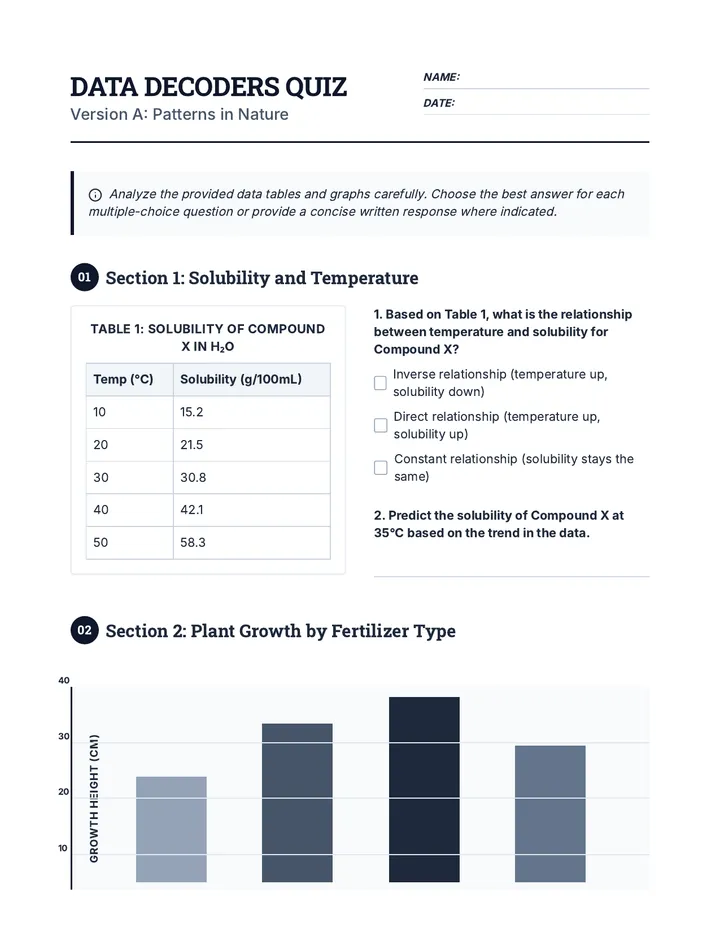
Data Decoders Quiz A

Data Decoders Assessment

A high-stakes assessment focused on interpreting various scientific data representations, including tables, bar graphs, line graphs, and scatter plots. Students will analyze trends, identify variables, and draw conclusions from realistic scientific scenarios.

JF

Jim Fusaro

4
Biomolecule Burnout Worksheet

Biomolecule Burnout

A high school biology quick lab exploring energy storage in biomolecules through the combustion of common foods representing carbohydrates, lipids, and proteins.

SB

Stephen Bassford

4
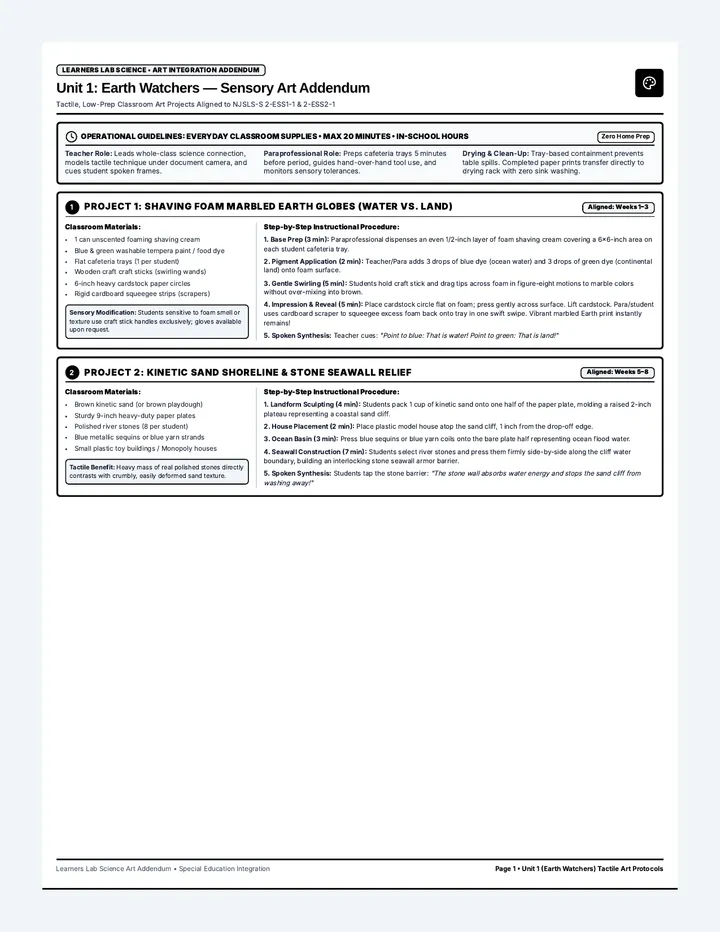
Learners Lab Science Art Addendum

Learners Lab Science

An adapted special education science curriculum framework aligning NJSLS-S standards across grades 2-4 with functional access points, 25-minute multi-sensory inquiry lessons, and rigorous tiered expression.

JE

jenn edwards

21
Molecular Lab Slides

Matter Lab Review

A comprehensive review of the states of matter and phase changes designed for diverse learners, featuring simplified text, visual aids, and structured graphic organizers.

CB

Chloe Brown

5
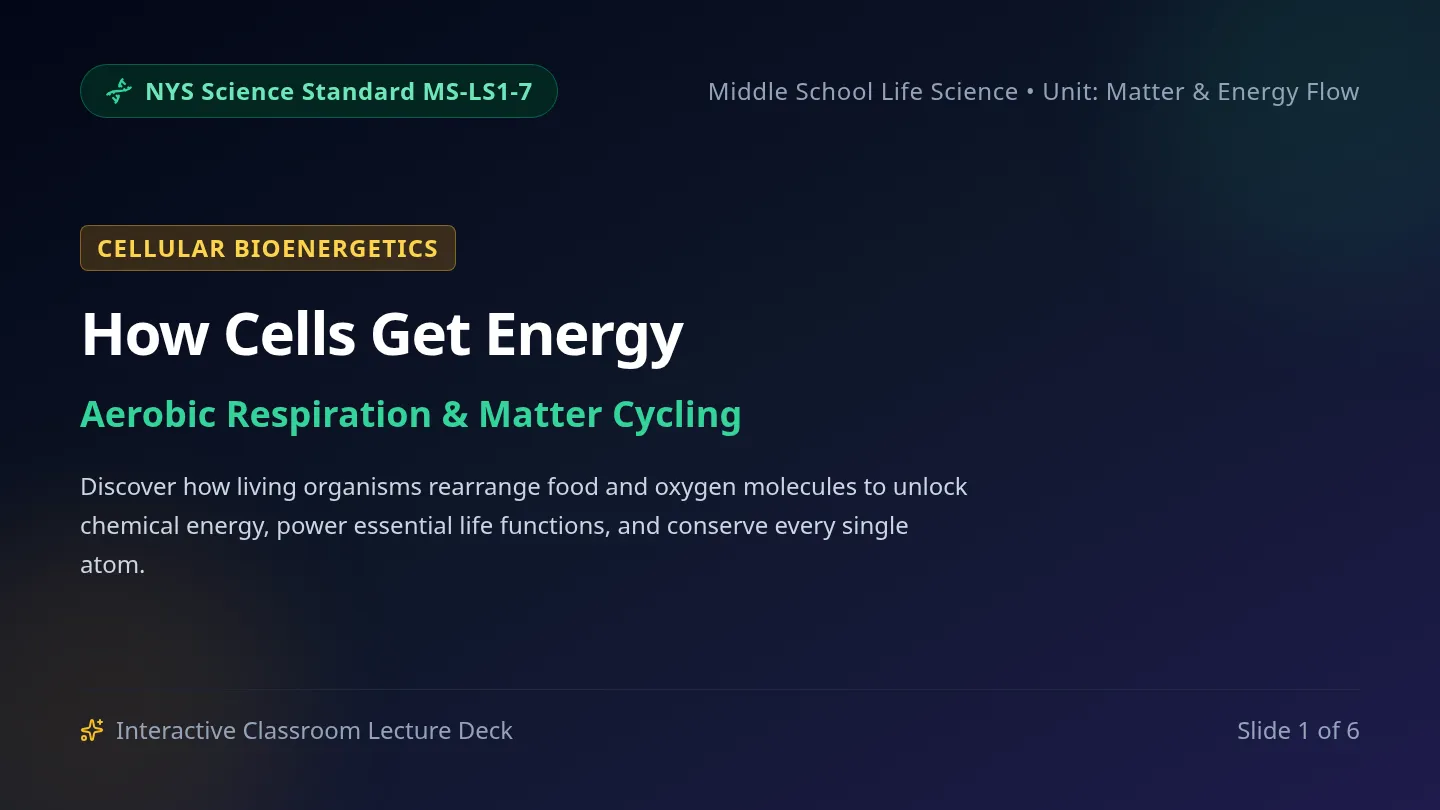
Cell Energy Slides

Cell Power

An inquiry-based middle school lesson on aerobic cellular respiration, matter cycling, and energy release aligned with NYS MS-LS1-7. Students explore how cells rearrange food and oxygen molecules to unlock chemical energy without losing a single atom.

JE

Jeffrey Elterman

4