Forces Motion Slides Grade 4 Physical Science • PS.4.1
Week 1: Fundamentals
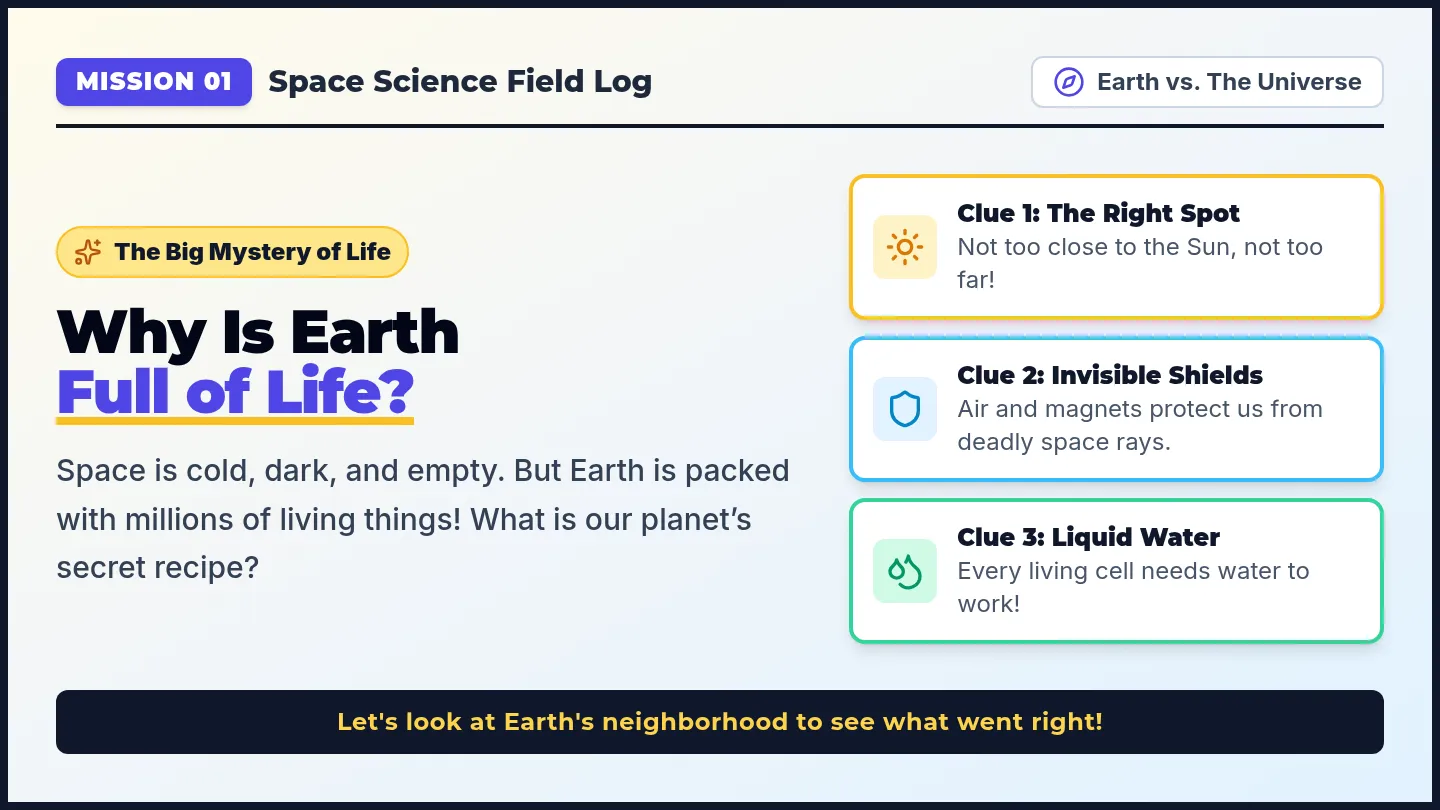
Forces in Motion!
How do pushes, pulls, and invisible fields make objects move and interact?
Push Forces Moving things away
Pull Forces Drawing things closer
Invisible Fields Action across space
Investigation 1 • Forces & Motion Physical Science Unit
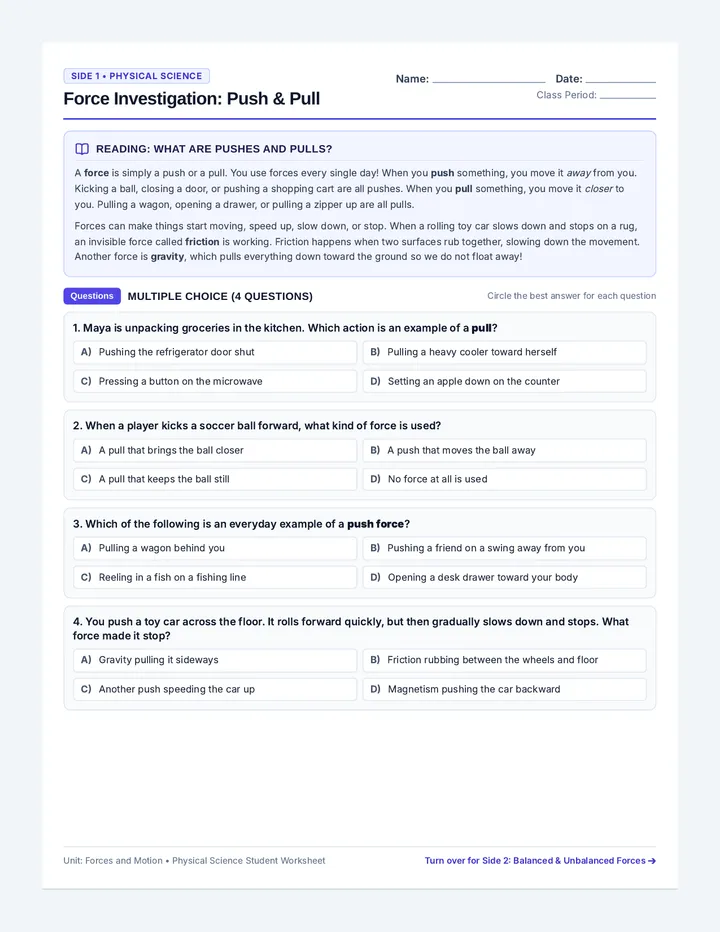
What is a Force? A Push or a Pull
Visual Science Model
A Push
Moves Away
A force directed away from the source applying it.
OBJECT
Kicking or Shoving Forward push causes forward acceleration!
Everyday Examples: ⚽ Kicking ball • 🚪 Shutting door • 🧲 Repelling N-N poles
A Pull
Brings Closer
A force that draws an object toward the source applying it.
Tugging or Attracting Rope pulls wagon towards the person!
Everyday Examples: 🛒 Pulling cart • 🌍 Gravity pulling down • 🧲 Magnet attraction
Golden Rule: Every force requires an interaction between at least TWO objects!
Contact Forces vs Non-Contact Forces
Core Distinction
Contact Forces
Direct Touch
Objects must physically touch to transfer energy and push or pull.
Friction & Push Rough surfaces lock together to resist motion!
• Applied Force: Hand pushing a swing
• Friction: Brakes stopping a bicycle
Non-Contact Forces
Empty Space
Forces act across an air gap through invisible fields!
N S
Magnetic Field Force Paperclip jumps through air before touching!
• Magnetism: North & South pole attraction
• Static Electric: Charged balloon hair lift
Non-contact forces prove that empty space is not empty —it is filled with invisible force fields!
Physicist Turn & Talk Discussion
Partner Inquiry
“Can an object move if nothing is physically touching it?”
N - Pole N - Pole
Observation A: Levitation Ring magnets hover in midair with zero physical contact!
Observation B: Jumping Paper Charged comb pulls confetti straight off the table!
What is crossing the gap between objects to cause this change in motion?
Unit: Force Fields Action Next Step: Hands-On Station Lab
Forces Motion Worksheet Grade 4 Physical Science • PS.4.1
Forces in Motion Lab Sheet
Investigating Pushes, Pulls, and Action at a Distance
Name:
Date: Class:
Physicist Vocabulary Box
Force: A push or pull that can change an object's speed or direction.
Contact Force: A force that occurs when two objects physically touch.
Non-Contact Force: A force that acts across empty space without touching.
Motion: A change in the position of an object over time.
1 Part 1: Push, Pull, or Both?
Classify each action by checking the correct box and stating whether contact is required.
Action Scenario Push / Pull Contact or Non-Contact? 1. Kicking a rolling soccer ball into a goal [ ] Push [ ] Pull [ ] Contact [ ] Non-Contact 2. A magnet lifting a steel paperclip off a table [ ] Push [ ] Pull [ ] Contact [ ] Non-Contact 3. A rubbed balloon pushing away another balloon [ ] Push [ ] Pull [ ] Contact [ ] Non-Contact 4. Pulling a wagon loaded with science supplies [ ] Push [ ] Pull [ ] Contact [ ] Non-Contact
2 Part 2: Cause and Effect on Motion
Scenario: A toy car is rolling forward on a smooth floor. You gently push it in the exact same direction it is already moving. What happens to its motion?
Scenario: You roll the same toy car across a rough shag carpet. What force slows it down, and is it a contact or non-contact force?
Unit 1: Force Fields Action Page 1 of 2
Forces Lab Station Observations
Hands-On Inquiry
Station A: The Floating Magnet Test
Materials: Ring magnets, pencil stand
Slide two ring magnets onto the pencil. Flip one magnet over if they snap together. Describe what happens when one magnet "floats" above the other:
Is this a contact force or non-contact force? How do you know?
Station B: The Electric Paper Jump
Materials: Plastic comb/rod, wool cloth, paper dots
Rub the plastic comb with the wool cloth for 15 seconds. Hold it 2 cm above tiny paper dots. Record your observation:
Did the comb touch the paper before the paper moved? What caused the motion?
Forces Vocabulary Flashcards Grade 4 Physical Science • PS.4.1 Vocabulary
Forces & Motion Flashcard Set (Set A)
Cut along dashed lines ✂️
Physics Term
Force
noun • [fors]
A push or pull on an object that can cause it to move, stop, speed up, or change direction.
Example: You exert a force when you kick a soccer ball across grass.
Physics Term
Motion
noun • [moh-shuhn]
A change in an object's position over time relative to a starting reference point.
Example: A rolling toy car is in motion until friction stops it.
Force Type
Contact Force
noun • direct physical touch
A force that can only act between two objects when they are physically touching each other.
Example: Friction, pushing a swing, and kicking a ball.
Force Type
Non-Contact Force
noun • action at a distance
A push or pull that acts across empty space without physical contact between objects.
Example: Magnetism, static electricity, and gravity.
Magnetism
Magnetic Field
noun • invisible force zone
The invisible region around a magnet where magnetic forces can push or pull magnetic objects.
Example: Iron filings align into curved lines in a magnetic field.
Magnetism
Magnetic Poles
noun • North & South ends
The two ends of a magnet where the magnetic field is strongest (North and South poles).
Example: Opposites attract (N-S) and like poles repel (N-N).
Electricity
Static Electricity
noun • resting charge buildup
An imbalance of positive and negative electrical charges on the surface of an object.
Example: Rubbing a balloon on a sweater builds up static charge.
Electricity
Electrical Charge
noun • positive (+) & negative (-)
A basic physical property of matter that causes objects to attract or repel when near each other.
Example: Electrons give objects a negative electrical charge.
Grade 4 Physical Science • Vocabulary Set A Page 1 of 2
Grade 4 Physical Science • PS.4.1 Vocabulary
Forces & Motion Flashcard Set (Set B)
Cut along dashed lines ✂️
Forces Unit Pacing Guide Teacher Instructional Resource
5-Week Unit Pacing Guide
Unit: Force Fields in Action (Grade 4 Physical Science • PS.4.1)
Grade 4 Science 5 Weeks • 25 Days
Target Standards
PS.4.1: How various forces affect the motion of an object.PS.4.1.1: Magnetic interactions between non-contact objects.PS.4.1.2: Electrically charged objects pushing/pulling to produce motion.
Essential Questions
• How can forces push or pull objects across empty space?
• What causes like poles/charges to repel and opposites to attract?
• How does distance change the strength of a force field?
Week 1 Forces & Motion Fundamentals (Contact vs Non-Contact)
5 Lessons (45 min/day)
Daily Flow: D1: Push/Pull Kickoff & Slides ➜ D2: Contact Forces Lab (Friction) ➜ D3: Non-Contact Intro & Worksheet ➜ D4: Station Exploration ➜ D5: Flashcard Matching & Check.
Key Materials: Forces Motion Slides, Motion Worksheet, Flashcard Set A.
Week 2 Magnetic Attraction & Pole Interactions (PS.4.1.1)
5 Lessons (45 min/day)
Daily Flow: D1: Magnet Power Slides & Material Sort ➜ D2: Mystery Metal Testing ➜ D3: Pole Attraction/Repulsion Lab ➜ D4: 4-Station Magnet Rotation ➜ D5: CER Lab Synthesis.
Key Materials: Magnet Power Slides, Mystery Lab Sheet, Magnet Stations Guide.
Week 3 Magnetic Fields, Distance, & Barrier Penetration (PS.4.1.1)
5 Lessons (45 min/day)
Daily Flow: D1: Magnetic Field Slides & Iron Filings Demo ➜ D2: Distance Measurement Trials ➜ D3: Barrier Penetration Lab ➜ D4: Field Line Mapping ➜ D5: Mid-Unit Checkpoint.
Key Materials: Magnetic Fields Slides, Field Strength Lab Sheet, Iron Filings, Bar Magnets.
Unit: Force Fields in Action • Teacher Pacing Guide Page 1 of 2
Weeks 4 & 5 Roadmap & Teaching Strategies
Instructional Guide
Week 4 Static Electricity & Charge Interactions (PS.4.1.2)
5 Lessons (45 min/day)
Daily Flow: D1: Static Electricity Slides & Atomic Intro ➜ D2: Friction & Balloon Investigations ➜ D3: 4-Station Electrostatic Rotation ➜ D4: Water Bending & CER Explanations ➜ D5: Charge Review.
Key Materials: Static Electricity Slides, Static Lab Sheet, Static Stations Guide.
Week 5 Unit Synthesis, STEM Design Challenge, & Assessment
Forces Motion Answer Key Teacher Scoring Guide NGSS PS.4.1
Forces Motion Answer Key
Model Answers, Point Allocations, & Instructional Notes for Worksheet 1
Total Points: 30
Page 1: 14 pts (Table & Scenarios)
Page 2: 16 pts (Stations & Synthesis)
Core Standard Alignment Note (PS.4.1):
Students must clearly distinguish between direct contact forces (mechanical push, pull, friction requiring physical touch) and non-contact forces (magnetism, static electricity, gravity acting across distance).
1 Part 1: Push, Pull, or Both? (8 Points • 2 pts per row: 1 pt type, 1 pt contact)
Action Scenario Correct Classification Force Category 1. Kicking a rolling soccer ball into a goal [✓] Push [✓] Contact 2. A magnet lifting a steel paperclip off a table [✓] Pull (Attract) [✓] Non-Contact 3. A rubbed balloon pushing away another balloon [✓] Push (Repel) [✓] Non-Contact 4. Pulling a wagon loaded with science supplies [✓] Pull [✓] Contact
2 Part 2: Cause and Effect on Motion (6 Points • 3 pts each)
Scenario 1: Gentle forward push on rolling car 3 Pts
Exemplar Student Response: “The car will speed up and travel faster in the same forward direction because an unbalanced push was added in the direction of its existing motion.”
Scoring: 2 pts for noting speed increase; 1 pt for recognizing direction remains forward.
Scenario 2: Rolling car across rough carpet 3 Pts
Exemplar Student Response: “The force is friction . Friction is a contact force that resists motion when the carpet fibers physically rub against the car’s wheels.”
Scoring: 1.5 pts for naming friction; 1.5 pts for identifying contact force with rubbing explanation.
Force Fields Action Unit • Worksheet 1 Answer Key Page 1 of 2
Station Observations & Synthesis Key
Model Student Observations & Rubric for Page 2 Activities (16 Points Total)
Teacher Guide
Station A: Floating Magnet Test (6 Points Total) Ring Magnets
Expected Observation (3 pts): “The top magnet hovers/floats above the bottom magnet with an empty space between them. If pushed down, it springs back up without touching.”
Magnet Power Slides Grade 4 Physical Science • PS.4.1.1
Week 2: Magnetism
The Power of Magnets!
Why do magnets attract some metals but ignore others? How do magnetic poles push and pull across empty air?
Magnetic Metals
Poles: N & S
Attract vs Repel
What Sticks to a Magnet?
Materials Test
Magnetic Materials
Magnets attract specific metals containing Iron, Nickel, or Cobalt (or Steel, which contains iron).
Steel paperclips and nails
Iron washers and filings
Refrigerator doors
Non-Magnetic Materials
Magnets do NOT stick to all metals or non-metals!
Aluminum foil and copper pennies
Plastic rulers and erasers
Wood, paper, and glass
Common Myth: "All shiny metals stick to magnets." Science Fact: Only certain metals are magnetic!
The Golden Rule of Magnetic Poles
Physics Rule
N + S
Opposites Attract!
When unlike poles come near each other, they pull together with a strong non-contact pulling force.
North Pole ➜ 🧲 ➜ South Pole = PULL
N + N
Like Poles Repel!
When two identical poles come near each other, they push apart with an invisible pushing force.
North Pole ⬅️ 🧲 ➡️ North Pole = PUSH
You can feel this invisible push like an invisible cushion of air between two like poles!
Today's Lab Mission
Mystery Station
Can You Move a Car Without Touching It?
Using two bar magnets and a toy car with a magnet attached to its roof, challenge your partner to guide the car along a test track without making contact!
Challenge 1: The Push
Drive the car forward by repelling its rear magnet.
Challenge 2: The Pull
Tow the car forward by attracting its front magnet.
Unit: Force Fields Action Investigation 2: Magnet Mystery Lab
Magnet Mystery Lab Sheet Grade 4 Physical Science • PS.4.1.1
Magnet Mystery Lab Sheet
Investigating Magnetic Materials & Action at a Distance
Name:
Date: Group:
1 Part 1: Material Attract-O-Meter Test
Predict whether each item is magnetic, then test it by holding a bar magnet close without touching.
Object / Material Prediction Actual Result What metal/material is it? Steel Paperclip [ ] Yes [ ] No [ ] Yes [ ] No Copper Penny [ ] Yes [ ] No [ ] Yes [ ] No Aluminum Foil [ ] Yes [ ] No [ ] Yes [ ] No Iron Nail [ ] Yes [ ] No [ ] Yes [ ] No Plastic Ruler [ ] Yes [ ] No [ ] Yes [ ] No Wooden Block [ ] Yes [ ] No [ ] Yes [ ] No
Look at your results table. What do the objects attracted to magnets have in common?
True or False Reflection:
"A student claims: If an object is made of metal, a magnet will always stick to it." Is this claim correct? Use evidence from your lab table to explain.
Unit 1: Force Fields Action • Week 2 Page 1 of 2
Part 2: Pole Power & Non-Contact Force
Hands-On Inquiry
Pole Combination 1: North (N) facing South (S)
Opposite Poles
Place one magnet on wheels. Slowly bring the opposite pole near it without touching.
What type of force did you observe? (Push or Pull? Attract or Repel?)
Did the rolling magnet move before the two magnets made physical contact?
Pole Combination 2: North (N) facing North (N)
Like Poles
Bring the matching pole near the rolling magnet without touching.
What type of force did you observe? (Push or Pull? Attract or Repel?)
How did it feel in your hand as the two magnets got closer together?
Scientist Summary Rule (PS.4.1.1)
Complete your scientific claim: Two magnets can push or pull each other across empty space because:
Grade 4 Physical Science • Week 2 Page 2 of 2
Magnet Stations Guide Grade 4 Physical Science • PS.4.1.1 Lab Stations
Magnet Mystery Station Rotation
Hands-On Explorations of Non-Contact Magnetic Forces
Name:
Date: Station Group:
1
Station 1: The Levitating Ring Tower
Repulsion in Action
Mission: Stack 4 ring magnets onto a vertical pencil stand so that each magnet "floats" above the one below it without touching.
What pole arrangement made them float?
What happens when you push down on top?
Physicist Note: What invisible force is pushing back against gravity?
2
Station 2: The Under-Desk Magnet Maze
Barrier Penetration
Mission: Place a steel washer on top of a cardboard maze card. Use a magnet held underneath the card to steer the washer to the finish line without touching it!
Did the magnetic field pass through the card?
What happened if you moved the wand too fast?
Explain how the washer moved forward without direct contact:
Unit 1: Force Fields Action • Magnet Stations Page 1 of 2
Magnet Mystery Stations 3 & 4
Rotation Guide
3
Station 3: Magnetic Fishing Frenzy
Material Discrimination
Mission: Test 6 mystery objects submerged in a plastic bin of water. Use a magnetic wand to "fish" them out without touching the water.
Objects Attracted by the Wand:
Objects Left Behind in Water:
Did the water barrier stop the non-contact magnetic force?
4
Station 4: The Compass Pole Navigator
Magnetic Field Orientation
Mission: Place 4 mini-compasses around an unmarked bar magnet. Observe which way the red needle points at different locations.
Which pole attracts the red needle tip?
How do the needles show field lines?
Why does a compass needle rotate when you bring a magnet near it?
Grade 4 Physical Science • Week 2 Page 2 of 2
Magnetic Fields Slides Grade 4 Physical Science • PS.4.1.1
Week 3: Invisible Fields
Mapping Invisible Fields!
What does a magnetic force field look like? How does distance change how strong a magnet feels?
Field Line Patterns
Distance & Strength
Through Barriers
What is a Magnetic Field?
Field Concept
The Area of Influence
A magnetic field is the invisible area of magnetic force surrounding every magnet.
Any magnetic object placed inside this field will immediately feel a non-contact push or pull!
Field Lines Flow
Field lines always travel from the North pole around in loops toward the South pole .
Where the lines are closest together (at the poles), the force is strongest !
We can sprinkle iron filings around a bar magnet to reveal these invisible field lines!
How Distance Changes Force
Core Pattern
Close Distance
When objects are very close to a magnet:
Magnetic field is very strong
Can lift multiple paperclips in a chain
Strong snap and rapid acceleration
Far Distance
As distance increases between objects:
Magnetic field becomes much weaker
Eventually drops to zero detectable pull
Cannot overcome gravity or friction
Scientific Law: Increasing distance always decreases the strength of a non-contact force.
Can Magnetic Fields Pass Through?
Inquiry Preview
Will a magnet attract a paperclip through barriers?
In today's lab, you will place non-magnetic barriers between your magnet and a steel clip to see if the invisible field travels right through solid objects:
Cardboard
Plastic Lid
Glass Cup
Water Tank
Unit: Force Fields Action Investigation 3: Barrier & Distance Lab
Field Strength Lab Sheet Grade 4 Physical Science • PS.4.1.1
Distance Dynamics Lab Sheet
Measuring Magnetic Force Strength Over Distance
Name:
Date: Group:
Investigation Procedure
Place a metric ruler on the table. Place a steel paperclip at the 0 cm mark. Start your bar magnet at the 15 cm mark and slowly slide it toward the paperclip. Record the exact distance where the clip suddenly jumps to the magnet.
1 Part 1: Distance Measurement Trials
Magnet Setup Trial 1 (cm) Trial 2 (cm) Trial 3 (cm) Average Distance 1 Single Bar Magnet 2 Stacked Bar Magnets 3 Stacked Bar Magnets
Pattern Analysis:
What happened to the jump distance when you added more magnets to the stack?
Scientific Reasoning:
Why did the paperclip sit still at 15 cm but suddenly accelerate at a closer distance?
Unit 1: Force Fields Action • Week 3 Page 1 of 2
Part 2: Barrier Penetration & Field Sketch
Hands-On Inquiry
Barrier Test: Can the magnetic field act through solid matter?
Place each barrier between the magnet and a paperclip. Record whether the paperclip still moves.
Barrier Tested Did the Force Pass Through? Observation Notes Index Card / Paper [ ] Yes [ ] No Cardboard Sheet [ ] Yes [ ] No Plastic Desk Top / Lid [ ] Yes [ ] No Glass Beaker / Water [ ] Yes [ ] No
Field Line Diagram Sketch
Draw the curved field lines and iron filing patterns you observed around the bar magnet below. Label the North (N) and South (S) poles.
[ Draw curved field lines connecting North to South ]
Conclusion Statement:
Summarize how magnetic fields travel through empty space and non-magnetic materials:
Grade 4 Physical Science • Week 3 Page 2 of 2
Static Electricity Slides Grade 4 Physical Science • PS.4.1.2
Week 4: Electric Forces
Static Electricity Zap!
How do electrically charged objects push and pull other objects without ever touching them?
+ & - Charges
Static Attraction
Electric Repulsion
What is Static Electricity?
Atomic Science
Charge Buildup
All matter contains tiny positive (+) and negative (-) charges. Normally they are perfectly balanced.
When two materials rub together, negative charges (electrons) jump from one object to another!
The Charge Rule
➕ Opposites Attract! (+ pulls towards -)
⚡ Like Charges Repel! (+ pushes away +, - pushes away -)
Notice a pattern? Just like magnetic poles, electric charges obey the rule: opposites attract, likes repel!
How Static Forces Produce Motion
Investigations
Hair Standing Up
Rubbing a balloon on hair transfers negative charges to each strand. Because every hair now has the same negative charge, they repel each other and stand straight up!
Bending Water
A charged plastic comb held near a thin stream of tap water will pull and bend the water stream sideways without touching it!
Rolling Can Race
Hold a charged balloon near an empty aluminum soda can resting on a table. The invisible electrostatic attraction pulls the can along the table like magic!
Standard PS.4.1.2: Electrically charged objects produce motion through non-contact push and pull!
Today's Static Lab Stations
Station Rotation
Hands-On Electrostatic Stations
Station 1: Dancing Pepper & Salt
Charge a plastic spoon with wool cloth and hover it above ground pepper.
Station 2: Twin Balloon Repulsion
Hang two charged balloons by strings and observe them pushing away.
Record what happens and measure the distance at which the force begins to produce motion!
Unit: Force Fields Action Investigation 4: Static Spark Lab
Static Electricity Lab Sheet Grade 4 Physical Science • PS.4.1.2
Static Spark Lab Sheet
Investigating Electrical Charges & Motion at a Distance
Name:
Date: Group:
1 Station 1: The Mysterious Tape Repulsion
Materials: Scotch tape, desk
Stick two 10 cm strips of smooth tape flat on the desk. Smooth them down, then quickly rip both off the desk and hold them hanging down near each other without touching.
What did the two strips of tape do when held near each other?
Why did this happen? (Think about whether both strips have the same charge):
2 Station 2: The Electrostatic Can Race
Materials: Balloon, wool fabric, empty soda can
Place the empty can on its side on a flat table. Rub your balloon vigorously on the wool cloth for 20 seconds. Hold the balloon 3 cm away from the can without touching it.
What happens to the motion of the can as you move the balloon?
Was physical contact needed to start the can rolling?
Unit 1: Force Fields Action • Week 4 Page 1 of 2
Part 2: Bending Streams & Charge Rules
Hands-On Inquiry
3 Station 3: The Bending Water Stream
Materials: Plastic comb/rod, sink/faucet
Turn the faucet on to create a very thin, steady stream of water. Charge your plastic comb with wool and bring it within 2 cm of the water stream without letting it get wet.
What did the water stream do? Draw and explain below:
[ Sketch water before & after ]
CER Physics Explanation (Claim, Evidence, Reasoning)
Question: How does an electrically charged object push or pull another object to produce motion without touching it?
Claim (Direct Answer):
Evidence (Lab Observation):
Reasoning (Electric Charge Rule):
Grade 4 Physical Science • Week 4 Page 2 of 2
Static Electricity Stations Guide Grade 4 Physical Science • PS.4.1.2 Lab Stations
Static Zap Station Rotation
Hands-On Explorations of Non-Contact Electrostatic Forces
Name:
Date: Station Group:
1
Station 1: The Dancing Pepper Separation
Electric Attraction
Mission: Mix ground black pepper and table salt on a paper plate. Charge a plastic spoon with wool and hover it 2 cm above the mixture.
Which substance jumped first to the spoon?
Why did the lighter pepper leap faster?
Did the spoon need to touch the plate for the pepper to leap into the air?
2
Station 2: The Flying Plastic Ring
Electrostatic Levitation
Mission: Cut a thin ring from a grocery produce bag. Rub both a balloon and the plastic ring with wool. Toss the ring up and keep it floating above the balloon!
What charge do both objects now share?
What type of force keeps the ring in the air?
Explain how like electric charges push against gravity:
Unit 1: Force Fields Action • Static Stations Page 1 of 2
Static Zap Stations 3 & 4
Rotation Guide
3
Station 3: The Tissue Paper Ghosts
Charge Transfer
Mission: Cut out small ghost shapes from lightweight tissue paper. Charge a PVC rod or balloon and slowly lower it over the ghosts.
What did the ghosts do as you hovered above?
At what height (cm) did they start rising?
Did the paper rise before or after contact?
4
Station 4: The Twin Balloon Repulsion Rig
Force Angle Measurement
Mission: Hang two identical balloons from the same support on 40 cm strings. Rub both balloons with wool. Release them and observe how far apart they hang!
Distance between hanging balloons (cm):
What happens if you place your uncharged hand between them?
Why do two identically charged objects always push apart?
Grade 4 Physical Science • Week 4 Page 2 of 2
Forces Review Slides Grade 4 Physical Science • PS.4.1
Week 5: Unit Finale
Forces Grand Finale!
Putting it all together: comparing magnetic fields, electrostatic charges, and engineering with non-contact forces!
Compare Forces
Engineering Task
Mastery Quiz
Comparing Non-Contact Forces
Review Matrix
Magnetic Forces
• Caused by magnetic poles: North & South
• Attracts iron, steel, nickel, cobalt
• Like poles repel (N-N, S-S); opposites attract (N-S)
• Acts through air, water, paper, and non-magnetic barriers
Electrostatic Forces
• Caused by electrical charges: Positive & Negative
• Created by friction rubbing electrons between objects
• Like charges repel (+ +, - -); opposites attract (+ -)
• Can attract uncharged light objects like paper & water
Shared Law: Both forces act across distance without touching, and both weaken as distance grows!
The Clean-Up Bot Challenge
STEM Challenge
Mission: Sort Recycling Without Human Hands!
A recycling plant needs to separate steel cans, plastic shreds, and aluminum scrap from a mixed bin without anyone touching the materials.
Step 1: Magnet Arm
Use magnetic attraction to lift iron and steel cans away from the belt.
Step 2: Static Roller
Use charged electrostatic rollers to pick up lightweight plastic shreds.
Step 3: Gravity Drop
Aluminum scrap rolls down the sorting chute to be boxed.
Junior Engineers: Draw and label your force-powered sorting conveyor in your design journal!
Unit Assessment Tips
Test Ready
Remember Three Golden Rules:
A force is always an interaction between two objects (a push or a pull).
Non-contact forces act across empty space without physical touch.
Both magnetic and electric forces grow weaker as distance increases.
Unit: Force Fields Action Final Task: Forces Master Assessment
Forces Master Assessment Grade 4 Physical Science • PS.4.1 Assessment
Forces & Motion Unit Assessment
Demonstrating Mastery of Contact and Non-Contact Forces
Name:
Date: Score: / 25
1. Which of the following is the best example of a non-contact force producing motion?
[ ] A. A pitcher throwing a baseball with their hand. [ ] B. A magnet pulling a steel paperclip across a table without touching it. [ ] C. Shoes gripping a basketball court to stop a slide. [ ] D. A hammer hitting a nail into a wooden board.
2. Maya holds the North (N) pole of a bar magnet near the North (N) pole of a second magnet. What will happen?
[ ] A. The two magnets will attract and snap together. [ ] B. The magnets will repel and push away from each other. [ ] C. Nothing will happen because they are not touching. [ ] D. Both magnets will lose their magnetic charge permanently.
3. What happens to the strength of a magnetic field as the distance between two objects increases?
[ ] A. The magnetic force becomes weaker. [ ] B. The magnetic force becomes stronger. [ ] C. The magnetic force stays exactly the same strength. [ ] D. The magnetic force changes from a pull to a push.
4. After rubbing a balloon on her wool sweater, Lucia notices her hair stands up toward the balloon. Why?
[ ] A. The balloon warmed up and melted the hair follicles. [ ] B. Static electrical charges built up, creating an invisible attraction between opposite charges. [ ] C. Air pressure between the balloon and head was removed completely. [ ] D. The balloon turned into a strong magnetic pole.
Unit 1: Force Fields Action • Final Assessment Page 1 of 2
Part 2: Data Analysis & Science Writing
Open Response
5. Data Table Analysis: Student Magnet Testing
A science group tested how many steel paperclips three different magnets could pick up through different barriers:
Magnet Tested Through Air Through Cardboard Through Wood (1 cm) Magnet X (Small Ring) 4 clips 2 clips 0 clips Magnet Y (Bar Magnet)
Master Assessment Answer Key Teacher Scoring Guide NGSS PS.4.1
Forces Assessment Answer Key
Complete Solutions, Point Allocations, & Misconception Diagnostics
Total Points: 25
Page 1: 12 pts (4 MC × 3)
Page 2: 13 pts (Data & Essay)
Part 1: Multiple Choice Questions (12 Points Total • 3 Points Each) Proficiency Threshold: 9/12 on Part 1
1. Non-contact force producing motion Correct: B (3 pts)
B. A magnet pulling a steel paperclip across a table without touching it.
Rationale: Magnetic force acts through an invisible field across space without physical contact.
Distractor Diagnostic: A, C, and D are all direct contact forces where objects physically push against each other (throwing, friction, hammering).
2. North pole held near North pole Correct: B (3 pts)
B. The magnets will repel and push away from each other.
Rationale: Fundamental magnetic law: like poles repel (N-N or S-S) and opposite poles attract (N-S).
Misconception Alert: Students choosing A assume magnets always stick together regardless of orientation.
3. Magnetic field strength vs distance Correct: A (3 pts)
A. The magnetic force becomes weaker.
Rationale: Magnetic field lines diverge as distance increases; magnetic force drops rapidly with distance.
Distractor Diagnostic: B reverses the relationship. C overlooks distance attenuation demonstrated in Lesson 3 lab.
4. Hair standing toward rubbed balloon Correct: B (3 pts)
B. Static electrical charges built up, creating an invisible attraction between opposite charges.
Rationale: Friction between wool and latex transfers electrons, creating an electrostatic charge that attracts strands.
Misconception Alert: Students choosing D confuse electrostatic attraction with magnetic poles.
Force Fields Action Unit • Teacher Answer Key & Diagnostics Page 1 of 2
Part 2: Rubrics & Exemplar Student Work
Performance Criteria for Questions 5 and 6 (13 Points Total)
Q5: 5 Pts Q6: 8 Pts
Question 5: Data Table Analysis (5 Points Total) PS.4.1.1 Evidence Analysis
Exemplar Student Response (Full 5/5 Credit):
“Magnet Z (Large Horseshoe) has the strongest magnetic field. First, it held the greatest number of paperclips through air (