Rock Recycler Guided Practice
Rock Recycler Guided Practice
Earth Science • The Rock Cycle: Transformations & Processes
Name:
Date:
Period:
Guided Board Mission
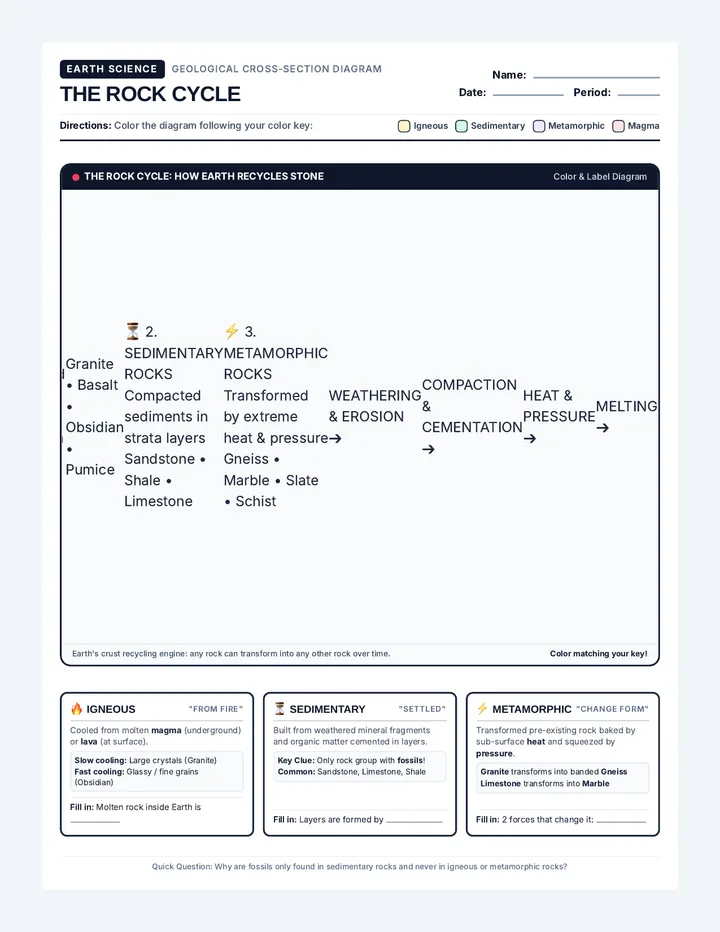
Follow along with the teacher's board drawing. Trace how molten rock cycles through crystallization, surface breakdown, deep lithification, and intense metamorphism back into magma.
Board Walkthrough: The Simplified Cycle Path
Draw & Label with Class
Stage 1
MAGMA Melted rock underground
State: Molten Liquid
Stage 2
IGNEOUS "Born from fire"
Ex: Basalt / Granite
Stage 3
SEDIMENTARY Compacted layers
Ex: Sandstone / Shale
Stage 4
METAMORPHIC "Changed form"
Ex: Marble / Gneiss
Stage 5
MAGMA Cycle restarts!
Subduction / Re-melt
→ Cooling & Hardening
→ Weathering, Erosion, Deposition, Compaction & Cementation
→ Heat & Pressure
→ Melting
Phase 1 Guided Notes: Fill in the Key Mechanisms
1. Magma → Igneous Rock: Process of Cooling & Hardening Intrusive vs. Extrusive
When magma cools slowly underground, crystals grow (large / small):
When lava cools quickly on the surface, crystals are (large / small / glassy):
2. Igneous → Sedimentary Rock: The 5-Step Surface Machine (W-E-D-C-C) Surface Forces
Define each action as demonstrated on the board:
Weathering
Erosion
Deposition
Compaction
Cementation
3. Sedimentary → Metamorphic Rock: Sub-Surface Transformation Tectonic Collision Zones
What provides the extreme heat without melting the rock?
What creates the immense pressure that flattens mineral bands?
4. Metamorphic → Magma: The Ultimate Re-Melt Subduction Zones
If heat continues to rise beyond the melting point, what happens to the solid rock?
Check for Understanding: What triggers the transition from solid rock to magma? Page 1 of 2
Phase 2: Rock Cycle Detective
Alternative Paths, Real-World Scenarios & Deep Analysis
Practice & Apply
Critical Discussion: Is the Rock Cycle a One-Way Street?
The sequence on the board (Magma → Igneous → Sedimentary → Metamorphic → Magma) is a classic path, but any rock can become any other rock at any time.
Activity A: Identify the "Shortcut" Pathways
Write the specific geological process required to complete each alternative shortcut transition:
Igneous Rock → Metamorphic Rock
Process needed (without becoming sedimentary first):
Sedimentary Rock → Sedimentary Rock
Process needed to recycle existing sedimentary rock:
Metamorphic Rock → Sediments
Process needed once uplift exposes the rock to the surface:
Activity B: Trace the Rock's Journey
Scenario 1: A granite peak (igneous) stands exposed in the Rocky Mountains. Rain, ice, and wind batter the cliff face over millions of years.
Trace the exact chronological sequence from granite cliff → sand grains on a beach → sandstone cliff:
Scenario 2: Marine shells and coral accumulate at the bottom of a tropical sea, forming limestone. Millions of years later, two tectonic plates collide, burying this limestone deep into the Earth's crust.
Explain what type of rock it transforms into and what physical forces cause this transformation:
Synthesis Check: The Two Energy Engines
The rock cycle is driven by two distinct energy sources: Earth's hot interior and the Sun. Which parts of the cycle are powered by each engine? Explain briefly below:
Engine 1: Earth's Core (Internal Heat)
Engine 2: The Sun (External Weathering)
Self-Assessment: Rate your confidence tracing the rock cycle (1 - 5): [ ] Page 2 of 2