Plant Adaptations Reading Guide
Grade 4 Science • Life Science • NGSS 4-LS1-1 Informational Text
Plant Superpowers: Built to Survive!
Discover how amazing body parts (structures) help plants live in extreme habitats
Name:
Date:
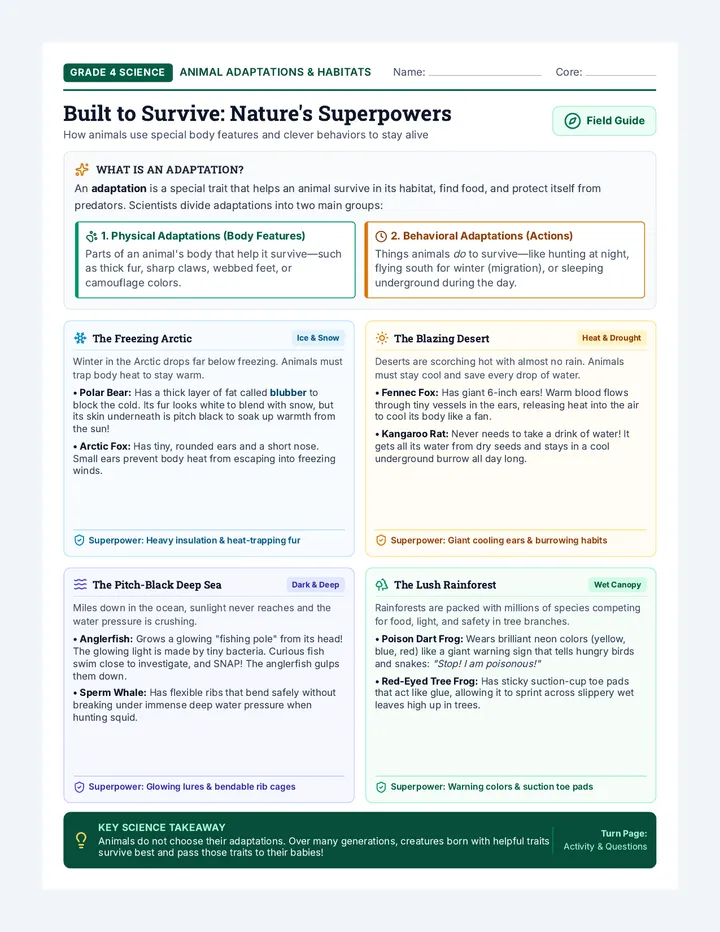
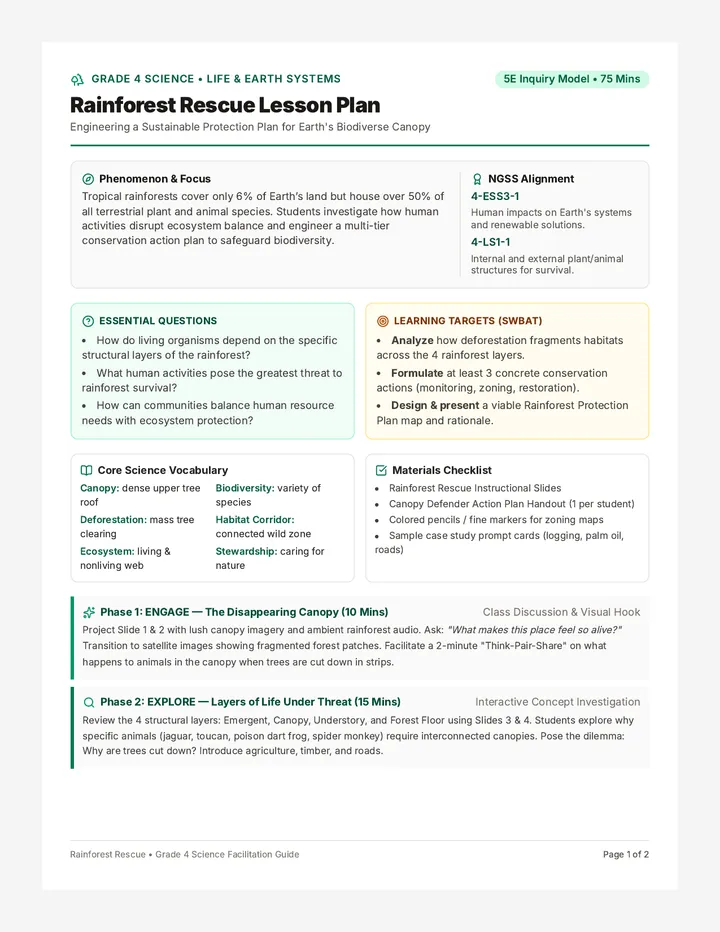
Plants cannot walk away when it gets too hot, and they cannot put on a jacket when it snows! Instead, they have adaptations. An adaptation is a special physical part (structure) or behavior that helps a living thing survive in its environment. Let's explore four wild habitats and see the plant superpowers that keep them alive!
1. The Sizzling Desert
Hot & Dry
Deserts receive very little rain and face blazing sunshine every day. Plants here are master water conservers!
- • Sharp Spines: Keep thirsty animals away and don't lose water like normal leaves do.
- • Waxy Skin: A thick, waxy coat seals water inside the plant like plastic wrap.
- • Spongy Stems: The stem swells up like an accordion to hold gallons of rainwater.
Featured Plant: Saguaro Cactus Biome: Desert
2. The Rainy Rainforest
Dark & Soaked
Rainforests get soaked with heavy rains, and giant tree branches block almost all sunlight from reaching the ground!
- • Drip Tip Leaves: Leaves have curved, pointy tips so water drips right off like a water slide. This stops mold and fungus from growing!
- • Air Plants (Epiphytes): Orchids and ferns sprout high on tall tree branches to reach sunlight without growing big trunks.
Featured Plant: Bromeliad & Orchid Biome: Rainforest
3. The Freezing Tundra
Sub-Zero Winds
The Arctic Tundra is frozen and windy. The ground stays frozen solid (called permafrost), so roots cannot grow deep.
- • Cushion Shape: Plants grow in low, rounded pillows only a few inches high to hide under the icy blast of wind.
- • Fuzzy Hairs: Stems and leaves are coated in tiny hairs that trap warm air like a fuzzy winter coat.
Featured Plant: Moss Campion Biome: Arctic Tundra
4. The Hungry Peat Bog
Nutrient-Poor Mud
Wetland bogs are flooded with soggy, acidic mud that has almost zero nitrogen or nutrients for plants to grow.
- • Pitcher Cups: Leaves form deep, slippery cups filled with sweet-smelling liquid.
- • Carnivorous Diet: When insects fall into the cup, the plant digests them to get the nutrients missing from the muddy soil!
Featured Plant: Pitcher Plant Biome: Wetland Bog
Big Idea: Every plant part has a special job that helps it survive challenges in its environment!
Page 1 of 2
Science Lab Activity
Plant Superpowers: Check for Understanding
Use clues from Page 1 to complete your work!
1 Superpower Match-Up
Write the letter of the correct adaptation
1. Sharp Spines
Deters thirsty animals and saves water
2. Waxy Skin
Seals in water like a plastic zip bag
3. Drip Tip Leaves
Lets water slide off so mold won't grow
4. Fuzzy Hairs
Traps warm air like a cozy sweater
A: Cushion Plant B: Saguaro Cactus C: Desert Succulent D: Rainforest Tree
2 Fact Check: True or False
Circle T for True or F for False
1. Pitcher plants catch insects because bog mud has very few nutrients.
[ T ] [ F ]
2. Tundra plants grow hundreds of feet tall to stay close to the clouds.
[ T ] [ F ]
3. Air plants (epiphytes) climb high on trees to reach sunlight.
[ T ] [ F ]
3 Evidence Questions
Choose the best answer
Question 1: Why do rainforest leaves have pointed "drip tips"?
A) To let water slide off quickly so fungus won't grow
B) To catch falling bugs and drink their juices
C) To hold heavy snow during winter storms
D) To make the leaf look scary to hungry birds
Question 2: What protects a Saguaro cactus from animals looking for water?
A) Colorful sweet flowers that attract bees
B) Sharp pointy spines covering the whole stem
C) Soft fuzzy hairs that make animals sneeze
D) Slippery cups filled with sticky nectar
4 Design Challenge: Plant Inventor!
Draw • Label • Explain
Your Mission: Imagine a newly discovered island that has scorching hot sunshine and strong freezing winds at night. Draw a plant designed to survive there, and explain two adaptations (superpowers) it uses!
Draw your plant here
Superpower 1:
Superpower 2:
Plant Superpowers Reading & Activity Guide • Grade 4 Life Science Page 2 of 2