Fall Changes Reading Passage
Name:
Date:
Grade 2 Reading
Nonfiction Science Reader
Fall Changes All Around
Read 3 Times
1
2
3
Cooler Breezes and Warm Clothes
Summer is waving goodbye, and autumn is here! In the fall, the air begins to feel cool and crisp. The hot summer sun does not warm the Earth as much. People put away their swimsuits and shorts. Instead, we pull out cozy sweaters, soft scarves, and light jackets to stay warm when we play outside.
Colorful Leaves Tumble Down
Look up at the trees! During spring and summer, leaves make food and stay green. In fall, the trees rest. The green color fades away, and bright colors appear. Leaves turn red, vibrant orange, bright yellow, and warm brown. Soon, the dry leaves tumble to the ground and make a fun crunching sound beneath our boots.
Shorter Days and Busy Animals
Have you noticed the sun setting earlier? In the fall, daytime gets shorter and nights grow longer. It gets dark outside right around dinner time. Animals also notice these changes! Busy squirrels hurry across lawns to gather acorns and seeds so they will have plenty of food to eat during winter.
Word Power
- crisp: cool, fresh, and slightly cold air
- tumble: to fall gently or roll downward
- gather: to bring or collect things together
Did You Know?
Another word for fall is autumn! Both words mean the season between warm summer and chilly winter.
Turn to Page 2 for Questions →
Autumn Science Reading • 2nd Grade Page 1 of 2
Fall Changes: Show What You Know!
Read each question carefully and answer using the passage.
Comprehension Check
A
Part 1: Choose the Best Answer
- What happens to the weather in the fall?
It gets much hotter
The air feels cool and crisp
Snow covers the ground
- Why do tree leaves change color during fall?
The green color fades
Animals paint them red
They need more rain
- What do squirrels gather to prepare for winter?
Warm winter coats
Acorns and seeds
Dry crunching leaves
B
Part 2: Write in Complete Sentences
-
What clothes do you wear when the weather turns cool in the fall?
-
How can you tell that the days are getting shorter in autumn?
C
Part 3: Fall Artist • Compare Two Trees
Draw and color both trees!
Summer Tree (Full of Green Leaves)
Fall Tree (Red, Orange, or Bare Branches)
Autumn Science Reading • 2nd Grade Page 2 of 2
Autumn Chemistry Reading Passage
Name:
Date:
Grade 4–5 Science Reader
Advanced Nonfiction • Botanical Science
Unlocking Autumn’s Chemistry
Text Complexity Lexile ~820L • 420 Words
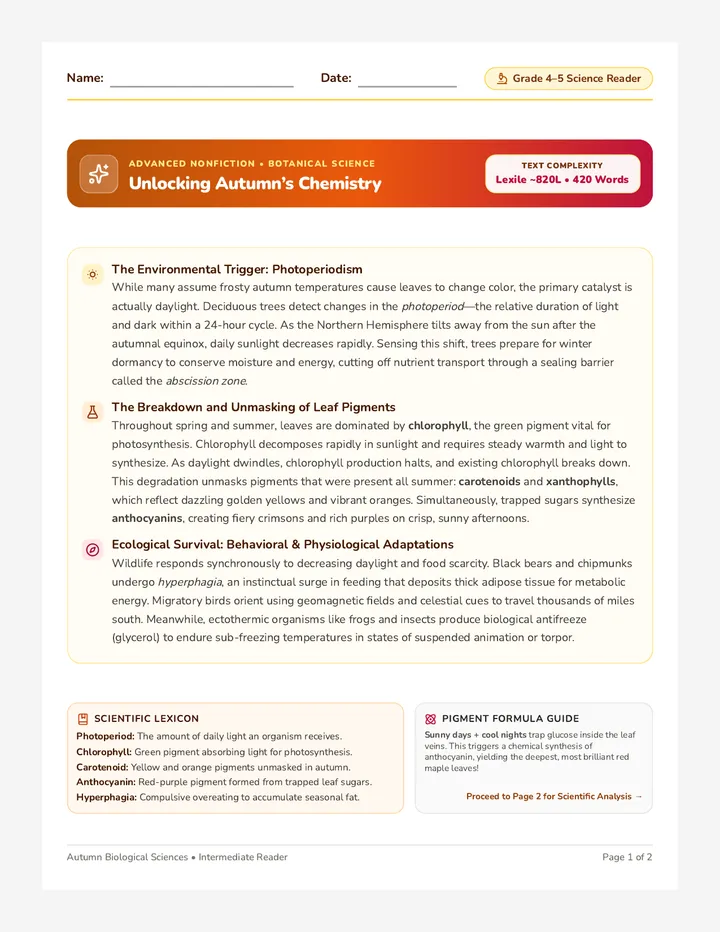
The Environmental Trigger: Photoperiodism
While many assume frosty autumn temperatures cause leaves to change color, the primary catalyst is actually daylight. Deciduous trees detect changes in the photoperiod—the relative duration of light and dark within a 24-hour cycle. As the Northern Hemisphere tilts away from the sun after the autumnal equinox, daily sunlight decreases rapidly. Sensing this shift, trees prepare for winter dormancy to conserve moisture and energy, cutting off nutrient transport through a sealing barrier called the abscission zone.
The Breakdown and Unmasking of Leaf Pigments
Throughout spring and summer, leaves are dominated by chlorophyll, the green pigment vital for photosynthesis. Chlorophyll decomposes rapidly in sunlight and requires steady warmth and light to synthesize. As daylight dwindles, chlorophyll production halts, and existing chlorophyll breaks down. This degradation unmasks pigments that were present all summer: carotenoids and xanthophylls, which reflect dazzling golden yellows and vibrant oranges. Simultaneously, trapped sugars synthesize anthocyanins, creating fiery crimsons and rich purples on crisp, sunny afternoons.
Ecological Survival: Behavioral & Physiological Adaptations
Wildlife responds synchronously to decreasing daylight and food scarcity. Black bears and chipmunks undergo hyperphagia, an instinctual surge in feeding that deposits thick adipose tissue for metabolic energy. Migratory birds orient using geomagnetic fields and celestial cues to travel thousands of miles south. Meanwhile, ectothermic organisms like frogs and insects produce biological antifreeze (glycerol) to endure sub-freezing temperatures in states of suspended animation or torpor.
Scientific Lexicon
- Photoperiod: The amount of daily light an organism receives.
- Chlorophyll: Green pigment absorbing light for photosynthesis.
- Carotenoid: Yellow and orange pigments unmasked in autumn.
- Anthocyanin: Red-purple pigment formed from trapped leaf sugars.
- Hyperphagia: Compulsive overeating to accumulate seasonal fat.
Pigment Formula Guide
Sunny days + cool nights trap glucose inside the leaf veins. This triggers a chemical synthesis of anthocyanin, yielding the deepest, most brilliant red maple leaves!