Creature Fuel Activity
Grade 5 Science Matter & Energy in Organisms
Creature Fuel Activity
How animals transform food into survival, motion, and body materials
Name:
Date:
Class:
The Big Scientific Concept
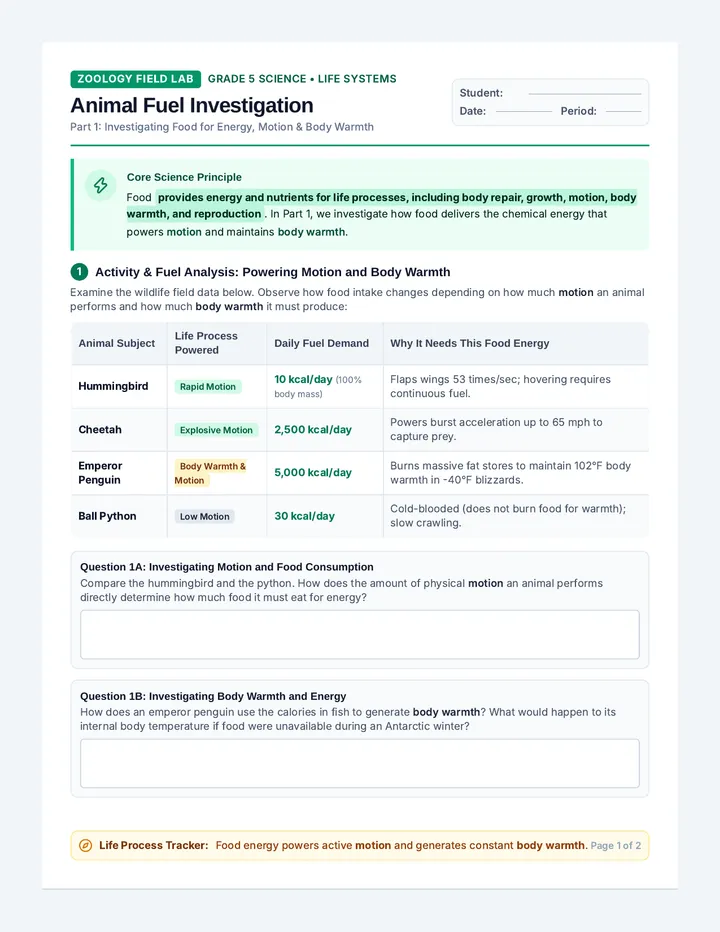
Animals cannot make their own food. Every meal supplies two essential resources: energy to power actions and warmth, and matter (nutrients) to construct and mend cells. Food powers five vital processes:
Motion
Running, flying
Body Warmth
Core body heat
Growth
New bones & size
Body Repair
Mending tissues
Reproduction
Eggs, milk & young
1 Wildlife Mission: Diagnose the Life Process
Identify which life process is primarily using food
Case A: Arctic Fox in a -30°F Blizzard
Life Process:
Curled tightly in the snow, the fox must continuously burn fat calories from lemmings it ate to keep its internal core temperature at a steady 102°F.
Why is food needed here?
Case B: Black Bear Yearling After Denning
Life Process:
Emerging in spring, the young bear grazes berries, roots, and insects constantly, adding over 50 pounds of brand-new muscle, bone, and organs.
Why is food needed here?
Case C: Injured Red-Tailed Hawk
Life Process:
After colliding with branches, the raptor rests. Its body uses nutrients from rodents to knit together cracked wing bones and replace broken flight feathers.
Why is food needed here?
2 Energy vs. Building Materials
Check the primary way food is used for each animal action
| Animal Action |
Energy (Fuel) |
Nutrients (Matter) |
| 1. Cheetah sprinting 60 mph across the savanna to hunt |
|
|
| 2. Mother sea turtle producing 110 nutrient-rich eggs |
|
|
| 3. Elk calf regenerating torn skin tissue after a scrape |
|
|
| 4. Sea otter shivering in icy water to keep muscles warm |
|
|
Page 1 of 2 • Creature Fuel Investigation
Field Lab Creature Fuel Activity: Energy Allocation & Survival
Part II: Quantitative & System Modeling
Case Study: The Wolverine's Winter Energy Budget
A female wolverine roams sub-zero snowy peaks. On average, she must consume roughly 4,000 Calories of food per day to survive. Here is how her biological systems divide up that daily fuel input:
Body Warmth
1,800 Cal
Combating -25°F cold
Motion
1,400 Cal
Trekking 25 miles in snow
Reproduction
600 Cal
Nourishing kits in den
Body Repair
200 Cal
Mending worn paw pads
1. Which process uses the greatest amount of food energy? Why?
2. If winter prey is scarce and she gets only 2,000 Cal, what happens?
3 Model Your Own Creature Fuel Flow
Select one animal (e.g., Wolf, Hummingbird, or Dolphin)
Chosen Animal:
Primary Food Source:
Describe one specific action your animal takes for each fuel destination using nutrients or energy from food:
Motion:
Body Warmth:
Growth:
Body Repair:
Reproduction:
4 Scientific Explanation & Synthesis
A classmate argues: "Animals only eat food so they have energy to run around."
Construct an argument using evidence from your activity to refute this claim and explain why food is needed for body building, warmth, repair, and future generations.
Page 2 of 2 • Creature Fuel Investigation