Animal Fuel Investigation Activity
Zoology Field Lab Grade 5 Science • Life Systems
Animal Fuel Investigation
Part 1: Investigating Food for Energy, Motion & Body Warmth
Student:
Date: Period:
Core Science Principle
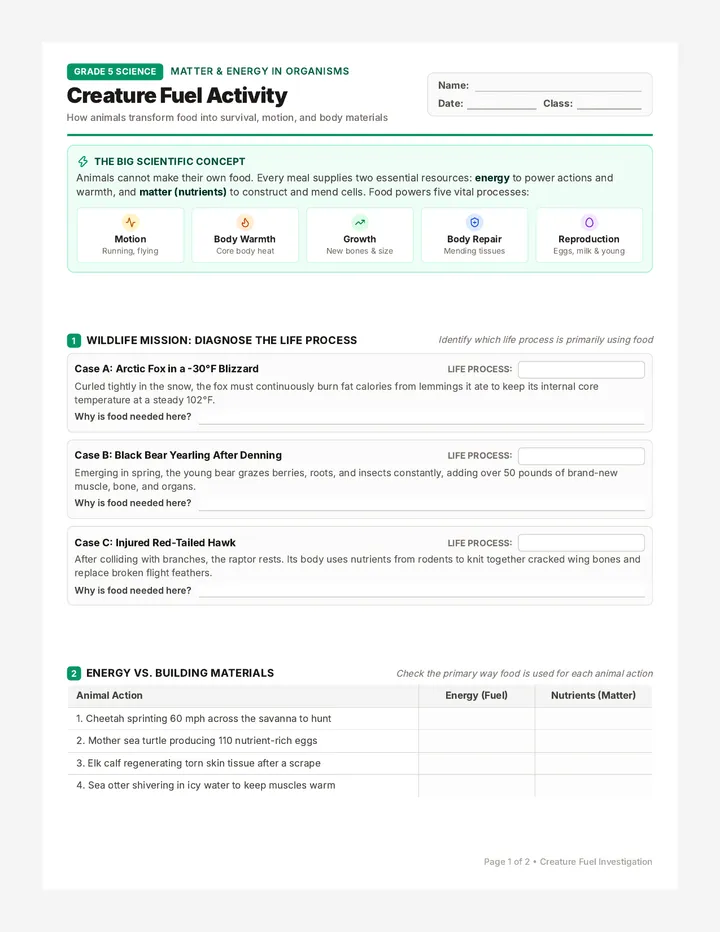
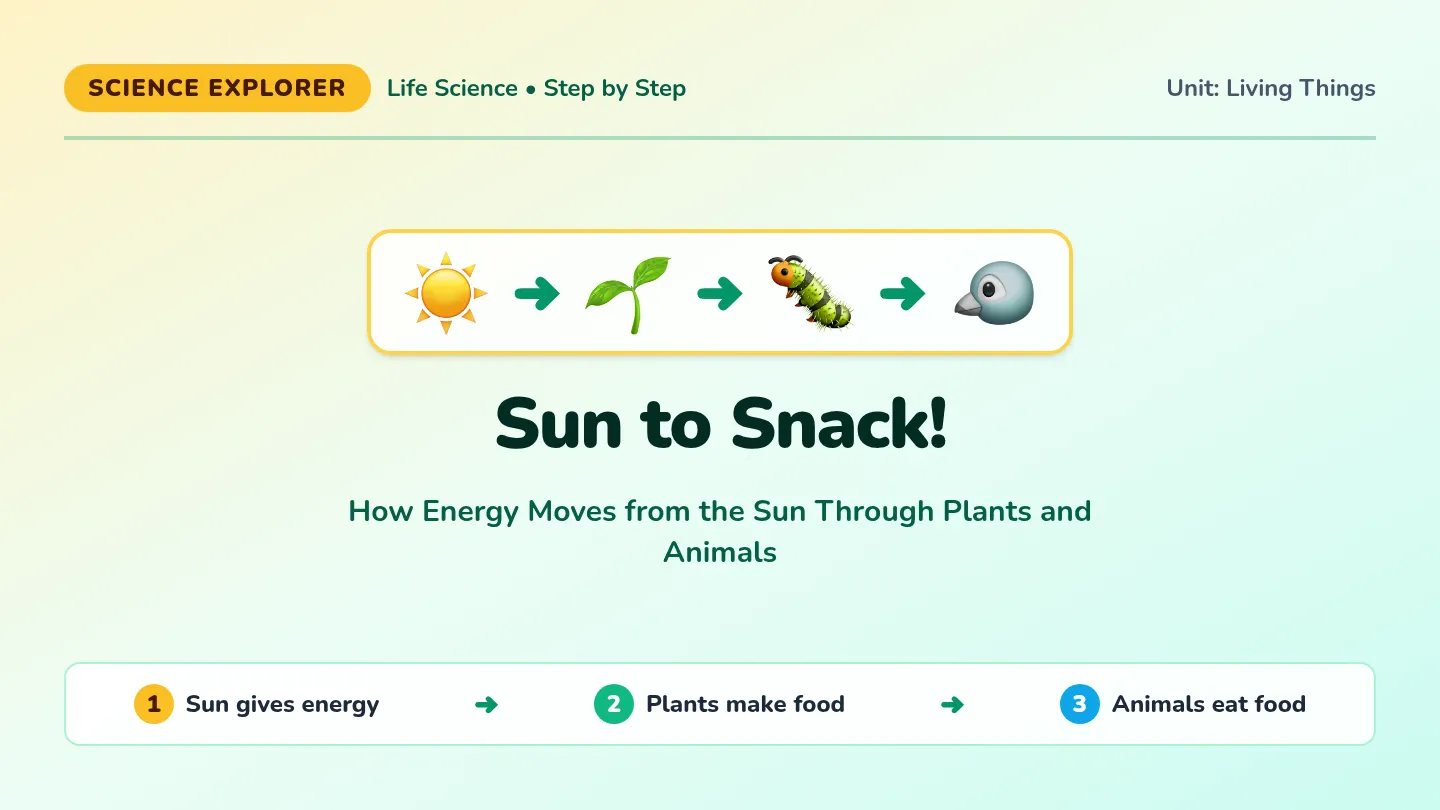
Food provides energy and nutrients for life processes, including body repair, growth, motion, body warmth, and reproduction. In Part 1, we investigate how food delivers the chemical energy that powers motion and maintains body warmth.
1
Activity & Fuel Analysis: Powering Motion and Body Warmth
Examine the wildlife field data below. Observe how food intake changes depending on how much motion an animal performs and how much body warmth it must produce:
| Animal Subject |
Life Process Powered |
Daily Fuel Demand |
Why It Needs This Food Energy |
| Hummingbird |
Rapid Motion |
10 kcal/day (100% body mass) |
Flaps wings 53 times/sec; hovering requires continuous fuel. |
| Cheetah |
Explosive Motion |
2,500 kcal/day |
Powers burst acceleration up to 65 mph to capture prey. |
| Emperor Penguin |
Body Warmth & Motion |
5,000 kcal/day |
Burns massive fat stores to maintain 102°F body warmth in -40°F blizzards. |
| Ball Python |
Low Motion |
30 kcal/day |
Cold-blooded (does not burn food for warmth); slow crawling. |
Question 1A: Investigating Motion and Food Consumption
Compare the hummingbird and the python. How does the amount of physical motion an animal performs directly determine how much food it must eat for energy?
Question 1B: Investigating Body Warmth and Energy
How does an emperor penguin use the calories in fish to generate body warmth? What would happen to its internal body temperature if food were unavailable during an Antarctic winter?
Life Process Tracker: Food energy powers active motion and generates constant body warmth.
Page 1 of 2
Zoology Field Lab Grade 5 Science • Life Systems
Nutrients for Life Processes
Part 2: Investigating Body Repair, Growth, and Body Warmth
Investigation 2
Scientific Principle: Nutrients for Structural Life Processes
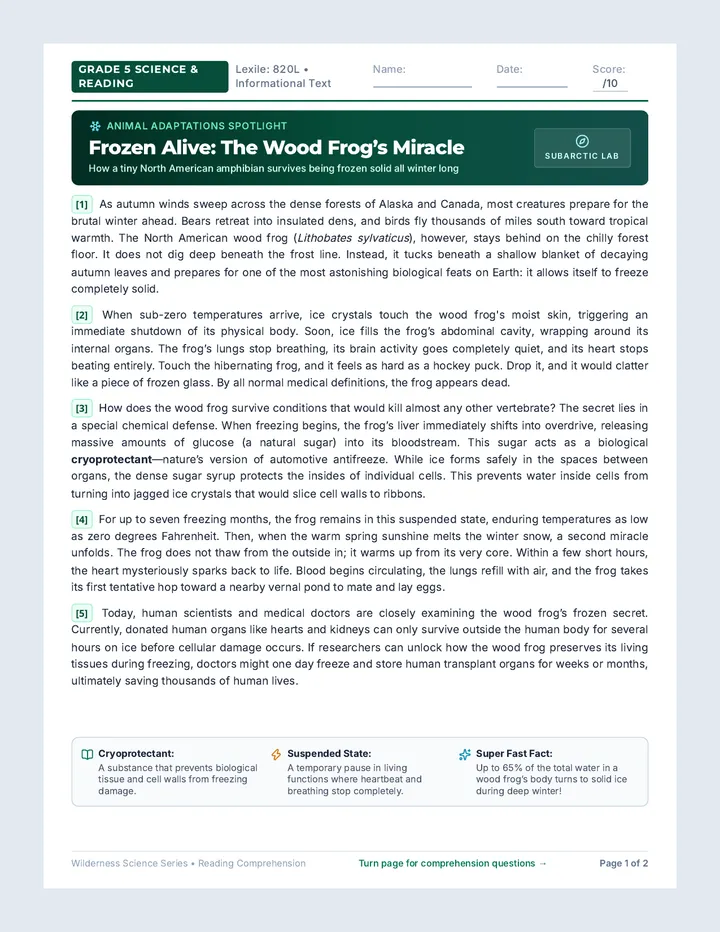
Food provides energy and nutrients for life processes, including body repair, growth, motion, body warmth, and reproduction. Animals do not just burn food for fuel; they break down food matter into molecular building blocks to construct new cells and sustain life.
2
Case Study Evidence Log: How Nutrients Build and Maintain Bodies
Read each field report. Notice how animals redirect food nutrients to support specific life processes:
Case A: Moose Growth
A bull moose eats 45 lbs of willow twigs daily, extracting calcium and proteins to grow 60 lbs of solid bone antlers in under 4 months.
Life Process: Growth
Case B: Turtle Healing
A sea turtle with a damaged shell receives protein-rich crabs. Its body synthesizes new keratin and bone cells to seal the wound and prevent infection.
Life Process: Body Repair
Case C: Walrus Blubber
A walrus converts nutrient-rich fats from shellfish into a 4-inch layer of dense blubber, creating heavy insulation that preserves vital body warmth in Arctic seas.
Life Process: Body Warmth
Question 2A: Nutrients for Growth & Body Repair
Explain how food provides the physical matter needed for growth (like growing antlers) and body repair (like healing damaged shell tissue). Where does that matter come from?
Question 2B: Nutrients for Preserving Body Warmth
Food provides energy and nutrients for life processes, including body repair, growth, motion, body warmth, and reproduction. How does an animal use nutrients from food (like fats and oils) to build physical insulating structures that maintain body warmth?
3
Synthesis: Matching Food's Role to the 5 Life Processes
Write which life process each animal is using food for: body repair, growth, motion, body warmth, or reproduction:
1. A black bear shivers in its den to keep its core temperature steady in winter:
2. A peregrine falcon dives at 200 mph to capture a pigeon in flight:
3. A newborn wolf pup increases its weight from 1 pound to 30 pounds:
4. A robin produces a clutch of 4 nutrient-filled blue eggs in springtime:
5. A lizard regenerates skin and scales after escaping a predator's bite:
Standard Benchmark: Food provides energy and nutrients for life processes (NGSS 5-PS3-1, 5-LS1-1) Page 2 of 2