Atomic Structure Scaffolded Assessment
Atomic Structure & Periodic Table Quiz
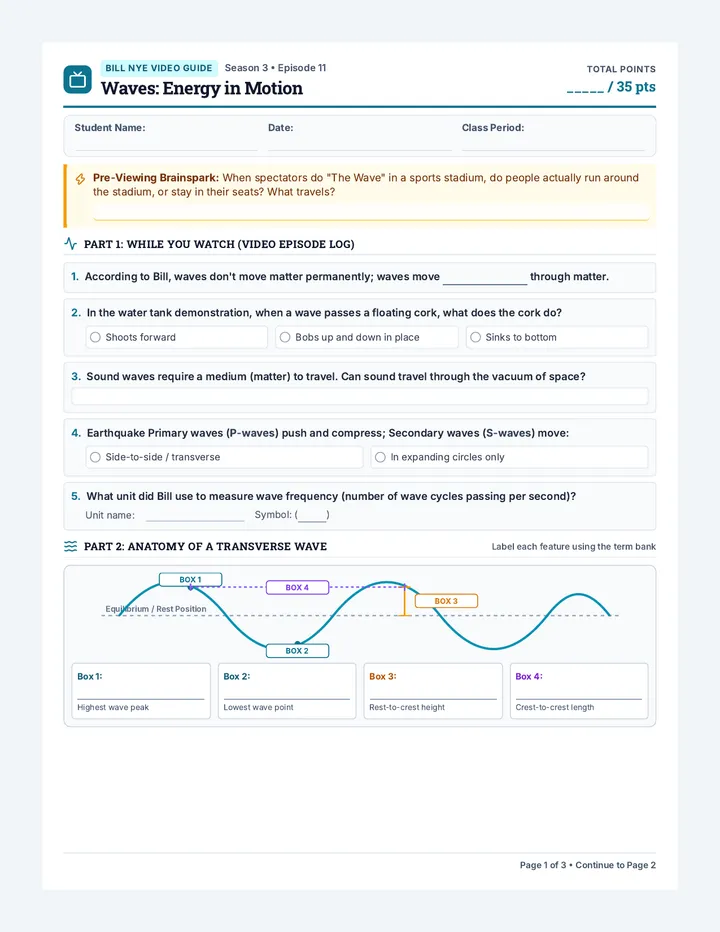
Scaffolded Edition • Read Aloud & Text-to-Speech Ready
TTS Supported
1-3. Student Name:
Date:
Score:
/ 26
4. Science Class Block:
B-Block C-Block D-Block F-Block G-Block
Science Anchor Chart: Atomic Rules
Protons (p+)
Positive (+) charge, mass of 1 amu, inside nucleus.
Neutrons (n0)
Zero (0) charge, mass of 1 amu, inside nucleus.
Electrons (e-)
Negative (-) charge, almost zero mass, outside orbit.
Question 5 1 point
Atomic Number
What is the atomic number of Fluorine-19?
9 F Fluorine 18.998
Step 1: Look at the top number on the element tile.
Step 2: The top whole number is always the Atomic Number.
Sentence frame: The atomic number of Fluorine is ________.
9 10
Question 6 1 point
Neutral Atom Electrons
How many electrons does a Sulfur-32 atom have?
16 S Sulfur 32.065
Step 1: Remember: In a neutral atom, Protons = Electrons = Atomic Number.
Step 2: Look at the atomic number of Sulfur (16).
Sentence frame: A neutral Sulfur atom has ________ electrons.
16 24
Atomic Structure & Periodic Table Quiz • Scaffolded Student Edition Page 1 of 7
Part 1: Calculating Particles & Particle Properties Questions 7 – 10
Question 7 1 point
Neutron Math
How many Neutrons does a Sulfur-35 atom have?
Mass Number 35
Minus Atomic # - 16
Equals Neutrons ?
Formula: Neutrons = Mass Number (35) minus Atomic Number (16).
19 32
Question 8 1 point
Electrons
Electrons have:
e-
Think about the electron: Is it positive (+) or negative (-)? Is it heavy (1 amu) or super tiny (almost no mass)?
A negative charge and almost no mass A positive charge and the most mass
Question 9 1 point
Protons
Protons have:
p+
Remember: "P" is for Proton and "P" is for Positive (+)!
A mass of 1 amu and a positive charge No mass or charge
Question 10 1 point
Neutrons
Neutrons:
n0
Remember: "N" is for Neutron and "N" is for Neutral (no charge)!
Have no mass and no charge Have mass, 1 amu, and no charge
Atomic Structure & Periodic Table Quiz • Scaffolded Student Edition Page 2 of 7
Part 2: Atom Structure & Matter Definitions Questions 11 – 14
Question 11 1 point
The Nucleus
Which subatomic particles are located in the nucleus?
Center = Nucleus
The center of the atom holds the heavy particles: Protons (p+) and Neutrons (n0).
Protons and leptons Protons and Neutrons
Question 12 1 point
Outside Orbits
Which subatomic particle has almost zero mass and orbits in the energy levels outside the nucleus of an atom?
Clue:
This particle moves quickly in energy levels (rings) around the outside of the center.
Protons Electrons
Question 13 1 point
Vocabulary
Anything that has mass and takes up space is ________
Definition match: Everything in the universe that has weight and takes up volume (like water, air, metal, desk) is this big scientific word.
Matter an element
Question 14 1 point
Smallest Unit
The smallest unit of matter that is an element:
Word Bank: Atom = 1 single basic unit • Molecule = two or more atoms connected together.
Atom Molecule
Atomic Structure & Periodic Table Quiz • Scaffolded Student Edition Page 3 of 7
Part 3: Scientific Terms (Isotopes, Elements, Ions, Mass) Questions 15 – 18
Question 15 1 point
True / False
Atoms of the same element that have different atomic masses are called isotopes.
Carbon-12 (Mass 12) vs. Carbon-14 (Mass 14)
Both are Carbon, but have different masses. Are these called isotopes?
True False
Question 16 1 point
Pure Substances
A(n) ________ is a pure substance that cannot be broken down into simpler substances by chemical means.
Vocabulary Clue: Made of only one type of atom (found on the Periodic Table: Gold, Oxygen, Iron). It is not bonded with other substances.
Element Compound
Question 17 1 point
Charged Atoms
An atom that has gained or lost an electron is called ________
Neutral Atom ➔ Gains/Loses (e-) ➔ Charged _____ ?
An Ion A Neutron
Question 18 1 point
Total Nucleus
This is equal to the number of protons plus the number of neutrons in an atom:
(Number of Protons) + (Number of Neutrons) = ?
Atomic Mass Atomic Length
Atomic Structure & Periodic Table Quiz • Scaffolded Student Edition Page 4 of 7
Part 4: Periodic Table & Electron Behavior Questions 19 – 22
Question 19 1 point
Negative Ion
How does a neutral atom become a negatively charged ion?
Remember: Electrons have negative charge (-). If an atom gets more negative particles, what did it gain?
(Note: Protons are trapped in the nucleus and do not move in chemistry!)
Gains an electron Gains a proton
Question 20 1 point
Groups vs Periods
What is the difference between a group and a period on the periodic table?
GROUP (Family) Vertical column (up and down ↕)
PERIOD Horizontal row (side to side ↔)
Groups are Vertical (up and down), Periods are Horizontal (side to side rows) They are interchangeable
Question 21 1 point
Valence Electrons
What are valence electrons, and where are they located in an atom?
Key Fact: Valence means the outermost layer. These outer electrons are the ones that bond with other atoms!
Valence electrons are the electrons that can form bonds. They are in the outermost shell of the electon cloud. Valence electrons are the electrons that cannot form bonds. They are in the first shell of the electon cloud.
Question 22 1 point
Element Identity
Which subatomic particle determines the identity of an element?
Atomic Fingerprint: The Atomic Number tells you the name of the element. The Atomic Number equals the number of which particle?
Protons Neutrons
Atomic Structure & Periodic Table Quiz • Scaffolded Student Edition Page 5 of 7
Part 5: Identifying Bohr Models & Particle Counts Questions 23 – 25
Question 23 1 point
Bohr Model 1
What kind of atom is this?
11 P 12 N
Step 1: Look inside the nucleus. How many protons? 11 P
Step 2: Look at the Periodic Table:
• Sodium (Na) = Atomic #11
• Magnesium (Mg) = Atomic #12
Sentence frame: This atom has 11 protons, so it is ________.
Sodium Magnesium
Question 24 1 point
Bohr Model 2
What kind of Atom is this?
8 p+ 8 n0
Step 1: Look at the nucleus: 8 p+ (8 protons).
Step 2: Look at the Periodic Table:
• Oxygen (O) = Atomic #8
• Helium (He) = Atomic #2
Sentence frame: This atom has 8 protons, so it is ________.
Oxygen Helium
Question 25 1 point
Particle Counting
A neutral atom of Oxygen has an atomic number of 8 and a mass number of 16. How many protons, neutrons, and electrons does it have?
Protons = Atomic # 8
Neutrons = 16 - 8 8
Electrons = Protons 8
8, 8, and 8 16, 16, and 8
Atomic Structure & Periodic Table Quiz • Scaffolded Student Edition Page 6 of 7
Part 6: Ions, Electrical Charges, & Isotopes Questions 26 – 30
Question 26 1 pt
Sodium Ion
An ion of Sodium (Na+) has an atomic number of 11, a mass number of 23, and a charge of +2. How many protons, neutrons, and electrons does it have?
Guide: Protons = Atomic # (11) • Neutrons = Mass 23 - 11 = 12 • +2 charge means it lost 2 electrons (11 - 2 = 9).
11 Protons, 12 Neutrons, 9 Electrons 13 Protons, 10 Neutrons, 11 Electrons
Question 27 1 pt
Element & Charge
If an atom has 17 protons, 18 neutrons, and 18 electrons, what kind of atom is it, and what is its electrical charge?
Guide: 17 protons = Element #17 (Chlorine). Charge = 17 positive (+) and 18 negative (-) = 17 - 18 = -1.
Chlorine; - 1 Argon; 0
Question 28 1 pt
Neutral Calcium
If a neutral atom of Calcium (Ca) has 20 electrons, how many protons does it have?
Neutral Rule: Positive (+) Protons = Negative (-) Electrons.
20 40.08
Question 29 1 pt
Overall Charge
What is the overall electrical charge of an atom that contains 8 protons and 10 electrons?
Math: (+8 protons) + (-10 electrons) = 8 - 10 = ?
-2 18
Question 30 1 pt
Oxygen-18 Nucleus
Oxygen-18 is an isotope of Oxygen (atomic number 8). All together, how many protons and neutrons are in its nucleus?
Key Fact: In "Oxygen-18", the number 18 is the Mass Number. Mass number = total protons + neutrons inside the nucleus!
10 18
Quiz Complete! Great job showing your science thinking!
Page 7 of 7