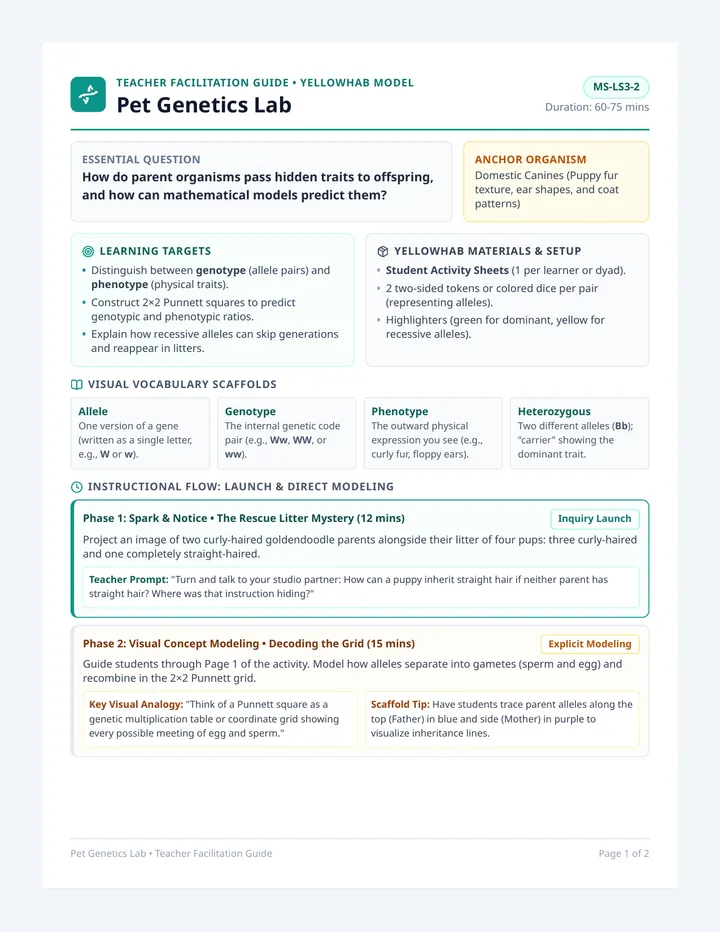
Pet Genetics Lesson Plan Teacher Facilitation Guide • Yellowhab Model
Pet Genetics Lab
MS-LS3-2
Duration: 60-75 mins
Essential Question
How do parent organisms pass hidden traits to offspring, and how can mathematical models predict them?
Anchor Organism
Domestic Canines (Puppy fur texture, ear shapes, and coat patterns)
Learning Targets
• Distinguish between genotype (allele pairs) and phenotype (physical traits).
• Construct 2×2 Punnett squares to predict genotypic and phenotypic ratios.
• Explain how recessive alleles can skip generations and reappear in litters.
Yellowhab Materials & Setup
• Student Activity Sheets (1 per learner or dyad).
• 2 two-sided tokens or colored dice per pair (representing alleles).
• Highlighters (green for dominant, yellow for recessive alleles).
Visual Vocabulary Scaffolds
Allele One version of a gene (written as a single letter, e.g., W or w ).
Genotype The internal genetic code pair (e.g., Ww , WW , or ww ).
Phenotype The outward physical expression you see (e.g., curly fur, floppy ears).
Heterozygous Two different alleles (Bb ); "carrier" showing the dominant trait.
Instructional Flow: Launch & Direct Modeling
Phase 1: Spark & Notice • The Rescue Litter Mystery (12 mins) Inquiry Launch
Project an image of two curly-haired goldendoodle parents alongside their litter of four pups: three curly-haired and one completely straight-haired.
Teacher Prompt: "Turn and talk to your studio partner: How can a puppy inherit straight hair if neither parent has straight hair? Where was that instruction hiding?"
Phase 2: Visual Concept Modeling • Decoding the Grid (15 mins) Explicit Modeling
Guide students through Page 1 of the activity. Model how alleles separate into gametes (sperm and egg) and recombine in the 2×2 Punnett grid.
Key Visual Analogy: "Think of a Punnett square as a genetic multiplication table or coordinate grid showing every possible meeting of egg and sperm."
Scaffold Tip: Have students trace parent alleles along the top (Father) in blue and side (Mother) in purple to visualize inheritance lines.
Pet Genetics Lab • Teacher Facilitation Guide Page 1 of 2
2
Application, Debrief & Scaffolding Interventions
Phases 3 & 4 • Universal Support
Phase 3: Studio Investigation • Pup Rescue Matchmaker (25 mins) Collaborative Challenge
Learners step into the role of shelter genetic consultants for "Happy Paws Rescue." They solve monohybrid crosses for ear shape (Floppy $E$ vs Pointed $e$), coat texture ($W$ vs $w$), and coat pattern ($S$ vs $s$).
Peer Conferencing: Partners cross-verify allele notation (capital letter always placed first in heterozygous combinations).Simulation Option: Learners roll allele dice or flip coins to simulate 8 actual puppy births and compare sample litter data to Punnett theoretical percentages.
Phase 4: Synthesis & Debrief • Probability vs Reality (15 mins) Debrief & Synthesis
Reconvene the studio circle. Focus discussion on why a 25% probability does not mean in a litter of 4 puppies exactly 1 will be straight-haired.
Essential Insight: Each puppy birth is an independent biological event (like flipping a fresh coin), but larger sample sizes match theoretical ratios more closely.
Common Misconceptions & Diagnostic Corrections
Student Misconception Targeted Reframing / Prompt
"Dominant means stronger, healthier, or most common in the population." Dominance simply means its effect masks the recessive allele when both are present. Polydactyly (extra toes) is dominant in cats, yet rare!
"If the ratio is 3:1, a litter of 4 will always have 3 dominant and 1 recessive." Compare to tossing a coin twice. You have a 25% chance of getting two heads, but flipping once doesn't lock in what the next flip will be.
"Writing alleles as 'wW' instead of 'Ww' creates a different trait." Order inside the pair does not change the phenotype. By scientific convention, we always write uppercase dominant letters first.
Differentiated Supports for Yellowhab Studios
Tier 1: Visual Entry
Use color coding: write dominant alleles in blue pen and recessive in orange highlighter across the grid to reveal patterns immediately.
Tier 2: Guided Language
Provide the sentence frame: "Because the genotype is [ __ ], the puppy will display [ __ ] fur because [dominant/recessive]."
Tier 3: Studio Extension
Challenge students to construct a 4×4 dihybrid cross predicting both fur texture and ear shape simultaneously (e.g., $WwEe \times WwEe$).
Mastery Checkpoint (Exit Indicator):
Learner can independently determine phenotypic percentages from a heterozygous × heterozygous ($Bb \times Bb$) cross with 100% accuracy.
Pet Genetics Lab • Teacher Facilitation Guide Page 2 of 2
Pet Genetics Activity Sheet Yellowhab Science • Genetics Investigation
Pet Genetics Activity Sheet
Name:
Date:
Studio:
Partner:
Part 1: The Puppy Trait Decoder
Uppercase = Dominant (masks recessive) • Lowercase = Recessive
Fur Texture 🐩
W = Curly fur (Dominant)
w = Straight fur (Recessive)
Ear Shape 🐕
E = Floppy ears (Dominant)
e = Pointed ears (Recessive)
Coat Pattern 🐾
S = Spotted coat (Dominant)
s = Solid coat (Recessive)
Part 2: Genotype to Phenotype Decoding
Identify each allele combination as Homozygous Dominant , Heterozygous , or Homozygous Recessive , then write the visible physical trait (phenotype).
Genotype
Type of Allele Pair (Circle One)
Visible Phenotype
WW
[ Homozygous Dominant ] / Heterozygous / Homozygous Recessive
Example: Curly Fur
Ww
Homozygous Dominant / Heterozygous / Homozygous Recessive
ee
Homozygous Dominant / Heterozygous / Homozygous Recessive
Ss
Homozygous Dominant / Heterozygous / Homozygous Recessive
How to Solve a Punnett Square in 4 Steps
1. Identify Parents Write out the 2-letter genotype for Dad and Mom.
2. Separate Alleles Place Dad's alleles on top, Mom's along the left side.
3. Fill the Boxes Bring alleles down and across (Capital letters first).
4. Calculate Odds Each of the 4 boxes represents 25% (1 in 4 chance).
Part 3: Guided Practice • Ear Shape Crossing
Guided Cross
Cross: A male dog with heterozygous floppy ears (Ee) is crossed with a female dog with pointed ears (ee).
Father's Alleles (Top)
Mother
Box 1
Box 2
Box 3
Box 4
A. Count the Genotypes in your 4 boxes:
EE: _____ / 4
Ee: _____ / 4
ee: _____ / 4
B. Calculate Phenotype Probabilities:
Chance of Floppy Ears : _____ / 4 = _____ %
Chance of Pointed Ears : _____ / 4 = _____ %
C. Explain: Why can puppies have pointed ears if the father has floppy ears?
Pet Genetics Activity Sheet • Yellowhab Science Page 1 of 2
Collaborative Investigation
Part 4: The Rescue Pup Matchmaker Challenge
Happy Paws Sanctuary
Two rescue dogs at Happy Paws Sanctuary are expecting puppies! The shelter director needs your team to calculate the traits of the upcoming litter to prepare foster families.
Case 1: Fur Texture (Curly W vs Straight w) Father: Ww × Mother: Ww
Both parents have curly fur, but both carry the hidden straight allele (Ww).
1
2
3
4
Genotype Ratio:
WW: ____ % Ww: ____ % ww: ____ %
Phenotype Prediction:
Curly Fur (W_): ____ % Straight Fur (ww): ____ %
Case 2: The Mystery Pup Dispute
When the litter was born, one puppy had completely straight fur (ww). A shelter volunteer said: "Neither Barnaby nor Luna has straight fur! One of the parents must be wrong!"
Use evidence from your Punnett square and allele rules to explain to the volunteer why Barnaby and Luna CAN be the true biological parents:
Case 3: Coat Pattern Crossing (Spotted S vs Solid s) Father: Ss × Mother: ss
Father has a spotted coat (Ss). Mother has a solid non-spotted coat (ss).
1
2
3
4
Expected % with Spotted Coat : ________ %
Expected % with Solid Coat : ________ %
Yellowhab Studio Think-Deeper Question
If Case 1 predicts a 75% chance of curly fur and 25% straight fur, does a litter of 4 pups guarantee that exactly 3 will be curly and 1 straight? Explain why or why not using the idea of probability:
Pet Genetics Activity Sheet • Yellowhab Science Page 2 of 2
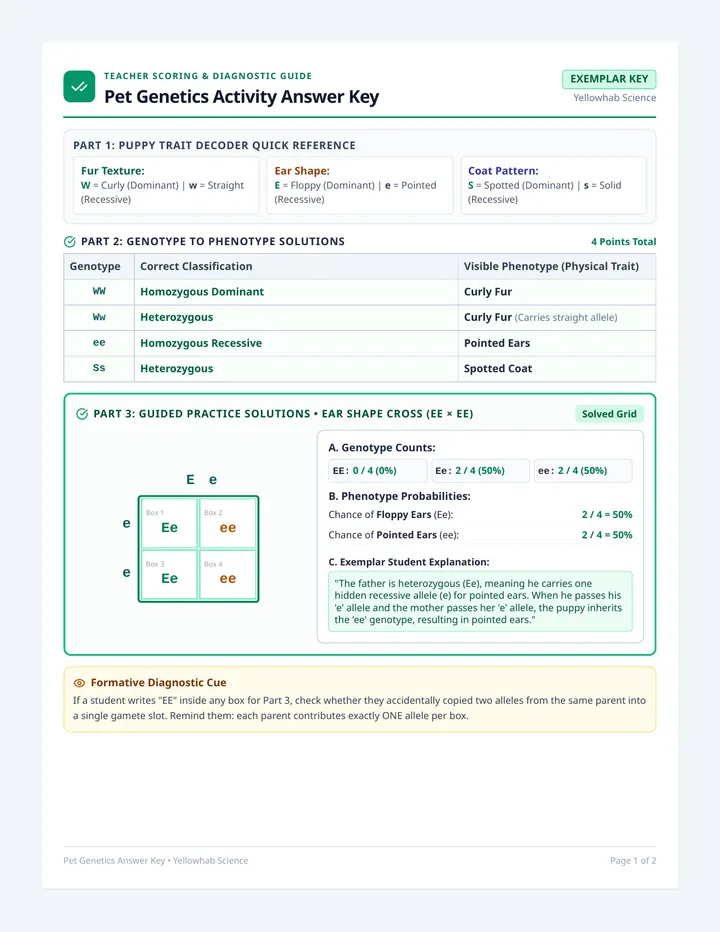
Pet Genetics Answer Key Teacher Scoring & Diagnostic Guide
Pet Genetics Activity Answer Key
EXEMPLAR KEY
Yellowhab Science
Part 1: Puppy Trait Decoder Quick Reference
Fur Texture:
W = Curly (Dominant) | w = Straight (Recessive)
Ear Shape:
E = Floppy (Dominant) | e = Pointed (Recessive)
Coat Pattern:
S = Spotted (Dominant) | s = Solid (Recessive)
Part 2: Genotype to Phenotype Solutions
4 Points Total
Genotype
Correct Classification
Visible Phenotype (Physical Trait)
WW
Homozygous Dominant
Curly Fur
Ww
Heterozygous
Curly Fur (Carries straight allele)
ee
Homozygous Recessive
Pointed Ears
Ss
Heterozygous
Spotted Coat
Part 3: Guided Practice Solutions • Ear Shape Cross (Ee × ee)
Solved Grid
E e
e e
Box 1 Ee
Box 2 ee
Box 3 Ee
Box 4 ee
A. Genotype Counts:
EE: 0 / 4 (0%)
Ee: 2 / 4 (50%)
ee: 2 / 4 (50%)
B. Phenotype Probabilities:
Chance of Floppy Ears (Ee): 2 / 4 = 50%
Chance of Pointed Ears (ee): 2 / 4 = 50%
C. Exemplar Student Explanation:
"The father is heterozygous (Ee), meaning he carries one hidden recessive allele (e) for pointed ears. When he passes his 'e' allele and the mother passes her 'e' allele, the puppy inherits the 'ee' genotype, resulting in pointed ears."
Formative Diagnostic Cue
If a student writes "EE" inside any box for Part 3, check whether they accidentally copied two alleles from the same parent into a single gamete slot. Remind them: each parent contributes exactly ONE allele per box.
Pet Genetics Answer Key • Yellowhab Science Page 1 of 2
Rescue Pup Matchmaker
Part 4: Challenge Solutions & Scoring Rubric
Page 2 Key
Case 1: Fur Texture Cross (Ww × Ww) Classic 3:1 Monohybrid
W w
W w
WW
Ww
Ww
ww
Genotypes: WW: 25% (1/4) | Ww: 50% (2/4) | ww: 25% (1/4)
Phenotypes: Curly (WW, Ww): 75% (3/4) | Straight (ww): 25% (1/4)
Case 2: The Mystery Pup Dispute • Exemplar Response & Rubric
Exemplar Answer: "The volunteer is incorrect because both Barnaby and Luna are heterozygous (Ww). While they both show curly fur because the dominant 'W' masks the 'w', they both secretly carry the recessive allele for straight fur ('w'). When each parent randomly passes down their 'w' allele, the offspring inherits 'ww' (homozygous recessive), resulting in straight fur. The Punnett square shows there is a 25% chance of this occurring in every birth."
Grading Look-Fors: ✓ Mentions both parents carry 'w' (heterozygous) ✓ Identifies puppy genotype as 'ww' ✓ Explains recessive alleles are masked by dominant ones
Case 3: Coat Pattern Cross (Ss × ss) Testcross 1:1
S s
s s
Ss
ss
Ss
ss
Expected % Spotted Coat (Ss) : 50% (2 / 4)
Expected % Solid Coat (ss) : 50% (2 / 4)
Studio Think-Deeper Exemplar (Probability vs Reality)
Exemplar Answer: "No, it does NOT guarantee exactly 3 curly and 1 straight puppy. A Punnett square calculates theoretical probability for each independent puppy birth (like flipping a coin has a 50% chance each time). A litter of 4 could randomly produce 4 curly pups, or 2 curly and 2 straight pups. Ratios become closer to exact percentages only across large sample sizes with hundreds of offspring."
Pet Genetics Answer Key • Yellowhab Science Page 2 of 2