| Term & Spanish | Plain English Definition | Kid-Friendly Analogy / Memory Hook |
|---|
| Chromosome | ||
| Cromosoma | An organized package of DNA in the nucleus that holds hundreds of genes. | Like a whole cookbook packed with recipes. |
| Gene | ||
| Gen | A small section of a chromosome that gives instructions for one trait. | Like one specific recipe inside the cookbook. |
| Allele | ||
| Alelo | A specific version or flavor of a gene (you get 1 from mom, 1 from dad). | The gene is "ice cream"; the alleles are "chocolate" or "vanilla." |
| Dominant | ||
| Dominante | A stronger allele that hides the other version (written with a CAPITAL letter, like B). | Like a loud voice in a room—it gets heard every time! |
| Recessive | ||
| Recesivo | A hidden allele that only shows if you get two copies (written with a lowercase letter, like b). | Like a whisper—you only hear it if no one is shouting. |
| Punnett Square | ||
| Cuadro de Punnett | A simple 4-box grid used to predict the possible allele combinations offspring can inherit. | A probability chart showing possible baby trait outcomes. |
Struggling Readers Support
Struggling Writers Support
Misconception 1: "Dominant means most common or better."
Prompt: "Dominant only means it masks recessive. Freckles are dominant, but not everyone has them!"
Misconception 2: "Daughter cells have half the chromosomes after mitosis."
Prompt: "Look at the diagram: Chromosomes DUPLICATE first, so both daughter cells get the EXACT same set!"
8th Grade Intermediate Life Science • Alleles & Punnett Squares Page 2 of 2
Nombre:
Apellido:
Fecha:
Clase (encierra): 8A 8B 8C 8D
Objetivo de la Lección:
Puedo explicar cómo los cromosomas se duplican para transmitir genes idénticos durante la división celular, definir los alelos como versiones de un gen y usar un cuadro de Punnett para predecir los rasgos de la descendencia.
Sección 1: Hazlo Ahora • Activación de Conocimientos Previos Tiempo: 4 Minutos
1. ¿Dónde se encuentran los cromosomas dentro de la célula? (Banco de palabras: pared celular, núcleo, citoplasma)
Inicio de oración: Los cromosomas se encuentran dentro del .
2. ¿Para qué contienen instrucciones los genes? (Banco de palabras: rasgos / características físicas, almacenar agua, digestión)
Inicio de oración: Los genes dan instrucciones que determinan los físicos.
Sección 2: Vocabulario Clave • Definiciones en Lenguaje Sencillo
1. Cromosoma:
Estructura formada por ADN en el núcleo que contiene muchos genes.
2. Gen:
Una sección corta en un cromosoma que contiene instrucciones para un rasgo específico.
3. Alelo:
Diferentes versiones de un mismo gen (ejemplo: alelo de ojos cafés vs. alelo de ojos azules).
4. Alelo Dominante:
Un alelo fuerte que oculta al recesivo. Se escribe con letra MAYÚSCULA (B).
5. Alelo Recesivo:
Un alelo oculto que solo se manifiesta si ambos alelos son minúsculas (bb).
6. Mitosis (División Celular):
Cuando 1 célula duplica sus cromosomas y se divide en 2 células hijas idénticas.
Sección 3: Cómo las Células Pasan Genes • Duplicación de Cromosomas
Bloque A (Duplicación): Antes de que una célula se divida, cada cromosoma hace una copia exacta de sí mismo. Este proceso se llama duplicación de cromosomas.
Bloque B (División): Durante la división celular (mitosis), las copias se separan en dos nuevas células llamadas células hijas. Ambas células hijas tienen el mismo número y tipo exacto de cromosomas que la célula madre original.
Modelo: Siguiendo la Duplicación de Cromosomas y la Mitosis
Etapa 1: Célula Madre
Célula Original (2 Cromosomas)
Etapa 2: Duplicación
Copias Exactas de Cromosomas
Etapa 3: 2 Células Hijas
Ambas Tienen el Mismo ADN
8th Grade Intermediate Life Science • Paquete del Estudiante Page 2 of 4
8th Grade Intermediate Life Science Unit 4: Genetics & Cell Division
Lesson Objective:
I can explain how chromosomes duplicate to pass identical genes during cell division, define alleles as versions of a gene, and use a Punnett square to predict offspring traits.
Section 4: Authentic NYS 8th Grade Science Exam Practice Time: 17–20 Minutes
Question 1 • NYS Statewide Intermediate-Level Science Exam Multiple Choice
A dog has 78 chromosomes in each of its body cells. When a body cell divides by mitosis to produce two new skin cells, how many chromosomes will each new daughter cell have?
(1) 39
(2) 78
(3) 156
(4) 0
Sentence Starter: Each new daughter cell will have chromosomes because before the cell divides, the chromosomes .
Question 2 • NYS Statewide Intermediate-Level Science Exam Model & Constructed Response
In pea plants, the allele for tall stems (T) is dominant over the allele for short stems (t). A tall plant with genotype Tt is crossed with a short plant with genotype tt.
Fill in the 4 boxes:
a. What percentage of offspring are expected to have tall stems?
Answer: % tall
b. Why will an offspring with the letters Tt be tall instead of short?
Sentence Starter: An offspring with Tt is tall because the allele T is , which masks the recessive allele.
Question 3 • NYS Statewide Intermediate-Level Science Exam Short Explanation
Why do children produced through sexual reproduction look similar to both parents, but are not an identical copy of either parent?
Sentence Starter: Children inherit allele from the mother and allele from the father, creating a unique combination of traits.
Section 5: Exit Slip • Silent Check for Understanding Time: 3 Minutes
If B is the dominant allele for brown eyes and b is the recessive allele for blue eyes, what eye color will a person with genotype Bb have?
Sentence Starter: A person with the genotype Bb will have eyes because .
8th Grade Intermediate Life Science • Student Core Packet Page 3 of 4
8th Grade Intermediate Life Science • Versión en Español Unidad 4: Genética y División Celular
Objetivo de la Lección:
Puedo explicar cómo los cromosomas se duplican para transmitir genes idénticos durante la división celular, definir los alelos como versiones de un gen y usar un cuadro de Punnett para predecir los rasgos de la descendencia.
Sección 4: Práctica Auténtica del Examen Estatal de Ciencias de 8.° Grado de NYS Tiempo: 17–20 Minutos
Pregunta 1 • Examen Estatal de Ciencias de Nivel Intermedio de NYS Opción Múltiple
Un perro tiene 78 cromosomas en cada una de sus células corporales. Cuando una célula corporal se divide por mitosis para producir dos nuevas células de piel, ¿cuántos cromosomas tendrá cada nueva célula hija?
(1) 39
(2) 78
(3) 156
(4) 0
Inicio de oración: Cada nueva célula hija tendrá cromosomas porque antes de dividirse, los cromosomas .
Pregunta 2 • Examen Estatal de Ciencias de Nivel Intermedio de NYS Modelo y Respuesta Construida
En las plantas de guisantes, el alelo para tallos altos (T) es dominante sobre el alelo para tallos cortos (t). Se cruza una planta alta con genotipo Tt con una planta corta con genotipo tt.
Llena los 4 cuadros:
a. ¿Qué porcentaje de descendientes se espera que tengan tallos altos?
Respuesta: % altos
b. ¿Por qué un descendiente con las letras Tt será alto y no corto?
Inicio de oración: Un descendiente con Tt es alto porque el alelo T es , el cual oculta al alelo recesivo.
Pregunta 3 • Examen Estatal de Ciencias de Nivel Intermedio de NYS Explicación Breve
¿Por qué los hijos nacidos por reproducción sexual se parecen a ambos padres, pero no son una copia idéntica de ninguno de ellos?
Inicio de oración: Los hijos heredan alelo de la madre y alelo del padre, creando una combinación única de rasgos.
Sección 5: Boleta de Salida • Comprobación Silenciosa Tiempo: 3 Minutos
Si B es el alelo dominante para ojos cafés y b es el alelo recesivo para ojos azules, ¿qué color de ojos tendrá una persona con el genotipo Bb?
Inicio de oración: Una persona con el genotipo Bb tendrá ojos porque .
8th Grade Intermediate Life Science • Paquete del Estudiante Page 4 of 4
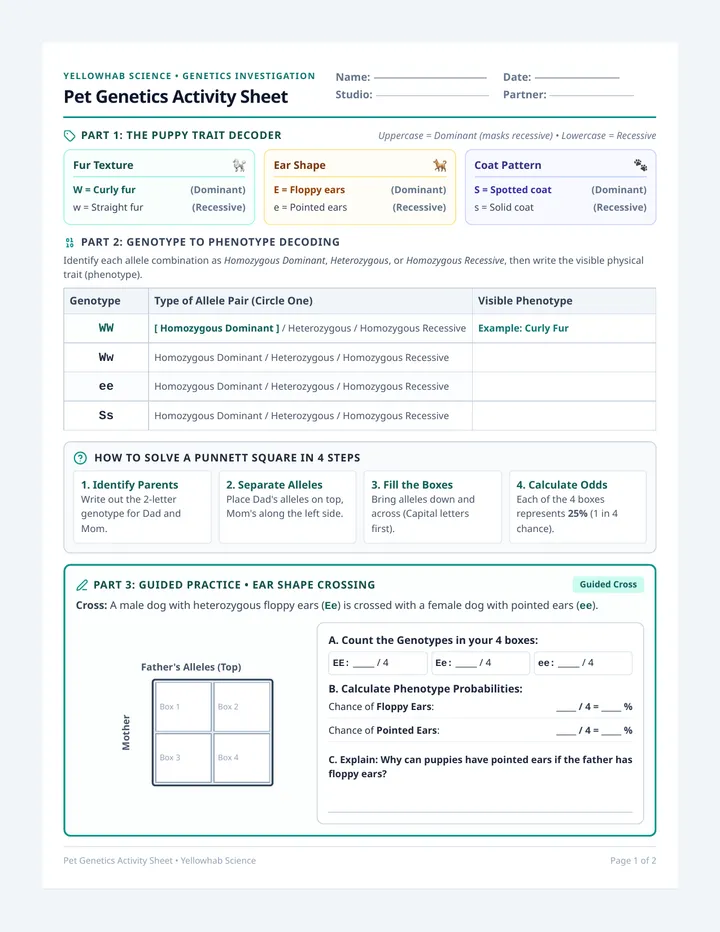
2 Put Parent 2 alleles down the left side (t and t).
3 "Drop and Slide" letters into the 4 boxes!
Result: 2 of 4 boxes are Tt = 50% Tall Offspring!
Matches Section 4 (Question 2) in your Student Packet Each box represents 25% chance
Lesson Objective: Apply vocabulary, chromosome duplication rules, and Punnett squares to NYS exam questions.
NYS Exam Questions 17–20 Mins
Silent Exit Slip 3 Mins
Need help? Check your vocabulary list on Page 1 / Página 2 You've got this!