Student Name:
Part 3
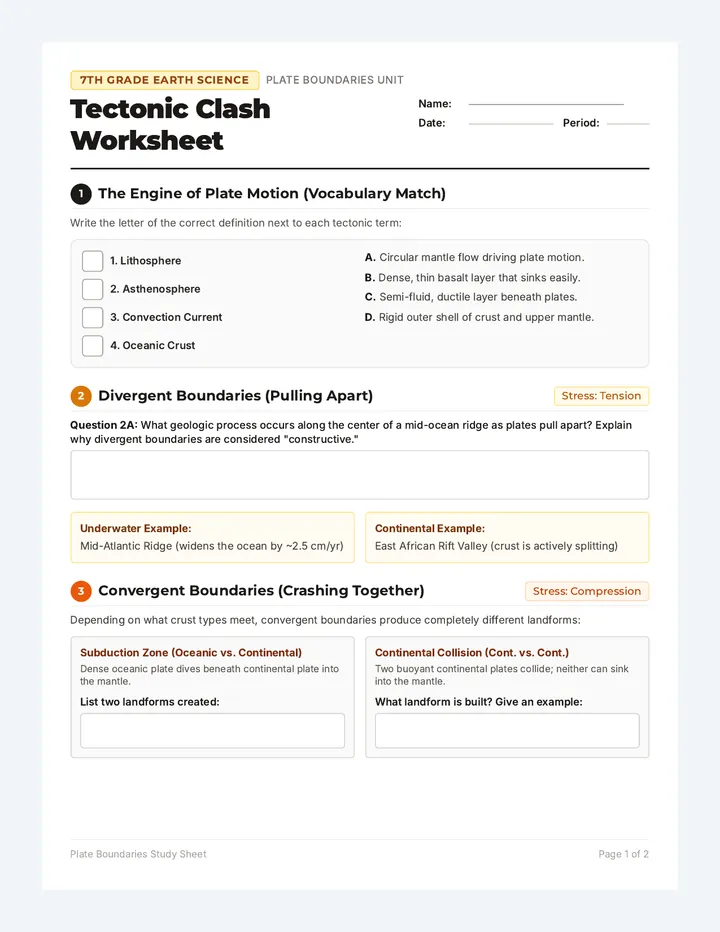
Question 1 (7.ESS.1): Explain why volcanic mountains form along the Pacific coast of South America (convergent subduction), but massive non-volcanic folded mountains form in the Himalayas (convergent continental collision). Contrast the crust types and processes.
Question 2 (7.ESS.2): If new oceanic crust is continuously being created at thousands of miles of divergent mid-ocean ridges every year, why is the overall surface area of planet Earth NOT expanding?
Part 4
ITEM 1 (Standard 7.ESS.2 Data Analysis) Multiple Choice
Scientists drill core samples across the Atlantic Ocean seafloor. Core sample A is collected 20 km east of the Mid-Atlantic Ridge. Core sample B is collected 1,500 km east of the ridge near the coast of Africa. Which observation provides the strongest evidence supporting sea-floor spreading?
A Sample A consists of thick marine sediments and ancient cold basalt rock.
B Sample A is significantly younger in age and warmer than Sample B.
C Sample B contains newly cooled magma with zero accumulation of ocean sediment.
D Both samples have identical ages and rock compositions because the seafloor formed all at once.
ITEM 2 (Standard 7.ESS.1 Multi-Part Performance Task) Constructed Response
An orange orchard in central California is split by the San Andreas Fault line. In 1906, an earthquake struck, and the rows of trees shifted offset by 18 feet. Over the past 120 years, no volcanic eruptions have occurred in the area.
A. Claim: Identify the plate boundary type and describe the horizontal crustal motion occurring here:
B. Reasoning: Explain why severe earthquakes occur frequently along this boundary, yet active volcanoes are absent:
Indiana Academic Standard 7.ESS.2 • Geoscience Processes & Temporal Scales Page 2 of 2
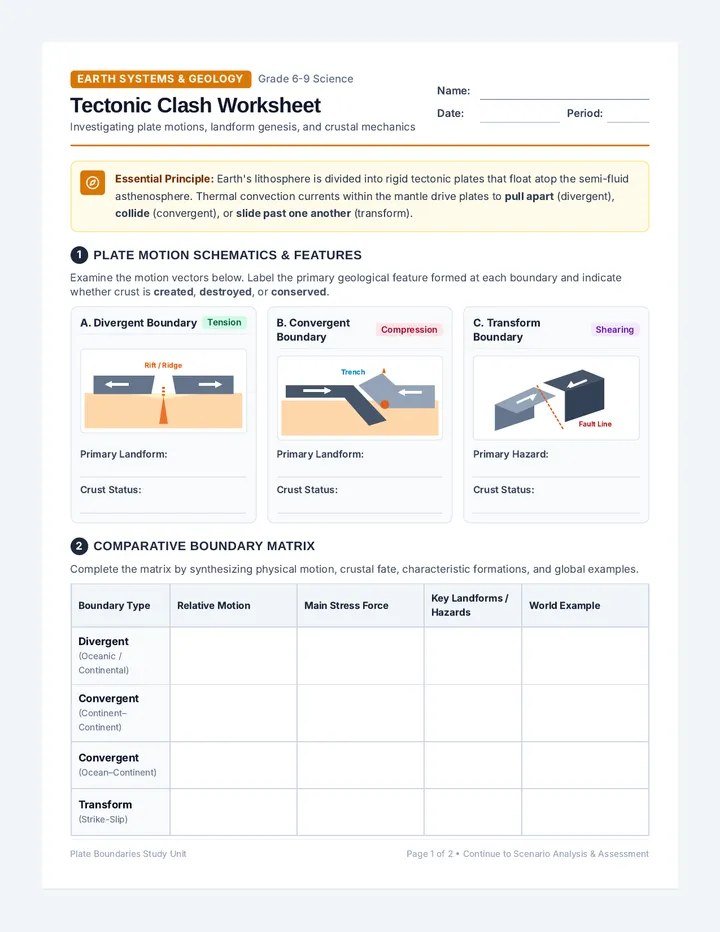
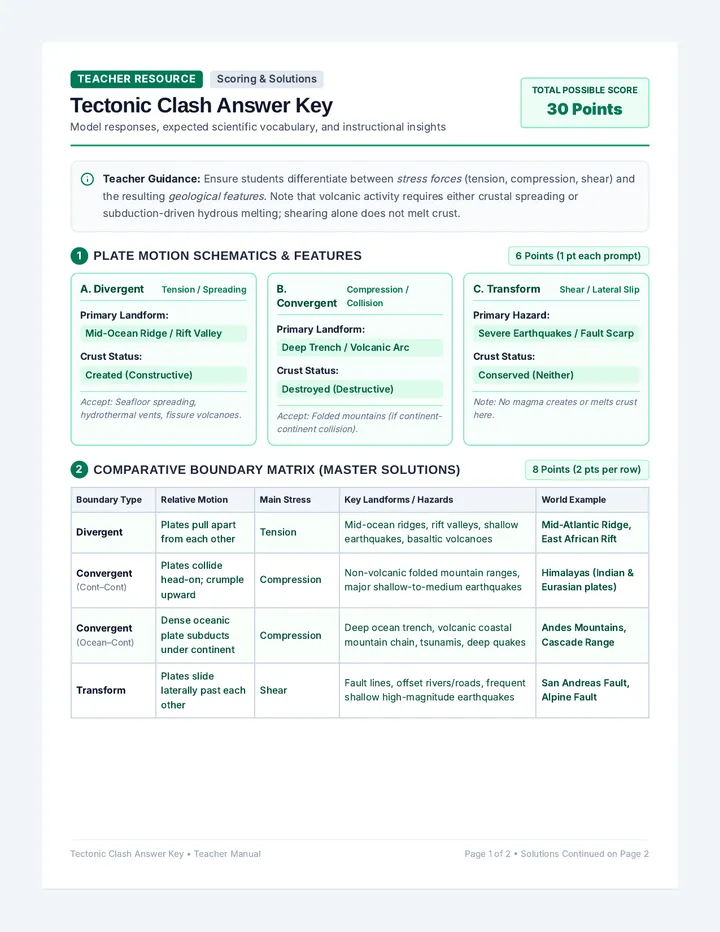
| San Andreas Fault (California); Alpine Fault (New Zealand). |
Part 2 Key
1.5 pts per prompt
DIAGRAM A: Subduction Zone 4.5 Pts
1. Identify feature [2]:
Volcanic Arc / Volcanic Mountain Range (formed by magma rising from the melting slab).
2. Identify feature [3]:
Deep Ocean Trench (the steep V-shaped depression where the seafloor bends down).
3. Density Explanation:
The oceanic plate is composed of dense basalt (~3.0 g/cm³), which is heavier than the buoyant continental granite (~2.7 g/cm³).
DIAGRAM B: Seafloor Spreading 4.5 Pts
1. Youngest rock location:
Directly at the ridge crest [2]. Rocks progressively increase in age with distance away from the ridge.
2. Driving thermal engine:
Mantle Convection Currents (hot magma rises, cools, and circulates, dragging the lithospheric plates).
3. Crust budget:
Crust is CREATED / PRODUCED as basaltic magma cools to become brand new oceanic lithosphere.
Teacher Guide • Indiana Standard 7.ESS.1 Rubric Guide Page 1 of 2
Constructed Response Rubrics & Test Item Rationales
16 Points Total on Page 2
Part 3 Key
4 pts per explanation
Question 1: Volcanic Arc vs. Non-Volcanic Collisional Mountains (4 Pts) Full Credit Criteria
Exemplary Student Response: "In South America, high-density oceanic basalt subducts beneath continental granite into the hot asthenosphere. Trapped ocean water lowers the melting point of rock, generating magma that rises through the crust to erupt as volcanoes. In the Himalayas, both colliding plates consist of thick, buoyant continental granite. Neither plate can sink into the mantle (no subduction), so no rock melts into magma. Instead, the crust folds, crumples, and uplifts into massive non-volcanic peaks."
• Subduction + melting magma mentioned: 2 pts • Continental buoyancy / no subduction explained: 2 pts
Question 2: Dynamic Surface Area Conservation (4 Pts) Full Credit Criteria
Exemplary Student Response: "Earth's surface area remains constant because new crust is created at divergent boundaries (mid-ocean ridges) at the exact same rate that old, dense oceanic crust is destroyed and recycled back into the mantle at convergent subduction zones (deep ocean trenches). The crustal budget is balanced."
• Identifies subduction as the recycling mechanism: 2 pts • Explicitly states creation rate equals destruction rate: 2 pts
Part 4 Key
Standard 7.ESS.1 & 7.ESS.2 Aligned
ITEM 1 (Multiple Choice): CORRECT ANSWER: B 3 Pts
Rationale for Choice B: New basalt erupts along the ridge axis; therefore, rock 20 km from the ridge (Sample A) must be geologically younger and thermally warmer than rock 1,500 km away (Sample B), which cooled millions of years ago.
Distractor Notes: Option A reverses the sediment pattern (sediments are thinnest at the ridge). Option C reverses locations. Option D denies plate movement.
ITEM 2 (Performance Task CER Prompt) 5 Pts Total (2 pts Part A, 3 pts Part B)
A. Claim (2 pts): "The San Andreas is a transform plate boundary with horizontal strike-slip / shearing motion where the Pacific and North American plates slide past each other."
B. Reasoning (3 pts): "Earthquakes occur because jagged rock edges lock together under friction; when elastic stress exceeds rock strength, it suddenly snaps and releases energy (2 pts). Volcanoes are absent because neither plate subducts into the mantle to melt, nor do plates pull apart to allow magma upwelling; crust is simply conserved (1 pt)."
Key 7th-Grade Indiana Misconceptions to Address During Debrief:
Teacher Guide • Indiana Standards 7.ESS.1 & 7.ESS.2 Scoring Rubric Page 2 of 2