Solton Rooftops Assignment
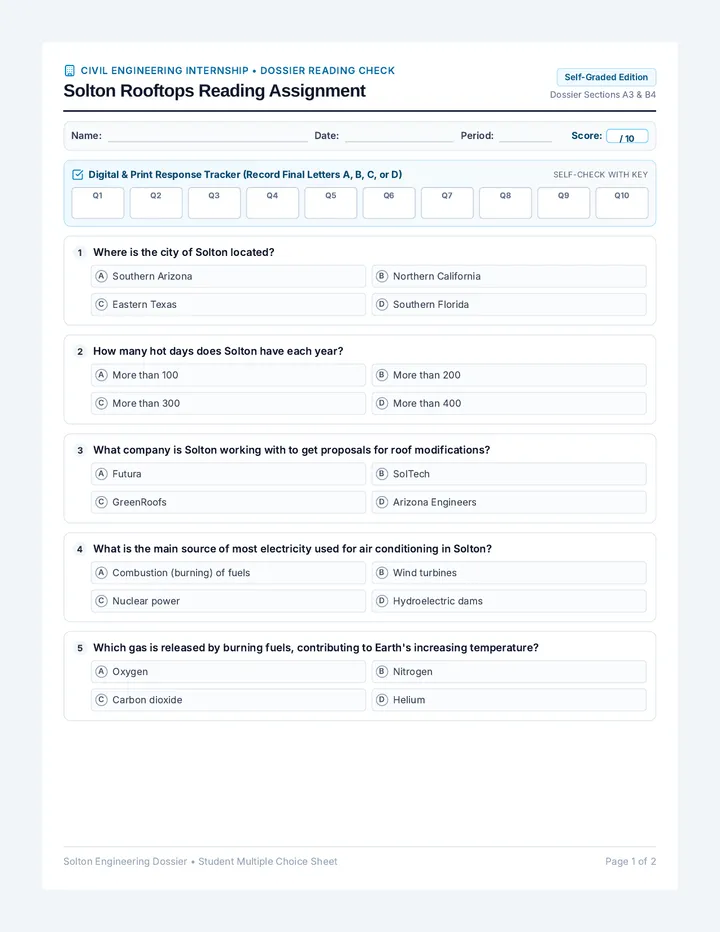
Civil Engineering Internship • Dossier Reading Check
Solton Rooftops Reading Assignment
Self-Graded Edition
Dossier Sections A3 & B4
Name:
Date:
Period:
Score: / 10
Digital & Print Response Tracker (Record Final Letters A, B, C, or D)
Self-Check with Key
Q1
Q2
Q3
Q4
Q5
Q6
Q7
Q8
Q9
Q10
1 Where is the city of Solton located?
A Southern Arizona
B Northern California
C Eastern Texas
D Southern Florida
2 How many hot days does Solton have each year?
A More than 100
B More than 200
C More than 300
D More than 400
3 What company is Solton working with to get proposals for roof modifications?
A Futura
B SolTech
C GreenRoofs
D Arizona Engineers
4 What is the main source of most electricity used for air conditioning in Solton?
A Combustion (burning) of fuels
B Wind turbines
C Nuclear power
D Hydroelectric dams
5 Which gas is released by burning fuels, contributing to Earth's increasing temperature?
A Oxygen
B Nitrogen
C Carbon dioxide
D Helium
Solton Engineering Dossier • Student Multiple Choice Sheet Page 1 of 2
Solton Rooftops Assignment (Continued)
Student: Questions 6–10
6 Why is preserving historic value especially important for buildings with pitched (slanted) roofs?
A They are cheaper to paint
B The changes are easy to see from street level
C They are made of wood
D They cannot support solar panels
7 Which of the following is a constraint for the proposed roof modifications?
A Must cut down trees to get more sunlight
B Must not include any major structural changes
C Must only use blue roofs
D Must completely rebuild the roofs
8 What are the only two types of roof modifications allowed under the constraints?
A Green roofs and metal roofs
B White roofs and solar roofs
C Shingle roofs and flat roofs
D Clay roofs and glass roofs
9 About how much of home energy use in the United States goes toward indoor temperature control?
A About 10%
B About 25%
C About half
D About 90%
10 By changing roofs, about how much can U.S. communities lower their energy use?
A By more than 5%
B By more than 10%
C By more than 20%
D By more than 50%
Student Self-Grading & Reflection Station
Use provided Answer Key
Compare each answer in your Response Tracker with the Answer Key.
Mark correct with () and incorrect with ().
Calculate total score (1 pt each) and record in the score badge.
Total Score:
/ 10
9–10: Mastered 7–8: Proficient <7: Review
Key Takeaway / Concept to Re-read:
Solton Engineering Dossier • Student Multiple Choice Sheet Page 2 of 2
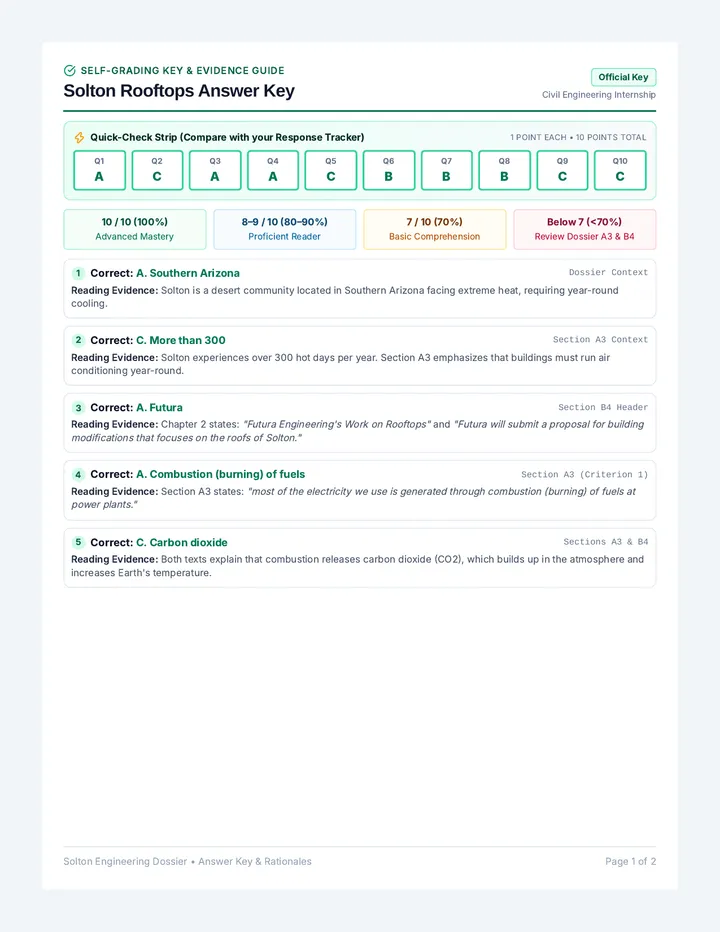
Solton Rooftops Answer Key
Self-Grading Key & Evidence Guide
Solton Rooftops Answer Key
Official Key
Civil Engineering Internship
Quick-Check Strip (Compare with your Response Tracker)
1 Point Each • 10 Points Total
Q1 A
Q2 C
Q3 A
Q4 A
Q5 C
Q6 B
Q7 B
Q8 B
Q9 C
Q10 C
10 / 10 (100%) Advanced Mastery
8–9 / 10 (80–90%) Proficient Reader
7 / 10 (70%) Basic Comprehension
Below 7 (<70%) Review Dossier A3 & B4
1 Correct: A. Southern Arizona
Dossier Context
Reading Evidence: Solton is a desert community located in Southern Arizona facing extreme heat, requiring year-round cooling.
2 Correct: C. More than 300
Section A3 Context
Reading Evidence: Solton experiences over 300 hot days per year. Section A3 emphasizes that buildings must run air conditioning year-round.
3 Correct: A. Futura
Section B4 Header
Reading Evidence: Chapter 2 states: "Futura Engineering's Work on Rooftops" and "Futura will submit a proposal for building modifications that focuses on the roofs of Solton."
4 Correct: A. Combustion (burning) of fuels
Section A3 (Criterion 1)
Reading Evidence: Section A3 states: "most of the electricity we use is generated through combustion (burning) of fuels at power plants."
5 Correct: C. Carbon dioxide
Sections A3 & B4
Reading Evidence: Both texts explain that combustion releases carbon dioxide (CO2), which builds up in the atmosphere and increases Earth's temperature.
Solton Engineering Dossier • Answer Key & Rationales Page 1 of 2
Solton Rooftops Answer Key (Questions 6–10 Continued)
Explanations & Evidence
6 Correct: B. The changes are easy to see from street level
Section A3 (Criterion 2)
Reading Evidence: The text explains that "changing the roofs can affect the historic value... especially when the buildings have pitched (slanted) roofs so that the changes are easy to see from street level."
7 Correct: B. Must not include any major structural changes
Section A3 (Constraints)
Reading Evidence: A key constraint specifies: "The proposed design must not include any major structural changes to the buildings, such as changes in the shape or direction of the roof."
8 Correct: B. White roofs and solar roofs
Sections A3 & B4
Reading Evidence: Section A3 states: "The roof modifications include only white roofs and solar roofs." Section B4 confirms Futura evaluated these two options.
9 Correct: C. About half
Section B4 (Paragraph 1)
Reading Evidence: Section B4 explicitly notes: "about half of home energy use goes toward indoor temperature control" in the United States.
10 Correct: C. By more than 20%
Section B4 (Paragraph 2)
Reading Evidence: Section B4 states: "By changing roofs, U.S. communities can lower their energy use by more than 20% and significantly reduce their climate impact."
Engineering Concept Review: Criteria vs. Constraints
Criteria (Goals to Optimize)
- Reduce climate impact (cut electricity & CO2)
- Preserve historic building value
- Keep project costs low
Constraints (Non-Negotiable Limits)
- No major structural changes (no shape/pitch changes)
- Do not cut down any trees
- Only use white roofs and solar roofs
Solton Engineering Dossier • Answer Key & Rationales Page 2 of 2