Chromosome Pairs Student Packet
NYS Regents Life Science Unit: Genetics & Cell Biology
Page 1 of 8
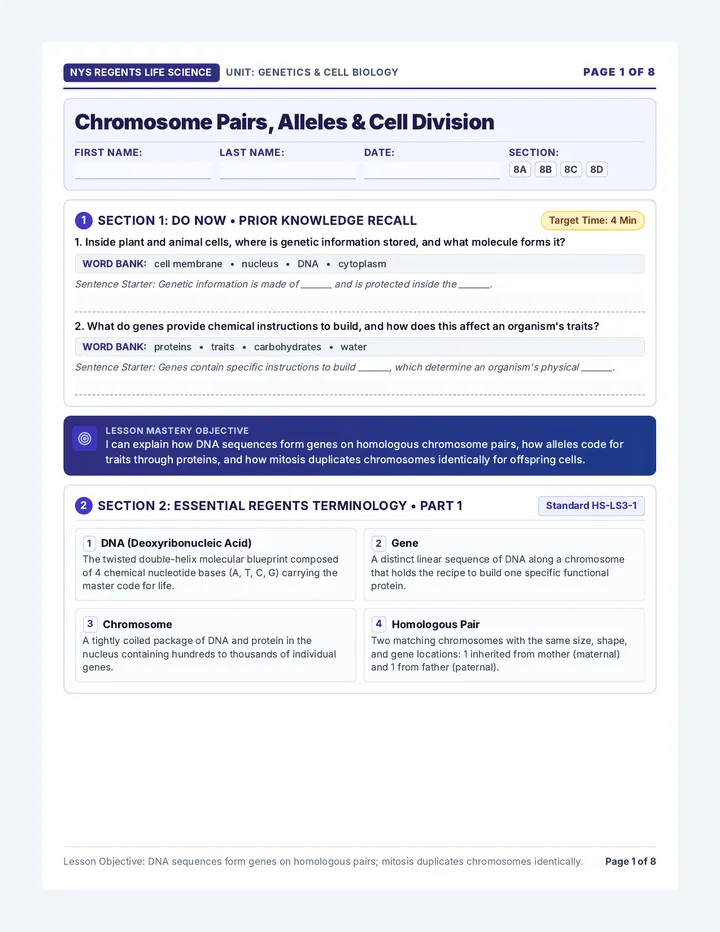
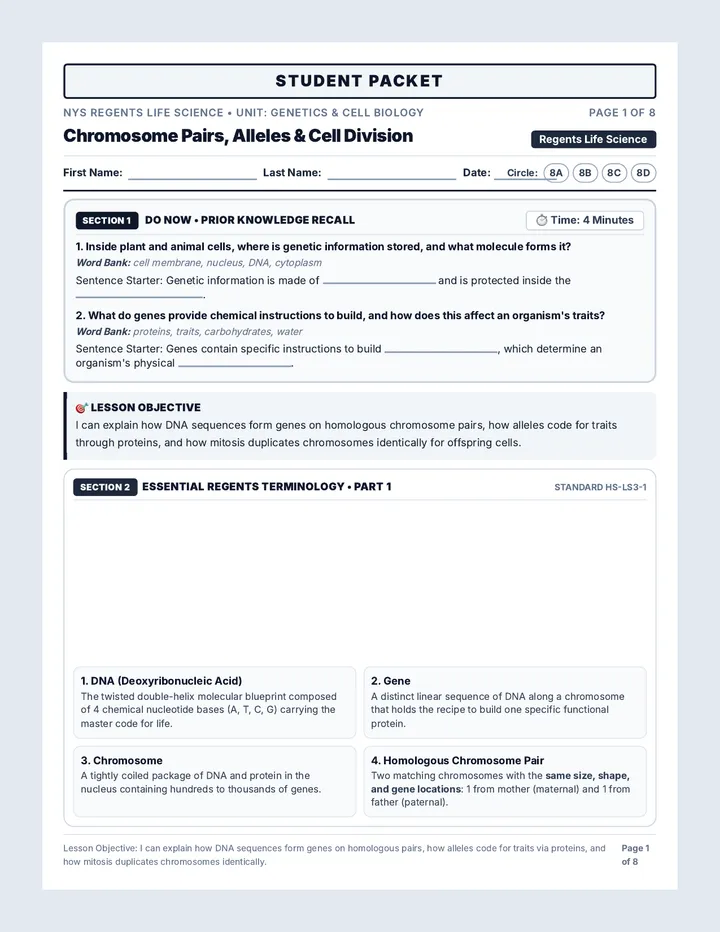
Chromosome Pairs, Alleles & Cell Division
First Name:
Last Name:
Date:
Section:
8A 8B 8C 8D
1
Section 1: Do Now • Prior Knowledge Recall
Target Time: 4 Min
1. Inside plant and animal cells, where is genetic information stored, and what molecule forms it?
Word Bank: cell membrane • nucleus • DNA • cytoplasm
Sentence Starter: Genetic information is made of _______ and is protected inside the _______.
2. What do genes provide chemical instructions to build, and how does this affect an organism's traits?
Word Bank: proteins • traits • carbohydrates • water
Sentence Starter: Genes contain specific instructions to build _______, which determine an organism's physical _______.
Lesson Mastery Objective
I can explain how DNA sequences form genes on homologous chromosome pairs, how alleles code for traits through proteins, and how mitosis duplicates chromosomes identically for offspring cells.
2
Section 2: Essential Regents Terminology • Part 1
Standard HS-LS3-1
1
DNA (Deoxyribonucleic Acid)
The twisted double-helix molecular blueprint composed of 4 chemical nucleotide bases (A, T, C, G) carrying the master code for life.
2
Gene
A distinct linear sequence of DNA along a chromosome that holds the recipe to build one specific functional protein.
3
Chromosome
A tightly coiled package of DNA and protein in the nucleus containing hundreds to thousands of individual genes.
4
Homologous Pair
Two matching chromosomes with the same size, shape, and gene locations: 1 inherited from mother (maternal) and 1 from father (paternal).
Lesson Objective: DNA sequences form genes on homologous pairs; mitosis duplicates chromosomes identically. Page 1 of 8
NYS Regents Life Science Unit: Genetics & Cell Biology
Page 2 of 8
Molecular Pathways: From DNA Code to Trait
Connecting nucleotides, gene expression, and observable physical characteristics.
Direct Instruction: 8 Min
Section 2: Essential Regents Terminology • Part 2
Alleles, Expression & Mitosis
5
Gene Locus & Allele
Locus: Specific physical address of a gene on a chromosome.
Allele: Alternative versions of that gene (e.g., dominant T vs. recessive t).
6
Genotype vs. Phenotype
Genotype: The two-letter allele combination (e.g., TT, Tt, tt).
Phenotype: The visible physical trait expressed (e.g., Tall vs. Short stem).
7
Homozygous vs. Heterozygous
Homozygous: Two identical alleles (TT homozygous dominant or tt homozygous recessive).
Heterozygous: Two different alleles (Tt).
8
Mitosis
Cellular division where 1 parent body cell duplicates all chromosomes to form 2 identical daughter cells for growth and tissue repair.
Model 1
The Molecular Connection: DNA Sequence → Gene → Protein → Trait
Genes carry instructions to assemble proteins. Follow how the sequence of chemical bases in DNA leads directly to an observable physical trait:
Step 1
DNA Base Code
A-T-C-G-G-T-A
The 4 chemical bases form the master code.
Step 2
Gene Segment
[ Gene on DNA ]
Specific recipe segment along chromosome.
Step 3
Protein Built
⚙️ Growth Enzyme
Cellular molecular machines and structures.
Step 4
Expressed Trait
🌱 Tall Stem
The visible phenotype created by the protein.
Key Scientific Idea: An allele is a slightly different DNA base sequence for that gene. A dominant allele produces a functional protein (such as an enzyme that makes pigment), while a recessive allele may produce a nonfunctional protein.
Lesson Objective: DNA sequences form genes on homologous pairs; mitosis duplicates chromosomes identically. Page 2 of 8
NYS Regents Life Science Unit: Genetics & Cell Biology
Page 3 of 8
Visual Model 2: Homologous Chromosome Pairs & Gene Loci
Maternal and paternal chromosomes carry matching loci with dominant or recessive alleles.
Direct Instruction: 8 Min
Visual Key:
Solid Border = Maternal (Mother)
Dashed Border = Paternal (Father)
Pair 1: Long Straight Pair
Gene: Stem Height
Maternal (Solid)
T
Dominant T
Identical ← Locus → Same gene height
Paternal (Dashed)
t
Recessive t
Genotype: Tt (Heterozygous)
Phenotype: Tall Stem (T masks t)
Pair 2: Short Hooked Pair
Gene: Eye Color
Maternal (Solid)
B
Dominant B
Identical ← Locus → Distinct shape
Paternal (Dashed)
b
Recessive b
Genotype: Bb (Heterozygous)
Phenotype: Brown Eyes (B masks b)
Concept Checkpoint: Why does each somatic body cell carry two alleles for each gene?
Sentence Starter: Body cells have two alleles for each gene because chromosomes exist in _______, inheriting one from _______ and one from _______.
Lesson Objective: DNA sequences form genes on homologous pairs; mitosis duplicates chromosomes identically. Page 3 of 8
NYS Regents Life Science Unit: Genetics & Cell Biology
Page 4 of 8
Visual Model 3: Mitosis & Allele Conservation
Tracking exact chromosome replication and distribution into 2 identical daughter cells.
Standard HS-LS1-4
Chromosome Key: Solid = Maternal (T, B) Dashed = Paternal (t, b)
Somatic Count: 2n = 4
Model 3: Following the Fate of Chromosomes & Alleles During Somatic Cell Division
Stage 1
Parent Cell (2n = 4)
Original Somatic Cell
Nucleus (2n=4)
T
t
B
b
4 Single Chromosomes Genotype: Tt Bb
Stage 2
S-Phase Replication
DNA Duplication
Replicated DNA (8 Chromatids)
T
T
t
t
B
B
b
b
8 Sister Chromatids Copies: TT tt BB bb
Stage 3
2 Daughter Cells
Post-Mitosis Cytokinesis
Daughter Cell 1 (2n=4)
T
t
B
b
Daughter Cell 2 (2n=4)
T
t
B
b
100% Identical Sets Each Cell: Tt Bb (2n = 4)
Regents Core Conclusion:
Mitosis is a mechanism of asexual somatic cell duplication. Through exact DNA replication in S-Phase followed by the equal separation of sister chromatids, two daughter cells are produced with chromosome numbers and allele combinations that are 100% identical to the original parent cell (and identical to each other).
Lesson Objective: DNA sequences form genes on homologous pairs; mitosis duplicates chromosomes identically. Page 4 of 8
NYS Regents Life Science Unit: Genetics & Cell Biology
Page 5 of 8
Section 5: Punnett Square Inheritance Modeling
Student Activity: 20 Min
REMINDER: All unfinished questions in class are homework due at our next class meeting.
Genetics Investigation Scenario: Pea Plant Stem Height
In pea plants, tall stem height (T) is dominant over short stem height (t). A plant geneticist crosses a heterozygous tall plant (Tt) with a homozygous short plant (tt).
Step 1: Maternal Alleles
Mother's pair separates: place T and t over columns.
Step 2: Paternal Alleles
Father's pair separates: place t and t down left rows.
Step 3: Combine Alleles
Bring top letter down and side letter across to form offspring pairs.
Mother's Alleles (Heterozygous Tt)
Father (tt)
t
t
T
t
Offspring 1
Offspring 2
Offspring 3
Offspring 4
a. Genotype Probabilities
TT (Homozygous Dom.):
______ %
Tt (Heterozygous):
______ %
tt (Homozygous Rec.):
______ %
b. Phenotype Probabilities
Tall Stems:
______ %
Short Stems:
______ %
Lesson Objective: DNA sequences form genes on homologous pairs; mitosis duplicates chromosomes identically. Page 5 of 8
NYS Regents Life Science Unit: Genetics & Cell Biology
Page 6 of 8
Section 5: Analysis & Regents Exam Practice
Student Activity: 20 Min
REMINDER: All unfinished questions in class are homework due at our next class meeting.
Punnett Square Analysis Questions
c. Explain why an offspring with the genotype Tt develops tall stems instead of short stems:
Sentence Starter: The plant develops tall stems because the dominant T allele codes for _______, which masks the nonfunctional recessive allele.
d. Why does each box in the Punnett square receive exactly two alleles?
Sentence Starter: Each square receives two alleles because chromosomes exist in _______, inheriting 1 allele from the _______ and 1 from the _______.
Question 1
NYS Regents Exam Practice
Standard HS-LS1-4
A domestic dog has 78 chromosomes (39 homologous pairs) in each healthy muscle cell. When a muscle cell undergoes mitosis to repair damaged tissue, how many total chromosomes will be found in each newly formed daughter cell?
(1) 39
(2) 78
(3) 156
(4) 0
Scientific Justification Scaffold:
Sentence Starter: Each new daughter cell will have _______ chromosomes because before the cell divides, all chromosomes _______, ensuring both daughter cells receive _______.
Lesson Objective: DNA sequences form genes on homologous pairs; mitosis duplicates chromosomes identically. Page 6 of 8
NYS Regents Life Science Unit: Genetics & Cell Biology
Page 7 of 8
Section 6: Regents Scientific Explanation (CRQ)
Student Activity: 20 Min
REMINDER: All unfinished questions in class are homework due at our next class meeting.
Constructed Response Question (CRQ)
Standard HS-LS3-1
Prompt: Why do biological children inherit traits from both parents, but are never an exact identical clone of either parent?
Scientific Criteria Checklist (Must include all 4 concepts in your explanation):
Homologous chromosome pairs
Maternal & paternal alleles
DNA base sequence variations
Proteins producing physical traits
Sentence Starter: Children resemble both parents because body cells contain homologous pairs of chromosomes, inheriting one chromosome from _______ and one from _______.
Lesson Objective: DNA sequences form genes on homologous pairs; mitosis duplicates chromosomes identically. Page 7 of 8
NYS Regents Life Science Unit: Genetics & Cell Biology
Page 8 of 8
Section 7: Exit Slip & Student Self-Check
Target Time: 7 Min
REMINDER: All unfinished questions in class are homework due at our next class meeting.
Section 7 Exit Slip • Individual Understanding Check
Silent Independent Work
Context: In domestic rabbits, black fur color (B) is dominant over white fur color (b). An individual rabbit has the heterozygous genotype Bb.
1. What is the rabbit's physical fur color (phenotype)?
Answer:
2. Explain at the molecular level why this specific color develops:
Sentence Starter: The dominant allele B contains a DNA sequence that codes for an active enzyme, which _______.
3. Mitosis Connection: When this rabbit's skin cells divide by mitosis, what alleles will each newly formed skin cell carry? Explain why.
Sentence Starter: Each new cell has genotype _______ because during mitosis, all DNA is _______.
Student Success Self-Check:
Matching homologous pairs explained
DNA codes for functional proteins
Mitosis duplicates 100% identical sets
Lesson Objective: DNA sequences form genes on homologous pairs; mitosis duplicates chromosomes identically. Page 8 of 8
Chromosome Pairs Lesson Slides
NYS Regents Life Science Unit: Genetics & Cell Biology
Direct Instruction & Guided Modeling
Chromosome Pairs, Alleles & Cell Division
Connecting DNA base sequences to functional proteins, homologous chromosome pairs, and the exact conservation of alleles during mitosis.
Standards: HS-LS3-1 & HS-LS1-4 Mirroring Student Packet Pages 1–8
1
Section 1: Do Now • Prior Recall
Target: 4 Minutes
Question 1
Where is genetic information stored in plant and animal cells, and what molecule forms it?
Word Bank: cell membrane • nucleus • DNA • cytoplasm
Key Recall: Genetic instructions are made of DNA and protected inside the nucleus.
Question 2
What do genes provide chemical instructions to build, and how does this shape physical traits?
Word Bank: proteins • traits • carbohydrates • water
Key Recall: Genes build specific proteins, which produce an organism's visible traits.
Turn & Talk with your partner to confirm your packet answers Packet Page 1
Lesson Mastery Objective
Standards HS-LS3-1 & HS-LS1-4
By the end of today's lesson, you can state:
"I can explain how DNA sequences form genes on homologous chromosome pairs, how alleles code for traits through proteins, and how mitosis duplicates chromosomes 100% identically for offspring cells."
1. Decode Gene Loci
2. Track Allele Expression
3. Model Mitotic Replication
Unit: Cellular & Molecular Genetics Packet Page 1
2
Essential Terminology • Part 1
Standard HS-LS3-1
1
DNA
The twisted double-helix molecule made of 4 chemical nucleotide bases (A, T, C, G) carrying the master genetic code.
2
Gene
A distinct linear sequence along a chromosome that contains the chemical recipe to build one specific functional protein.
3
Chromosome
A tightly coiled structure of DNA and proteins in the nucleus packed with hundreds to thousands of individual genes.
4
Homologous Pair
Two matching chromosomes of the same size and gene order: one inherited from mother (maternal) and one from father (paternal).
Humans carry 23 homologous pairs (46 total chromosomes) in every somatic body cell Packet Page 1
2
Essential Terminology • Part 2
Alleles, Genotypes & Mitosis
5
Locus & Allele
Locus: Physical address of a gene.
Allele: Alternative DNA versions of that gene (e.g., dominant T vs. recessive t).
6
Genotype vs. Phenotype
Genotype: The allele letters (TT, Tt, tt).
Phenotype: The visible physical characteristic (Tall vs. Short stem).
7
Homozygous vs. Heterozygous
Homozygous: Matching alleles (TT or tt).
Heterozygous: Two different alleles (Tt).
8
Mitosis
Cell division where 1 parent body cell duplicates all chromosomes to create 2 identical daughter cells for growth and repair.
Direct Instruction: Check that your definitions match Packet Page 2 Packet Page 2
Model 1
The Molecular Connection: Code → Trait
Central Dogma of Genetics
Step 1
DNA Base Code
A-T-C-G-G-T-A
The 4 nucleotide bases create the master linear recipe.
Step 2
Gene Segment
[ Gene on DNA ]
Specific functional address along the chromosome.
Step 3
Protein Built
⚙️ Growth Enzyme
Amino acid chain acts as cellular machine.
Step 4
Expressed Trait
🌱 Tall Stem
Visible physical phenotype in the organism.
Key Scientific Principle: Different alleles have slightly different DNA nucleotide sequences. A dominant allele produces an active, functional enzyme, while a recessive allele produces an inactive or nonfunctional protein.
DNA Sequence → Amino Acid Chain → Functional Protein → Observable Trait Packet Page 2
Model 2
Homologous Chromosome Pairs & Gene Loci
Solid = Maternal
Dashed = Paternal
Pair 1: Long Straight Pair
Gene: Stem Height
Maternal (Solid)
T
Dominant T
← Locus 1 → Matching Address
Paternal (Dashed)
t
Recessive t
Genotype: Tt (Heterozygous) Phenotype: Tall Stem
Pair 2: Short Hooked Pair
Gene: Eye Color
Maternal (Solid)
B
Dominant B
← Locus 2 → Distinct Shape
Paternal (Dashed)
b
Recessive b
Genotype: Bb (Heterozygous) Phenotype: Brown Eyes
Every somatic cell carries 2 alleles per gene because homologous pairs come from both parents Packet Page 3
Model 3
Following Chromosomes Through Mitosis
Solid Maternal (T, B) Dashed Paternal (t, b)
Stage 1
Parent Cell (2n = 4)
Original Somatic Cell
Nucleus (2n=4)
T
t
B
b
4 Single Chromosomes Genotype: Tt Bb
Stage 2
S-Phase Replication
DNA Duplication
8 Sister Chromatids
T
T
t
t
B
B
b
b
Exact Duplicate Copies TT tt BB bb
Stage 3
2 Daughter Cells
Mitosis Complete
Daughter 1 (2n=4)
T
t
B
b
Daughter 2 (2n=4)
T
t
B
b
100% Identical Genomes Both: Tt Bb (2n=4)
Mitosis produces 2 daughter cells 100% genetically identical to the parent cell and each other Packet Page 4
Regents Core Conclusion: Allele Conservation
Standard HS-LS1-4
1. Exact Replication (S-Phase)
Before division, every chromosome makes an identical sister chromatid copy. A parent cell starting with 4 chromosomes replicates into 8 chromatids.
2. Equal Separation (Mitosis)
Spindle fibers separate sister chromatids to opposite poles. Both new nuclei receive the exact same maternal and paternal chromosomes.
3. Biological Function
Mitosis occurs in somatic body cells for growth, tissue repair, and cellular replacement.
Daughter cells maintain identical diploid (2n) chromosome numbers Packet Page 4
5
Section 5: Punnett Square Inheritance Modeling
Activity: 20 Min
Investigation Scenario
Cross a heterozygous tall plant (Tt) with a homozygous short plant (tt).
Step 1: Mother's alleles (T, t) placed above columns.
Step 2: Father's alleles (t, t) placed down left rows.
Step 3: Combine letters into each 2x2 grid box.
Mother's Alleles (Tt)
Father (tt)
t t
T t
Tt Tall
tt Short
Tt Tall
tt Short
Results: 50% Tt (Tall) and 50% tt (Short) Packet Page 5
Practice
NYS Regents Exam Question 1
Standard HS-LS1-4
A domestic dog has 78 chromosomes (39 homologous pairs) in each healthy muscle cell. When a muscle cell undergoes mitosis to repair damaged tissue, how many total chromosomes will be found in each newly formed daughter cell?
(1) 39
(2) 78 ★
(3) 156
(4) 0
Scientific Justification Scaffold: "Each new daughter cell will have 78 chromosomes because before the cell divides, all chromosomes replicate in S-Phase, ensuring both daughter cells receive an identical complete set."
Mitosis maintains the somatic diploid chromosome number (2n → 2n) Packet Page 6
6
Section 6: Regents Scientific Explanation (CRQ)
Standard HS-LS3-1
Constructed Response Prompt:
Why do biological children inherit traits from both parents, but are never an exact identical clone of either parent?
Scientific Criteria Checklist (Must Include All 4 Concepts):
✓ Homologous chromosome pairs
✓ Maternal & paternal alleles
✓ DNA base sequence variations
✓ Proteins producing physical traits
Draft your complete response on Packet Page 7 Packet Page 7
7
Section 7: Exit Slip & Self-Check
Final 7 Minutes
Rabbit Genetics Scenario
In domestic rabbits, black fur color (B) is dominant over white fur color (b). A rabbit has genotype Bb.
1. Phenotype: Black fur (Dominant B masks b)
2. Molecular Cause: Active pigment enzyme built from B DNA
3. Mitosis Result: Every skin cell receives identical Bb
Self-Check Checklist:
Homologous pairs have matching loci from mother and father
DNA sequences direct protein synthesis to build traits
Mitosis replicates & splits chromosomes 100% identically
Submit Packet Page 8 to the bin before leaving!
All unfinished work is homework due at our next class meeting Packet Page 8