Chromosome Code Student Packet STUDENT PACKET
NYS Regents Life Science • Unit: Genetics & Cell Biology Page 1 of 8
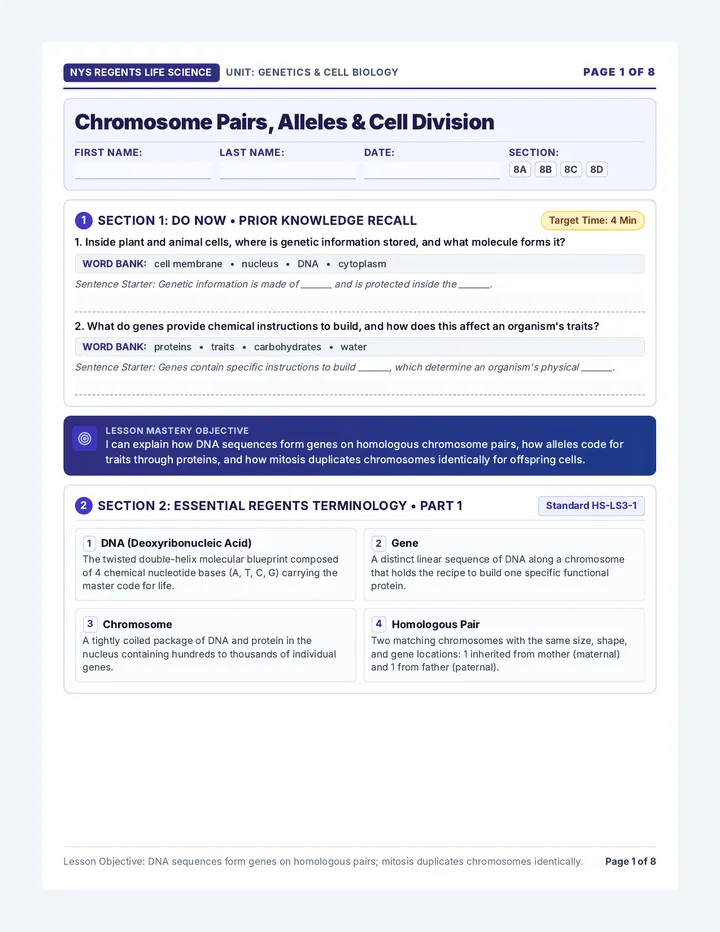
Chromosome Pairs, Alleles & Cell Division
Regents Life Science
First Name:
Last Name:
Date:
Circle: 8A 8B 8C 8D
Section 1 Do Now • Prior Knowledge Recall
⏱️ Time: 4 Minutes
1. Inside plant and animal cells, where is genetic information stored, and what molecule forms it?
Word Bank: cell membrane, nucleus, DNA, cytoplasm
Sentence Starter: Genetic information is made of and is protected inside the .
2. What do genes provide chemical instructions to build, and how does this affect an organism's traits?
Word Bank: proteins, traits, carbohydrates, water
Sentence Starter: Genes contain specific instructions to build , which determine an organism's physical .
🎯 Lesson Objective
I can explain how DNA sequences form genes on homologous chromosome pairs, how alleles code for traits through proteins, and how mitosis duplicates chromosomes identically for offspring cells.
Section 2 Essential Regents Terminology • Part 1
Standard HS-LS3-1
1. DNA (Deoxyribonucleic Acid)
The twisted double-helix molecular blueprint composed of 4 chemical nucleotide bases (A, T, C, G) carrying the master code for life.
2. Gene
A distinct linear sequence of DNA along a chromosome that holds the recipe to build one specific functional protein.
3. Chromosome
A tightly coiled package of DNA and protein in the nucleus containing hundreds to thousands of genes.
4. Homologous Chromosome Pair
Two matching chromosomes with the same size, shape, and gene locations: 1 from mother (maternal) and 1 from father (paternal).
Lesson Objective: I can explain how DNA sequences form genes on homologous pairs, how alleles code for traits via proteins, and how mitosis duplicates chromosomes identically. Page 1 of 8
NYS Regents Life Science • Unit: Genetics & Cell Biology Page 2 of 8
Molecular Pathways: From DNA Code to Trait
Direct Instruction: 8 Min
Section 2 Essential Regents Terminology • Part 2
5. Gene Locus & Allele
Locus: Specific physical address of a gene. Allele: Alternative versions of that gene (e.g., T vs. t).
6. Genotype vs. Phenotype
Genotype: The two-letter allele combination (TT, Tt, tt). Phenotype: The visible physical appearance (Tall vs Short).
7. Homozygous vs. Heterozygous
Homozygous: Two identical alleles (TT or tt). Heterozygous: Two different alleles (Tt).
8. Mitosis
Cellular division where 1 parent body cell duplicates all chromosomes to form 2 identical daughter cells for growth and repair.
Model 1 The Molecular Connection: DNA Sequence → Gene → Protein → Trait
Genes carry instructions to assemble proteins. Follow how the sequence of chemical bases in DNA leads directly to an observable physical trait:
Step 1
DNA Base Code
A-T-C-G-G-T-A
The 4 chemical bases form the linear genetic code.
Step 2
Gene Segment
[ Gene on DNA ]
Specific recipe segment along the chromosome.
Step 3
Protein Built
⚙️ Growth Enzyme
Cellular molecular machines and structures.
Step 4
Expressed Trait
🌿 Tall Stem
The visible phenotype created by the protein.
Key Scientific Idea: An allele is a slightly different DNA base sequence for that gene. A dominant allele produces a functional protein (such as an enzyme that makes pigment), while a recessive allele may produce a nonfunctional protein.
Lesson Objective: I can explain how DNA sequences form genes on homologous pairs, how alleles code for traits via proteins, and how mitosis duplicates chromosomes identically. Page 2 of 8
NYS Regents Life Science • Unit: Genetics & Cell Biology Page 3 of 8
Visual Model 2: Homologous Chromosome Pairs & Gene Loci
Direct Instruction: 8 Min
Visual Key for Grayscale Printing: Solid Border = Maternal (Mother) Dashed Border = Paternal (Father)
Pair 1: Long Straight Pair (Stem Height) Locus 1
Maternal (Solid)
T
Long
Dominant T
Identical
← Locus →
Same gene height
Paternal (Dashed)
t
Long
Recessive t
Genotype: Tt (Heterozygous)
Pair 2: Short Hooked Pair (Eye Color) Locus 2
Maternal (Solid)
B
Hooked
Dominant B
Identical
← Locus →
Distinct shape
Paternal (Dashed)
b
Hooked
Recessive b
Genotype: Bb (Heterozygous)
Concept Checkpoint: Why does each somatic body cell carry two alleles for each gene?
Sentence Starter: Body cells have two alleles for each gene because chromosomes exist in , inheriting one from and one from .
Lesson Objective: I can explain how DNA sequences form genes on homologous pairs, how alleles code for traits via proteins, and how mitosis duplicates chromosomes identically. Page 3 of 8
NYS Regents Life Science • Unit: Genetics & Cell Biology Page 4 of 8
Visual Model 3: Mitosis & Allele Conservation
Standard HS-LS1-4
Model 3 Following the Fate of Chromosomes & Alleles During Somatic Cell Division
During mitosis, somatic cells duplicate and separate chromosomes so that each daughter cell receives an identical genome:
Stage 1
Parent Cell (2n = 4)
Original somatic cell
T
t
B
b
4 Single Chromosomes
Stage 2
S-Phase Replication
Exact copy of every allele
TT
tt
BB
bb
8 Sister Chromatids
Stage 3
Two Daughter Cells
Sister chromatids split
Daughter 1: Tt Bb (4)
Daughter 2: Tt Bb (4)
Identical Chromosome Sets
Regents Core Conclusion: Mitosis produces two daughter cells with chromosome numbers and allele combinations that are 100% identical to the original parent cell.
Lesson Objective: I can explain how DNA sequences form genes on homologous pairs, how alleles code for traits via proteins, and how mitosis duplicates chromosomes identically. Page 4 of 8
NYS Regents Life Science • Unit: Genetics & Cell Biology Page 5 of 8
Section 5: Punnett Square Inheritance Modeling
⏱️ Student Activity: 20 Min
📌 All unfinished questions in class is homework due at our next class meeting
Genetics Investigation Scenario: Pea Plant Stem Height
In pea plants, tall stem height (T) is dominant over short stem height (t). A plant geneticist crosses a heterozygous tall plant (Tt) with a homozygous short plant (tt).
Step 1: Maternal Alleles
Mother's pair separates: place T and t over columns.
Step 2: Paternal Alleles
Father's pair separates: place t and t down left rows.
Step 3: Combine Alleles
Bring top letter down and side letter across to form pairs.
Mother's Alleles (Heterozygous Tt)
Father (tt)
a. Genotype Probabilities:
TT: %
Tt: %
tt: %
b. Phenotype Probabilities:
Tall Stems: %
Short Stems: %
Lesson Objective: I can explain how DNA sequences form genes on homologous pairs, how alleles code for traits via proteins, and how mitosis duplicates chromosomes identically. Page 5 of 8
NYS Regents Life Science • Unit: Genetics & Cell Biology Page 6 of 8
Section 5: Analysis & Regents Exam Practice
⏱️ Student Activity: 20 Min
📌 All unfinished questions in class is homework due at our next class meeting
Punnett Square Analysis Questions
c. Explain why an offspring with the genotype Tt develops tall stems instead of short stems:
Sentence Starter: The plant develops tall stems because the dominant T allele codes for , which masks the nonfunctional recessive allele.
d. Why does each box in the Punnett square receive exactly two alleles?
Sentence Starter: Each square receives two alleles because chromosomes exist in , inheriting 1 allele from the and 1 from the .
Question 1 • NYS Regents Exam Practice Standard HS-LS1-4
A domestic dog has 78 chromosomes (39 homologous pairs) in each healthy muscle cell. When a muscle cell undergoes mitosis to repair damaged tissue, how many total chromosomes will be found in each newly formed daughter cell?
(1) 39
(2) 78
(3) 156
(4) 0
Scientific Justification Scaffold:
Sentence Starter: Each new daughter cell will have chromosomes because before the cell divides, all chromosomes , ensuring both daughter cells receive .
Lesson Objective: I can explain how DNA sequences form genes on homologous pairs, how alleles code for traits via proteins, and how mitosis duplicates chromosomes identically. Page 6 of 8
NYS Regents Life Science • Unit: Genetics & Cell Biology Page 7 of 8
Section 6: Regents Scientific Explanation (CRQ)
⏱️ Student Activity: 20 Min
📌 All unfinished questions in class is homework due at our next class meeting
Constructed Response Question (CRQ) Standard HS-LS3-1
Prompt: Why do biological children inherit traits from both parents, but are never an exact identical clone of either parent?
Scientific Criteria Checklist (Must include all 4 concepts):
Homologous chromosome pairs Maternal & paternal alleles DNA base sequence variations Proteins producing physical traits
Sentence Starter: Children resemble both parents because body cells contain homologous pairs of chromosomes, inheriting one chromosome from and one from .
Lesson Objective: I can explain how DNA sequences form genes on homologous pairs, how alleles code for traits via proteins, and how mitosis duplicates chromosomes identically. Page 7 of 8
NYS Regents Life Science • Unit: Genetics & Cell Biology Page 8 of 8
Section 7: Exit Slip & Student Self-Check
⏱️ Time: 7 Min
📌 All unfinished questions in class is homework due at our next class meeting
Section 7 Exit Slip • Individual Understanding Check Silent Work
Context: In domestic rabbits, black fur color (B) is dominant over white fur color (b). An individual rabbit has the heterozygous genotype Bb.
1. What is the rabbit's physical fur color (phenotype)?
Answer:
2. Explain at the molecular level why this specific color develops:
The dominant allele B contains a DNA sequence that codes for an active enzyme, which .
3. Mitosis Connection:
When this rabbit's skin cells divide by mitosis, what alleles will each newly formed skin cell carry? Explain why.
Sentence Starter: Each new cell has genotype because during mitosis, all DNA is .
Student Success Self-Check:
Matching pairs explained DNA codes for proteins Mitosis duplicates identical sets
Lesson Objective: I can explain how DNA sequences form genes on homologous pairs, how alleles code for traits via proteins, and how mitosis duplicates chromosomes identically. Page 8 of 8
Chromosome Code Slides NYS Regents Life Science • Genetics Unit Standards: HS-LS3-1 • HS-LS1-4 • HS-LS3-2
🧬 Student Packet Companion Deck • 8-Page Unit Guide
Chromosome Pairs, Alleles & Mitosis
How DNA sequences code for proteins, how homologous pairs carry alleles, and how mitosis duplicates chromosomes identically.
🎯 Lesson Objective (Packet Page 1)
I can explain how DNA sequences form genes on homologous pairs, how alleles code for traits via proteins, and how mitosis duplicates chromosomes identically for offspring cells.
Section 1
Do Now • Prior Knowledge Recall
⏱️ Packet Page 1 • 4 Min
1. Inside cells, where is genetic instruction stored and what molecule is it made of?
Word Bank: nucleus • DNA • cell membrane • cytoplasm
Sentence Starter: Genetic information is made of DNA and is protected inside the nucleus.
2. What do genes provide instructions to build, and how does this affect traits?
Word Bank: proteins • traits • carbohydrates • water
Sentence Starter: Genes contain chemical instructions to build proteins, which determine an organism's physical traits.
Check your answers on Packet Page 1 before proceeding to the mini-lesson!
Model 1
The Molecular Pathway: DNA → Gene → Protein → Trait
Packet Page 2 • Standard HS-LS3-1
Step 1
🧬
DNA Sequence
A - T - C - G
Linear order of 4 bases forms the master genetic code.
Step 2
📜
Gene Segment
[ Gene on DNA ]
Specific recipe segment along the chromosome.
Step 3
⚙️
Specific Protein
Growth Enzyme
Molecular machines built according to the gene code.
Step 4
🌿
Physical Trait
Tall Stem
The visible phenotype created by the protein.
Core Regents Concept: An allele is a slightly different DNA base sequence for a gene. Different base sequences create different protein structures, resulting in different traits!
Model 2
Homologous Chromosome Pairs & Gene Loci
Packet Page 3 • Solid = Maternal (Mother) | Dashed = Paternal (Father)
Pair 1: Long Straight Pair (Height Gene) Locus 1
Mother (Solid)
T
Long
Dominant T
Same Size & Shape
← Exact Locus →
Same trait, different alleles
Father (Dashed)
t
Long
Recessive t
Genotype: Tt (Heterozygous) → Phenotype: Tall Stem
Pair 2: Short Hooked Pair (Eye Color) Locus 2
Mother (Solid)
B
Hooked
Dominant B
Shorter & Curved
← Exact Locus →
Distinguished by shape
Father (Dashed)
b
Hooked
Recessive b
Genotype: Bb (Heterozygous) → Phenotype: Brown Eyes
💡 Why 2 alleles for every gene in body cells? Because chromosomes exist in pairs (one from mom, one from dad)!
Model 3
Mitosis: Fate of Chromosomes & Alleles
Packet Page 4 • Standard HS-LS1-4
Stage 1
Parent Body Cell
Original diploid cell (2n = 4)
T
t
B
b
Carries 2 homologous pairs with genotypes Tt and Bb.
Stage 2
DNA Replication
Exact copy made of all DNA
TT
tt
BB
bb
Each single chromosome becomes a pair of identical sister chromatids (8 total).
Stage 3
Two Daughter Cells
Sister chromatids split evenly
Daughter 1: Tt Bb (4 total)
Daughter 2: Tt Bb (4 total)
Each daughter cell receives an exact identical set of chromosomes and alleles for growth and repair!
🎯 Regents Takeaway: Mitosis maintains chromosome number and genetic identity across all body cells.
Vocabulary
Regents Genetics Essential Terminology & Definitions
Packet Pages 1–2 Reference
Genotype vs. Phenotype
Genotype: The two-letter genetic combination (TT, Tt, tt).
Homozygous
Having two identical alleles for a gene.
Heterozygous
Having two different alleles for a gene (Tt or Bb). The dominant allele masks the recessive allele.
Dominant Allele
Represented by an UPPERCASE letter (T, B). Codes for a functional protein that shows up whenever present.
Recessive Allele
Represented by a lowercase letter (t, b). Gets masked when a dominant allele is present; only expresses if both are recessive.
Gene Locus
The exact physical address or band on a chromosome where a specific gene is located. Both homologous partners share the same locus.
Use these exact terms in your scientific explanations on Packet Pages 6, 7, and 8!
Section 5
Step-by-Step Modeling: Solving the Punnett Square
Packet Page 5 • Standard HS-LS3-2
Cross Scenario: Heterozygous Tall Plant (Tt) × Homozygous Short Plant (tt)
Step 1: Maternal Allele Segregation
Homologous pair separates during gamete formation: place T over column 1 and t over column 2.
Step 2: Paternal Allele Segregation
Father's pair separates: place t beside row 1 and t beside row 2.
Step 3: Offspring Allele Combinations
Combine 1 maternal and 1 paternal allele in each box to calculate offspring chances!
Mother (Tt)
50% Tall (Tt) | 50% Short (tt)
Record your genotypic and phenotypic percentages on Packet Page 5! 📌 Unfinished questions in class is homework
Regents Practice
NYS Regents Exam Question 1
Packet Page 6 • Standard HS-LS1-4
A domestic dog has 78 chromosomes (39 homologous pairs) in each body cell. When a muscle cell undergoes mitosis to repair tissue, how many total chromosomes will be in each new daughter cell?
(1) 39
(2) 78 ★ Correct
(3) 156
(4) 0
Scientific Justification Scaffold:
Before the cell divides, all chromosomes replicate into sister chromatids. When the cell divides, each daughter cell receives an identical, complete set of 78 chromosomes (39 pairs) so that normal bodily function continues.
💡 Regents Tip: Mitosis produces body cells with the exact same chromosome number. 📌 Unfinished questions in class is homework
Section 6
Constructed Response: Why Do Children Resemble Parents?
Packet Page 7 • Standard HS-LS3-1
Regents Scientific Prompt:
Why do children inherit physical traits from both biological parents, but are never an exact replica of either parent?
Required Scientific Vocabulary (Packet Page 7):
Homologous chromosome pairs
Maternal & paternal alleles
DNA nucleotide sequences
Proteins producing traits
Model Scientific Reasoning:
Children inherit homologous chromosome pairs, receiving 1 chromosome from mother and 1 from father for each pair.
Because each chromosome carries different alleles (slight differences in DNA base sequences), the combination of proteins produced is completely unique to that child!
Unique DNA Combination = Unique Individual
Write your full scientific explanation on Packet Page 7! 📌 Unfinished questions in class is homework
Section 7
Exit Slip: Silent Check for Understanding
⏱️ Packet Page 8 • 7 Min
Scenario: In rabbits, black fur (B) is dominant over white fur (b). An individual rabbit has genotype Bb.
1. Rabbit Phenotype:
Black coat color (dominant allele B masks recessive allele b).
2. Molecular Level:
The B allele's DNA sequence codes for an active enzyme that builds dark pigment protein.
3. Mitosis Outcome:
Every new skin cell formed by mitosis will have the exact same Bb genotype.
Success Criteria Self-Check (Packet Page 8):
☑ Matching chromosome pairs
☑ DNA sequence codes for protein
☑ Mitosis makes identical copies
Complete your work on Packet Page 8! All unfinished questions in class is homework due at our next class meeting.
Regents Genetics Practice Exam PRACTICE EXAM • REGENTS LIFE SCIENCE
The University of the State of New York • Regents Examination Page 1 of 6
Genetics & Cellular Division Practice Examination
Part A: Core Concepts
First Name:
Last Name:
Date:
Circle: 8A 8B 8C 8D
1. Which statement best describes the primary relationship between a gene and a molecule of DNA?
(1) A gene is composed of many linked DNA molecules inside the ribosome.
(2) A gene is a specific linear segment of DNA nucleotides that codes for a protein.
(3) DNA is synthesized from individual genes whenever cell division ceases.
(4) Genes are cellular organelles that convert DNA into lipids and carbohydrates.
2. The hereditary information in all living cells is organized in the linear order of:
(1) nitrogenous bases in the DNA double helix
(2) water molecules surrounding the nucleus
(3) glucose rings forming the outer cell wall
(4) ribosomal amino acid sequences outside chromosomes
3. How does genetic information directly lead to the expression of physical traits (phenotypes)?
(1) DNA sequences provide the instructional template to build specific proteins.
(2) Traits are built directly by dissolving chromosomes into cytoplasmic carbohydrates.
(3) Genes absorb environmental proteins directly without cellular modification.
(4) Alleles replicate only after physical traits have finished developing.
4. In sexually reproducing diploid organisms, why do chromosomes occur in pairs?
(1) Both partner chromosomes are replicated solely from maternal organelles.
(2) One matching chromosome is inherited from the female parent and one from the male parent.
(3) Body cells lose half of their chromosomes whenever mitosis initiates.
(4) Pairs fuse into a single giant chromosome before cellular growth can proceed.
NYS Regents Life Science • Practice Exam • Parts A, B-1, B-2 & C Page 1 of 6
The University of the State of New York • Regents Examination Page 2 of 6
Genetics & Cellular Division Practice Examination
Part A: Core Concepts
5. Which term describes alternative versions of the same gene that occur at the exact same chromosome locus?
(1) Gametes (2) Alleles (3) Centrioles (4) Ribosomes
6. Prior to mitotic division, a parent cell replicates its nuclear DNA. What is the essential biological function of this replication?
(1) To produce two daughter cells each containing half of the genetic information
(2) To guarantee that each daughter cell receives a complete, identical set of genetic instructions
(3) To transform somatic body cells into specialized reproductive gametes
(4) To allow alleles to randomly alter their physical gene loci on chromosomes
7. A human bone marrow cell undergoes mitosis to produce two new red blood cell precursors. If the original bone marrow cell contained 46 chromosomes, how many chromosomes are present in each newly generated daughter cell?
(1) 23 (2) 46 (3) 92 (4) 0
8. An individual organism inherits one dominant allele and one recessive allele for stem height (Tt). Which statement accurately characterizes this organism?
(1) It is homozygous dominant and will express a short phenotype.
(2) It is heterozygous and will display the dominant tall phenotype.
(3) It is homozygous recessive and cannot synthesize active enzymes.
(4) It produces gametes that all carry both T and t on the exact same chromosome.
NYS Regents Life Science • Practice Exam • Parts A, B-1, B-2 & C Page 2 of 6
The University of the State of New York • Regents Examination Page 3 of 6
Genetics & Cellular Division Practice Examination
Part B-1: Models & Analysis
9. Base your answer to question 9 on the diagram below representing a pair of homologous chromosomes in a somatic cell:
Maternal Chromosome
A R
← Locus 1 (Gene A/a)
Paternal Chromosome
a r
The letters "A" and "a" represent:
(1) identical sister chromatids
(2) different alleles of the same gene
(3) different genes coding for identical lipids
(4) non-homologous sex chromosomes
10. Which statement explains why alleles located on homologous chromosomes segregate during the formation of gametes?
(1) Homologous partners separate so that each sex cell receives only one allele per gene.
(2) Mitotic spindle fibers destroy all paternal chromosomes in gamete precursors.
(3) Cells merge multiple pairs to ensure diploidy in sperm and egg cells.
(4) Dominant alleles disintegrate when recessive alleles enter the cell membrane.
11. In fruit flies (Drosophila melanogaster), normal straight wings (W) are dominant over curved wings (w). Two heterozygous straight-winged flies are crossed (Ww × Ww). What proportion of the offspring is predicted to have curved wings?
(1) 0% (2) 25% (3) 50% (4) 75%
NYS Regents Life Science • Practice Exam • Parts A, B-1, B-2 & C Page 3 of 6
The University of the State of New York • Regents Examination Page 4 of 6
Genetics & Cellular Division Practice Examination
Part B-2: Punnett Modeling
12. Which genotype represents a true-breeding (homozygous) organism that produces only nonfunctional recessive enzymes for a metabolic trait?
(1) BB (2) Bb (3) bb (4) bB
Genetics Scenario: Pea Seed Pod Color
In garden pea plants, green pod color (G) is dominant over yellow pod color (g). A plant breeder crossed a heterozygous green-pod plant (Gg) with a homozygous yellow-pod plant (gg).
13. Complete the Punnett square below by placing the parental alleles along the borders and writing the resulting offspring genotypes inside the four boxes:
• Top border: Heterozygous (Gg)
• Left border: Homozygous (gg)
14. Based on your completed Punnett square, determine the expected phenotypic percentage of the offspring:
Green Pods: % Yellow Pods: %
NYS Regents Life Science • Practice Exam • Parts A, B-1, B-2 & C Page 4 of 6
The University of the State of New York • Regents Examination Page 5 of 6
Genetics & Cellular Division Practice Examination
Parts B-2 & C: Constructed Responses
15. Explain why offspring exhibiting the yellow pod phenotype must possess the genotype gg rather than Gg:
16. A biology student claims: "Because muscle cells and skin cells in the same human perform completely different functions, their nuclei must contain different sets of chromosomes." State whether this claim is scientifically accurate, and provide an explanation referencing mitosis:
Claim Accuracy (Yes/No):
17. An organism has a diploid chromosome number of 2n = 12. Describe the state of the chromosomes during S-phase of interphase and explain how sister chromatids are distributed during mitosis:
NYS Regents Life Science • Practice Exam • Parts A, B-1, B-2 & C Page 5 of 6
The University of the State of New York • Regents Examination Page 6 of 6
Genetics & Cellular Division Practice Examination
Part C: Extended Constructed Responses
18. In terms of DNA base sequence and protein synthesis, describe what causes one allele to be dominant and an alternative allele to be recessive for an enzyme that produces melanin pigment:
Questions 19 & 20: Family Pedigree & Inheritance
Two brown-eyed parents have three children. Two of the children have brown eyes, but their third child has blue eyes. Brown eyes (B) is dominant over blue eyes (b).
19. Identify the genotypes of both parents and explain how you deduced them:
20. Explain why siblings born to the same biological parents possess different combinations of traits, using the scientific terms homologous pairs and alleles :
NYS Regents Life Science • Practice Exam • Parts A, B-1, B-2 & C Page 6 of 6
Chromosome Code Teacher Guide NYS Regents Life Science • Teacher Instructional Resource Regents Life Science
Chromosome Code: Instructional Guide
Teacher Reference
Standards Alignment & Performance Expectations
HS-LS3-1 Clarify relationships regarding the role of DNA and chromosomes in coding characteristic traits passed to offspring.
HS-LS1-4 Illustrate the role of cellular division (mitosis) in producing and maintaining complex organisms with identical genomes.
HS-LS3-2 Apply concepts of statistics and probability (Punnett squares) to explain the variation and distribution of expressed traits.
Lesson Architecture & Pacing Breakdown (45 Minutes)
0:00 – 0:04 (4 Min) Do Now & Objective Activates recall of nucleus, DNA, and traits (Page 1 of Packet). Students read objective.
0:04 – 0:12 (8 Min) Mini-Lesson (Slides 3–5) Concise direct instruction: DNA to protein (p. 2), homologous pairs (p. 3), and mitosis (p. 4).
0:12 – 0:18 (6 Min) Guided Modeling (Slide 7) Teacher models 3-step Punnett square configuration (p. 5) before student independent release.
0:18 – 0:38 (20 Min) Student Activity (pp. 5–7) Student practice: Punnett square crosses, analysis questions, Question 1, and Section 6 CRQ.
0:38 – 0:45 (7 Min) Exit Slip & Self-Check Silent formative check on Page 8: Bb rabbit cross and mitosis reflection. Homework assigned.
Common Regents Misconceptions & Instructional Probes
Misconception 1: Students confuse sister chromatids (exact duplicates joined at centromere) with homologous chromosome pairs (maternal and paternal partners with different alleles).
Instructional Probe: "Point to Pair 1 on Page 3: Why does one have a solid border and one have a dashed border? What do the letters T and t tell us about their DNA?"
Misconception 2: Students believe that dominant traits are always "stronger", "better", or more frequent in a population than recessive traits.
Instructional Probe: "Dominance only describes whether an allele masks another when heterozygous. It does not dictate abundance or survival advantage."
Misconception 3: Students think genes directly "turn into" traits, skipping the critical protein synthesis intermediate.
Instructional Probe: "What is the physical worker built from the gene's recipe? How does an active enzyme versus an inactive enzyme produce brown vs. blue eyes?"
Chromosome Code • Teacher Instructional Guide • NYS Regents Life Science Page 1 of 2
NYS Regents Life Science • Teacher Instructional Resource Page 2 of 2
Differentiation Strategies & Exam Implementation
Classroom Delivery
Bilingual & Tiered Differentiation Supports
Dedicated Spanish Standalone Documents
Separate Spanish editions are provided for both the 8-page student packet and the 6-page practice exam, clearly labeled with Spanish Translation in bold font next to the title, ensuring 100% equitable access.
Sentence Starters & Ruled Lines
Every open-ended question is equipped with an explicit sentence starter and generous, full-width ruled handwriting lines that lower the cognitive and physical barrier for struggling writers.
Grayscale Visual Scaffolds
Chromosome pairs are differentiated by both size (long vs. short) and shape (straight vs. hooked). Maternal chromosomes have solid borders; paternal have dashed borders, ensuring 100% legibility in B&W copies.
Homework Reminder Banners
Thick-font banners before the questions reinforce student accountability: "All unfinished questions in class is homework due at our next class meeting."
Practice Exam Delivery Options & Diagnostic Matrix (6-Page Exam)
Option 1: Summative Test Administer as a 45-minute unit exam. Available in English (6 pages) and Spanish (6 pages). Parts A, B-1, B-2, and C mirror authentic NYS Regents exam weightings.
Option 2: Station Rotation Assign Pages 1-2 (Part A) to Station 1, Page 3 (Part B-1) to Station 2, Page 4 (Part B-2) to Station 3, and Pages 5-6 (Part C) to Station 4 for active review.
Option 3: Daily Bellringers Assign 3 to 4 questions per day across 5-6 instructional days to spiral and assess retention over time.
Teacher High-Leverage Discussion Prompts
On DNA & Proteins: "If a mutation changes the DNA base sequence of a gene, what happens to the protein, and how might that alter the phenotype?"On Mitosis: "Why is it vital that skin cells undergo mitosis and produce identical daughter cells rather than cells with new combinations?"On Homologous Pairs: "Why do we draw two copies of every chromosome in a somatic cell, but only one letter per parent along the Punnett square border?"On Phenotypic Ratios: "Why does a cross between two heterozygous parents (Bb × Bb) result in a 3:1 phenotype ratio, but a 1:2:1 genotype ratio?"
Chromosome Code • Teacher Instructional Guide • NYS Regents Life Science Page 2 of 2
Chromosome Code Answer Key NYS Regents Life Science • Teacher Answer Key Regents Life Science
Core Student Packet: Master Answer Key
Packet Solutions
Section 1: Do Now Solutions (Page 1 / Página 1)
1. Storage Location: Genetic information is made of DNA and is protected inside the nucleus.
2. Instruction Purpose: Genes contain specific instructions to build proteins, which determine an organism's physical traits.
Visual Models Checkpoints (Pages 2–4 / Páginas 2–4)
Homologous Pairs Check (Page 3 / Página 3): Pair 1 (Height) chromosomes share identical length, centromere location, and locus for T/t. Pair 2 (Eye color) is distinctly shorter with a hooked shape carrying B/b.
Mitosis Conservation Check (Page 4 / Página 4): Parent cell (4 chromosomes, Tt Bb) duplicates in S-phase to 8 sister chromatids. Chromatids separate evenly, giving each daughter cell exactly 4 chromosomes with genotype Tt Bb.
Section 5: Punnett Square & Regents Solutions (Pages 5–6 / Páginas 5–6)
Question 1 (Page 6 / Página 6): Correct Option = (2) 78
Justification: Each new daughter cell will have 78 chromosomes because before division occurs, each chromosome replicates into identical sister chromatids , ensuring both daughter cells receive identical diploid sets.
Question 2 (Punnett Square Cross: Tt × tt - Page 5 / Página 5):
a. Genotypes: TT: 0% | Tt: 50% (2/4) | tt: 50% (2/4)
b. Phenotypes: Tall Plants: 50% | Short Plants: 50%
c. Why Tt is Tall: Dominant allele T codes for an active growth enzyme that produces tall stems, masking the nonfunctional recessive t allele.
d. Why 2 Alleles: Chromosomes exist in homologous pairs, inheriting one from mother and one from father.
Sections 6 & 7: Synthesis CRQ & Exit Slip Solutions (Pages 7–8 / Páginas 7–8)
Section 6 CRQ Exemplar (Page 7 / Página 7):
Children resemble both parents because body cells contain homologous pairs of chromosomes , inheriting one chromosome from mother and one from father. Each chromosome contains unique alleles with slightly different DNA base sequences that code for specific proteins . Because the offspring receives a unique combination of maternal and paternal alleles, they exhibit traits of both parents but have their own distinct phenotypic combination.
Section 7 Exit Slip Solutions (Page 8 / Página 8):
1. Phenotype: Black coat color (Black fur).
2. Molecular Cause: The dominant allele B codes for an active enzyme that synthesizes black melanin pigment, masking the nonfunctional white allele.
3. Mitosis Outcome: Each new skin cell has genotype Bb because mitosis replicates all DNA identically and distributes identical copies to both daughter cells.
Master Answer Key • NYS Regents Life Science • Core Student Packet Page 1 of 3
The University of the State of New York • Regents Examination Regents Life Science
Practice Exam: Parts A & B-1 Solutions
Exam Pages 1–3
Q#
Answer
Standard
Scientific Rationale & Key Regents Concept
1
(2)
HS-LS3-1
A gene is defined as a specific linear segment of DNA nucleotides that codes for a polypeptide/protein.
2
(1)
HS-LS3-1
Genetic information is encoded in the linear sequence of nitrogenous bases (A, T, C, G) along the double helix.
3
(1)
HS-LS3-1
DNA sequences provide the chemical template to synthesize proteins, which act as structural elements and enzymes.
4
(2)
HS-LS3-2
Diploid organisms receive one homologous chromosome partner from the maternal gamete and one from paternal.
5
(2)
HS-LS3-1
Alleles are defined as alternative versions of the same gene located at the same physical locus on homologous chromosomes.
6
(2)
HS-LS1-4
DNA replication ensures that upon nuclear division, both daughter cells receive an exact, full copy of all chromosomes.
7
(2)
HS-LS1-4
Mitosis conserves the somatic chromosome count (2n = 46). Sister chromatids separate, leaving 46 in each new daughter cell.
8
(2)
HS-LS3-2
Genotype Tt possesses contrasting alleles (heterozygous), where the dominant allele T masks t to produce tall stems.
9
(2)
HS-LS3-1
Positions A and a occupy the identical locus on homologous chromosomes, representing contrasting alleles of gene A.
10
(1)
HS-LS3-2
Mendel's Law of Segregation: homologous chromosome pairs separate during gamete formation so each gamete has 1 allele.
11
(2)
HS-LS3-2
In a monohybrid heterozygous cross (Ww × Ww), the offspring genotype ratio is 1 WW : 2 Ww : 1 ww. Recessive ww = 25%.
12
(3)
HS-LS3-2
True-breeding recessive organisms have two identical recessive alleles (bb), producing only the recessive phenotype.
Scoring Guidance for Multiple Choice (1–12): Award exactly 1 point for each correct option selected. No partial credit is awarded for Part A and B-1 multiple choice items. Total points possible on Questions 1–12 = 12 points.
Master Answer Key • NYS Regents Life Science • Practice Exam Questions 1–12 Page 2 of 3
The University of the State of New York • Regents Examination Regents Life Science
Practice Exam: Parts B-2 & C Solutions & Rubrics
Exam Pages 4–6
Part B-2 Solutions (Pea Pod Color Scenario - Exam Pages 4–5):
13. Completed Punnett Square [1 pt]:
14. Phenotypic Percentage [1 pt]: Green Pods = 50% (2/4) | Yellow Pods = 50% (2/4).
15. Explanation [1 pt]: The allele for green pods (G) is dominant. Any individual with genotype Gg will produce green pods because the dominant allele masks the recessive allele. Therefore, yellow pods can only appear when both alleles are recessive (gg).
Part C Constructed Responses (Exam Pages 5–6):
16. Claim Accuracy & Mitosis [2 pts]:
Accuracy: No (Inaccurate). [1 pt]
Explanation: All somatic cells in an individual originate from a single fertilized egg (zygote) through mitosis , which replicates and distributes identical sets of chromosomes to every body cell. Muscle and skin cells have identical chromosomes and genes; they differ only in which specific genes are turned on (expressed) to make proteins. [1 pt]
17. S-Phase & Mitotic Distribution (2n = 12) [2 pts]:
During S-phase, each of the 12 unreplicated chromosomes replicates its DNA, forming two identical sister chromatids joined at the centromere (total 24 chromatids). During mitosis, the sister chromatids separate evenly and move to opposite poles of the cell, ensuring each of the two daughter cells receives an exact set of 12 chromosomes. [2 pts]
18. Dominant vs. Recessive at Molecular Level [2 pts]:
The dominant allele has a DNA base sequence that codes for a functional protein/enzyme (e.g., active tyrosinase that synthesizes melanin). The recessive allele contains a mutated base sequence that codes for an inactive or nonfunctional protein . If at least one functional dominant allele is present, sufficient pigment is produced to exhibit the dark trait. [2 pts]
Part C Pedigree Inheritance (Exam Page 6):
19. Parental Genotypes & Deduction [1 pt]: Both parents must be heterozygous (Bb) . Deduction: The third child has blue eyes, which requires the homozygous recessive genotype (bb). The child must have inherited one recessive allele (b) from each parent. Since both parents express the dominant brown-eye phenotype, each parent must carry one dominant B allele alongside the recessive b allele.
20. Sibling Variation & Resemblance [1 pt]: Body cells contain homologous chromosome pairs , with one chromosome inherited from each parent. During reproduction, parents pass on different combinations of alleles . Siblings inherit different combinations of maternal and paternal alleles for various genes, causing each child to produce a unique blend of proteins and physical traits, resembling both parents without being clones.
Master Answer Key • NYS Regents Life Science • Practice Exam Questions 13–20 Page 3 of 3
Chromosome Spanish Student Packet STUDENT PACKET • PAQUETE DEL ESTUDIANTE
Ciencias de la Vida de NYS Regents • Unidad: Genética y Biología Celular Página 1 de 8
Pares de Cromosomas, Alelos y División Celular Spanish Translation
Regents Life Science
Nombre:
Apellido:
Fecha:
Círculo: 8A 8B 8C 8D
Sección 1 Hazlo Ahora • Activación de Conocimientos Previos
⏱️ Tiempo: 4 Minutos
1. En las células de plantas y animales, ¿dónde se almacena la información genética y qué molécula la forma?
Banco de Palabras: membrana celular, núcleo, ADN, citoplasma
Inicio de oración: La información genética está compuesta de y se protege dentro del .
2. ¿Para qué dan instrucciones químicas los genes y cómo afecta esto a los rasgos físicos de un organismo?
Banco de Palabras: proteínas, rasgos, carbohidratos, agua
Inicio de oración: Los genes contienen instrucciones específicas para construir , las cuales determinan los físicos del organismo.
🎯 Meta de la Lección
Puedo explicar cómo las secuencias de ADN forman genes en pares de cromosomas homólogos, cómo los alelos codifican rasgos a través de proteínas y cómo la mitosis duplica cromosomas de forma idéntica para las células hijas.
Sección 2 Terminología Esencial de Regents • Parte 1
Estándar HS-LS3-1
1. ADN (Ácido Desoxirribonucleico)
La molécula en doble hélice compuesta por 4 bases químicas de nucleótidos (A, T, C, G) que porta el código genético principal.
2. Gen
Una secuencia lineal definida de nucleótidos en el ADN que codifica la síntesis de una proteína funcional específica.
3. Cromosoma
Un paquete condensado de ADN y proteínas dentro del núcleo que contiene cientos o miles de genes individuales.
4. Par de Cromosomas Homólogos
Dos cromosomas con mismo tamaño, forma y ubicación de genes: 1 de origen materno (madre) y 1 de origen paterno (padre).
Meta de la Lección: Puedo explicar cómo las secuencias de ADN forman genes en pares homólogos, cómo los alelos codifican rasgos mediante proteínas, y cómo la mitosis duplica cromosomas de forma idéntica. Página 1 de 8
Ciencias de la Vida de NYS Regents • Unidad: Genética y Biología Celular Página 2 de 8
Vías Moleculares: Del Código de ADN al Rasgo Spanish Translation
Instrucción Directa: 8 Min
Sección 2 Terminología Esencial de Regents • Parte 2
5. Locus del Gen y Alelos
Locus: Posición física del gen. Alelo: Secuencias alternativas del gen (ej: T vs. t).
6. Genotipo vs. Fenotipo
Genotipo: La combinación de alelos (TT, Tt, tt). Fenotipo: La apariencia observable (Alto vs Corto).
7. Homocigoto vs. Heterocigoto
Homocigoto: Dos alelos idénticos (TT o tt). Heterocigoto: Dos alelos diferentes (Tt).
8. Mitosis
División celular en la cual 1 célula progenitora duplica todos sus cromosomas para formar 2 células hijas con dotaciones idénticas.
Modelo 1 La Conexión Molecular: Secuencia de ADN → Gen → Proteína → Rasgo
Los genes contienen recetas para ensamblar proteínas. Observa cómo la secuencia de bases químicas en el ADN produce un rasgo observable:
Paso 1
Código de ADN
A-T-C-G-G-T-A
Las 4 bases forman el código lineal genético.
Paso 2
Segmento del Gen
[ Gen en el ADN ]
Receta específica a lo largo del cromosoma.
Paso 3
Proteína Creada
⚙️ Enzima de Altura
Máquinas moleculares que ejecutan funciones.
Paso 4
Rasgo Expresado
🌿 Tallo Alto
El fenotipo visible producido por la proteína.
Idea Científica Clave: Un alelo es una variación en la secuencia de bases de ese gen. Un alelo dominante sintetiza una proteína funcional activa, mientras que un alelo recesivo puede generar una proteína modificada o inactiva.
Meta de la Lección: Puedo explicar cómo las secuencias de ADN forman genes en pares homólogos, cómo los alelos codifican rasgos mediante proteínas, y cómo la mitosis duplica cromosomas de forma idéntica. Página 2 de 8
Ciencias de la Vida de NYS Regents • Unidad: Genética y Biología Celular Página 3 de 8
Modelo Visual 2: Pares de Cromosomas Homólogos y Loci Spanish Translation
Instrucción Directa: 8 Min
Clave para Impresión en Blanco y Negro: Borde Continuo = Materno (Madre) Borde Discontinuo = Paterno (Padre)
Par 1: Par Largo Recto (Gen de Altura) Locus 1
Materno (Continuo)
T
Largo
Dominante T
Idéntico
← Locus →
Mismo rasgo
Paterno (Discontinuo)
t
Largo
Recessive t
Genotipo: Tt (Heterocigoto)
Par 2: Par Corto Curvo (Color de Ojos) Locus 2
Materno (Continuo)
B
Curvo
Dominante B
Idéntico
← Locus →
Morfología distinta
Paterno (Discontinuo)
b
Curvo
Recesivo b
Genotipo: Bb (Heterocigoto)
Punto de Control: ¿Por qué cada célula corporal tiene dos alelos para cada gen?
Inicio de oración: Las células tienen dos alelos para cada gen porque los cromosomas existen en , heredando uno de la y uno del .
Meta de la Lección: Puedo explicar cómo las secuencias de ADN forman genes en pares homólogos, cómo los alelos codifican rasgos mediante proteínas, y cómo la mitosis duplica cromosomas de forma idéntica. Página 3 de 8
Ciencias de la Vida de NYS Regents • Unidad: Genética y Biología Celular Página 4 de 8
Modelo Visual 3: Mitosis y Conservación de Alelos Spanish Translation
Estándar HS-LS1-4
Modelo 3 Siguiendo el Destino de los Cromosomas y Alelos Durante la División Celular
Durante la mitosis, las células corporales duplican y separan sus cromosomas para que cada célula hija reciba un genoma idéntico:
Etapa 1
Célula Somática (2n = 4)
Célula original diploide
T
t
B
b
4 Cromosomas Simples
Etapa 2
Fase S (Replicación)
Copia exacta de cada alelo
TT
tt
BB
bb
8 Cromátidas Hermanas
Etapa 3
Dos Células Hijas
Separación equitativa
Hija 1: Tt Bb (4)
Hija 2: Tt Bb (4)
Dotaciones Idénticas
Conclusión Fundamental de Regents: La mitosis produce dos células hijas con un número de cromosomas y combinaciones de alelos 100% idénticos a los de la célula madre original.
Meta de la Lección: Puedo explicar cómo las secuencias de ADN forman genes en pares homólogos, cómo los alelos codifican rasgos mediante proteínas, y cómo la mitosis duplica cromosomas de forma idéntica. Página 4 de 8
Ciencias de la Vida de NYS Regents • Unidad: Genética y Biología Celular Página 5 de 8
Sección 5: Modelado del Cuadro de Punnett Spanish Translation
⏱️ Actividad: 20 Min
📌 All unfinished questions in class is homework due at our next class meeting • Todas las preguntas no terminadas son tarea para la próxima clase
Escenario de Investigación Genética: Altura de Guisantes
En las plantas de guisantes, el tallo alto (T) es dominante sobre el tallo corto (t). Un genetista realiza un cruce entre una planta alta heterocigota (Tt) y una planta corta homocigota (tt).
Paso 1: Alelos Maternos
El par materno se separa: escribe T y t arriba.
Paso 2: Alelos Paternos
El par paterno se separa: escribe t y t a la izquierda.
Paso 3: Combinar Alelos
Baja la letra superior y desliza la lateral para formar los pares.
Alelos de la Madre (Heterocigoto Tt)
Padre (tt)
a. Probabilidades de Genotipo:
TT: %
Tt: %
tt: %
b. Probabilidades de Fenotipo:
Tallos Altos: %
Tallos Cortos: %
Meta de la Lección: Puedo explicar cómo las secuencias de ADN forman genes en pares homólogos, cómo los alelos codifican rasgos mediante proteínas, y cómo la mitosis duplica cromosomas de forma idéntica. Página 5 de 8
Ciencias de la Vida de NYS Regents • Unidad: Genética y Biología Celular Página 6 de 8
Sección 5: Análisis y Práctica de Examen Regents Spanish Translation
⏱️ Actividad: 20 Min
📌 All unfinished questions in class is homework due at our next class meeting • Todas las preguntas no terminadas son tarea para la próxima clase
Preguntas de Análisis del Cuadro de Punnett
c. Explica por qué una planta con genotipo Tt desarrolla tallos altos en lugar de cortos:
Inicio de oración: La planta desarrolla tallos altos porque el alelo dominante T codifica , el cual oculta al alelo recesivo inactivo.
d. ¿Por qué cada casilla del cuadro de Punnett recibe exactamente dos alelos?
Inicio de oración: Cada casilla recibe dos alelos porque los cromosomas existen en , heredando 1 alelo de la y 1 del .
Pregunta 1 • Práctica del Examen Regents de NYS Estándar HS-LS1-4
Un perro doméstico tiene 78 cromosomas (39 pares homólogos) en cada célula muscular sana. Cuando una célula muscular pasa por mitosis para reparar tejido dañado, ¿cuántos cromosomas en total habrá en cada nueva célula hija formada?
(1) 39
(2) 78
(3) 156
(4) 0
Guía de Justificación Científica:
Inicio de oración: Cada nueva célula hija tendrá cromosomas porque antes de dividirse, todos los cromosomas , asegurando que ambas células reciban .
Meta de la Lección: Puedo explicar cómo las secuencias de ADN forman genes en pares homólogos, cómo los alelos codifican rasgos mediante proteínas, y cómo la mitosis duplica cromosomas de forma idéntica. Página 6 de 8
Ciencias de la Vida de NYS Regents • Unidad: Genética y Biología Celular Página 7 de 8
Sección 6: Explicación Científica de Regents (CRQ) Spanish Translation
⏱️ Actividad: 20 Min
📌 All unfinished questions in class is homework due at our next class meeting • Todas las preguntas no terminadas son tarea para la próxima clase
Pregunta de Respuesta Construida (CRQ) Estándar HS-LS3-1
Pregunta: ¿Por qué los hijos biológicos heredan rasgos de ambos padres, pero nunca son un clon idéntico de ninguno de ellos?
Lista de Criterios Científicos (Debes incluir los 4 conceptos):
Pares de cromosomas homólogos Alelos maternos y paternos Variaciones en secuencias de ADN Proteínas que producen rasgos físicos
Inicio de oración: Los hijos se parecen a ambos padres porque las células corporales contienen pares de cromosomas homólogos, heredando un cromosoma de la y uno del .
Meta de la Lección: Puedo explicar cómo las secuencias de ADN forman genes en pares homólogos, cómo los alelos codifican rasgos mediante proteínas, y cómo la mitosis duplica cromosomas de forma idéntica. Página 7 de 8
Ciencias de la Vida de NYS Regents • Unidad: Genética y Biología Celular Página 8 de 8
Sección 7: Boleta de Salida y Autoverificación Spanish Translation
⏱️ Tiempo: 7 Min
📌 All unfinished questions in class is homework due at our next class meeting • Todas las preguntas no terminadas son tarea para la próxima clase
Sección 7 Boleta de Salida • Comprobación Individual Silenciosa Trabajo Silencioso
Contexto: En conejos domésticos, el pelaje negro (B) es dominante sobre el pelaje blanco (b). Un conejo tiene el genotipo heterocigoto Bb.
1. ¿Cuál es el color físico de pelaje (fenotipo) de este conejo?
Respuesta:
2. Explica a nivel molecular por qué se manifiesta este color:
El alelo dominante B contiene una secuencia de ADN que codifica una enzima activa, la cual .
3. Conexión con la Mitosis:
Cuando las células de la piel de este conejo se dividen por mitosis, ¿qué alelos llevará cada nueva célula? Explica por qué.
Inicio: Cada nueva célula tiene genotipo porque durante la mitosis, todo el ADN se .
Autoverificación de Éxito del Estudiante:
Expliqué pares homólogos El ADN codifica proteínas La mitosis duplica copias idénticas
Meta de la Lección: Puedo explicar cómo las secuencias de ADN forman genes en pares homólogos, cómo los alelos codifican rasgos mediante proteínas, y cómo la mitosis duplica cromosomas de forma idéntica. Página 8 de 8
Regents Spanish Practice Exam PRACTICE EXAM • EXAMEN DE PRÁCTICA
La Universidad del Estado de Nueva York • Examen Regents Página 1 de 6
Examen de Práctica: Genética y División Celular Spanish Translation
Regents Ciencias de la Vida
Nombre:
Apellido:
Fecha:
Círculo: 8A 8B 8C 8D
1. ¿Qué afirmación describe mejor la relación fundamental entre un gen y una molécula de ADN?
(1) Un gen está compuesto por muchas moléculas de ADN unidas dentro del ribosoma.
(2) Un gen es un segmento lineal específico de nucleótidos de ADN que codifica una proteína.
(3) El ADN se sintetiza a partir de genes individuales cuando la división celular cesa.
(4) Los genes son orgánulos celulares que convierten el ADN en lípidos y carbohidratos.
2. La información hereditaria en todas las células vivas está organizada en el orden lineal de:
(1) las bases nitrogenadas en la doble hélice de ADN
(2) las moléculas de agua que rodean al núcleo
(3) los anillos de glucosa que forman la pared celular externa
(4) las secuencias de aminoácidos ribosomales fuera de los cromosomas
3. ¿Cómo conduce directamente la información genética a la expresión de los rasgos físicos (fenotipos)?
(1) Las secuencias de ADN proporcionan la plantilla de instrucciones para sintetizar proteínas específicas.
(2) Los rasgos se forman directamente al disolverse los cromosomas en carbohidratos citoplasmáticos.
(3) Los genes absorben proteínas del ambiente sin requerir modificaciones celulares.
(4) Los alelos solo se replican después de que los rasgos físicos han terminado de desarrollarse.
4. En los organismos diploides con reproducción sexual, ¿por qué los cromosomas se presentan en pares?
(1) Ambos cromosomas homólogos se replican únicamente de orgánulos maternos.
(2) Se hereda un cromosoma homólogo del progenitor femenino y uno del progenitor masculino.
(3) Las células corporales pierden la mitad de sus cromosomas al iniciarse la mitosis.
(4) Los pares se fusionan en un solo cromosoma gigante antes de que comience el crecimiento.
NYS Regents Ciencias de la Vida • Examen de Práctica • Partes A, B-1, B-2 y C Página 1 de 6
La Universidad del Estado de Nueva York • Examen Regents Página 2 de 6
Examen de Práctica: Genética y División Celular Spanish Translation
Parte A: Conceptos
5. ¿Qué término describe las versiones alternativas de un mismo gen situadas en el mismo locus cromosómico?
(1) Gametos (2) Alelos (3) Centriolos (4) Ribosomas
6. Antes de la división mitótica, una célula progenitora replica su ADN nuclear. ¿Cuál es la función biológica esencial de esta replicación?
(1) Producir dos células hijas que contengan cada una la mitad de la información genética
(2) Garantizar que cada célula hija reciba un juego completo e idéntico de instrucciones genéticas
(3) Transformar las células corporales somáticas en gametos reproductivos especializados
(4) Permitir que los alelos alteren aleatoriamente sus loci físicos en los cromosomas
7. Una célula de médula ósea humana experimenta mitosis para producir dos nuevos precursores de glóbulos rojos. Si la célula original contenía 46 cromosomas, ¿cuántos cromosomas habrá en cada nueva célula hija formada?
(1) 23 (2) 46 (3) 92 (4) 0
8. Un organismo individual hereda un alelo dominante y un alelo recesivo para la altura del tallo (Tt). ¿Qué afirmación describe con precisión a este organismo?
(1) Es homocigoto dominante y expresará un fenotipo corto.
(2) Es heterocigoto y manifestará el fenotipo dominante alto.
(3) Es homocigoto recesivo y no puede sintetizar enzimas activas.
(4) Produce gametos que portan tanto T como t en el mismo cromosoma exacto.
NYS Regents Ciencias de la Vida • Examen de Práctica • Partes A, B-1, B-2 y C Página 2 de 6
La Universidad del Estado de Nueva York • Examen Regents Página 3 de 6
Examen de Práctica: Genética y División Celular Spanish Translation
Parte B-1: Modelos
9. Basándote en el diagrama siguiente que representa un par de cromosomas homólogos en una célula somática:
Cromosoma Materno
A R
← Locus 1 (Gen A/a)
Cromosoma Paterno
a r
Las letras "A" y "a" representan:
(1) cromátidas hermanas idénticas
(2) diferentes alelos del mismo gen
(3) genes distintos que codifican lípidos idénticos
(4) cromosomas sexuales no homólogos
10. ¿Qué enunciado explica por qué los alelos situados en cromosomas homólogos se segregan durante la formación de gametos?
(1) Los pares homólogos se separan para que cada célula sexual reciba un solo alelo por gen.
(2) Las fibras del huso mitótico destruyen los cromosomas paternos en los precursores de gametos.
(3) Las células fusionan múltiples pares para garantizar la diploidía en óvulos y espermatozoides.
(4) Los alelos dominantes se desintegran cuando los alelos recesivos ingresan a la célula.
11. En moscas de la fruta (Drosophila melanogaster), las alas rectas normales (W) son dominantes sobre las alas curvas (w). Se cruzan dos moscas heterocigotas de alas rectas (Ww × Ww). ¿Qué porcentaje de descendientes se espera que tenga alas curvas?
(1) 0% (2) 25% (3) 50% (4) 75%
NYS Regents Ciencias de la Vida • Examen de Práctica • Partes A, B-1, B-2 y C Página 3 de 6
La Universidad del Estado de Nueva York • Examen Regents Página 4 de 6
Examen de Práctica: Genética y División Celular Spanish Translation
Parte B-2
12. ¿Qué genotipo representa a un organismo de línea pura (homocigoto) que produce únicamente enzimas recesivas inactivas para un rasgo metabólico?
(1) BB (2) Bb (3) bb (4) bB
Escenario Genético: Color de Vainas en Guisantes
En plantas de guisantes, el color verde de la vaina (G) es dominante sobre el color amarillo (g). Un agricultor cruza una planta verde heterocigota (Gg) con una planta amarilla homocigota (gg).
13. Completa el cuadro de Punnett colocando los alelos parentales en los bordes y los genotipos de los descendientes en las cuatro casillas:
• Arriba: Heterocigoto (Gg)
• Lado: Homocigoto (gg)
14. Basándote en tu cuadro de Punnett, determina el porcentaje fenotípico esperado de los descendientes:
Vainas Verdes: % Vainas Amarillas: %
NYS Regents Ciencias de la Vida • Examen de Práctica • Partes A, B-1, B-2 y C Página 4 de 6
La Universidad del Estado de Nueva York • Examen Regents Página 5 de 6
Examen de Práctica: Genética y División Celular Spanish Translation
Partes B-2 y C
15. Explica por qué los descendientes que exhiben el fenotipo de vaina amarilla deben poseer el genotipo gg y no Gg:
16. Un estudiante de biología afirma: "Dado que las células musculares y las de la piel en un ser humano cumplen funciones distintas, sus núcleos deben poseer conjuntos diferentes de cromosomas." Indica si la afirmación es científicamente correcta y justifícala haciendo referencia a la mitosis:
Exactitud (Sí/No):
17. Un organismo tiene un número cromosómico diploide de 2n = 12. Describe el estado de los cromosomas durante la fase S de la interfase y explica cómo se distribuyen las cromátidas hermanas durante la mitosis:
NYS Regents Ciencias de la Vida • Examen de Práctica • Partes A, B-1, B-2 y C Página 5 de 6
La Universidad del Estado de Nueva York • Examen Regents Página 6 de 6
Examen de Práctica: Genética y División Celular Spanish Translation
Parte C: Respuestas
18. En términos de la secuencia de bases de ADN y síntesis de proteínas, describe qué causa que un alelo sea dominante y un alelo alternativo sea recesivo para una enzima que produce pigmento de melanina:
Preguntas 19 & 20: Árbol Genealógico y Herencia
Dos progenitores con ojos cafés tienen tres hijos. Dos hijos tienen ojos cafés, pero su tercer hijo tiene ojos azules. El alelo de ojos cafés (B) es dominante sobre el de ojos azules (b).
19. Identifica los genotipos de ambos padres y explica cómo los dedujiste:
20. Explica por qué hermanos biológicos de los mismos progenitores poseen distintas combinaciones de rasgos, usando los términos pares homólogos y alelos :
NYS Regents Ciencias de la Vida • Examen de Práctica • Partes A, B-1, B-2 y C Página 6 de 6