Tectonic Tour Teacher Guide
Tectonic Tour Guide
Teacher Facilitation Guide
Learning Objectives
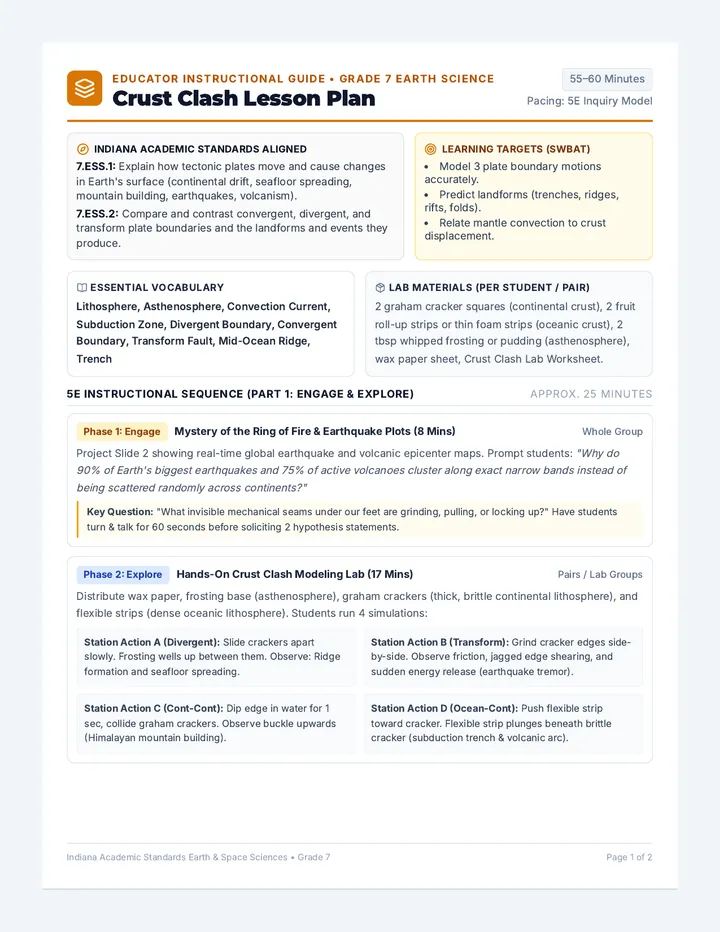
Students will be able to synthesize knowledge of plate tectonic boundaries (convergent, divergent, transform) to explain specific real-world geological hazards along the Pacific Ring of Fire.
Pacing & Flow
5 Min
Warm-up: The Cluster Check
Show the earthquake map. Ask: "Where do they cluster? Why are some areas safe while others are shaking?"
10 Min
Video: The Plate Tectonics Revolution
Watch the Ring of Fire section (7:00-8:30). Focus on subduction and the friction mechanism.
25 Min
Main Activity: Hazardous Holiday Brochure
Creative project. Students research a specific stop and explain the "tectonic reason" for its dangers.
5 Min
Sharing: Tectonic Gallery Walk
Students display their brochures. Use a 'peer-critique' format where students vote on the most convincing hazard warning.
Kit Checklist
- Projector for Slide Deck
- Paper/Art Supplies
- Tablets/Computers (Research)
- Brochure Rubric (Printed)
Vocabulary
Subduction Convergent Divergent Transform Lithosphere
Expert Tips
Common Misconceptions
Students often think continents "plow" through the ocean. Emphasize the "conveyor belt" analogy from the video: the seafloor itself moves and carries the continents.
Clarify that not all plate boundaries create volcanoes. Transform boundaries (like the San Andreas) usually result in earthquakes but lack the subduction-driven magma needed for eruptions.
Differentiation Strategies
Scaffolded: Provide a partially completed brochure template with the tectonic mechanism diagram already outlined for students who need it.
Extension: Challenge advanced students to explain why Venus doesn't have plate tectonics (as mentioned in the video conclusion) and how that affects its surface hazards compared to Earth.
Key Discussion Questions
1. Why was Alfred Wegener's "Continental Drift" rejected in 1912?
Answer: He had evidence (fossils, shapes) but no mechanism (he couldn't explain HOW they moved).
2. How did Cold War technology help us understand subduction?
Answer: Seismic monitoring for nuclear tests revealed deep earthquakes that showed slabs of crust diving into the mantle.
3. What is the difference between a convergent boundary with subduction and one without?
Answer: Subduction occurs with oceanic-continental crust, creating volcanoes. Continental-continental collision (Himalayas) doesn't subduct, creating huge mountains instead.
Tectonic Tour Slides
The Ring of Fire
Geological Tour Guide Training
SUBDUCTION ZONE INBOUND
Warm-up: The Cluster
Look at the map of recent seismic activity.
- Where do the earthquakes cluster?
- Why are some coastal cities safe while others are in high-risk zones?
Pacific Seismic Data Feed
Convergent: Subduction
The thinner, denser oceanic crust dives beneath the lighter, thicker continental crust.
Hazards Checklist:
- High-magnitude Earthquakes
- Stratovolcanoes (Explosive)
- Tsunami Generation
Oceanic
Continental
Magma rises as the plate melts in the mantle
Transform: Friction
FRICTION POINT
Plates slide horizontally past each other.
Case Study: San Andreas
Stress builds up as the plates get "stuck." When they break, energy is released in a massive quake. No subduction = No volcanoes.
The Revolution
Watch: 7:00 - 8:30
Embedded media
Observe the cross-sections of the subduction zone and notice the "conveyor belt" mechanism.
Mission: Tour Guide
Create a "Hazardous Holiday" Brochure
Your brochure must include:
- One specific location (e.g., Japan, Chile, CA)
- The tectonic "Mechanism" (The Reason!)
- Types of potential hazards
Slogan Example:
"Visit the Peru-Chile Trench! Come for the beaches, stay for the subduction quakes!"
Be creative, but scientifically accurate!
Hazardous Holiday Project Guide
Hazardous Holiday
Brochure Planning Sheet
Name:
Date:
"Your mission is to create a travel brochure for a high-risk tectonic zone along the Ring of Fire. You must convince your 'tourists' that the geological danger is half the fun—but you must use actual science to explain why these hazards happen."
1. Destination Choice
Select one specific location along the Ring of Fire.
Tokyo, Japan
Valdivia, Chile
San Francisco, California
Other: _______________________
2. Tectonic Identification
Identify the plates and boundary type.
Boundary Type:
Plates Involved (e.g. Nazca & South American):
3. Mechanism Sketch (The Science!)
Sketch a cross-section of your boundary. Label the lithosphere, asthenosphere, and show the direction of plate movement. Mark where magma is rising or where friction is building up.
4. Hazard Highlights
List 3 specific geological hazards tourists should expect.
5. The "Pitch"
Write your catchy slogan explaining the tectonic reason for the danger.
Final Brochure Requirements
Visuals
Colorful, high-quality illustrations of hazards and landscapes.
Science
Clear explanation of the subduction or lateral sliding mechanism.
Engagement
Persuasive, fun, and adventurous tone for your tourists.