Fix It Choice Board Indiana Science • Grade 7 IAS 6-8.E.1 • SEPS.1 & SEPS.6
EVERYDAY FIXERS CHOICE BOARD
Engineering Sprint
Criteria & Constraints
Lead Engineer:
Date:
Challenge #:
Mission: Select one dilemma below to engineer and prototype (IAS 6-8.E.1).
School Home Community
#1 • SCHOOL
Locker Avalanche Stopper
Books, binders, and water bottles tumble out whenever narrow hallway lockers open.
Constraint
Zero permanent adhesives; must deploy or fold in under 5 seconds.
#2 • SCHOOL
Cafeteria Acoustic Baffle
Lunchroom noise spikes over 85 dB, causing sensory overload and chaotic communication.
Constraint
Tabletop-portable, wipe-clean surfaces, passive sound dampening.
#3 • SCHOOL
Backpack Weight Balancer
Overloaded student bookbags strain spine, shoulders, and posture during transit.
Constraint
Lightweight retrofittable strap attachment shifting load to core.
#4 • HOME
Tangled Cord Station
Multiple phone, tablet, and headphone wires knot into a dangerous tripping tangle.
Constraint
Separates 4+ cables; enables 1-handed release without dropping cables.
#5 • HOME
Door Draft & Heat Stopper
Cold drafts enter under entry doors, wasting household electricity and heating fuel.
Constraint
Glides smoothly across carpet/tile; seals air gap without jamming.
#6 • HOME
Gravity Pet Portioner
Pets overeat or spill dry kibble when bowls are overfilled by hurried family members.
Constraint
Purely mechanical (no power); dispenses consistent measured dry volume.
#7 • COMMUNITY
Sidewalk Puddle Bridge
Rain creates deep standing water pools blocking pedestrians at sidewalk curb cuts.
Constraint
Modular, compact footprint, non-slip elevated walkway surface.
#8 • COMMUNITY
Garden Critter Shield
Birds and squirrels consume community vegetables before neighbors can harvest them.
Constraint
100% humane, weatherproof, permits sunlight and rainwater flow.
#9 • COMMUNITY
Ergonomic Grocery Gripper
Carrying multiple heavy grocery bags cuts into fingers and wrists of elderly neighbors.
Constraint
Distributes load comfortably; securely locks 3+ bag handles.
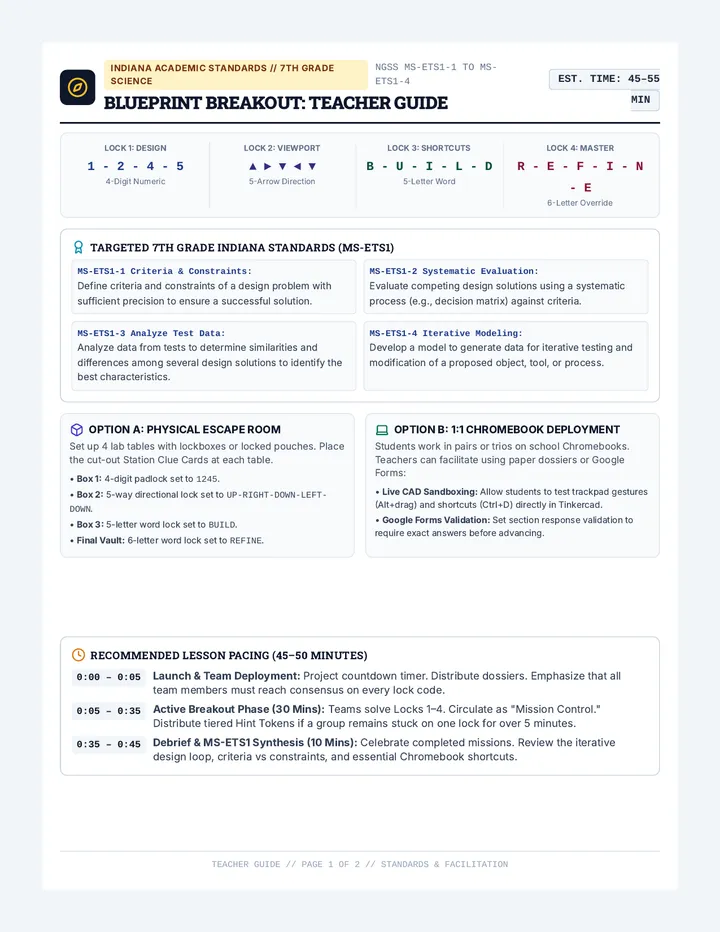
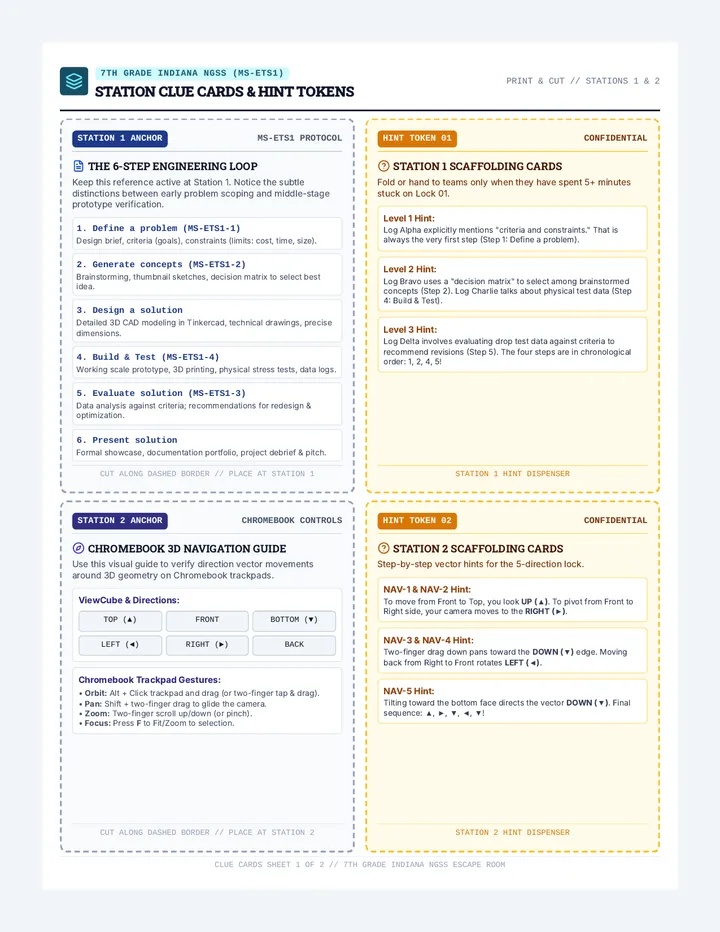
Indiana Engineering Design Cycle (IAS 6-8.E) Record evidence in your Design Planning Sheet
IAS 6-8.E.1
Ask & Criteria
IAS 6-8.E.2
Brainstorm
IAS 6-8.E.4
Model & Draft
SEPS.2 / SEPS.6
Prototype
IAS 6-8.E.3
Test & Data
IAS 6-8.E.4
Optimize V2
Design Cycle Planning Sheet Indiana Science Grade 7 • IAS 6-8.E.1, 6-8.E.2, 6-8.E.4
ENGINEERING DESIGN PLANNING SHEET
SHEET 1 OF 2
Engineer Name:
Date:
Chosen Challenge:
1
Phase 1: Ask & Define Criteria & Constraints (IAS 6-8.E.1 • SEPS.1)
Clarify user need and environmental limits
Problem Statement & User Need (Who experiences this problem and why does it matter?):
Criteria & Constraints Checklist (IAS 6-8.E.1):
Primary user safety & durability limits
Upcycled / low environmental impact parts
Operational constraint: ____________________
2
Phase 2: Competing Design Ideas (IAS 6-8.E.2)
Generate 3 concepts to evaluate systematically
Concept A Quick sketch
Concept B Quick sketch
Concept C Quick sketch
3
Phase 3: Design Model & Technical Schematic (IAS 6-8.E.4 • SEPS.2)
Include labels, dimensions (cm/in), and motion arrows
TOP / FRONT SCHEMATIC MODEL SCALE: 1 GRID = 2 CM
MODEL: IAS-7E REV: V1.0
SPEC CHECK: [ ] PASS [ ] REVISE
* Label at least three functional mechanisms and indicate load/stress points. Turn to Sheet 2 to log Materials & Testing →
Indiana Science Grade 7 • IAS 6-8.E.3, 6-8.E.4 • SEPS.3, 4, 6
PROTOTYPE TESTING & ITERATION LOG
SHEET 2 OF 2
Engineer:
Prototype Codename / Model:
4
Phase 4: Bill of Materials & Construction (SEPS.6)
Inventory every part before building
# Material / Item Qty Source / Upcycled? Functional Purpose in Prototype 1 2 3 4
5
Phase 5: Prototype Testing & Data Analysis (IAS 6-8.E.3 • SEPS.3 & 4)
Run minimum 3 controlled trials
Testing Metric / Procedure:
Trial # Quantitative Measurement (time, mass, load, drops) Qualitative Observation (what happened? where was friction?) Result
Design Solutions Rubric Indiana Academic Standards • Grade 7 Science (6-8.E & SEPS)
DESIGN SOLUTIONS RUBRIC
Total Available
20 Points
Engineer Name:
Date:
Challenge Solved:
Indiana Standards Focus 4 • Master Engineer 3 • Proficient 2 • Developing 1 • Novice Score Criteria & Constraints IAS 6-8.E.1 • SEPS.1 Precisely specifies user needs, environmental limits, scientific principles, and every required constraint for success. Clearly defines the problem, identifying main constraints and practical success criteria. Identifies general problem but omits key constraints, environmental impact, or safety factors. Unclear problem focus; fails to define measurable criteria or operational constraints. Self: __ T: __ Schematic Modeling IAS 6-8.E.4 • SEPS.2 Exceptional technical model drawing with metric scale, clear callouts, precise dimensions, and motion indicators. Clean blueprint including labeled components, estimated dimensions, and clear mechanical structure. Basic sketch lacking precise dimensions, component labels, or functional assembly details. Minimal sketch with no labels or dimensions; insufficient detail to guide physical prototype build. Self: __ T: __ Prototype Build Quality IAS 6-8.E.1 • SEPS.6 Fully functioning prototype constructed with resourceful upcycled materials; durable, safe, and meets all limits. Functioning prototype meeting primary constraints; built securely with minor structural flexing. Partially functional build; violates one constraint or demonstrates structural instability under test. Non-functional or fragile build; fails to satisfy core design constraints or safety requirements. Self: __ T: __ Testing & Data Analysis IAS 6-8.E.3 • SEPS.3 & 4 Conducts 3+ controlled trials; logs accurate quantitative data and nuanced qualitative friction/stress evidence. Completes 3 trials recording clear quantitative measurements and descriptive observations of trial outcomes. Completes 1–2 trials; data recorded inconsistently or relies solely on subjective observations. Testing missing or uncontrolled; lacks quantitative data or systematic observations. Self: __ T: __ Optimization & V2.0 IAS 6-8.E.4 • SEPS.6 & 8 Analyzes failure points rigorously; implements justified modifications producing measured optimization gains.
Problem Solver Reflection Ticket Indiana Science 7th • SEPS.7 & SEPS.8
PROBLEM SOLVER REFLECTION
Iterative Mindset
Engineer:
Date:
Challenge #:
The Pivot: What failure evidence emerged during testing? (IAS 6-8.E.3)
Empathy: How does your design meet community user needs?
Indiana SEPS Self-Assessment (1 = Low, 5 = High):
Persevered through test setbacks: [ 1 2 3 4 5 ]
Argued from data & evidence: [ 1 2 3 4 5 ]
Key evidence communicated to peer team (SEPS.8):
Cut Along Dashed Line (2 Copies Per Sheet)
Indiana Science 7th • SEPS.7 & SEPS.8
PROBLEM SOLVER REFLECTION
Iterative Mindset
Engineer:
Date:
Challenge #:
The Pivot: What failure evidence emerged during testing? (IAS 6-8.E.3)
Empathy: How does your design meet community user needs?
Indiana SEPS Self-Assessment (1 = Low, 5 = High):
Persevered through test setbacks: [ 1 2 3 4 5 ]
Argued from data & evidence: [ 1 2 3 4 5 ]
Key evidence communicated to peer team (SEPS.8):