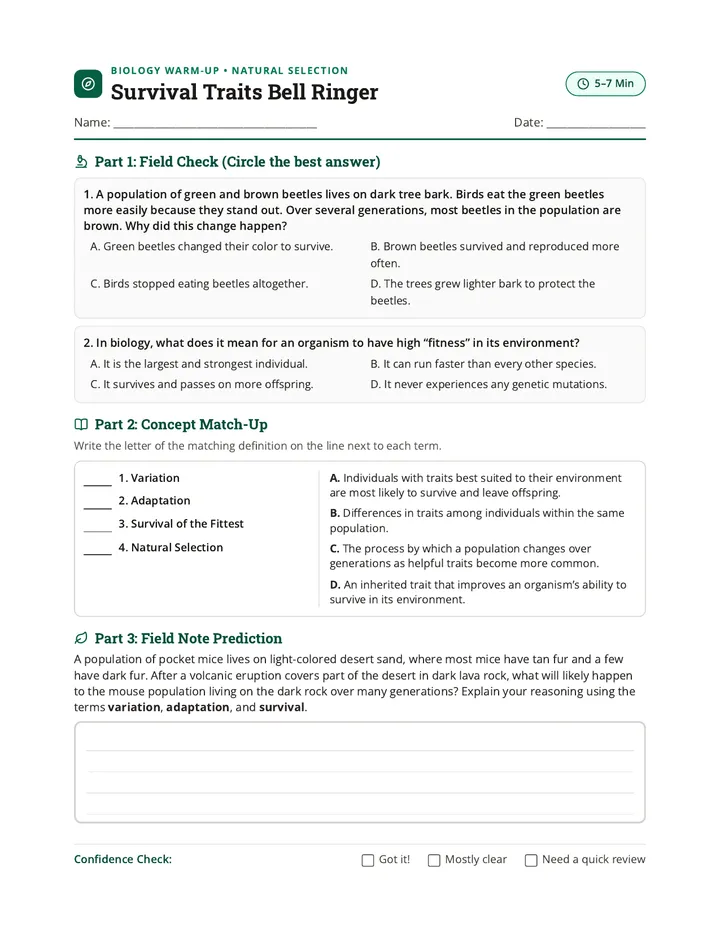
Survival Traits Bell Ringer
Biology Warm-Up • Natural Selection
Survival Traits Bell Ringer
5–7 Min
Name: _______________________________________
Date: ___________________
Part 1: Field Check (Circle the best answer)
1. A population of green and brown beetles lives on dark tree bark. Birds eat the green beetles more easily because they stand out. Over several generations, most beetles in the population are brown. Why did this change happen?
A. Green beetles changed their color to survive.
B. Brown beetles survived and reproduced more often.
C. Birds stopped eating beetles altogether.
D. The trees grew lighter bark to protect the beetles.
2. In biology, what does it mean for an organism to have high “fitness” in its environment?
A. It is the largest and strongest individual.
B. It can run faster than every other species.
C. It survives and passes on more offspring.
D. It never experiences any genetic mutations.
Part 2: Concept Match-Up
Write the letter of the matching definition on the line next to each term.
1. Variation
2. Adaptation
3. Survival of the Fittest
4. Natural Selection
A. Individuals with traits best suited to their environment are most likely to survive and leave offspring.
B. Differences in traits among individuals within the same population.
C. The process by which a population changes over generations as helpful traits become more common.
D. An inherited trait that improves an organism’s ability to survive in its environment.
Part 3: Field Note Prediction
A population of pocket mice lives on light-colored desert sand, where most mice have tan fur and a few have dark fur. After a volcanic eruption covers part of the desert in dark lava rock, what will likely happen to the mouse population living on the dark rock over many generations? Explain your reasoning using the terms variation, adaptation, and survival.
Confidence Check:
Got it!
Mostly clear
Need a quick review
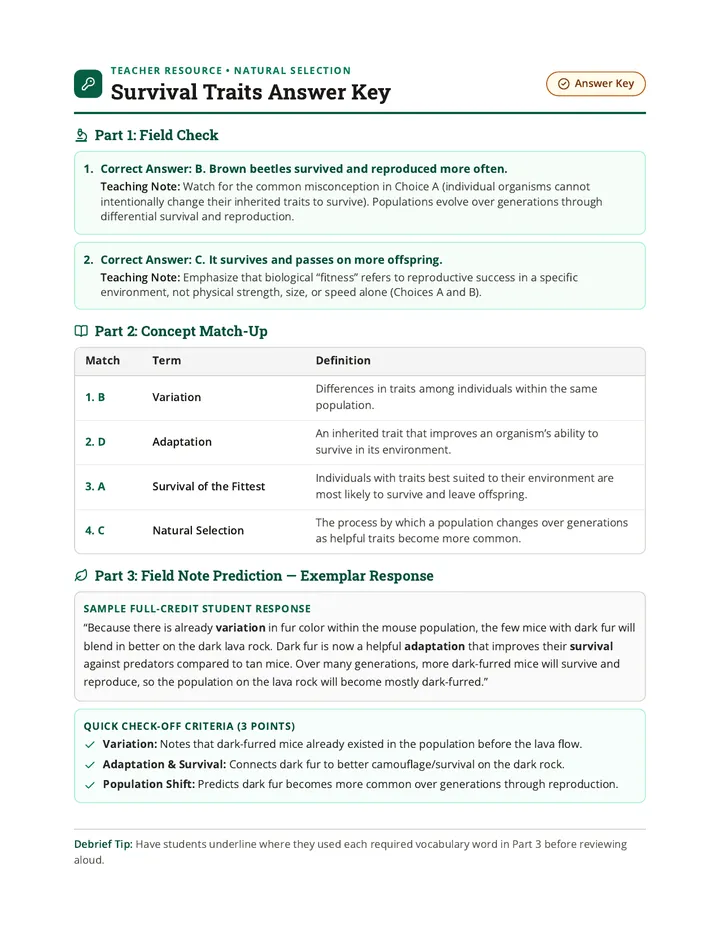
Survival Traits Answer Key
Teacher Resource • Natural Selection
Survival Traits Answer Key
Answer Key
Part 1: Field Check
Correct Answer: B. Brown beetles survived and reproduced more often.
Teaching Note: Watch for the common misconception in Choice A (individual organisms cannot intentionally change their inherited traits to survive). Populations evolve over generations through differential survival and reproduction.
Correct Answer: C. It survives and passes on more offspring.
Teaching Note: Emphasize that biological “fitness” refers to reproductive success in a specific environment, not physical strength, size, or speed alone (Choices A and B).
Part 2: Concept Match-Up
| Match |
Term |
Definition |
| 1. B |
Variation |
Differences in traits among individuals within the same population. |
| 2. D |
Adaptation |
An inherited trait that improves an organism’s ability to survive in its environment. |
| 3. A |
Survival of the Fittest |
Individuals with traits best suited to their environment are most likely to survive and leave offspring. |
| 4. C |
Natural Selection |
The process by which a population changes over generations as helpful traits become more common. |
Part 3: Field Note Prediction — Exemplar Response
Sample Full-Credit Student Response
“Because there is already variation in fur color within the mouse population, the few mice with dark fur will blend in better on the dark lava rock. Dark fur is now a helpful adaptation that improves their survival against predators compared to tan mice. Over many generations, more dark-furred mice will survive and reproduce, so the population on the lava rock will become mostly dark-furred.”
Quick Check-Off Criteria (3 Points)
Variation: Notes that dark-furred mice already existed in the population before the lava flow.
Adaptation & Survival: Connects dark fur to better camouflage/survival on the dark rock.
Population Shift: Predicts dark fur becomes more common over generations through reproduction.
Debrief Tip: Have students underline where they used each required vocabulary word in Part 3 before reviewing aloud.