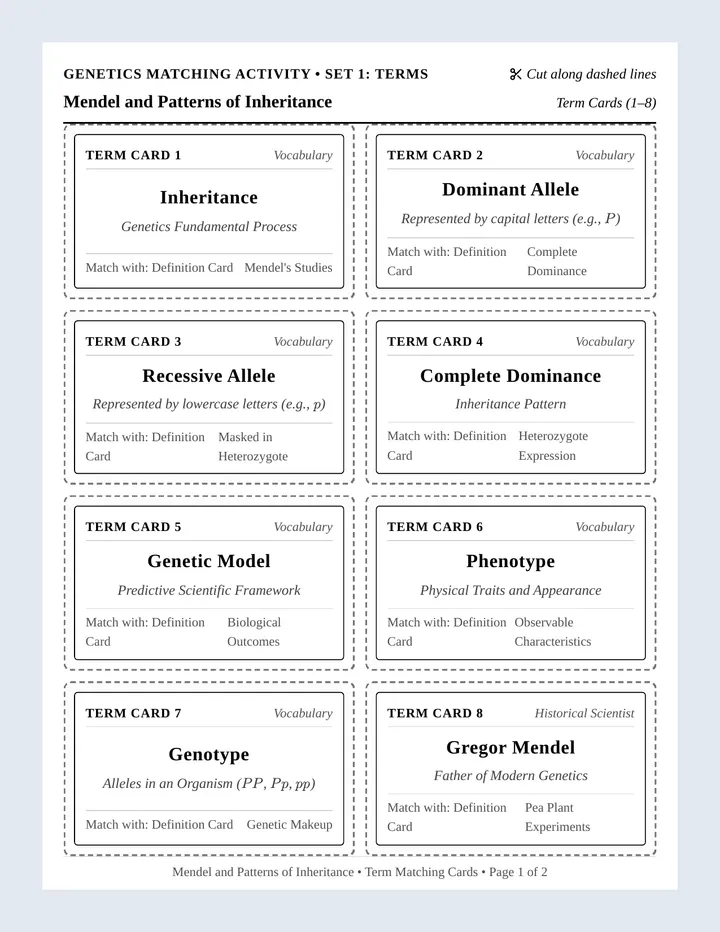
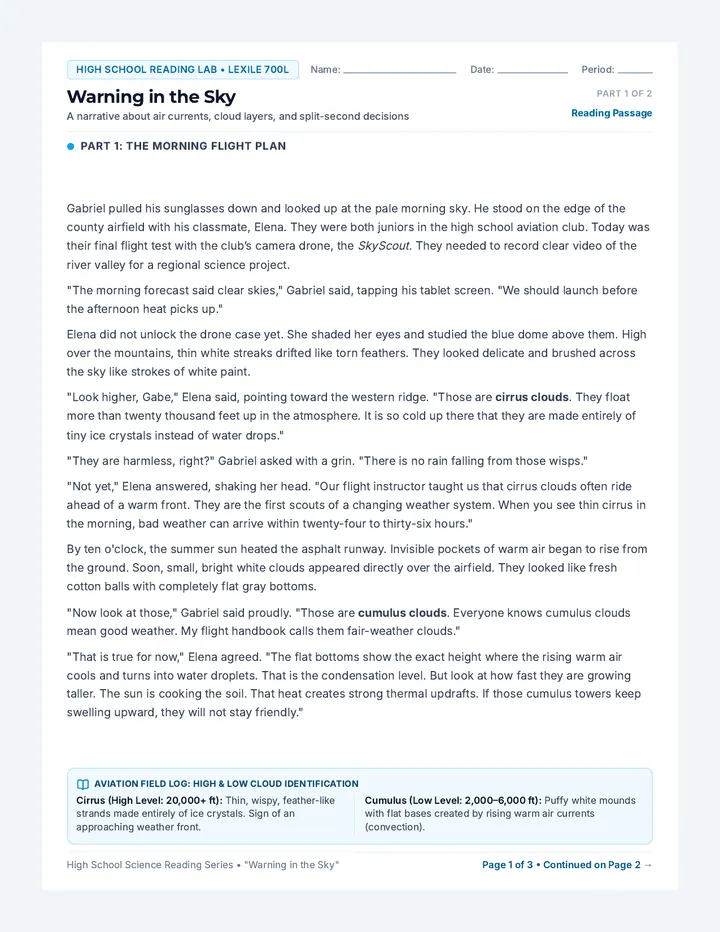
Motion and Energy Study Guide
Grade 7 Science • Assessment Mastery
Forces & Motion Study Guide
Part 1 of 2 Core Physics Principles
Speed Formula \(s = \frac{d}{t}\) Speed = Distance ÷ Time
Net Force \(F_{\text{net}} = m \cdot a\) Force = Mass × Accel.
Potential Energy \(PE = mgh\) Stored (Height & Mass)
Kinetic Energy \(KE = \frac{1}{2}mv^2\) Motion (Mass & Speed)
1
Motion, Speed, & Position-Time Graphs
Calculating Speed (\(s\))
- • Formula: \(s = \frac{\text{distance}}{\text{time}}\) (units: \(\text{m/s}\) or \(\text{km/h}\)).
- • Change in Position: If an object moves from position \(d_1\) to \(d_2\), distance is \(\Delta d = d_2 - d_1\).
- • Exam Trap: A helicopter moving from \(20\text{ m}\) to \(60\text{ m}\) travels \(40\text{ m}\), NOT \(60\text{ m}\)!
Example: 50 m in 10 s \(\implies s = \frac{50}{10} = \mathbf{5\text{ m/s}}\)
dist time
Constant Speed Straight diagonal line. Steeper slope = faster speed.
dist time
At Rest (Stopped) Flat horizontal line. Distance is not changing over time.
dist time
Accelerating Curved upward line showing increasing speed over time.
dist time
Trip with Stop Middle flat segment represents stopping during a journey.
2
Forces & Net Force Calculations
Balanced Forces Net Force = 0 N
- • Opposing forces are equal in size and opposite in direction.
- • Effect on Motion: NO change in motion. The object stays at rest OR continues moving at a constant speed in a straight line.
- • Acceleration = 0: No speeding up, slowing down, or turning.
Unbalanced Forces Net Force > 0 N
- • Opposing forces are unequal, or an unopposed push/pull exists.
- • Effect on Motion: ALWAYS causes acceleration (changes speed or direction of the object).
- • Direction: Object accelerates in the direction of the larger force.
Sumo Wrestlers / Tug-of-War Rule: Forces in opposite directions SUBTRACT. If Wrestler A pushes right with \(200\text{ N}\) and Wrestler B pushes left with \(210\text{ N}\):
Left Force (210 N) > Right Force (200 N) \(F_{\text{net}} = 210 - 200 = \mathbf{10\text{ N to the left}}\) Forces are unbalanced \(\implies\) Motion changes to the left!
3
Newton's Laws & Force-Mass-Acceleration Relationships
Newton's 2nd Law: Force, Mass, & Acceleration
• More Force = More Acceleration: If you double the net force on the same cart, its acceleration doubles (\(2\times F \implies 2\times a\)).
• More Mass = Less Acceleration: Heavier objects have greater inertia; applying the same force to a heavier cart results in lower acceleration.
Key Takeaway: Acceleration increases when force increases, and decreases when mass increases.
Newton's 3rd Law: Action & Reaction Pairs
• Equal & Opposite: When Body A exerts a force on Body B, Body B exerts an equal force in the opposite direction on Body A.
• Astronauts in Space / Spring Carts: When one astronaut pushes another, both experience the exact same force, but the lighter astronaut accelerates and moves farther (\(a = F/m\))!
Space Station Note: Footholds keep astronauts from floating backwards when pushing objects!
Grade 7 Science Interim Assessment Mastery Guide Turn Over for Energy & Experimental Design → Page 1 of 2
Grade 7 Science • Assessment Mastery
Energy & Scientific Investigation
Part 2 of 2 Energy Transformations
4
Potential & Kinetic Energy Fundamentals
Gravitational Potential Energy (\(PE\))
- • Definition: Stored energy an object has due to its position or height above ground.
- • Key Factors: Depends directly on mass (\(m\)) and height (\(h\)).
- • Proportions:
- - If height doubles, \(PE\) doubles (\(2\times\)).
- - If ramp height increases above 4 m, \(PE\) increases.
- - To increase \(PE\), raise the object higher!
- • Peak Location: Highest point of a ramp, roller coaster hill, or peak of a bouncing ball.
Kinetic Energy (\(KE\))
- • Definition: Energy of an object in motion.
- • Key Factors: Depends on mass (\(m\)) and speed squared (\(v^2\)).
- • Proportions:
- - Mass effect: If mass doubles at same speed, \(KE\) doubles (a 2-ton truck has \(2\times\) the \(KE\) of a 1-ton car!).
- - Speed effect: If speed increases, \(KE\) grows quadratically.
- • Peak Location: Lowest elevation where speed is fastest (bottom of hill/halfpipe).
Energy Transformation on a Track / Halfpipe / Ramp Total Mechanical Energy is Conserved (\(PE + KE = \text{Constant}\))
Position X (Top of Hill) Max PE • Zero/Min KE Highest point; object at rest or just starting down.
Moving Downhill (X → Y) PE Decreases • KE Increases Gravity converts stored potential energy directly into kinetic energy.
Position Y (Valley / Bottom) Min PE • Max KE Lowest elevation; moving with maximum speed.
5
Experimental Design & Fair Testing
Independent Variable (IV)
The ONE variable the scientist deliberately manipulates or changes. (Plotted on the X-axis).
Exam: Speed of bumper car, mass of skater, applied force.
Dependent Variable (DV)
The variable being measured or observed as the result/outcome. (Plotted on the Y-axis).
Exam: Strength of collision, distance traveled, kinetic energy.
Controlled Variables
All conditions kept identical across trials to guarantee a fair test.
Exam: Using a machine to hit balls with exact same force rather than human players.
Tools to Compare Speed: • Meter Stick (measures distance \(d\))
• Timer / Stopwatch (measures time \(t\))
Tools to Compare Kinetic Energy (at same speed): • Electronic Scale / Balance (measures mass \(m\))
(Because speed is already constant, KE differences depend solely on mass!)
6
Mastering Open Response Questions (CER Framework)
1. Claim
Directly answer the question in one complete sentence. Take a clear stand.
"Car Y will travel faster than Car X in Trial 5."
2. Evidence
Quote exact numbers & data from the table or graph. Never speak in generalities.
"Car Y has a mass of 0.15 kg while Car X has 0.45 kg. In Trial 3, the 0.15 kg car went 1.80 m."
3. Reasoning
Cite the scientific principle (\(F=ma\), friction, inertia, or energy conservation) connecting evidence to claim.
"Because smaller masses accelerate more rapidly when subjected to the same force."
Grade 7 Science Interim Assessment Mastery Guide Review Complete • Ready for Practice Sheet Page 2 of 2
Forces and Motion Practice Sheet
Interim Assessment 1 Review
Forces, Motion & Energy Practice
Name:
Date:
Period:
A Motion, Speed, and Position Graphs Standard: MS-PS2-2 • 4 Questions
1. Speed & Change in Position [Show Work]
A motorized drone starts at position \(15\text{ m}\) and flies in a straight line to position \(75\text{ m}\). It completes this flight in \(3\text{ seconds}\). What is the speed of the drone?
Speed = m/s
2. Experimental Measurement Tools
A student investigates two carts rolling down a ramp. Which pair of tools is required to determine each cart's speed?
I. Spring scale II. Meter stick III. Triple beam balance IV. Stopwatch
(A) I and III only (B) II and IV only (C) II and III only (D) I and IV only
Distance vs. Time of Three Runners A B C Time Distance
3. Which runner was at rest for a portion of the time?
(A) Runner A (B) Runner B (C) Runner C (D) None
4. Which runner traveled with the greatest constant speed throughout?
(A) Runner A (B) Runner B (C) Runner C (D) All equal
B Forces, Net Force & Newton's Laws Standard: MS-PS2-1 • 4 Questions
5. Sumo Wrestler Net Force Diagram
Two wrestlers push against each other. Wrestler 1 pushes to the right with \(240\text{ N}\). Wrestler 2 pushes to the left with \(200\text{ N}\).
\(240\text{ N} \longrightarrow\) [ Wrestlers ] \(\longleftarrow 200\text{ N}\)
Net Force: Direction:
Will motion change? Yes, unbalanced No, balanced
6. Newton's 2nd Law (\(F=ma\))
A rolling cart is pushed along a friction-free surface. If the net force applied to the cart is doubled while its mass remains constant, the cart's acceleration will:
(A) Stay the same (B) Double (C) Be cut in half (D) Quadruple
7. Astronauts in Microgravity (Action-Reaction)
Astronaut A (\(90\text{ kg}\)) floats in the ISS and pushes Astronaut B (\(60\text{ kg}\)) away. Which statement accurately compares their experiences?
(A) Only Astronaut B feels a force and moves. (B) Astronaut A feels a larger force because he pushed. (C) Both feel equal force, but Astronaut B accelerates faster due to smaller mass. (D) Neither accelerates because gravity is zero.
8. Experimental Data Analysis
<table class="w-full text-center border-collapse text-[10px] bg-white border border-slate-200 mb-1"><tbody><tr class="bg-slate-100 font-bold border-b border-slate-200 text-slate-700"><td class="p-0.5">Trial</td><td class="p-0.5">Mass (kg)</td><td class="p-0.5">Force (N)</td><td class="p-0.5">Acceleration (\(\text{m/s}^2\))</td></tr><tr class="border-b border-slate-100"><td class="p-0.5">1</td><td class="p-0.5">1.5</td><td class="p-0.5">3.0</td><td class="p-0.5">2.0</td></tr><tr><td class="p-0.5">2</td><td class="p-0.5">1.5</td><td class="p-0.5">6.0</td><td class="p-0.5">4.0</td></tr></tbody></table>
<table class="w-full text-center border-collapse text-[9.5px] bg-white border border-slate-300"><tbody><tr class="bg-indigo-50 font-bold border-b border-slate-300 text-slate-800"><td class="p-0.5" rowspan="2">Trial</td><td class="p-0.5" colspan="2">Mass (kg)</td><td class="p-0.5" colspan="2">Distance (m)</td></tr><tr class="bg-slate-50 text-[9px] border-b border-slate-200 font-semibold"><td class="p-0.5">Car A</td><td class="p-0.5">Car B</td><td class="p-0.5">Car A</td><td class="p-0.5">Car B</td></tr><tr class="border-b border-slate-100"><td class="p-0.5 font-bold">1</td><td>0.10</td><td>0.10</td><td>1.40</td><td>1.40</td></tr><tr class="border-b border-slate-100"><td class="p-0.5 font-bold">2</td><td>0.10</td><td>0.20</td><td>1.60</td><td>0.80</td></tr><tr class="border-b border-slate-100"><td class="p-0.5 font-bold">3</td><td>0.20</td><td>0.10</td><td>0.80</td><td>1.60</td></tr><tr class="bg-amber-50/50 font-bold"><td class="p-0.5">5</td><td>0.40</td><td>0.10</td><td>?</td><td>?</td></tr></tbody></table>