Matter Investigator Anchor Chart Official Agency Dossier
Matter Mission
Lab Classification States & Properties
Detective Briefing
Matter is anything that has mass (weight) and takes up space . Everything you can touch, see, or breathe is made of matter!
The Three States of Matter
S
Solids
Locked & Stiff
Keeps its shape
Keeps its size
Particles sit tight
Examples: Toys, Wood, Ice
L
Liquids
Flowy & Free
Takes shape of cup
Keeps its size
Particles can slide
Examples: Water, Juice, Honey
G
Gases
Wild & Spready
Fills entire space
Changes its size
Particles fly fast
Examples: Air, Steam, Helium
Physical Properties Checklist
Buoyancy Sink/Float
Does the matter float on top of water or sink to the very bottom? Testing this shows how light/dense an object is in liquid!
Flexibility Bendy/Stiff
Does the matter bend easily without snapping? Bendy items (pipe cleaners) have high flexibility. Wood blocks have low flexibility.
Texture Feel
How does the outside surface feel when you rub it with your fingers? It could feel rough, smooth, slimy, bumpy, or soft!
Strength Tough
Does the matter withstand squeezing or pulling without breaking or tearing? Sponge has high strength. Thin foil tears under high pressure.
ELEMENTARY INVESTIGATION UNIT // HG-02-MATTER Approved by Lead Scientist Lenny PAGE 01 / 01
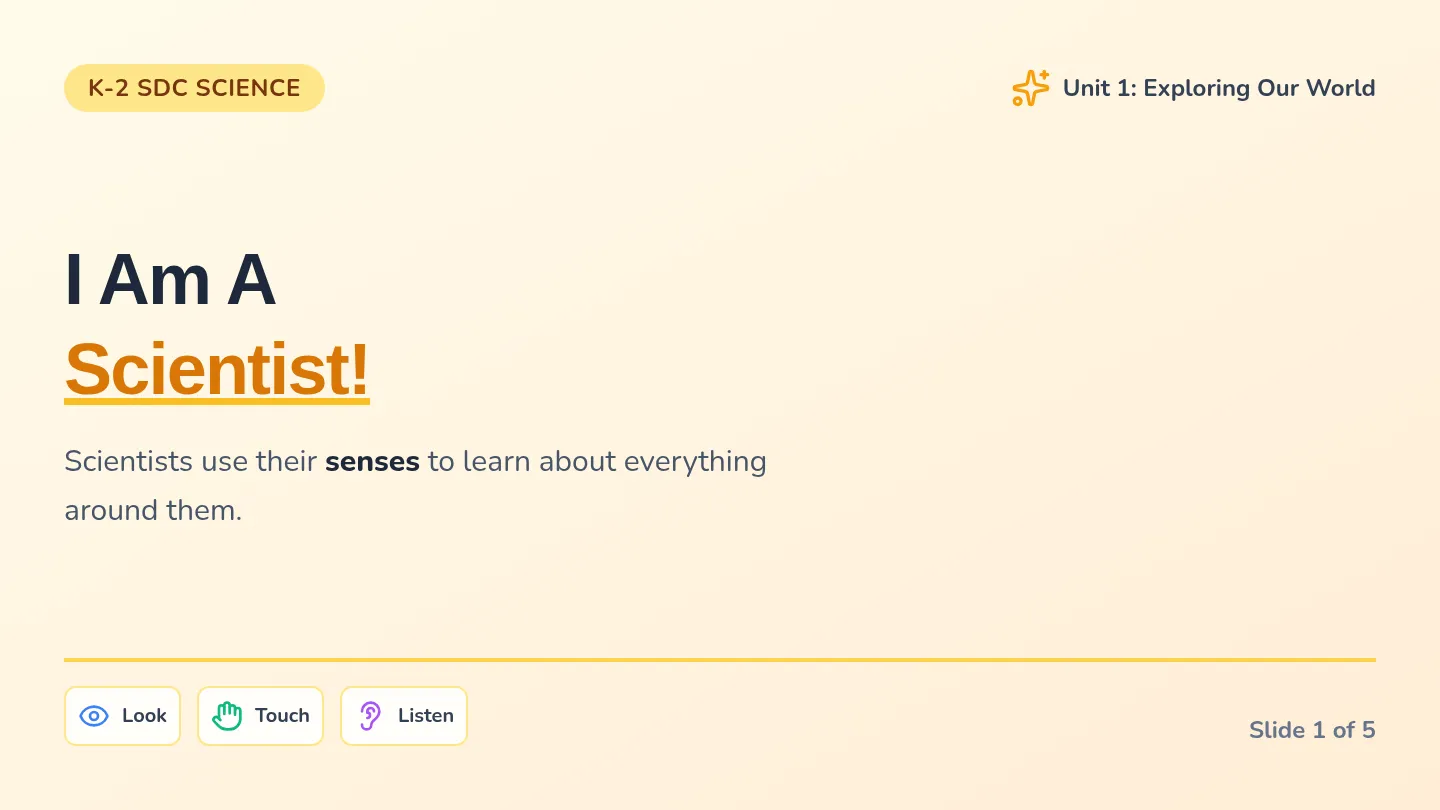
Matter Mission Slides HQ Division
Mission Code: STATE-02
Matter Mission:
The Secret Properties Lab
Calling all 2nd-Grade Science Detectives! Today we investigate the hidden secrets of Solids, Liquids, and Gases!
CLASSROOM MISSION COMMAND // 2026 Prepare for Briefing
Dossier File 01
The Detective Case
PART 1: OBSERVATION
What is Matter?
Matter is everything around us!
If it takes up space (even if you can't see it!) and has weight, it is made of Matter .
Is air matter? Yes! It fills up balloons!
Our Mission Tasks
1 Touch and describe textures
2 Flex and bend solid shapes
3 Pour liquids and catch gases
MATTER LABS INC. NEXT: THREE STATES BRIEFING
Dossier File 02
The Secret Forms
PART 2: CLASSIFICATION
Solids
Holds its own shape and size. Doesn't flow.
Examples: Wood, Rock, Metal
Liquids
Changes shape to match the container. Flows smoothly.
Examples: Water, Juice, Milk
Gases
Spreads out wide to fill the whole room or container.
Examples: Air, Steam, Helium
MATTER LABS INC. NEXT: PROPERTIES CASE FILE
Dossier File 03
The Matter Properties
PART 3: PROPERTIES
Buoyancy
Does it float on water or sink to the bottom? Some matter sinks, some floats!
Flexibility
Is the matter bendy like a pipe cleaner, or stiff like wood?
Texture
How does the outside surface feel? Rough, bumpy, or super smooth?
Strength
Is it tough and hard to rip (wood block), or can you break it easily (thin foil)?
MATTER LABS INC. NEXT: SAFE LAB RULES
LAB PROTOCOL
Safety Regulations
DANGER PREVENTION
No Tasting!
Even if things look yummy, never eat or taste anything in the science lab!
Investigator Rules
1
Be Gentle: Do not crush, pull, or bend too hard unless directed. Use items with care.
2
Clean Up Spills: Liquids can be slippery! Use a paper towel immediately if some water drips.
3
Record Honestly: Good agents record exactly what they see—even if it's surprising!
MATTER LABS INC. NEXT: ROTATION AND ACTION
FINAL STEP
Mission Complete
DEBRIEFING
Show What You Found!
Review your detective lab sheet with your team:
Which solid was the most flexible?
Did the liquid change its amount?
LEAD SCIENTIST LENNY CONGRATULATIONS, DETECTIVES!
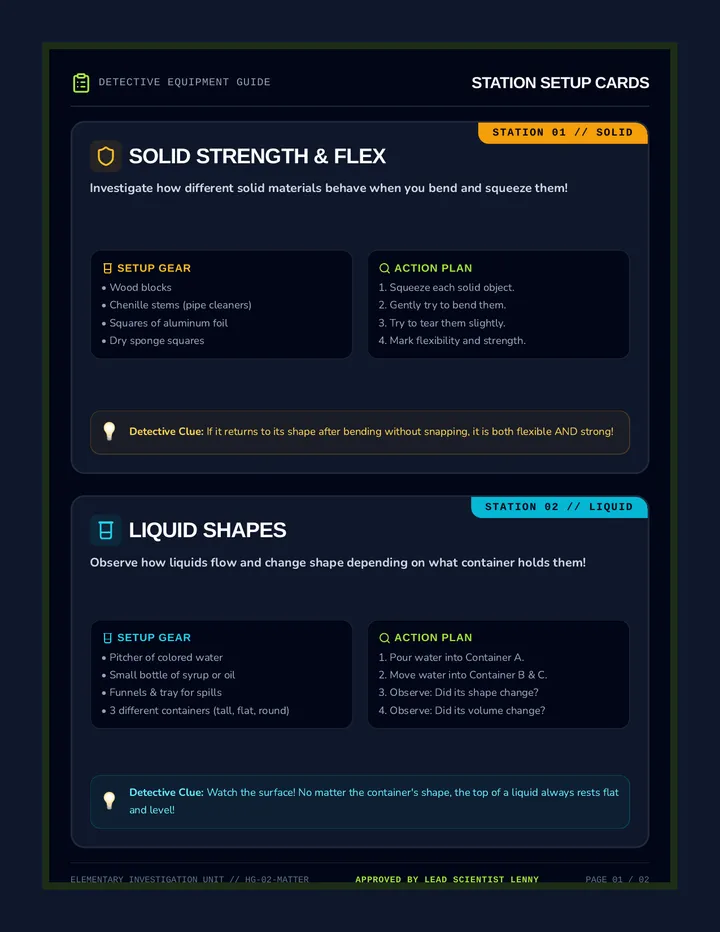
Station Setup Cards Detective Equipment Guide
Station Setup Cards
STATION 01 // SOLID
Solid Strength & Flex
Investigate how different solid materials behave when you bend and squeeze them!
Setup Gear
• Wood blocks
• Chenille stems (pipe cleaners)
• Squares of aluminum foil
• Dry sponge squares
Action Plan
1. Squeeze each solid object.
2. Gently try to bend them.
3. Try to tear them slightly.
4. Mark flexibility and strength.
💡
Detective Clue: If it returns to its shape after bending without snapping, it is both flexible AND strong!
STATION 02 // LIQUID
Liquid Shapes
Observe how liquids flow and change shape depending on what container holds them!
Setup Gear
• Pitcher of colored water
• Small bottle of syrup or oil
• Funnels & tray for spills
• 3 different containers (tall, flat, round)
Action Plan
1. Pour water into Container A.
2. Move water into Container B & C.
3. Observe: Did its shape change?
4. Observe: Did its volume change?
💡
Detective Clue: Watch the surface! No matter the container's shape, the top of a liquid always rests flat and level!
ELEMENTARY INVESTIGATION UNIT // HG-02-MATTER Approved by Lead Scientist Lenny PAGE 01 / 02
Detective Equipment Guide
Station Setup Cards
STATION 03 // GAS
Gas Catchers
Capture invisible gas inside containment units and prove that it takes up space!
Setup Gear
• Resealable ziploc plastic bags
• Fun balloons (uninflated)
• Empty plastic drink bottle
• Flexy drinking straws
Action Plan
1. Open a bag, trap air, zip it shut.
2. Squeeze the puffed-up bag.
3. Blow air into a balloon.
4. Describe what happened inside.
💡
Detective Clue: Gas is sneaky! Although invisible, it expands to fill the entire container. When you squeeze, the air pushes back!
STATION 04 // BUOYANCY
Sink or Float Laboratory
Test the buoyancy of different solid objects in deep waters to discover who rules!
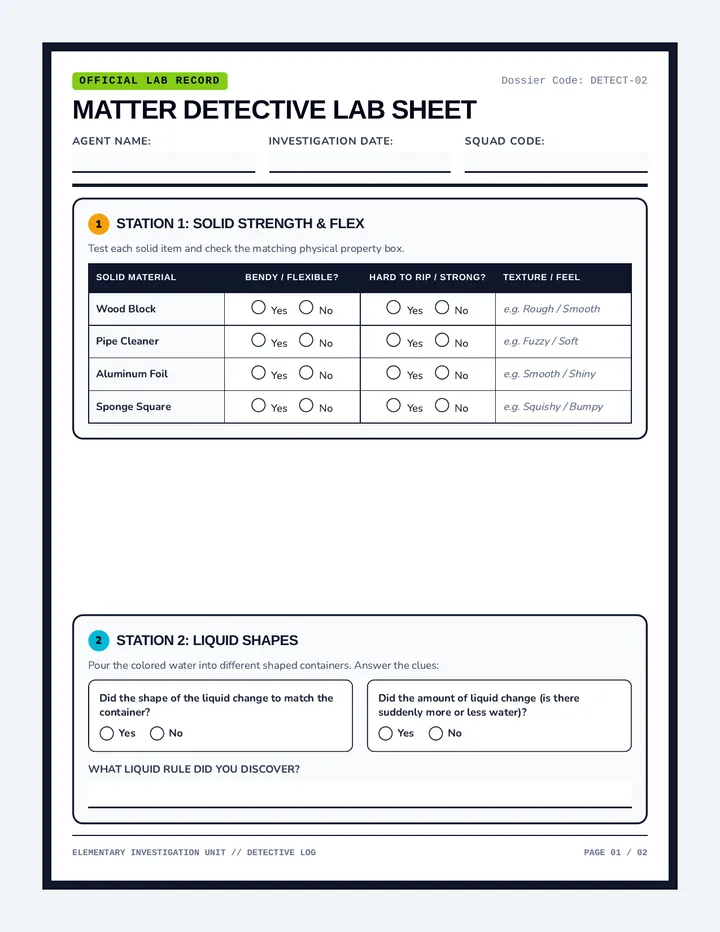
Matter Mission Lab Sheet Official Lab Record Dossier Code: DETECT-02
Matter Detective Lab Sheet
Agent Name:
Investigation Date:
Squad Code:
1
Station 1: Solid Strength & Flex
Test each solid item and check the matching physical property box.
Solid Material Bendy / Flexible? Hard to Rip / Strong? Texture / Feel Wood Block Yes No Yes No e.g. Rough / Smooth Pipe Cleaner Yes No Yes No e.g. Fuzzy / Soft Aluminum Foil Yes No Yes No e.g. Smooth / Shiny Sponge Square Yes No Yes No e.g. Squishy / Bumpy
2
Station 2: Liquid Shapes
Pour the colored water into different shaped containers. Answer the clues:
Did the shape of the liquid change to match the container?
Yes No
Did the amount of liquid change (is there suddenly more or less water)?
Yes No
What liquid rule did you discover?
ELEMENTARY INVESTIGATION UNIT // DETECTIVE LOG PAGE 01 / 02
Matter Detective Lab Sheet PAGE 02 // LAB ANALYSIS
3
Station 3: Gas Catchers
Capture air inside a bag and zip it tight! Answer these questions:
Does the caught air take up space?
Y N
Can you see the captured air?
Y N
Does it change shape when squeezed?
Y N
What does gas feel like when squeezed inside the balloon?
4
Station 4: Sink or Float
Predict then test which items float or sink in the water tub!
Object My Prediction Actual Result Wooden Block Sink Float Sink / Float Metal Spoon Sink Float Sink / Float Cork Stopper Sink Float Sink / Float
Case File Conclusion
Answer this final science clue using what you learned:
A solid stays the same shape, but a liquid:
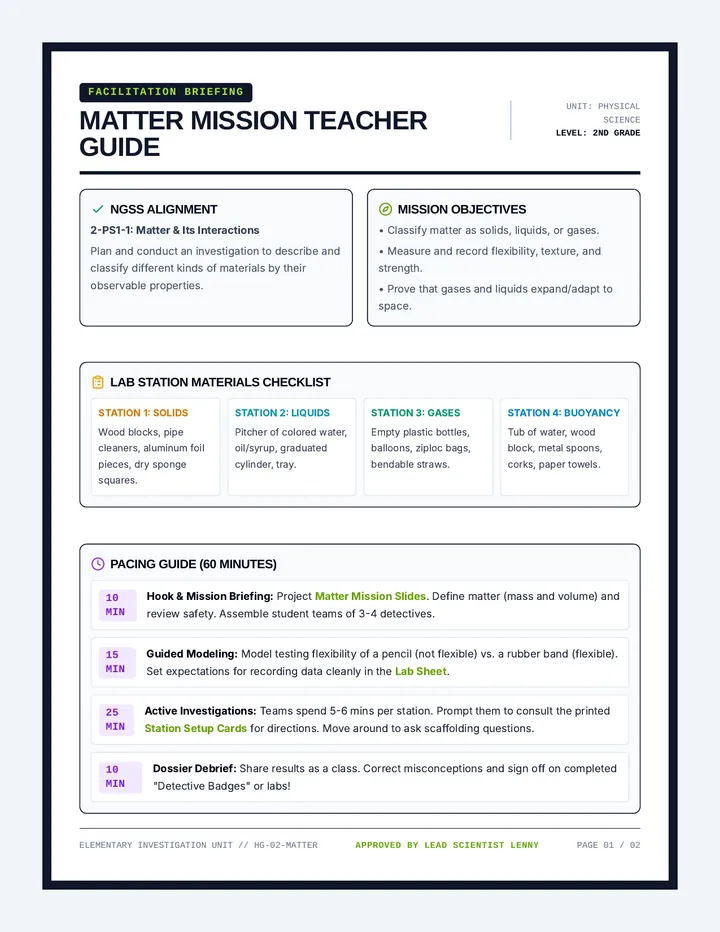
Matter Mission Teacher Guide FACILITATION BRIEFING
Matter Mission Teacher Guide
UNIT: PHYSICAL SCIENCE
NGSS Alignment
2-PS1-1: Matter & Its Interactions
Plan and conduct an investigation to describe and classify different kinds of materials by their observable properties.
Mission Objectives
• Classify matter as solids, liquids, or gases.
• Measure and record flexibility, texture, and strength.
• Prove that gases and liquids expand/adapt to space.
Lab Station Materials Checklist
Station 1: Solids
Wood blocks, pipe cleaners, aluminum foil pieces, dry sponge squares.
Station 2: Liquids
Pitcher of colored water, oil/syrup, graduated cylinder, tray.
Station 3: Gases
Empty plastic bottles, balloons, ziploc bags, bendable straws.
Station 4: Buoyancy
Tub of water, wood block, metal spoons, corks, paper towels.
Pacing Guide (60 Minutes)
10 MIN
Hook & Mission Briefing: Project Matter Mission Slides. Define matter (mass and volume) and review safety. Assemble student teams of 3-4 detectives.
15 MIN
Guided Modeling: Model testing flexibility of a pencil (not flexible) vs. a rubber band (flexible). Set expectations for recording data cleanly in the Lab Sheet.
25 MIN
Active Investigations: Teams spend 5-6 mins per station. Prompt them to consult the printed Station Setup Cards for directions. Move around to ask scaffolding questions.
10 MIN
Dossier Debrief: Share results as a class. Correct misconceptions and sign off on completed "Detective Badges" or labs!
ELEMENTARY INVESTIGATION UNIT // HG-02-MATTER Approved by Lead Scientist Lenny PAGE 01 / 02
Matter Mission Facilitation PAGE 02 // ANSWER KEY & PEDAGOGY
Guiding Questions to Ask Teams
Station 1 & 4 (Solids & Water):
"Why does the sponge bend but the wood doesn't? Are they still both solids?"
"Why do some heavy things like a big wood block float while small toy coins sink?"
Station 2 & 3 (Liquids & Gases):
"If I pour water into a bowl, did we lose any water, or is it just flat?"
"Can you hold gas in your open hand? Why does it need a sealed plastic bag or balloon to stay trapped?"
Common Misconceptions to Address
Misconception 1: "Air is empty space."