Matter Lexicon Slides Grade 5 Science & Literacy Lab
RI.5.4 | RL.5.4 | PS.5.2.1 & PS.5.2.2
Matter Detectives
Decoding Domain-Specific Science Vocabulary & Unlocking Figurative Language in the World of Matter
RI.5.4: Scientific & Domain-Specific Terms
RL.5.4: Metaphors, Similes & Vivid Imagery
Dual Perspective Two Lenses, One Phenomenon
How Authors Talk About Matter
RI.5.4 Informational
Domain-Specific Words
Precise technical terms scientists use to explain physical properties and behaviors.
"The solute dissolved into the warm solvent ."
RL.5.4 Literary
Figurative Language
Metaphors and similes that paint sensory pictures of how matter looks and transforms.
"The crystals vanished like ghosts slipping into liquid fog ."
💡 Detective Secret: Both describe dissolving, but each uses a distinct author toolkit!
Science Target PS.5.2.1 (Properties) & PS.5.2.2 (Changes)
Core Physical Science Concepts
1
Particles & States
Matter is made of tiny particles in solid, liquid, or gas states depending on thermal energy.
2
Physical Properties
Measurable traits like mass, volume, density, and solubility that identify matter.
3
Mixtures vs. Solutions
Substances blend together; in solutions, a solute dissolves evenly into a solvent.
Conservation of Matter: Total mass stays identical when substances melt or dissolve! Mass Conserved
RI.5.4 Toolkit Context Clue Radar
Cracking Domain-Specific Words
1. Definition & Appositive
Look for commas or phrases like is or means : "The solvent, or dissolving liquid..."
2. Restatement / Synonym
The author repeats the concept in simple words: "It was dense—particles were packed tightly."
3. Example or List
Look for such as or for example : "Solutes, such as sugar, salt, and baking powder..."
4. Contrast Clue
Look for unlike or however : "Unlike chunky trail mix, a solution is totally uniform."
🎯 Quick Check: Substitute your clue-based meaning back into the sentence to test it!
RL.5.4 Toolkit Figurative Language Decoder
Deconstructing Figurative Devices
Simile
Compares two unlike things using "like" or "as" .
"Bubbling like a nest of angry hornets."
Metaphor
Directly states one thing IS another to transfer meaning.
"The ice was a stubborn crystal fortress."
Personification
Gives human actions or emotions to non-living matter.
"Steam leaped eagerly into the chilly air."
🔑 Key Question: What image does the author paint, and how does it illustrate the science?
Lab Investigation Identify & Translate
Compare the Two Accounts
Account A: Lab Report RI.5.4
"Adding heat accelerates particles until liquid reaches its boiling point, causing rapid vaporization ."
🔍 Clues: "adding heat accelerates particles", "boiling point"
💡 Meaning: Changing from liquid to gas vapor.
Account B: Narrative Story RL.5.4
"The kettle sang in fury as ghostly ribbons of steam vanished like thieves into the ceiling ."
🔍 Simile: "vanished like thieves"
💡 Meaning: Fast, invisible spread of water vapor.
Science Insight: Both show phase change! Ready for the Paired Passage Worksheet!
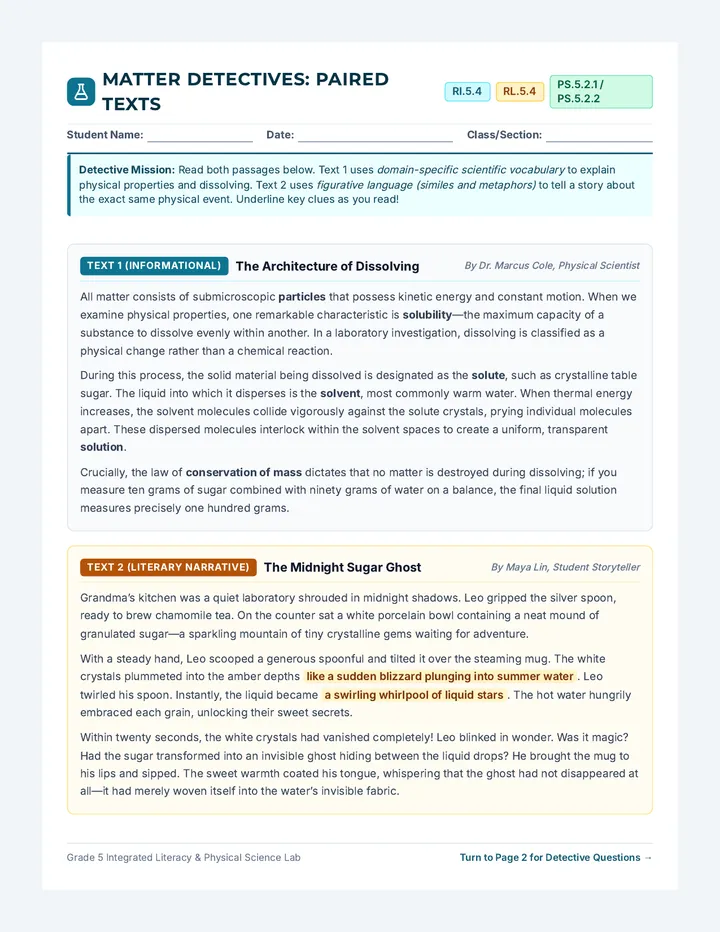
Matter Mysteries Paired Passages Matter Detectives: Paired Texts
RI.5.4 RL.5.4 PS.5.2.1 / PS.5.2.2
Student Name:
Date:
Class/Section:
Detective Mission: Read both passages below. Text 1 uses domain-specific scientific vocabulary to explain physical properties and dissolving. Text 2 uses figurative language (similes and metaphors) to tell a story about the exact same physical event. Underline key clues as you read!
Text 1 (Informational)
The Architecture of Dissolving
By Dr. Marcus Cole, Physical Scientist
All matter consists of submicroscopic particles that possess kinetic energy and constant motion. When we examine physical properties, one remarkable characteristic is solubility —the maximum capacity of a substance to dissolve evenly within another. In a laboratory investigation, dissolving is classified as a physical change rather than a chemical reaction.
During this process, the solid material being dissolved is designated as the solute , such as crystalline table sugar. The liquid into which it disperses is the solvent , most commonly warm water. When thermal energy increases, the solvent molecules collide vigorously against the solute crystals, prying individual molecules apart. These dispersed molecules interlock within the solvent spaces to create a uniform, transparent solution .
Crucially, the law of conservation of mass dictates that no matter is destroyed during dissolving; if you measure ten grams of sugar combined with ninety grams of water on a balance, the final liquid solution measures precisely one hundred grams.
Text 2 (Literary Narrative)
The Midnight Sugar Ghost
By Maya Lin, Student Storyteller
Grandma’s kitchen was a quiet laboratory shrouded in midnight shadows. Leo gripped the silver spoon, ready to brew chamomile tea. On the counter sat a white porcelain bowl containing a neat mound of granulated sugar—a sparkling mountain of tiny crystalline gems waiting for adventure.
With a steady hand, Leo scooped a generous spoonful and tilted it over the steaming mug. The white crystals plummeted into the amber depths like a sudden blizzard plunging into summer water. Leo twirled his spoon. Instantly, the liquid became a swirling whirlpool of liquid stars. The hot water hungrily embraced each grain, unlocking their sweet secrets.
Within twenty seconds, the white crystals had vanished completely! Leo blinked in wonder. Was it magic? Had the sugar transformed into an invisible ghost hiding between the liquid drops? He brought the mug to his lips and sipped. The sweet warmth coated his tongue, whispering that the ghost had not disappeared at all—it had merely woven itself into the water’s invisible fabric.
Grade 5 Integrated Literacy & Physical Science Lab Turn to Page 2 for Detective Questions →
Detective Evidence & Vocabulary Analysis
Page 2 of 2
Part 1
RI.5.4: Domain-Specific Vocabulary in Science
1. In Text 1, what does the domain-specific word solute mean? Use context clues from paragraph 2.
A) The liquid that heats up in a beaker
B) The solid material that is dissolved
C) The measurement of grams on a scale
D) A chemical reaction creating new gas
2. In Text 1, the author writes: "solubility—the maximum capacity of a substance to dissolve evenly within another." What type of context clue is this?
A) A direct definition set off by a dash
B) An antonym showing the opposite state
C) An idiom commonly used in literature
D) A sensory comparison using a simile
Part 2
RL.5.4: Figurative Language in Narrative
3. In Text 2, the author describes the sugar falling "like a sudden blizzard plunging into summer water." What does this simile convey about the event?
A) The tea instantly froze into cold ice
B) A flurry of white particles met hot liquid
C) The water ruined the kitchen counter
D) The sugar had dangerous physical properties
4. In Text 2, the phrase "a swirling whirlpool of liquid stars" is an example of a:
A) Metaphor (comparing sugar grains to stars)
B) Scientific definition of matter
C) Domain-specific chemical equation
D) Simile using signal words like or as
Part 3
Science & Literary Synthesis
Standards: RI.5.4 + RL.5.4 + PS.5.2.2
5. In Text 2, Leo wonders if the sugar became an "invisible ghost." How does the scientific concept of conservation of mass and solution from Text 1 prove Leo’s grandmother’s sugar did NOT really vanish? Use at least one science vocabulary word and explain Leo’s sensory observation.
Matter Detectives Assessment • Grade 5 Total Score: ______ / 10 pts
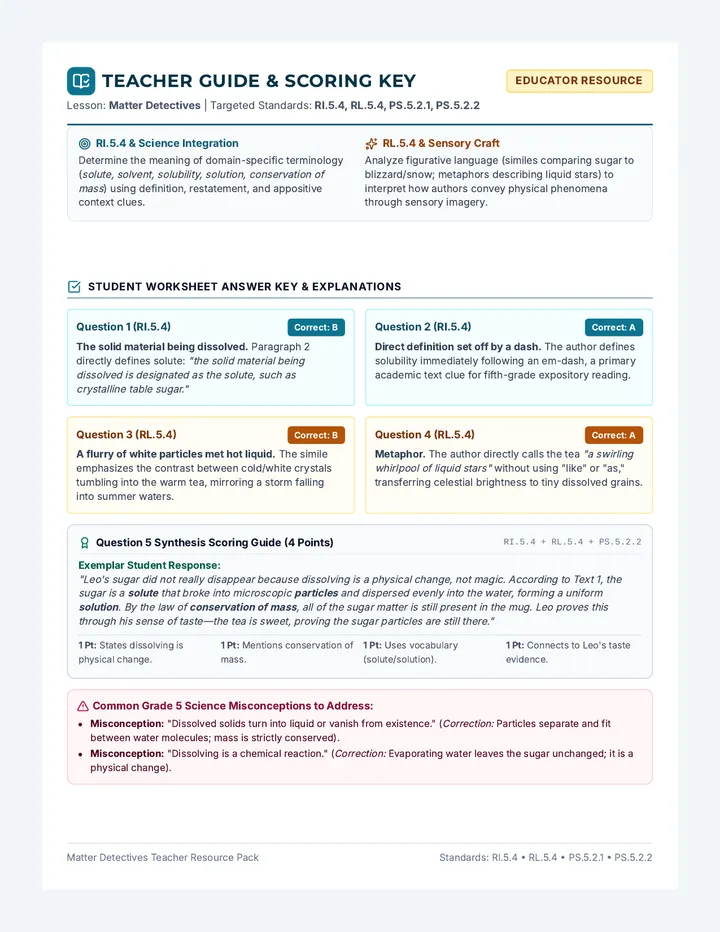
Matter Detectives Teacher Guide Teacher Guide & Scoring Key
Educator Resource
Lesson: Matter Detectives | Targeted Standards: RI.5.4, RL.5.4, PS.5.2.1, PS.5.2.2
RI.5.4 & Science Integration
Determine the meaning of domain-specific terminology (solute, solvent, solubility, solution, conservation of mass ) using definition, restatement, and appositive context clues.
RL.5.4 & Sensory Craft
Analyze figurative language (similes comparing sugar to blizzard/snow; metaphors describing liquid stars) to interpret how authors convey physical phenomena through sensory imagery.
Student Worksheet Answer Key & Explanations
Question 1 (RI.5.4) Correct: B
The solid material being dissolved. Paragraph 2 directly defines solute: "the solid material being dissolved is designated as the solute, such as crystalline table sugar."
Question 2 (RI.5.4) Correct: A
Direct definition set off by a dash. The author defines solubility immediately following an em-dash, a primary academic text clue for fifth-grade expository reading.
Question 3 (RL.5.4) Correct: B
A flurry of white particles met hot liquid. The simile emphasizes the contrast between cold/white crystals tumbling into the warm tea, mirroring a storm falling into summer waters.
Question 4 (RL.5.4) Correct: A
Metaphor. The author directly calls the tea "a swirling whirlpool of liquid stars" without using "like" or "as," transferring celestial brightness to tiny dissolved grains.
Question 5 Synthesis Scoring Guide (4 Points) RI.5.4 + RL.5.4 + PS.5.2.2
Exemplar Student Response: "Leo's sugar did not really disappear because dissolving is a physical change, not magic. According to Text 1, the sugar is a solute that broke into microscopic particles and dispersed evenly into the water, forming a uniform solution . By the law of conservation of mass , all of the sugar matter is still present in the mug. Leo proves this through his sense of taste—the tea is sweet, proving the sugar particles are still there."
1 Pt: States dissolving is physical change.
1 Pt: Mentions conservation of mass.
1 Pt: Uses vocabulary (solute/solution).
1 Pt: Connects to Leo's taste evidence.
Common Grade 5 Science Misconceptions to Address:
Misconception: "Dissolved solids turn into liquid or vanish from existence." (Correction: Particles separate and fit between water molecules; mass is strictly conserved).Misconception: "Dissolving is a chemical reaction." (Correction: Evaporating water leaves the sugar unchanged; it is a physical change).
Matter Detectives Teacher Resource Pack Standards: RI.5.4 • RL.5.4 • PS.5.2.1 • PS.5.2.2