Circle Vectors Bell Ringer
Physics Warm-Up Est. Time: 5–7 min
Circle Vectors Bell Ringer
Name:
Date: Period:
Vector Code:
Velocity \( (\vec{v}) \) Centripetal Accel. \( (\vec{a}_c) \) Centripetal Force \( (\vec{F}_c) \)
1 Diagram Challenge: Sketch the Vectors
Uniform Circular Motion (Counter-Clockwise)
A tetherball travels along a horizontal circular path at constant speed in a counter-clockwise direction. At points A and B, draw and label arrows for \( \vec{v} \), \( \vec{a}_c \), and \( \vec{F}_c \).
Center (C) Direction of Motion Point A (Draw v, a_c, F_c) Point B Vector Checklist: [ ] v (velocity) [ ] a_c (centripetal accel.) [ ] F_c (force)
2 Direction Rulebook: Describe Each Vector
Velocity \( (\vec{v}) \)
What is the geometric direction of \( \vec{v} \) relative to the circular path?
Your Description:
Centripetal Accel. \( (\vec{a}_c) \)
In what direction does the centripetal acceleration vector always point?
Your Description:
Centripetal Force \( (\vec{F}_c) \)
What direction must the net force act, and why does it match \( \vec{a}_c \)?
Your Description:
3 Concept Trap & Angle Check
Angle Relationship:
At any instant, what is the angle between \( \vec{v} \) and \( \vec{F}_c \)? Why does \( \vec{F}_c \) turn the object without changing its speed?
"Snap!" Inertia Scenario:
If the tether snaps at Point A, which path does the ball take (straight tangent, straight outward, or curved)? Explain using Newton's 1st Law.
Memory Anchor: "Centripetal" = center-seeking; velocity = tangent to circle.
\( \vec{F}_{net} = m\vec{a}_c \)
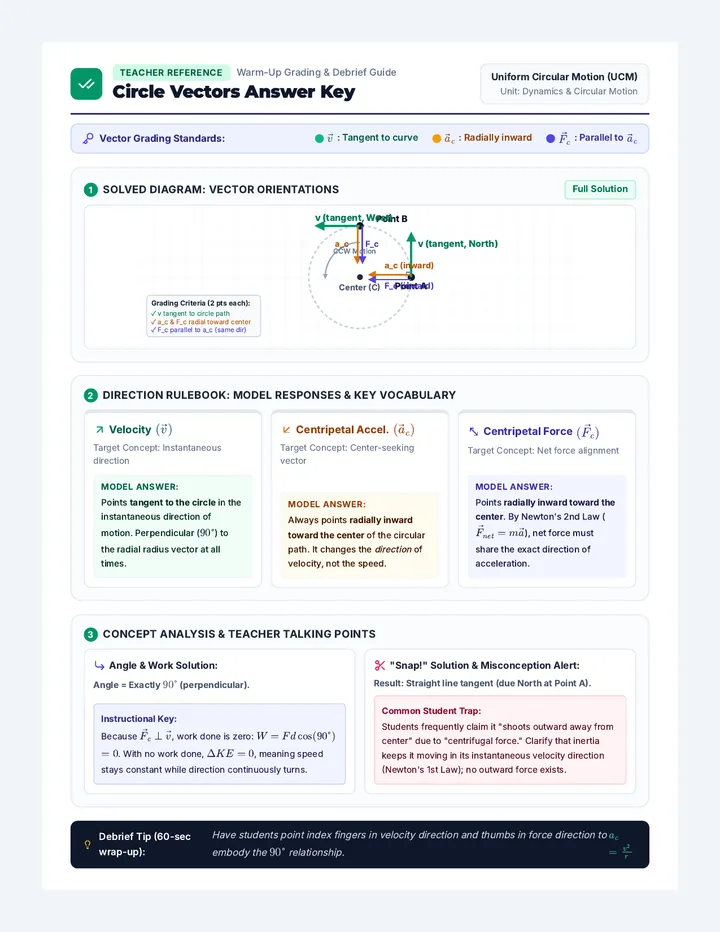
Circle Vectors Answer Key
Teacher Reference Warm-Up Grading & Debrief Guide
Circle Vectors Answer Key
Uniform Circular Motion (UCM)
Unit: Dynamics & Circular Motion
Vector Grading Standards:
\( \vec{v} \): Tangent to curve \( \vec{a}_c \): Radially inward \( \vec{F}_c \): Parallel to \( \vec{a}_c \)
1 Solved Diagram: Vector Orientations
Full Solution
Center (C) CCW Motion Point A v (tangent, North) a_c (inward) F_c (inward) Point B v (tangent, West) a_c F_c Grading Criteria (2 pts each): ✓ v tangent to circle path ✓ a_c & F_c radial toward center ✓ F_c parallel to a_c (same dir)
2 Direction Rulebook: Model Responses & Key Vocabulary
Velocity \( (\vec{v}) \)
Target Concept: Instantaneous direction
Model Answer:
Points tangent to the circle in the instantaneous direction of motion. Perpendicular (\(90^\circ\)) to the radial radius vector at all times.
Centripetal Accel. \( (\vec{a}_c) \)
Target Concept: Center-seeking vector
Model Answer:
Always points radially inward toward the center of the circular path. It changes the direction of velocity, not the speed.
Centripetal Force \( (\vec{F}_c) \)
Target Concept: Net force alignment
Model Answer:
Points radially inward toward the center. By Newton's 2nd Law (\(\vec{F}_{net} = m\vec{a}\)), net force must share the exact direction of acceleration.
3 Concept Analysis & Teacher Talking Points
Angle & Work Solution:
Angle = Exactly \(90^\circ\) (perpendicular).
Instructional Key: Because \(\vec{F}_c \perp \vec{v}\), work done is zero: \(W = F d \cos(90^\circ) = 0\). With no work done, \(\Delta KE = 0\), meaning speed stays constant while direction continuously turns.
"Snap!" Solution & Misconception Alert:
Result: Straight line tangent (due North at Point A).
Common Student Trap: Students frequently claim it "shoots outward away from center" due to "centrifugal force." Clarify that inertia keeps it moving in its instantaneous velocity direction (Newton's 1st Law); no outward force exists.
Debrief Tip (60-sec wrap-up): Have students point index fingers in velocity direction and thumbs in force direction to embody the \(90^\circ\) relationship.
\( a_c = \frac{v^2}{r} \)