Course Launch An introductory framework establishing course policies, Indiana state biology standards, and the integrated biochemistry roadmap for the academic year.
M MELANIE.ROBERTS
Biology Syllabus Infographic
A visual one-pager syllabus infographic integrating Indiana Biology standards with foundational biochemistry concepts for each units, featuring course policies and grading breakdown.
Launch Checklist Teacher Guide
A checklist teacher guide to align first-week classroom logistics, lab safety setups, and Indiana biochemistry integration milestones for General Biology.
36-Week Curricular Roadmap
A highly structured week-by-week curriculum roadmap detailing all 36 weeks of General Biology, aligned with Indiana Standards and highlighting biochemistry and homeostasis mechanisms.
Rigorous Unit Unwrapping Guides
A set of five Larry Ainsworth RCD style unit unwrapping guides mapping Big Ideas, Essential Questions, Nouns/Verbs (Know/Do), vocabulary, and Indiana Biology Standards for all units.
Course Launch An introductory framework establishing course policies, Indiana state biology standards, and the integrated biochemistry roadmap for the academic year.
M MELANIE.ROBERTS
Biology Syllabus Infographic General Biology
Indiana Standards • Integrated Biochemistry & Homeostatic Systems
Instructor: Mrs. Henderson
khenderson@indiana.k12.in.us
Room 204 • Lab Wing
Student:
Class Period:
Lab Station:
Theme: Maintaining Life's Balance
The Homeostasis Lens
Life is a constant struggle to maintain chemical balance (homeostasis ). Throughout this course, we will analyze how biochemical processes keep organisms alive—and what happens when these systems fail.
Grading Matrix
Unit Tests & Labs 40%
In-Class Lab Log & Work 35%
Quizzes & Benchmarks 25%
Required Gear
Biology Lab Notebook: Quad-ruled for recording classroom experiment results.Basic Calculator: For data calculation and laboratory measurements.Course Binder: For storing chemical pathway sketches and study guides.
The Lab Code
01 / Accurate Recording: Good science depends on honest records. Write down what you observe in labs directly as it happens.02 / Lab Safety: Strict safety goggles compliance, secure hair, and immediate reporting of any spills.03 / Step-by-Step Growth: Concepts connect over time. Understanding cells early makes genetics easier later on!
Curricular Roadmap & Standard Integrations 36 Weeks • General Track
1
Molecules & Cell Architecture
IAS B.2 (Structure & Function) • 8 Wks NGSS: HS-LS1-1, HS-LS1-2, HS-LS1-3
Cell parts, organelles, and how substances move across cellular membranes.
Biochem Water polarity, chemical gradients, cell boundaries.
Balance Osmotic regulation controls water levels inside cells.
Failure Osmotic collapse causes cells to burst or dehydrate.
2
Cellular Energetics & Metabolism
IAS B.1 (Matter & Energy Flow) • 7 Wks NGSS: HS-LS1-5, HS-LS1-6, HS-LS1-7
How plants and animals capture, transform, and use energy to survive.
Biochem ATP high-energy phosphate bonds; enzyme helpers.
Balance Cells continuous break down sugars to maintain ATP energy pools.
Failure Lack of ATP stops all metabolic activity, causing cellular death.
3
Genetics & Molecular Machinery
IAS B.3 (Genetics & Heredity) • 8 Wks NGSS: HS-LS1-1, HS-LS1-4, HS-LS3-1, HS-LS3-2
How DNA is copied, read, used to build proteins, and how cells divide (mitosis & meiosis).
Biochem Hydrogen bonds in nucleotides; enzyme reading complexes.
Balance Genes produce precise regulatory proteins (like insulin/enzymes).
Failure Mutated codes disable functional proteins, triggering systemic disease.
4
Evolution & Molecular Evidence
IAS B.4 (Evolution & Adapt) • 6 Wks NGSS: HS-LS4-1, HS-LS4-2, HS-LS4-3, HS-LS4-4
Natural selection and evolutionary links using anatomical and genetic traits.
Biochem DNA sequence matching; shared metabolic pathways.
Balance Species adapt gene pools over generations to maintain population stability.
Failure Inability to adjust to sudden molecular/climate shifts causes extinction.
5
Ecology & Chemical Interactions
IAS B.5 (Interdependence) • 7 Wks NGSS: HS-LS2-1, HS-LS2-2, HS-LS2-3, HS-LS2-4
Ecosystem levels, food webs, and how nutrients cycle through nature.
Biochem Biogeochemical conversions (carbon, nitrogen cycles).
Balance Global chemical loops recycle atomic raw materials to keep biomes in equilibrium.
Failure Nutrient pollution creates dead zones, causing ecological collapse.
INDIANA ACADEMIC STANDARDS COMPLIANT (BIOLOGY 2026 ROADMAP)
CHEMISTRY + BIOLOGY = THE MECHANICS OF LIFE
Please review this integrated pathway. Return signed block by the second laboratory meeting of the semester.
Student Signature
Parent/Guardian Signature
Launch Checklist Teacher Guide Course Launch Checklist
Teacher Implementation Guide • Homeostasis Focus
First Week Protocol
General Biology Track
Purpose: Use this companion guide alongside the General Biology Syllabus Infographic . This checklist helps teachers highlight the unifying biological theme: Homeostasis (how living systems maintain chemical balance) and the physical consequences of its Failure .
Phase 1: Pre-Launch Prep
Review Homeostasis Framework: Prepare simple explanations linking metabolic pathways to cellular health and the hazards of chemical imbalances.
Assign Lab Stations: Establish consistent teams of 3 or 4. Ensure each station has its assigned lab scale, carbon logs, and basic glassware.
Demonstrate Salt/Water Balance: Prepare red food coloring in dialysis tubing to visibly model cellular shrinking and swelling (osmotic homeostasis).
Phase 2: Syllabus Walkthrough
Introduce "The Lens": Walk through the 5 core units using the syllabus infographic. Show students how every unit focuses on maintaining stability.
Highlight "Failure" Examples: Connect failure to maintain balance to real-life consequences: diabetic shock (Unit 2/3) and ecosystem dead zones (Unit 5).
Collect Parent Slips: Monitor the sign-off block at the bottom of the syllabus infographic. Require students to record their assigned lab station numbers.
Phase 3: Lab Safety & Setup
Carbon Log Setup: Instruct students to format Page 1 of their quad-ruled book. Require a table of contents and permanent ink labeling.
The "Bio-Code" Workshop: Review how improper tool handling causes physical stress on experiments. Define boundaries for clean and stable testing.
Active Inquiry Hook: Lead a 15-minute introductory investigation measuring heart rates before and after exercise to map immediate physical homeostasis.
Compliance Checklist
Verify safety paperwork and initial log entries are completed prior to the first cellular modeling lab next week.
Form Collection Parent signature slips filed by student name.
Station Verification All student goggles sanitized and counted.
36-Week Curricular Roadmap 36-Week Curricular Roadmap
Indiana Standards • Week-by-Week Instructional Guide
Page 1 of 3
Weeks 1 – 12
Unit 1: Molecules & Cell Architecture (Weeks 1-8) IAS B.2 • NGSS HS-LS1-1, HS-LS1-2, HS-LS1-3
Week Instructional Topic Biochemical Foundation Maintaining Homeostasis Failure Consequences Week 1 Characteristics of Life & Homeostasis Matter and chemical energy requirements; metabolic criteria. Active monitoring and adjustment of stable core parameters. Systemic cell death and organic decay. Week 2 Cell Chemistry & Water Polar molecular structure of water; hydrogen bonding configurations. Universal solvent actions dissolve metabolic chemistry. Dehydration; immediate chemical shutdown of cellular enzymes. Week 3 Building Blocks (Polymers) Carbon valence shells; polymer build/break dehydration synthesis. Synthesis processes build structural molecules. Inability to construct structural cell membranes. Week 4 Energy & Boundaries Carbon ring chains vs hydrophobic fatty acid lipid structure. Storage molecules provide cell energy & boundary membranes. Membrane rupture; cell boundary leakage. Week 5 Enzymes & Reactions Amino acid structures; folding shapes; kinetic reaction activation. Enzyme catalysts speed up chemical responses. Acidic/heat damage denatures proteins, stopping reactions. Week 6 Cell Parts & Organelles Internal membrane areas; ribosome/ER synthesis complexes. Organelle specialization segregates metabolic chemistry. Organelle leakage (e.g. lysosome acid bursts destroy cell). Week 7 Cell Transport (Passive/Active) Gradients, passive osmosis, ATP-coupled protein pump changes. Osmotic regulation keeps steady internal cell hydration and potentials. Plasmolysis, cell burst, or electrical neurological seizures. Week 8 Unit 1 Review & Cell Lab Evaluation of biochemical transport & osmotic gradients. Synthesis of transport mechanics & modeling. Review of failures to maintain cellular boundaries.
Rigorous Unit Unwrapping Guides RCD Unit Unwrapping Guide
Larry Ainsworth Rigorous Curriculum Design Framework
Unit 1 • 8 Weeks
Molecules & Cell Architecture
Indiana Standard: IAS B.2 (Structure & Function) NGSS Alignment: HS-LS1-1, HS-LS1-2, HS-LS1-3
Unwrapped Concepts (Know / Nouns)
• Criteria of Life & Homeostasis: Stimulus response, feedback loops, metabolic needs.
• Water properties: Polarity, hydrogen bonds, solvent behaviors.
• Macromolecules: Lipids, sugars, proteins, nucleic acids.
• Organelles: Nucleus, ER, ribosomes, lysosomes, boundaries (after macromolecules).
Unwrapped Skills (Do / Verbs)
• Identify (DOK 1): Characteristics defining alive vs non-alive systems.
• Explain (DOK 2): How folded macromolecules construct active organelle parts.
• Model (DOK 3): Selective membrane transport systems.
"I Can" Learning Targets
• I can define the criteria that define life and explain why homeostasis is essential for cell survival.
• I can describe how complex biomolecules assemble to build functioning cell organelles.
Big Ideas (Enduring Understandings)
1. All living things share vital characteristics—chiefly, the continuous biochemical adjustments that preserve homeostatic balance.
2. Cell organelles represent specialized chemical compartments constructed entirely from folded macromolecules.
Essential Questions
Q1: What defines a living system, and how does it prevent metabolic collapse?
Q2: How do simple biomolecules organize into complex working structures?
Academic & Domain Vocabulary
Domain (Tier 3): Stimulus, Metabolism, Homeostatic feedback, Bilayer, Tonicity, Macromolecule, Specialized organelle, Dehydration synthesis.Academic (Tier 2): Balance, Sequence, Systemic, Assembly, Selective.
Homeostasis & Biochem Connection
Mechanism: Macromolecular boundaries block random chemical decay, while active internal compartments separate distinct metabolic reactions.Failure Point: Extreme chemical disruptions denature catalytic enzyme networks, stopping cellular balance and leading to systemic cell decay.
INDIANA DEPARTMENT OF EDUCATION Rigorous Curriculum Design Framework PAGE 1 of 5 • UNIT 1 PLANS
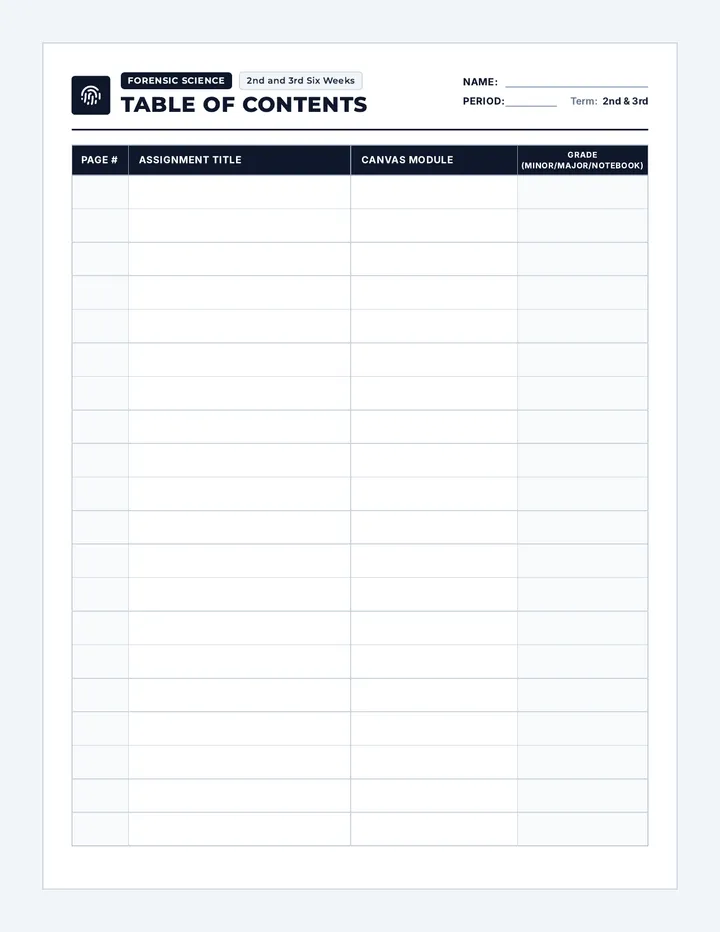
First-Week Class Signature & Binder Tracker Class Record Sheet
Notes / Station Assignment
Unit 2: Cellular Energetics & Metabolism (Weeks 9-12) IAS B.1 • NGSS HS-LS1-5, HS-LS1-6, HS-LS1-7
INDIANA DEPARTMENT OF EDUCATION COMPLIANT (BIOLOGY I) GENERAL TRACK • PATHWAY BLUEPRINT • PAGE 1
36-Week Curricular Roadmap Indiana Standards • Week-by-Week Instructional Guide
Unit 2: Energetics Continued (Weeks 13-15) IAS B.1 • NGSS HS-LS1-3, HS-LS1-7
Week Instructional Topic Biochemical Foundation Maintaining Homeostasis Failure Consequences Week 13 Cellular Respiration & Mitochondria Mitochondrial matrix oxidation; NADH and FADH2 coenzyme chemistry. Oxygen acts as final electron sink, driving massive aerobic ATP generation. Cyanide blocking stops electron flows, causing instant cell death. Week 14 Metabolism & Body Temp Thyroid hormone cues; brown fat uncoupling membrane chemistry. Maintains stable metabolic rates in heat or severe cold. Metabolic crash, extreme exhaustion, or heat stroke. Week 15 Unit 2 Review & Energetics Lab Evaluation of light absorption, cellular yeast respiration rates. Measuring active metabolic outputs of model cells. Anoxia review; consequences of oxygen starvation.
Unit 3: Genetics & Molecular Machinery (Weeks 16-23) IAS B.3 • NGSS HS-LS1-1, HS-LS1-4, HS-LS3-1, HS-LS3-2
Unit 4: Evolution & Molecular Evidence (Weeks 24 of 6) IAS B.4 • NGSS HS-LS4-2, HS-LS4-3
INDIANA DEPARTMENT OF EDUCATION COMPLIANT (BIOLOGY I) GENERAL TRACK • PATHWAY BLUEPRINT • PAGE 2
36-Week Curricular Roadmap Indiana Standards • Week-by-Week Instructional Guide
Unit 4: Evolution Continued (Weeks 25-29) IAS B.4 • NGSS HS-LS4-1, HS-LS4-4
Week Instructional Topic Biochemical Foundation Maintaining Homeostasis Failure Consequences Week 25 Genetics of Populations Allele frequency; random mating statistical models. Stable genetic frequencies maintain population viability. Extreme inbreeding, expression of lethal recessive genes. Week 26 Evidence for Evolution DNA alignments; protein sequencing (e.g. Cytochrome c). Molecules track homologous lineage configurations accurately. Misinterpreting structural patterns as evolutionary traits. Week 27 Environmental Adaptation Lactase persist gene mutations; chemical digestive enzymes. Adaptable diets sustain nutritional homeostasis. Severe food intolerance, dynamic gut inflammation. Week 28 How Species Form (Speciation) Pheromone ligand mismatches; membrane protein blocks on egg. Reproductive boundaries isolate species integrity. Divergent gene loss, sterile sterile hybrid generation. Week 29 Unit 4 Review & Evolution Lab Phylogenetic alignments of blood proteins. Synthesizing ancestral lines of common descent. Inability to model chemical relationships across taxa.
Unit 5: Ecology & Chemical Interactions (Weeks 30-36) IAS B.5 • NGSS HS-LS2-1, HS-LS2-2, HS-LS2-3, HS-LS2-4, HS-LS2-5
INDIANA DEPARTMENT OF EDUCATION COMPLIANT (BIOLOGY I) GENERAL TRACK • PATHWAY BLUEPRINT • PAGE 3
RCD Unit Unwrapping Guide Larry Ainsworth Rigorous Curriculum Design Framework
Cellular Energetics & Metabolism
Indiana Standard: IAS B.1 (Matter & Energy Flow) NGSS Alignment: HS-LS1-5, HS-LS1-6, HS-LS1-7
Unwrapped Concepts (Know / Nouns)
• ATP Cycle: High-energy chemical phosphate bonds, ATP-ADP reactions.
• Photosynthesis: Solar capture, chloroplast structures, Calvin cycle, RuBisCO.
• Cell Respiration: Glycolysis, mitochondria, ETC, anaerobic fermentation.
• Uncoupling: Metabolic rates, body heat conversion.
Unwrapped Skills (Do / Verbs)
• Calculate (DOK 2): Net ATP gains between aerobic/anaerobic sugar reactions.
• Model (DOK 3): Energy conversion from solar light to glucose bonds.
• Analyze (DOK 3): How respiratory input loss stops cellular energy.
"I Can" Learning Targets
• I can model how plants convert solar light energy into sugar molecules.
• I can explain how cells break down glucose to generate active ATP energy.
Big Ideas (Enduring Understandings) 1. All life requires a constant input of chemical energy (ATP) to fight metabolic disorder and maintain stable physiological states.
2. Matter cycles and energy flows continuously through paired biochemical reactions, linking the plant and animal kingdoms.
Essential Questions Q1: How do cells convert raw environmental energy into a usable cellular fuel?
Q2: What happens to an organism when its chemical energy production falls behind its energy demand?
Academic & Domain Vocabulary Domain (Tier 3): Adenosine triphosphate, Chlorophyll, Calvin cycle, Glycolysis, Mitochondria matrix, Fermentation, Oxidative reaction.Academic (Tier 2): Efficiency, Output, Input, Conversion, Consumption.
Homeostasis & Biochem Connection Mechanism: Energy derived from ATP hydrolysis drives immediate cell repairs, active transport channels, and mechanical movement.Failure Point: Depletion of oxygen or sugar stops ETC flows, causing cellular metabolic exhaustion and death.
INDIANA DEPARTMENT OF EDUCATION Rigorous Curriculum Design Framework PAGE 2 of 5 • UNIT 2 PLANS
RCD Unit Unwrapping Guide Larry Ainsworth Rigorous Curriculum Design Framework
Genetics & Molecular Machinery
Indiana Standard: IAS B.3 (Genetics & Inherited Traits) NGSS Alignment: HS-LS1-1, HS-LS1-4, HS-LS3-1, HS-LS3-2
Unwrapped Concepts (Know / Nouns)
• Transcription: RNA polymerase enzymes, mRNA strands, base replication.
• Translation: Ribosomes, codon reading, amino acid peptide chains.
• Proteins: Regulatory proteins, insulin, enzyme active folding.
• Cell Division: Mitosis growth checkpoints, Meiosis crossover.
Unwrapped Skills (Do / Verbs)
• Translate (DOK 2): DNA sequences into mRNA codes & peptide amino acids.
• Explain (DOK 3): Protein building/folding role in biological bodies.
• Investigate (DOK 3): Mitosis checkpoint failures causing abnormal division.
"I Can" Learning Targets
• I can transcribe and translate genes into functional regulatory proteins.
• I can describe how mitosis and meiosis allow for stable cellular growth.
Big Ideas (Enduring Understandings) 1. Genes provide precise molecular templates for functional proteins that carry out cell growth and balance regulation.
2. Controlled cell division (mitosis and meiosis) guarantees genomic stability during growth, healing, and reproduction.
Essential Questions Q1: How does a change in a molecular DNA sequence disrupt the homeostatic balance of an entire organism?
Q2: How do cells guarantee that genetic instructions are transmitted accurately during growth and reproduction?
Academic & Domain Vocabulary Domain (Tier 3): Nucleotide, Splicing, Ribosome, Anticodon, Peptide bonds, Folded structural enzyme, Chromosome spindle, Nondisjunction.Academic (Tier 2): Code, Mechanism, Template, Fidelity, Division.
Homeostasis & Biochem Connection Mechanism: Protein synthesis continuously replaces broken active-site enzymes and signaling hormones, preserving chemical equilibrium.Failure Point: Mutations that alter amino acid polar charges warp protein folds, triggering cellular disease (e.g. cystic fibrosis, cancer).
INDIANA DEPARTMENT OF EDUCATION Rigorous Curriculum Design Framework PAGE 3 of 5 • UNIT 3 PLANS
RCD Unit Unwrapping Guide Larry Ainsworth Rigorous Curriculum Design Framework
Evolution & Molecular Evidence
Indiana Standard: IAS B.4 (Evolution & Adaptation) NGSS Alignment: HS-LS4-1, HS-LS4-2, HS-LS4-3, HS-LS4-4
Unwrapped Concepts (Know / Nouns)
• Natural Selection: Genetic variation, differential survival, selective environmental stresses.
• Hardy-Weinberg: Population genetic stability equations, allele frequencies.
• Molecular Homology: DNA alignment, protein codes, phylogenetics.
• Speciation: Isolation boundaries, gene flow blocks.
Unwrapped Skills (Do / Verbs)
• Analyze (DOK 3): DNA and amino acid sequence alignments across animal taxa.
• Predict (DOK 3): Population allele frequency shifts under pressure.
• Construct (DOK 2): Simple cladograms mapping shared protein traits.
"I Can" Learning Targets
• I can analyze DNA alignments to trace shared ancestral relationships.
• I can predict how a population's gene pool shifts over adaptive generations.
Big Ideas (Enduring Understandings) 1. Natural selection serves as an active environmental screen, shaping species' gene pools to match biochemical stressors over geological time.
2. Shared molecular pathways (like glycolysis enzyme chains) provide clear physical evidence of common biological descent.
Essential Questions Q1: How do populations adapt over generations to maintain evolutionary stability in a changing world?
Q2: How does molecular evidence help us reconstruct historical relationships among diverse living things?
Academic & Domain Vocabulary Domain (Tier 3): Allele frequency, Genetic drift, Hardy-Weinberg equilibrium, Sequence alignment, Cladogram, Speciation, Lactase mutation.Academic (Tier 2): Evidence, Generation, Adaptation, Diversity, Alignment.
Homeostasis & Biochem Connection Mechanism: Gene pool adjustments preserve population homeostasis, selecting for traits (like lactose digest mechanisms) to resolve chemical nutrient stress.Failure Point: Populations lacking genetic variation cannot adapt to sudden chemical/climatic shifts, resulting in localized extinction.
INDIANA DEPARTMENT OF EDUCATION Rigorous Curriculum Design Framework PAGE 4 of 5 • UNIT 4 PLANS
RCD Unit Unwrapping Guide Larry Ainsworth Rigorous Curriculum Design Framework
Ecology & Chemical Interactions
Indiana Standard: IAS B.5 (Interdependence) NGSS Alignment: HS-LS2-1, HS-LS2-2, HS-LS2-3, HS-LS2-4, HS-LS2-5
Unwrapped Concepts (Know / Nouns)
• Ecosystem Limits: Carrying capacities, density-limiting factors.
• Energy Pyramids: 10% trophic efficiency calculations, heat wastes.
• Biogeochemical Cycles: Carbon loops, nitrogen fixing, phosphate solubility.
• Disruptions: Heavy metal bioaccumulations, fertilizer runoff dead zones.
Unwrapped Skills (Do / Verbs)
• Calculate (DOK 2): Biomass energy transfer across trophic levels.
• Model (DOK 3): Pathways of nitrogen-fixing or carbon capture reactions.
• Deduce (DOK 3): How agricultural waste runoff induces eutrophication.
"I Can" Learning Targets
• I can calculate energy flow efficiency across trophic levels in a food web.
• I can explain how nitrogen/carbon cycles maintain ecosystem-wide homeostasis.
Big Ideas (Enduring Understandings) 1. Ecosystems are dynamic chemical matrices where the constant cycling of nutrient atoms maintains biological carrying capacities.
2. Ecological balance is shaped by thermodynamic laws; 90% metabolic energy losses limit trophic pyramid levels.
Essential Questions Q1: How do geochemical cycles establish and protect global homeostatic balance?
Q2: How can small localized chemical or environmental disruptions cascade into widespread ecosystem collapses?
Academic & Domain Vocabulary Domain (Tier 3): Carrying capacity, Trophic transfer, Biogeochemical pathway, Eutrophication, Allelopathic toxins, Biomagnification.Academic (Tier 2): Equilibrium, Cascade, Interactive, Capacity, Systemic.
Homeostasis & Biochem Connection Mechanism: Steady biogeochemical conversions cycle carbon, nitrogen, and phosphorus between organisms and physical geology, preserving ecosystem balance.Failure Point: Fertilizer runoffs overload nitrogen balances, triggering toxic algal blooms that choke oxygen and cause local trophic collapses.
INDIANA DEPARTMENT OF EDUCATION Rigorous Curriculum Design Framework PAGE 5 of 5 • UNIT 5 PLANS