Energy cannot be created or destroyed, only transformed. Life depends on producers to capture solar energy and all organisms to release it to power life’s work.
Essential Question
"How does energy from the sun become the energy that powers my muscles?"
Unit Storyline
This unit tracks the carbon atom as it moves from the atmosphere into a glucose molecule via photosynthesis, and then back out via cellular respiration. Students model energy flow from light to ATP, investigating why we must breathe oxygen to unlock food energy.
Key Concepts
ATP/ADP Cycle
Light-Dependent Reactions
The Krebs Cycle & ETC
Aerobic vs. Anaerobic Pathways
Unit Launch Activity
"Exercise and CO2": Students measure the time it takes for indicator solution to change color as they blow into it before and after activity.
Biology Unit Launch Series Page 03
Unit 04 Mission Briefing
Cell Cycle & Growth
NGSS ALIGNMENT
HS-LS1-4
The Big Idea
Multicellular organisms grow and repair themselves through a regulated cycle of division. When regulation fails, uncontrolled growth leads to disease, highlighting the critical importance of checkpoints.
Essential Question
"How does a single fertilized egg become a human with trillions of specialized cells?"
Unit Storyline
We investigate the lifecycle of a cell, focusing on DNA replication precision and mitosis mechanics. Students explore differentiation—how stem cells activate specific genes. Finally, we look at the societal and biological implications of cancer.
Key Concepts
Mitosis (PMAT)
Interphase (G1, S, G2)
Stem Cell Differentiation
Cancer & Checkpoint Regulators
Unit Launch Activity
"The HeLa Cell Debate": Students discuss ethics and the immortality of cancer cells by reading about Henrietta Lacks.
Biology Unit Launch Series Page 04
Unit 05 Mission Briefing
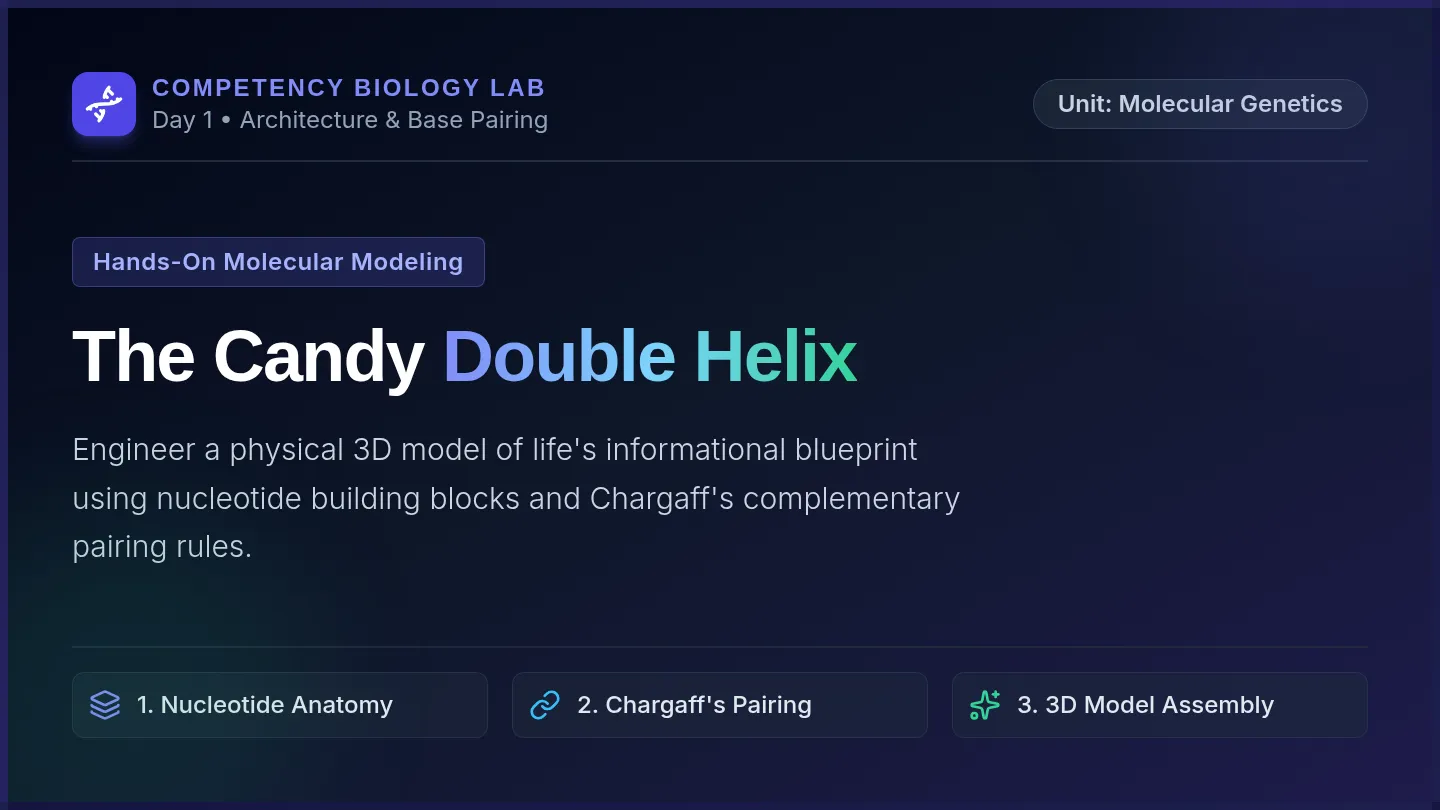
Molecular Genetics
NGSS ALIGNMENT
HS-LS3-1
The Big Idea
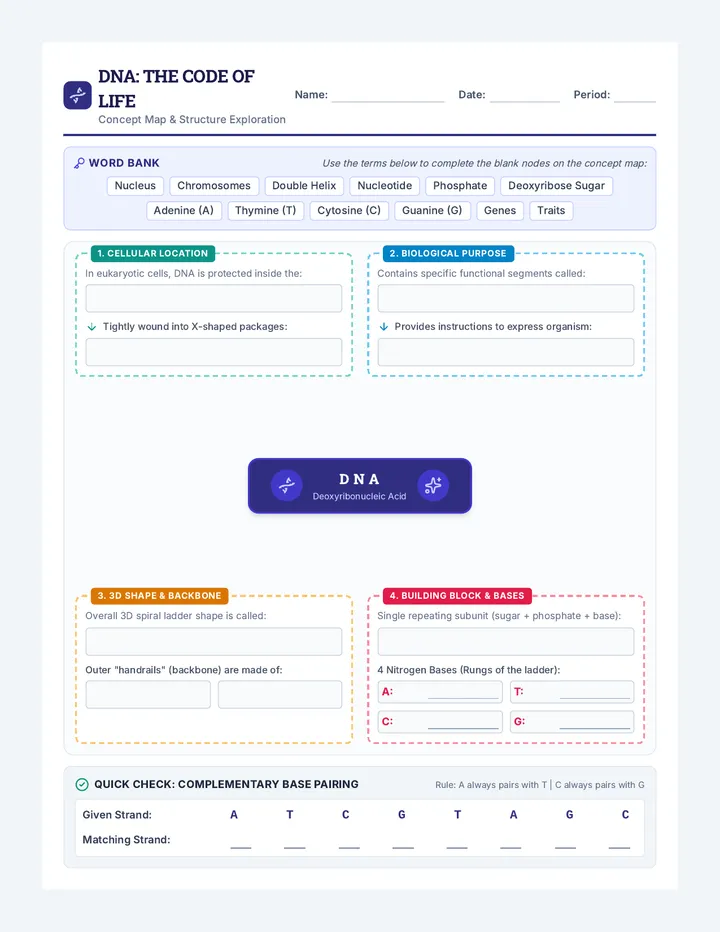
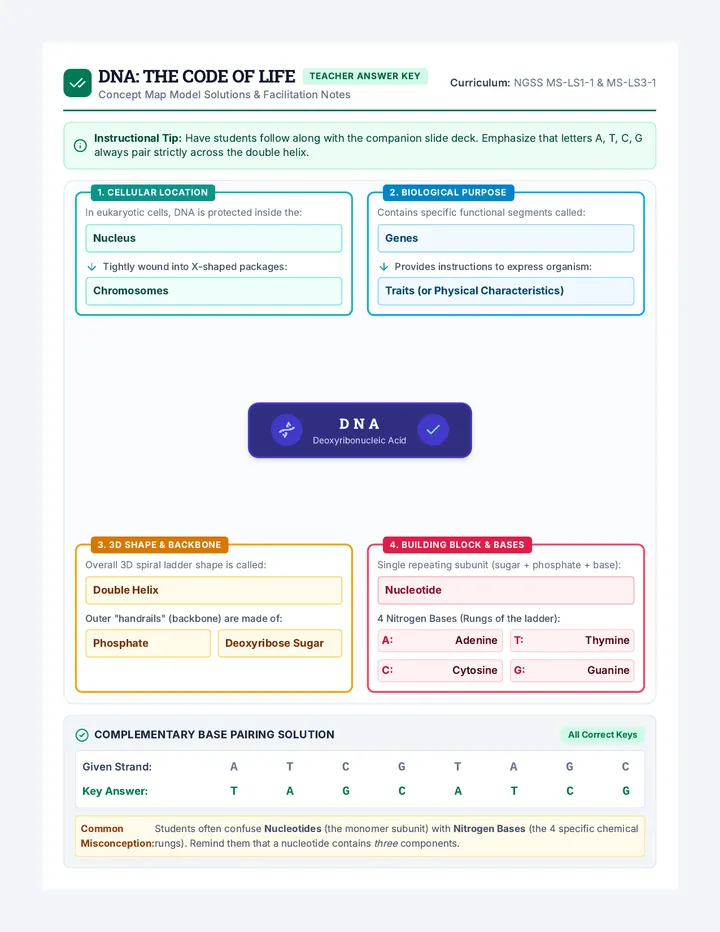
DNA is the universal language of life. The sequence of nucleotides in a gene provides instructions to build proteins, which determine traits and functions.
Essential Question
"How does a molecule made of only four letters determine who I am?"
Unit Storyline
Students decode "The Central Dogma": DNA to RNA to Protein. We track information from nucleus to ribosome, exploring how mutations lead to functional changes and how humans are learning to "edit" life's code.
Key Concepts
Transcription & Translation
Codon Redundancy
Point vs. Frameshift Mutations
Gene Expression Control
Unit Launch Activity
"Strawberry DNA Extraction": A hands-on lab where students precipitate visible DNA strands from fruit.
Biology Unit Launch Series Page 05
Unit 06 Mission Briefing
Inheritance Patterns
NGSS ALIGNMENT
HS-LS3-2, HS-LS3-3
The Big Idea
Biological variation is generated through meiosis. By applying mathematical probability, we can predict trait distribution across generations and understand population diversity.
Essential Question
"Why am I a unique combination of my parents, but not exactly like either one?"
Unit Storyline
This unit bridges microscopic meiosis with macroscopic traits. We investigate Mendel’s laws and complex patterns like polygenic traits, evaluating how "crossing over" ensures unique gametes.
Key Concepts
Meiosis I & II
Independent Assortment
Non-Mendelian Genetics
Pedigree Analysis
Unit Launch Activity
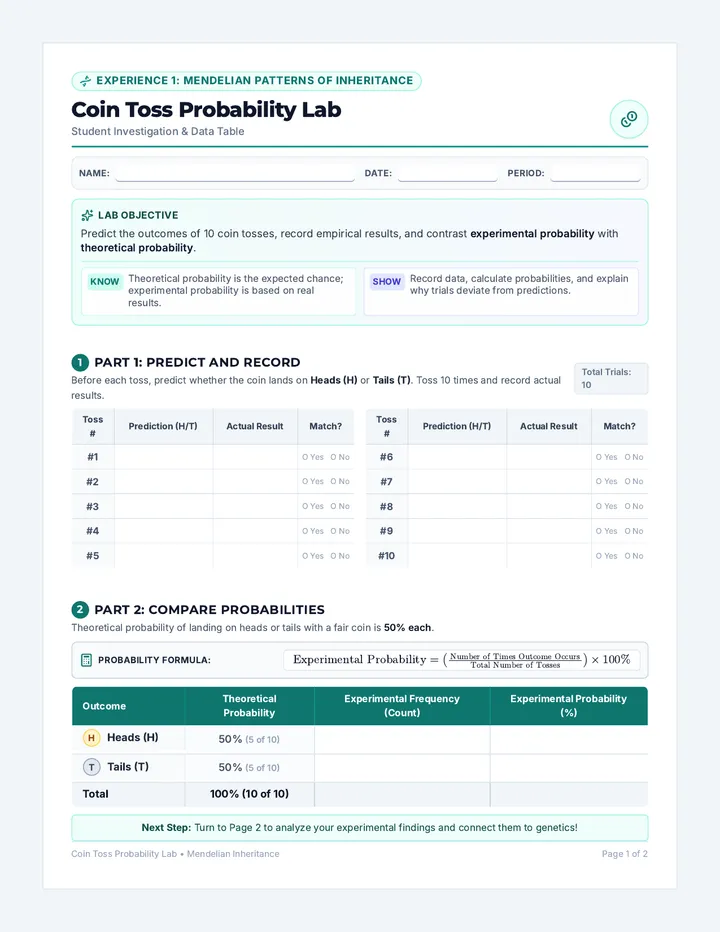
"Baby Face Lab": Students flip coins to determine genotype and resulting phenotype of a simulated child.
Biology Unit Launch Series Page 06
Unit 07 Mission Briefing
Biological Evolution
NGSS ALIGNMENT
HS-LS4-1 to HS-LS4-5
The Big Idea
Evolution is the unifying theory of biology. Through natural selection, populations change as favorable traits thrive, leading to the immense diversity and common ancestry of life.
Essential Question
"How can a single ancestor be responsible for both a whale and a mushroom?"
Unit Storyline
Students analyze fossils, anatomy, embryology, and DNA. We simulate natural selection to see how environments favor variation, leading to speciation and the "Tree of Life."
Key Concepts
Homologous Structures
Survival of the Fittest
Cladograms & Phylogeny
Genetic Drift & Flow
Unit Launch Activity
"Beaks of Finches": A simulation where students use different tools as "beaks" to see which succeed in specific environments.
Biology Unit Launch Series Page 07
Unit 08 Mission Briefing
Ecosystem Dynamics
NGSS ALIGNMENT
HS-LS2-1 to HS-LS2-8
The Big Idea
Organisms exist in a web where matter cycles and energy flows. Human activity impacts these systems, requiring informed solutions for biodiversity and stability.
Essential Question
"How much change can an ecosystem take before it collapses?"
Unit Storyline
We zoom out to the "Big Picture". Students evaluate carrying capacity and keystone species roles. We conclude by analyzing human impact and designing engineering solutions to mitigate effects.
Key Concepts
Trophic Levels & 10% Rule
Nitrogen & Carbon Cycles
Succession & Resilience
Invasive Species Impact
Unit Launch Activity
"The Wolf Effect": Students analyze the trophic cascade that occurred in Yellowstone after the reintroduction of wolves.
Biology Unit Launch Series Page 08
Materials
Owl Pellets, Dissecting Kits, Bone Charts.
HS-LS2-4
Science Practice Alignment
SEP 3
Investigations
SEP 4
Data Analysis
SEP 2
Modeling
Refer to the Biology Curriculum Map for specific assessment dates and timelines.