Tectonic Clash Slides
7TH GRADE EARTH SCIENCE
UNIT: PLATE TECTONICS
Tectonic Clash:
Earth's Moving Plates
Investigate how colossal lithospheric plates crash, split, and scrape past each other to shape continents and oceans.
Divergent
Spreading Apart
Convergent
Colliding Together
Transform
Sliding Past
Foundational Concepts
The Engine Beneath Our Feet
The Lithosphere
Earth's rigid outer shell is cracked into tectonic plates that drift on molten rock.
The Asthenosphere
A hot, ductile mantle zone that flows slowly, carrying the rigid plates above.
Convection Currents
Deep heat rises, cools near the crust, and sinks. This endless thermal cycle drives all plate motion!
Rate of Movement
2 to 10 cm / year
(About as fast as your fingernails grow!)
✓
Oceanic Crust: Thin, dense basalt that readily sinks into the mantle.
✓
Continental Crust: Thicker, buoyant granite that resists sinking.
Key Takeaway: Boundaries are where intense geologic action occurs!
Plate Motion Mechanics Slide 2 of 8
Classification Framework
Three Ways Plates Meet
Divergent
Moving Apart ⬅️ ➡️
Plates pull apart. Magma wells up to generate fresh oceanic crust.
Crust Action:
Constructive (Creates crust)
Convergent
Crashing In ➡️ ⬅️
Plates push together. One subducts or both crumple upward into mountain chains.
Crust Action:
Destructive (Recycles crust)
Transform
Sliding Past ⬆️ ⬇️
Plates slide horizontally. Extreme friction catches rock until sudden rupture occurs.
Crust Action:
Conservative (No crust lost)
Overview of Boundary Dynamics Slide 3 of 8
BOUNDARY TYPE 1 Tensional Stress (Pulling Apart)
Divergent Boundaries: Spreading Centers
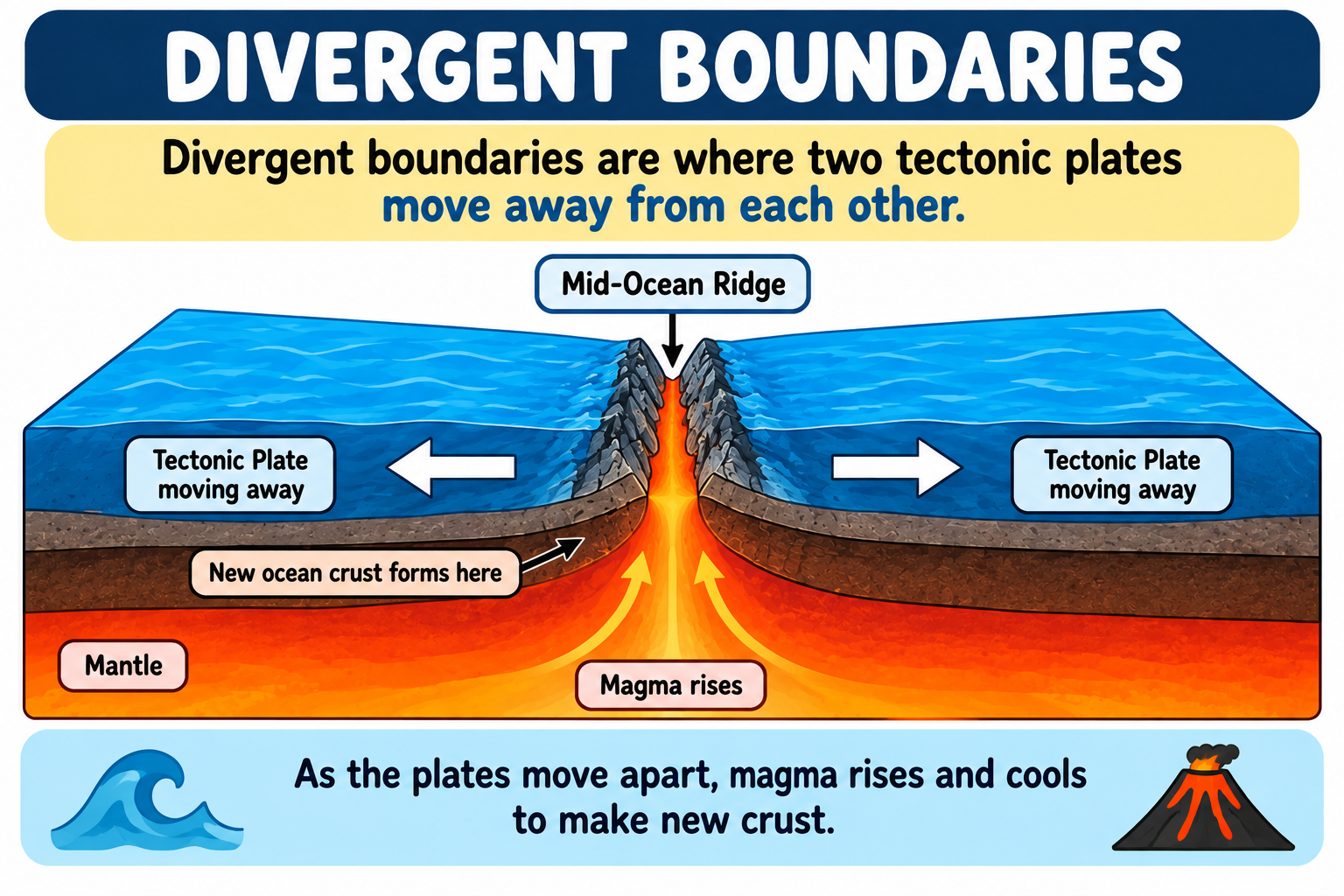
How It Works
Plates pull apart. Magma rises from the mantle and cools to create fresh oceanic crust at spreading ridges.
Key Landforms
Mid-Ocean Ridge: Underwater volcanic mountain belts.
Rift Valley: Continental splitting (e.g., East African Rift).
Divergent Boundary Mechanics Slide 4 of 8
BOUNDARY TYPE 2 Compressional Stress (Pushing Together)
Convergent Boundaries: Collisions & Subduction
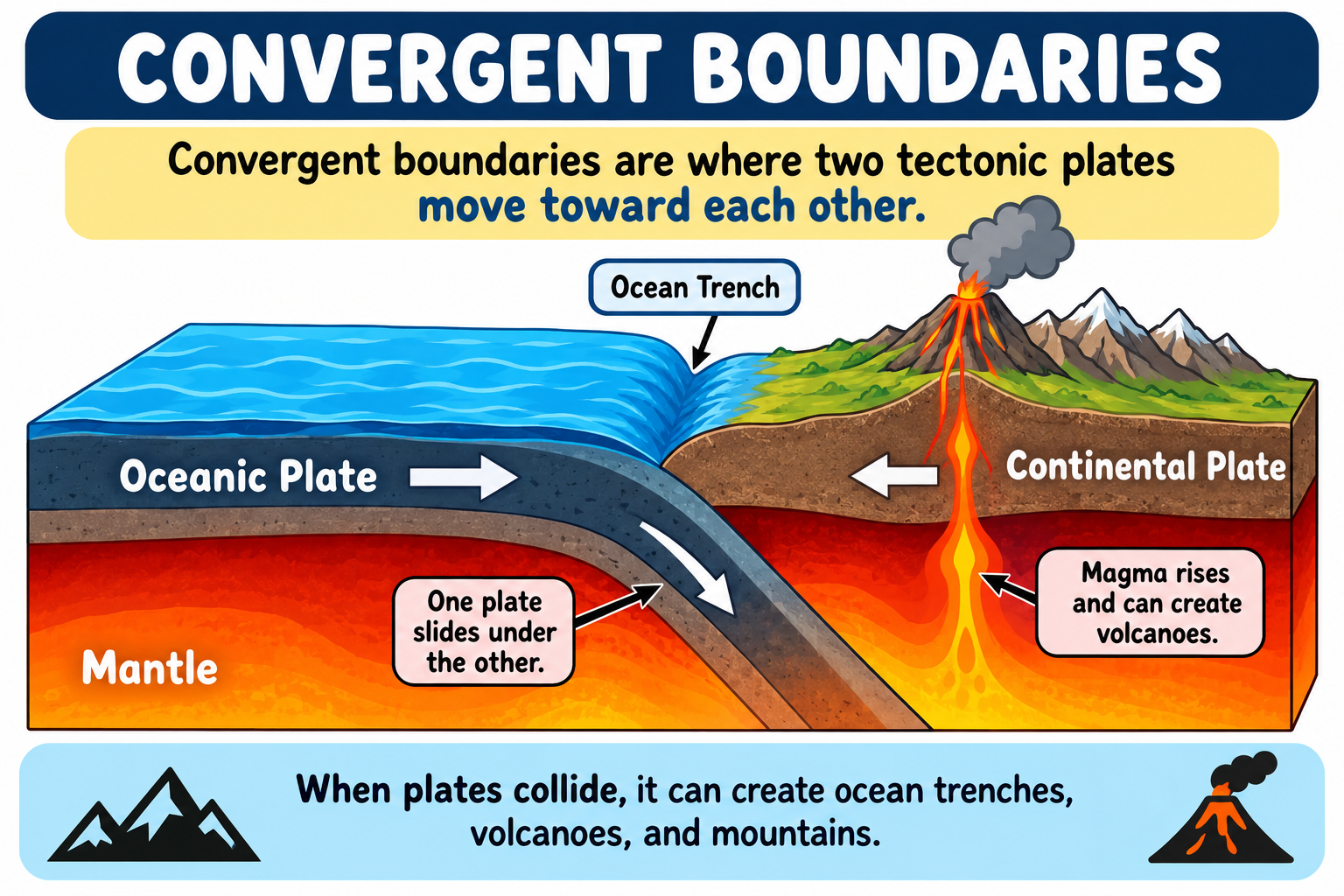
Subduction (Ocean + Cont.)
Dense oceanic plate sinks into the mantle. Sinking crust melts, generating magma that fuels coastal volcanic arcs and deep ocean trenches.
Collision (Cont. + Cont.)
Neither continental plate sinks. Rock crumples upward into towering fold mountain chains like the Himalayas.
Convergent Boundary Mechanics Slide 5 of 8
BOUNDARY TYPE 3 Shearing Stress (Sliding Horizontally)
Transform Boundaries: Faults & Friction
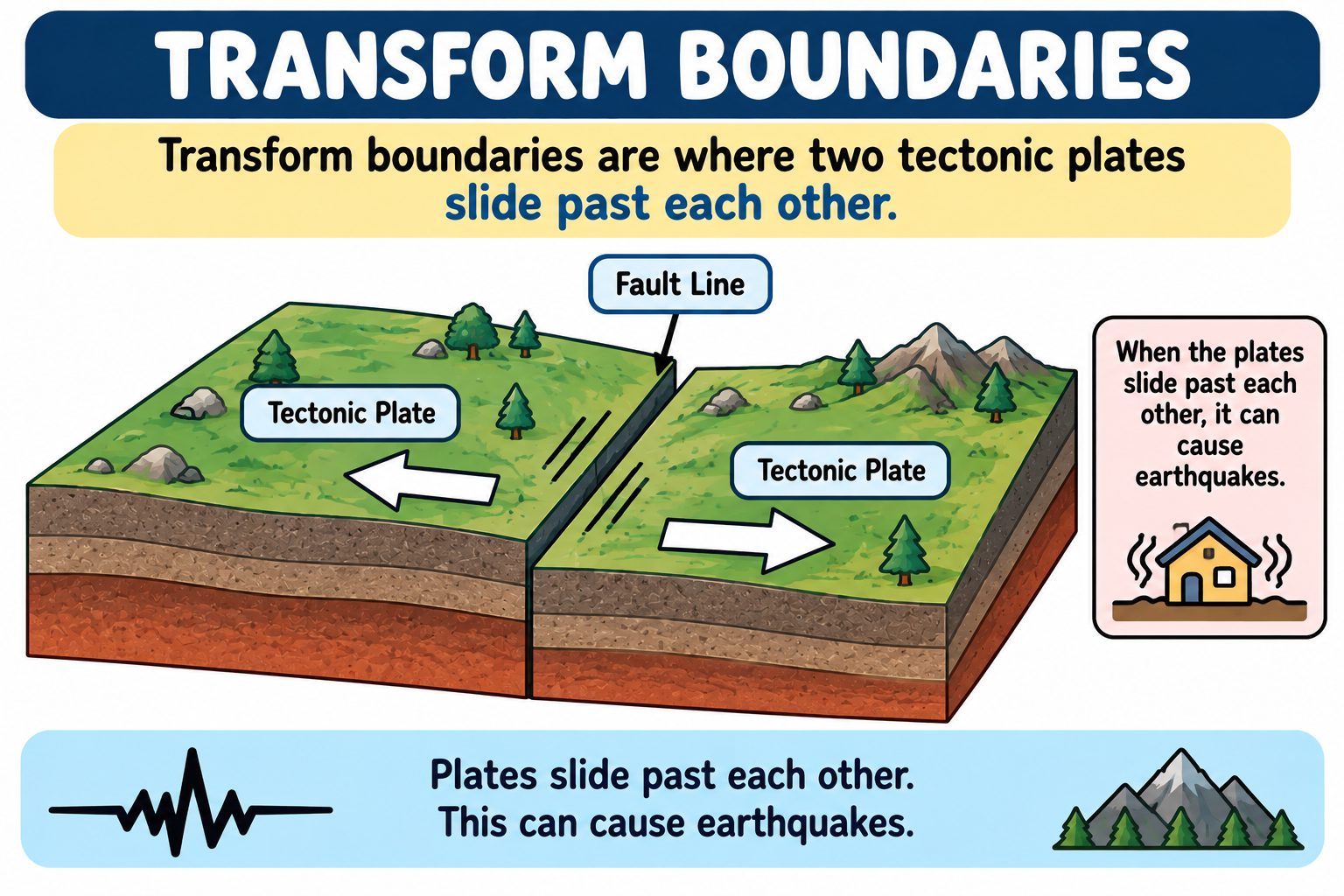
Stick-Slip Friction
Rough jagged edges lock plates in place. Stress builds over decades until the fault snaps suddenly, unleashing violent earthquakes.
Key Facts
Crust Fate: Conserved (neither created nor destroyed).
Example: California's San Andreas Fault (~5 cm/yr).
Transform Boundary Mechanics Slide 6 of 8
Synthesis & Quick Reference
Comparing the Three Boundaries
| Feature | Divergent ⬅️ ➡️ | Convergent ➡️ ⬅️ | Transform ⬆️ ⬇️ |
|---|
| Motion | Pulling apart | Colliding together | Grinding side-by-side |
| Stress Type | Tension | Compression | Shear |
| Crust Fate | Created (Constructive) | Destroyed/Recycled | Conserved (No change) |
| Key Landforms | Mid-ocean ridges, rift valleys | Trenches, volcanoes, fold mountains | Fault lines, offset features |
| Earthquakes? | Yes (shallow & mild) | Yes (deep & severe) | Yes (shallow & frequent) |
Summary Comparison Chart Slide 7 of 8
Active Review
Boundary Detective: Name That Boundary!
01
Case File Alpha
"Scientists locate an undersea mountain range where magma wells up and new basalt cools."
Boundary Type: [ ? ? ? ]
02
Case File Beta
"A continental plate crumples against another continental plate, thrusting giant peaks upward."
Boundary Type: [ ? ? ? ]
03
Case File Gamma
"Fences in a valley are cleanly severed and offset 4 meters horizontally after a shallow tremor."
Boundary Type: [ ? ? ? ]
Discussion Prompt: Which type of plate boundary poses the most danger to human cities, and why?
Slide 8 of 8
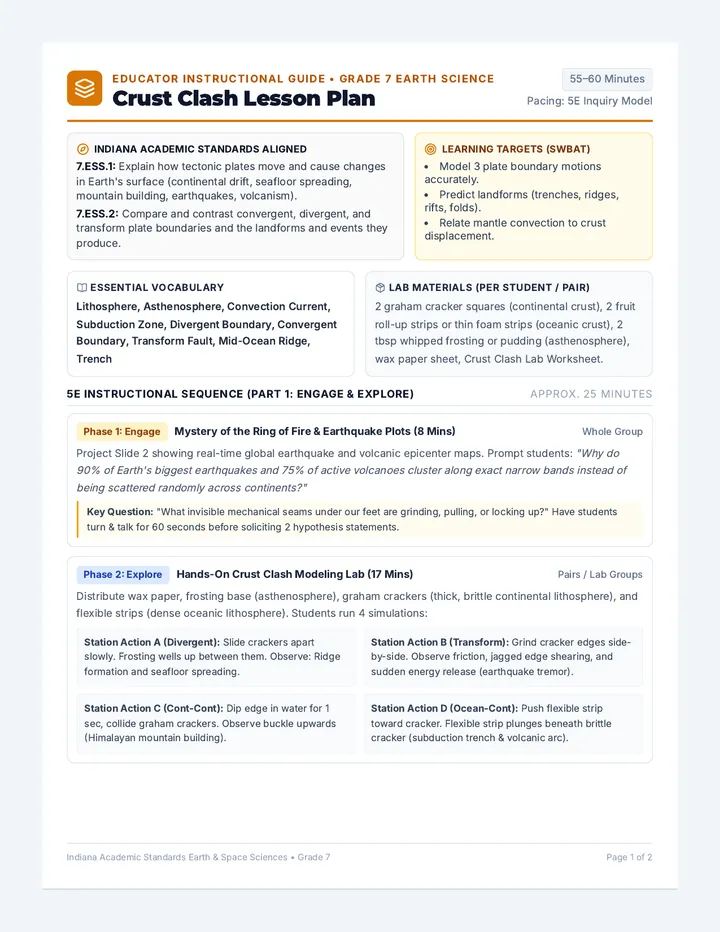
Tectonic Clash Worksheet
7th Grade Earth Science Plate Boundaries Unit
Tectonic Clash Worksheet
Name:
Date: Period:
1
The Engine of Plate Motion (Vocabulary Match)
1. Lithosphere
2. Asthenosphere
3. Convection Current
4. Oceanic Crust
A. Circular mantle heat flow driving plate motion.
B. Dense, basaltic crust that subducts easily.
C. Semi-fluid, ductile mantle layer beneath plates.
D. Rigid outer shell of crust and solid upper mantle.
2
Divergent Boundaries (Pulling Apart)
Stress: Tension • Constructive Margin
Question 2A (Diagram Evidence): Read the diagram labels and bottom banner. As plates move away from each other, what rises up from the mantle, and how does this create new oceanic crust?
Question 2B (Long-Term Geologic Impact): Name one underwater ridge and one continental rift valley. Explain what happens to the ocean basin and surrounding continents as seafloor spreading continues over millions of years:
3
Convergent Boundaries (Crashing Together)
Stress: Compression • Destructive Margin
Question 3A (Subduction Mechanics): Based on the diagram and bottom banner, why does the oceanic plate sink beneath the continental plate, and what three geologic features are formed as magma rises?
Question 3B (Continental Collision Comparison): When two continental plates collide without sinking into the mantle, how does the resulting landform differ from a subduction zone? Provide 1 real-world example:
Tectonic Clash • Plate Boundaries Investigation Page 1 of 2
Tectonic Clash: Investigation Guide Student Name: ___________________________
4
Transform Boundaries (Sliding Past)
Stress: Shear • Conservative Margin