Sun and Stars Writing Handout
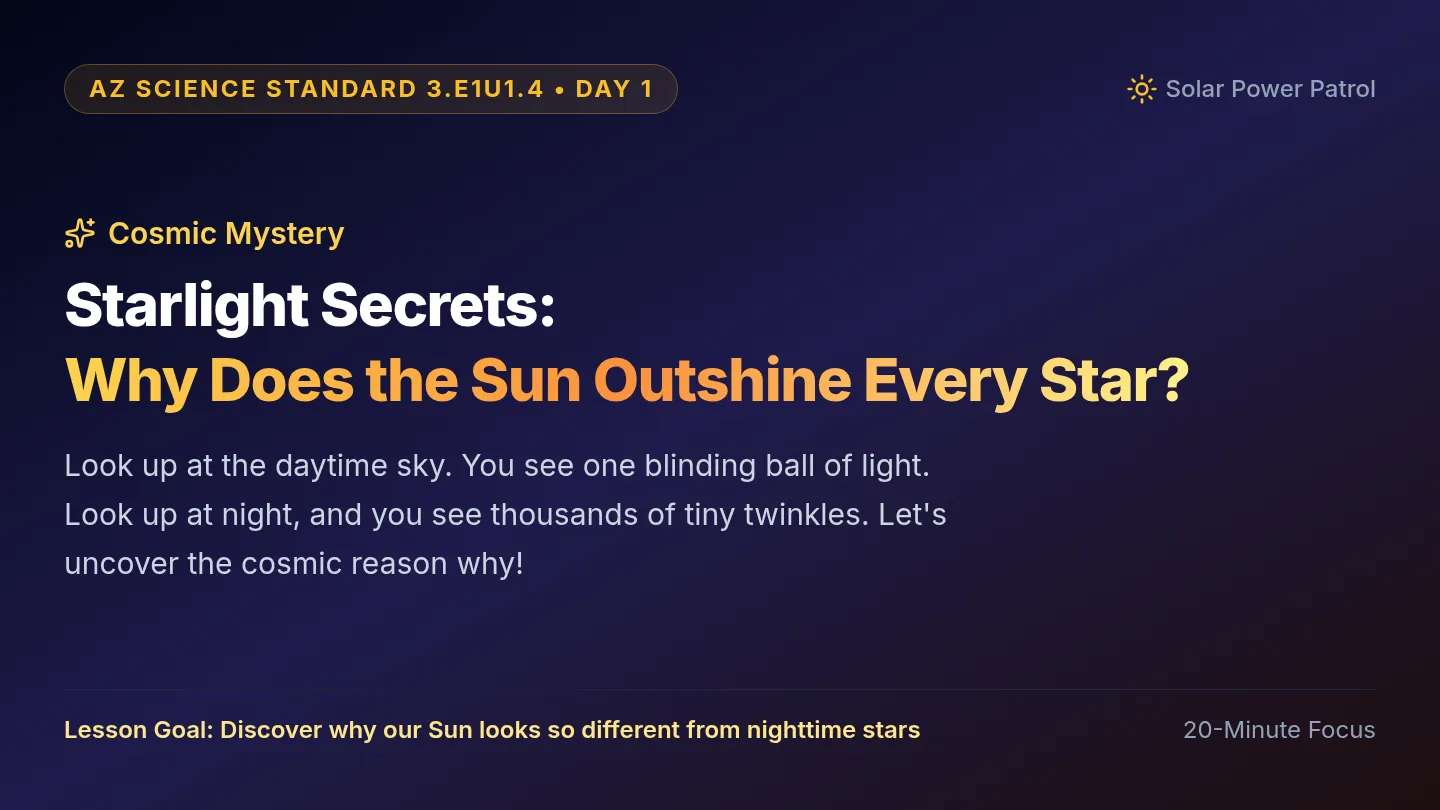
AZ Standard 3.E1U1.4 Grade 3 Earth & Space Science
Sun and Stars: Giants of the Sky
Name:
Date:
Big Science Question
Why does our daytime Sun look gigantic and blindingly bright, while nighttime stars look like tiny specks of dust?
1. What Is a Star?
A star is a massive, spinning ball of super-hot gas. Stars make their own light and heat through powerful reactions deep in their cores. When you look up at our daytime sky, you are looking directly at a star! Our Sun is not a planet or a moon—it is an ordinary, medium-sized yellow dwarf star.
2. Night Stars Are Suns, Too!
At night under the clear Arizona desert sky, thousands of twinkling lights appear. Every single point of light in the night sky is another star. In fact, many of those stars are hundreds of times larger and thousands of times brighter than our Sun! Some are fiery blue giants, while others are swelling red super-giants like Betelgeuse.
3. The Distance Secret (Apparent Brightness)
If other stars are so big, why does only our Sun light up our whole world? The secret is distance.
Our Sun is about 93 million miles away from Earth. That sounds far, but in space, that is right in our neighborhood! Meanwhile, the next closest star is 25 trillion miles away. Its light takes over four years of traveling through deep space just to reach our eyes!
Try the Flashlight Model
Hold a small flashlight six inches from your eyes. It looks huge and bright.
Now imagine a giant stadium spotlight shining from three miles across a valley. The spotlight is much bigger, but because it is far away, it appears as a tiny faint point of light!
Key Science Terms
- Star: A giant ball of hot, glowing gas producing light.
- Distance: How far apart two objects are in space.
- Apparent Size: How large an object looks based on how close it is.
Mind-Blowing Fact
Over 1,000,000 Earths could fit inside our Sun!
CHECKPOINT Keep these two numbers in mind for your writing: 93 million miles vs. 25 trillion miles!
Turn page to write →
Informational Writing Studio T.E.X.T. Strategy Response
Construct Your Sun & Stars Explanation
Part 2: Plan & Write
T
Topic Sentence
State your main idea clearly
E
Evidence
Cite a real fact from the text
X
eXplain
Show why the evidence matters
T
Tie-up
Wrap up with a closing thought
Writing Prompt
Based on the informational passage, why does our Sun look so much bigger and brighter than nighttime stars, even though many night stars are actually larger? Write an informative paragraph using the T.E.X.T. structure.
T Topic Sentence: Introduce your main idea about the Sun's size and brightness.
E Evidence: Quote or state a specific distance or science fact from page 1.
X eXplain: Explain how distance causes this effect (hint: flashlight comparison).
T Tie-up: Write a concluding sentence that summarizes your explanation.
Final Polished Paragraph: Combine your sentences into one cohesive paragraph.
Writer's Checklist: T: Topic stated E: Real fact cited X: Explained clearly T: Strong tie-up