Puzzle Packets Lesson Plan
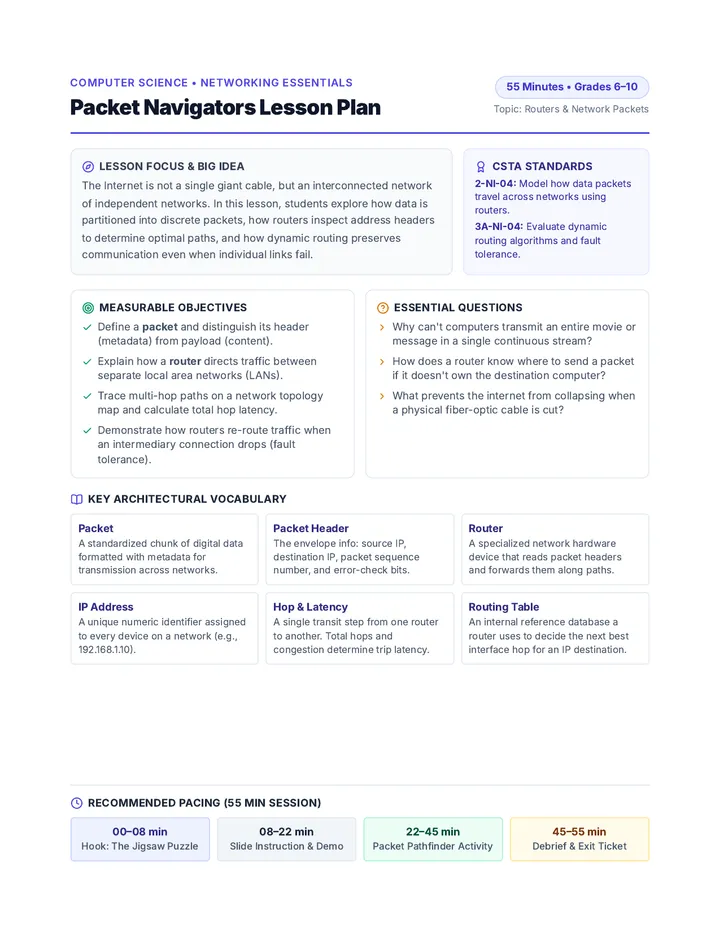
Computer Science • Networks & Data Routing
Puzzle Packets Lesson Plan
Simulating Internet Data Transmission, Packet Headers, and TCP/IP Reassembly via Jigsaw Challenges
Target Level Grades 4–8 • 60 Min
Class Layout 4–5 Network Nodes
Team Sizes 4–6 Students / Node
Core Core Mechanics Addressing & Relays
Key Standards CSTA 2-NI-04 / 1B-NI-04
Instructional Objectives
1 Packet Breakdown: Explain how digital files split into discrete packets before traversing the internet.
2 Addressing & Routing: Route puzzle packets using IP headers, hop counts, and simulated router waypoints.
3 TCP Reassembly: Verify, organize out-of-order packets, and assemble puzzle images into complete data.
The Computing Analogy Matrix
| Puzzle Simulation Element | Internet & Networking Reality | Role & Function in the Challenge |
|---|
| 1 Jigsaw Puzzle Piece | Data Packet Payload | Smallest unit of transmitted message data carried in a packet envelope. |
| Envelope Label (Source / Dest IP) | Packet Header & Metadata | Directs routers where the packet came from and where it must go. |
| Number on Back of Piece | TCP Sequence Number | Allows receiver to arrange pieces sequentially regardless of arrival time. |
| Corner Table / Network Desk | Host Device / Local Network (LAN) | Endpoint holding an IP address that generates, sends, and receives data. |
| Student Walkers & Center Waypoints | Routers & Network Switches | Inspects IP header and forwards packets toward their target destination. |
Teacher Preparation & Puzzle Pre-Distribution
1. Sourcing & Marking the Puzzles
Gather 4–5 distinct jigsaw puzzles (24–48 pieces each). On the back of each piece, lightly pencil the Target Network ID and a Sequence Number (e.g., NET-1 #01, #02...). This guarantees verifiable reassembly.
2. Creating the "Mixed Packets"
Do not give each team their own puzzle! Distribute an equal mixture of foreign puzzle pieces into every team's "Outbox" basket. To finish their own puzzle, teams must transmit and exchange pieces across the network.
3. Room Layout & Routing Pathways
Place Network Stations at room corners. Tape two central "Router Hubs" in the center of the room. Runners may not cross straight to other stations—they must pass through a central Router Hub.
4. Packet Envelopes & Checksum Slips
Provide 15–20 reusable mini-envelopes or pouches per station labeled with dry-erase or sticky labels: Source IP, Destination IP, and Seq #.
Unit: Internet Architecture • Lesson Plan Section 1: Architecture & Setup Page 1 of 3
Network Operations & Protocol
Team Roles, Routing Protocol & Challenge Flow
Simulation Guide
Station Roles & Responsibilities (Rotate Every Round)
The Packetizer (Sender) Client Device
Takes mixed puzzle pieces from the Station Outbox. Identifies which destination network owns the piece. Places one piece into an envelope, fills out the header (Source IP, Target IP, Sequence #), and hands it to the Router.
The Router Relay (Runner) Network Hop
Carries packets strictly along marked floor lines. Rule: Can only carry ONE packet envelope at a time. Must check in at the Central Router Waypoint, verify routing table direction, then deliver to target Station Inbox.
The Buffer Inspector (Receiver) TCP Buffer
Monitors the station Inbox. Inspects the envelope header. If Destination IP does NOT match this station, hands it back as a misrouted packet. If valid, extracts piece, logs sequence number, and delivers envelope back.
The Assembly Engineer Application Layer
Collects incoming verified puzzle pieces. Uses sequence numbers and visual cues to rebuild the complete puzzle image on the station build tray. Alerts team when missing packets cause an assembly bottleneck.
Standard Packet Header Specification ENVELOPE FRONT PROTOCOL
Source IP 192.168.1.10 (Net 1)
Destination IP 192.168.4.10 (Net 4)
Sequence ID Packet #07 / 36
Payload 1 Jigsaw Piece
Timed Challenge: Round 1 • Standard Network Transmission (15 Min)
0:00–2:00
Addressing Phase: Station Packetizers inspect initial mixed outbox pieces, identify destination team IPs, and package the first wave of 3–5 packets.
2:00–12:00
Routing Relay Active: Routers relay envelopes across center waypoints. Receivers unpack and verify. Assemblers piece together incoming fragments. Teams experience out-of-order packet arrival (e.g., piece #14 arrives before piece #2).
12:00–15:00
Buffer Clear & Final Puzzle Verification: All teams race to lock in remaining pieces. First team with a 100% correctly assembled puzzle triggers the network completion bell.
Strict Physical Network Constraints (Enforce Consistently!) 1. No running—data travels fast, but students must speed-walk for safety. • 2. Strict bandwidth: One packet per router trip. • 3. No direct handoffs across corners: All traffic must route through center junction nodes!
Unit: Internet Architecture • Lesson Plan Section 2: Protocols & Round 1 Execution Page 2 of 3
Advanced Simulation & Debrief
Round 2 Chaos, Discussion & Evaluation
Assessment & Synthesis
Round 2 Challenge: Real-World Internet Glitches (15 Min)
Rotate roles before Round 2! Introduce these real-world disruptions dynamically via teacher flashcards:
Severed Undersea Cable
Teacher blocks one hallway pathway with red tape. Routers must dynamically discover an alternate, longer path around the room.
Dropped Packet & NACK
Teacher intercepts 1 router envelope and drops it in the "Loss Bucket." The receiving team must notice missing sequence numbers and send a resend request!
Network Congestion Delay
A 3-second hold buffer is enforced at the central waypoint table. Routers must wait, modeling buffer queueing and high network latency.
Guided Debrief: Connecting Physical Play to Real Technology (10 Min)
Q1: Why did we break images into small puzzle pieces instead of handing over the full puzzle box?
Key insight: Large files clog networks. Small packets allow multiple devices to share bandwidth simultaneously; if one packet fails, only that tiny piece is resent.
Q2: Did puzzle pieces arrive in sequence? How did your assembly tech know where pieces went?
Key insight: Packets take different routes and arrive out of order. The TCP protocol uses sequence numbers in the header to reassemble data reliably.
Q3: What happened when the teacher blocked a pathway or dropped an envelope?
Key insight: The internet is fault-tolerant. Routers reroute around failed links (like undersea cable cuts), and TCP re-requests dropped packets.
Performance & Understanding Assessment Rubric
| Criteria | Proficient (3 pts) | Developing (2 pts) | Needs Support (1 pt) |
|---|
| Packet Protocol | All headers accurately filled; zero packets sent without IP/Seq metadata. | Minor addressing errors; occasionally forgets sequence number. | Carries raw pieces without envelopes or addresses. |
| Routing Compliance | Strictly follows waypoints and hop paths; adheres to 1-packet bandwidth limit. | Occasional shortcuts; requires occasional teacher reminder on pathway rules. | Ignores waypoints and carries bulk packets directly to peers. |
| Reassembly & Verification | Verifies IP on arrival; flags dropped/misrouted pieces promptly. | Assembles pieces but fails to notice misrouted pieces until puzzle stalls. | Forces pieces without checking sequence or destination. |
Next Day Extension: Add Caesar Cipher encrypted envelope tags to simulate HTTPS/SSL secure sockets layer!
Unit 2 Preview
Unit: Internet Architecture • Lesson Plan Section 3: Chaos Simulations & Debrief Page 3 of 3