A hands-on activity placemat where students model the four primary phases of the moon using Oreo cookies, including descriptions and a reflection prompt. Revised to fit on a single page with appropriately sized cookie circles.
A sample list of curiosity questions for teachers to use when modeling how to ask questions about the natural world. This material serves as a reference for anchor charts and class discussions.
A teacher facilitation guide for the Nature Explorers lesson, revised for consistency with curriculum terminology and instructional steps. Fixed page break and contrast issues.
A presentation for the introductory lesson on growth and change. Revised to include the second video viewing, improved layout for smaller screens, and polished instructional prompts.
An independent practice worksheet where students record observations from a unit introduction video and generate three of their own curious questions. Revised to fix page break logic and handwriting area sizing.
A visual presentation for the Dream Builders Expo. Includes an introduction to the engineering mindset, the design process loop, and overview slides for each workshop rotation (Bridge Blitz, Launch Pad, Community Machine).
A student worksheet for the 'Community Machine' activity. It features a collaborative design space for mapping 'Input' and 'Output' triggers between squads, as well as an internal sketching grid for their specific machine module.
A facilitator guide for the 'Community Machine' workshop. This final rotation focuses on collaborative engineering, where squads build connected modules for a massive Rube Goldberg machine, emphasizing interdependence and communication.
A student flight log worksheet for the 'Launch Pad' activity. Includes a technical design grid, flight data recorder for three tests, and a 'Failure Analysis' section to promote iterative engineering design.
A facilitator guide for the 'Launch Pad' aerospace workshop. Features a mission-oriented protocol for building catapults or stomp rockets, including aerospace theory basics and safety guidelines for mixed-age groups. Includes assembly diagrams.
A detailed facilitator guide for the Bridge Blitz workshop. Includes step-by-step instructions for a 60-minute session, a supply list, and specific tips for fostering social connection and collaboration among mixed-age groups.
A student worksheet for the 'Bridge Blitz' challenge. Includes a blueprint-style sketching area, roles for mixed-age squads, and a testing log for structural integrity.
A comprehensive event schedule and facilitator overview for the Dream Builders Expo STEM camp. It outlines the 5.5-hour schedule, core philosophy, and group strategies for mixed-age rotations.
A teacher-facing answer key and scoring guide for the Mirage Mission food web worksheet. Revised for 2-page consistency and improved contrast.
An ecology-focused 2-page worksheet exploring desert food webs. Students categorize organisms as producers, consumers, or decomposers, build a food chain, draw a food web based on clues, and analyze a population scenario. Revised for compact 2-page layout.
Teacher answer key for the Sands of Science worksheet. Provides clear explanations for the rain shadow effect, plant terminology (cuticle, succulent), and animal biological terms like estivation and nocturnality. Includes the word search solution.
A science-focused 2-page worksheet based on the CK-12 Advanced Biology reading about deserts. It covers the rain shadow effect, plant cuticle chemistry, animal nocturnality, and estivation, adapted for a 3rd-grade reading level. Includes a 10x10 mini-word search.
Teacher answer key for the Scorpion Scramble word search. It provides a color-coded grid solution and legend for easy grading. This version fixes the grid coloring to match the updated word search layout.
A desert-themed word search for 3rd graders. It includes 14 key vocabulary words from the Desert Grit lesson, such as Sahara, adaptation, and fennec, arranged in a 12x12 grid. This version includes corrected spelling and layout to ensure it fits on a single page.
A teacher-facing answer key and scoring checklist for the Dune Dash exit ticket. Includes example animal adaptations and the names of cold deserts.
A 2-per-page exit ticket for the desert biome lesson. Students identify an animal adaptation, name a cold desert (like the Gobi or Antarctica), and draw a cactus with spines. Optimized for single-page printing with expanded work areas.
A 3-page printable student workbook including a reading comprehension passage about trees and gardens, a math data analysis activity with a bar graph template, and a creative eco-action planning section.
A visually engaging classroom presentation introducing Earth Day, the environmental importance of plants and trees, the three R's (Reduce, Reuse, Recycle), and preparing students for the integrated math and ELA project.
A teacher-facing answer key for the Sandstorm Showdown quiz. It provides clear answers for multiple-choice, matching, diagram labeling, and short-answer sections, along with a revised 16-point scoring guide.
A 2-page formative assessment quiz for the desert biome lesson. It features multiple-choice questions on climate, plant/animal adaptations (including Gila monsters and Kangaroo rats), a randomized matching section for geography, a true/false section, and a new diagram labeling question.
A detailed teacher's guide for the Eco Champions project, featuring lesson procedures, student objectives, material checklists, and a complete answer key for the ELA and Math sections.
Updated teacher answer key for the Desert Grit worksheet, now including answers for the Gila monster and kangaroo rat sections, plus updated grading guidance.
A comprehensive 4-page student worksheet exploring the desert biome. It includes reading passages on climate, mapping tasks, plant word banks, and an expanded section on animal adaptations featuring camels, fennec foxes, Gila monsters, and kangaroo rats.
Comprehensive answer keys and teacher facilitation notes for all student materials in the Wild Web Balance lesson.
A data-collection worksheet for the "Resource Runner" simulation, allowing students to track their survival through various environmental scenarios.
A quick individual assessment checking for understanding of the 10% rule, the impact of water scarcity on food chains, and the role of invasive species.
A high-engagement graphic organizer where students map an ecosystem food web and perform "What If" impact analysis on human-caused environmental disruptions.
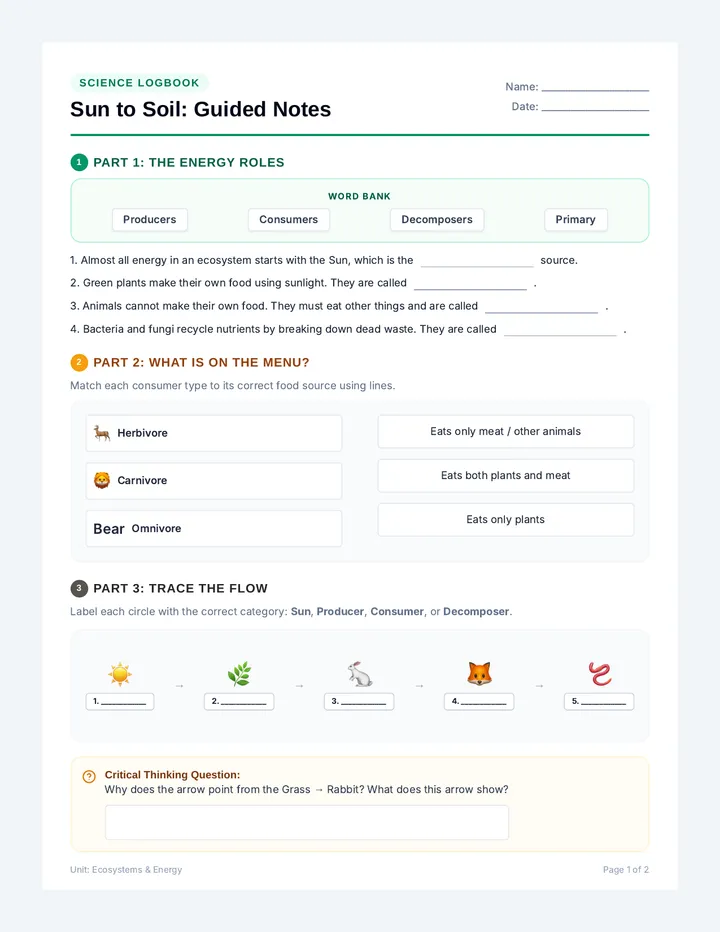
Guided notes for students to complete while following the slide presentation, featuring fill-in-the-blank sections, a pyramid sketching area, and reflection prompts.
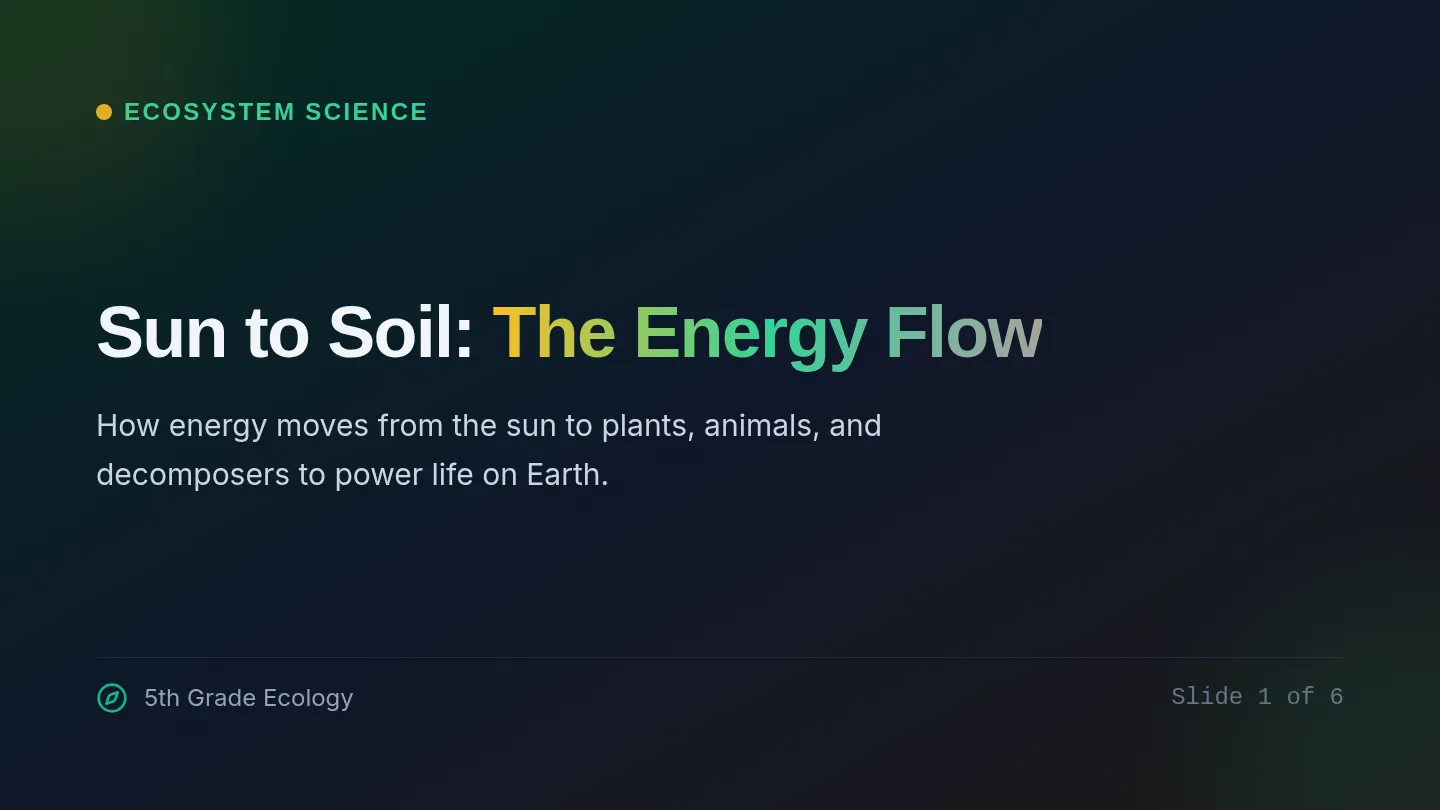
A visual presentation covering the energy pyramid, the 10% rule, and the negative impacts of water diversion and invasive species on ecosystem balance.
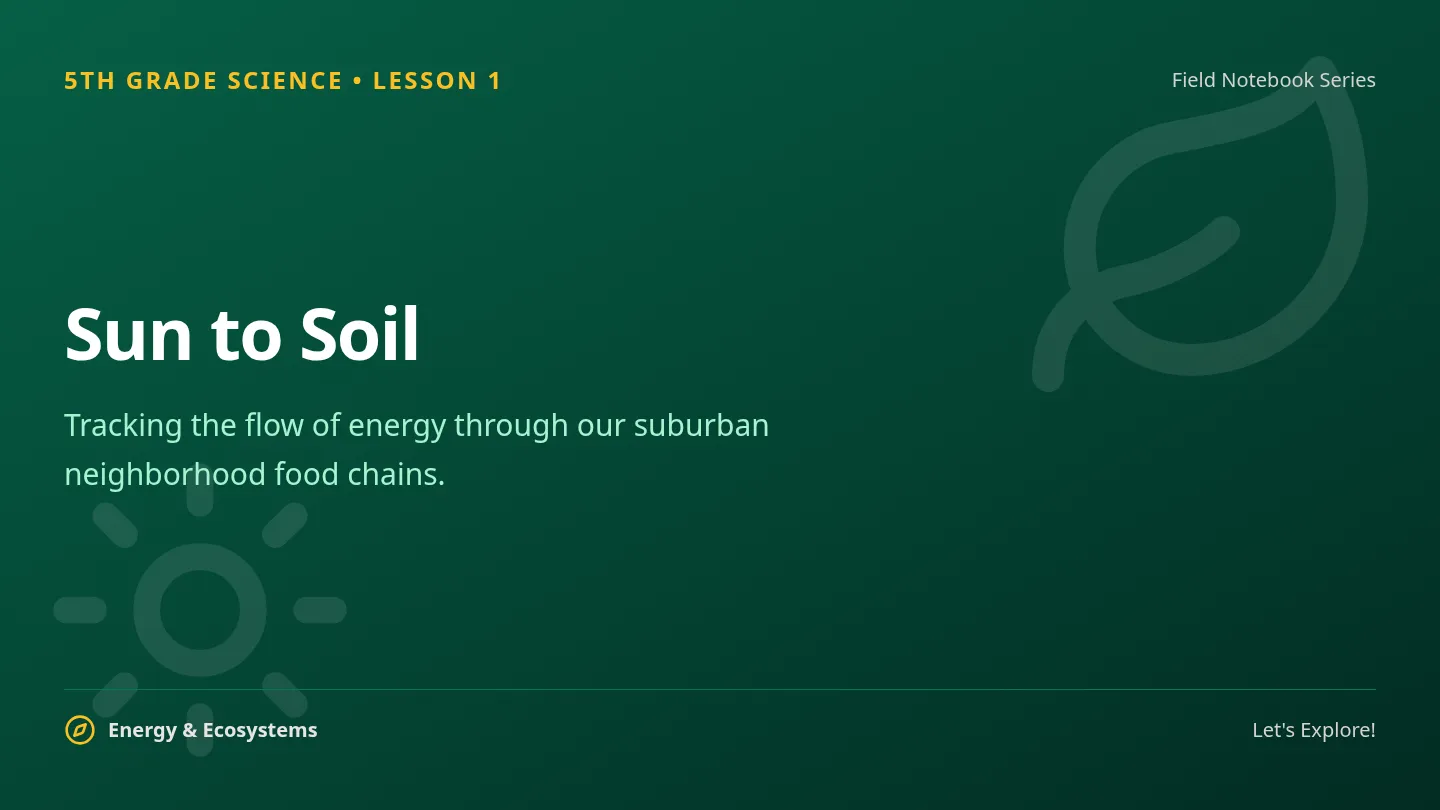
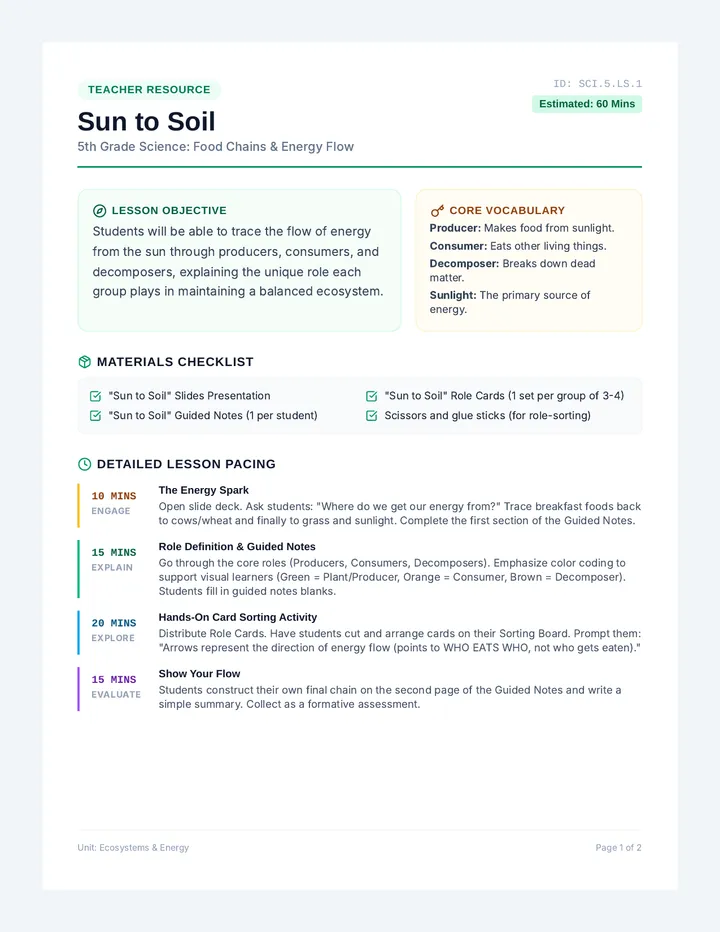
A detailed lesson plan for teaching energy flow in food chains, featuring a three-round "Resource Runner" simulation that models balanced ecosystems, water scarcity, and invasive species impact.
A reflective journal sheet where students synthesize their learning by writing from the perspective of a pollinator and crafting a persuasive pitch for environmental action at their school.