Life Science Study Guide
Grade 5 Science • Independent Study & Practice
Ecosystem Explorers Study Guide
Name:
Date:
Mission: Review key terms and complete the practice questions to master 5th grade life science!
Page 1 of 3
1 Biotic vs. Abiotic Factors
Living vs. Non-Living
An ecosystem is a community of living things interacting with their non-living environment:
Biotic Factors (Living)
Things that are alive or were once alive. They grow, need food or water, and reproduce.
Examples: Trees, deer, mushrooms, worms, bacteria.
Abiotic Factors (Non-Living)
Things that are not alive and never were. Living things depend on them to survive!
Examples: Sunlight, water, air, rocks, soil, temperature.
Quick Check: Circle B for Biotic or A for Abiotic:
Sunlight: ( B / A )
Oak Tree: ( B / A )
River Water: ( B / A )
Earthworm: ( B / A )
2 Photosynthesis: Plant Power!
How Plants Make Food
Plants are producers. They trap solar energy to make their own food through photosynthesis (photo = light, synthesis = put together):
The Photosynthesis Recipe
Sunlight
Light Energy
Water
From roots
Carbon Dioxide
Gas from air
Glucose
Sugar (Food!)
Oxygen
Gas released
Quick Question: Which product of photosynthesis do humans and other animals need to breathe?
[A] Carbon Dioxide
[B] Oxygen
[C] Glucose
Turn to Page 2 to explore Producers, Consumers, and Food Chains!
Part 2: Ecosystem Roles & Food Chains
Page 2 of 3
3 Who's Who in the Ecosystem?
Every organism has a job!
Producer
Makes its own food using sunlight. All food chains start with producers!
🌱 Grass, trees, algae
Consumer
Eats other living things for energy because it cannot make its own food.
🐰 Rabbits, frogs, hawks
Decomposer
Breaks down dead matter into rich soil nutrients so plants can grow.
🍄 Mushrooms, bacteria, worms
3 Types of Consumers: Herbivore: Eats plants Carnivore: Eats meat Omnivore: Eats both
4 Follow the Energy! (The Food Chain)
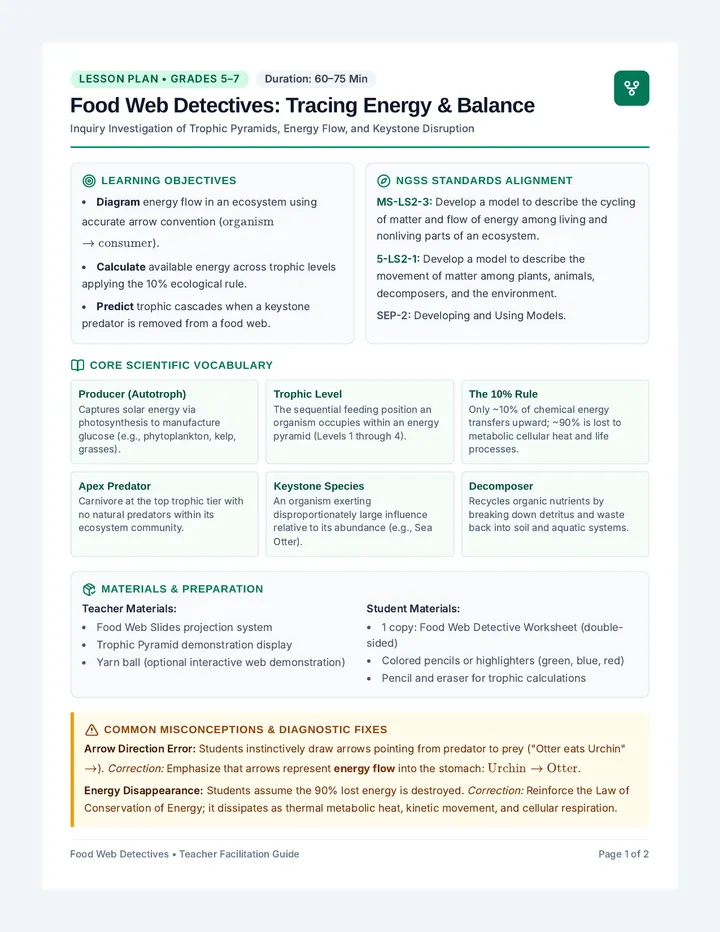
⚠️ Key Rule: Arrow Points to the Eater!
A food chain models the flow of energy. The arrow means "gives energy to":
Sun
Energy Source
Grass
Producer
Grasshopper
Herbivore
Frog
Carnivore
Hawk
Top Predator
5 Concept Warm-Up Questions
Quick Check
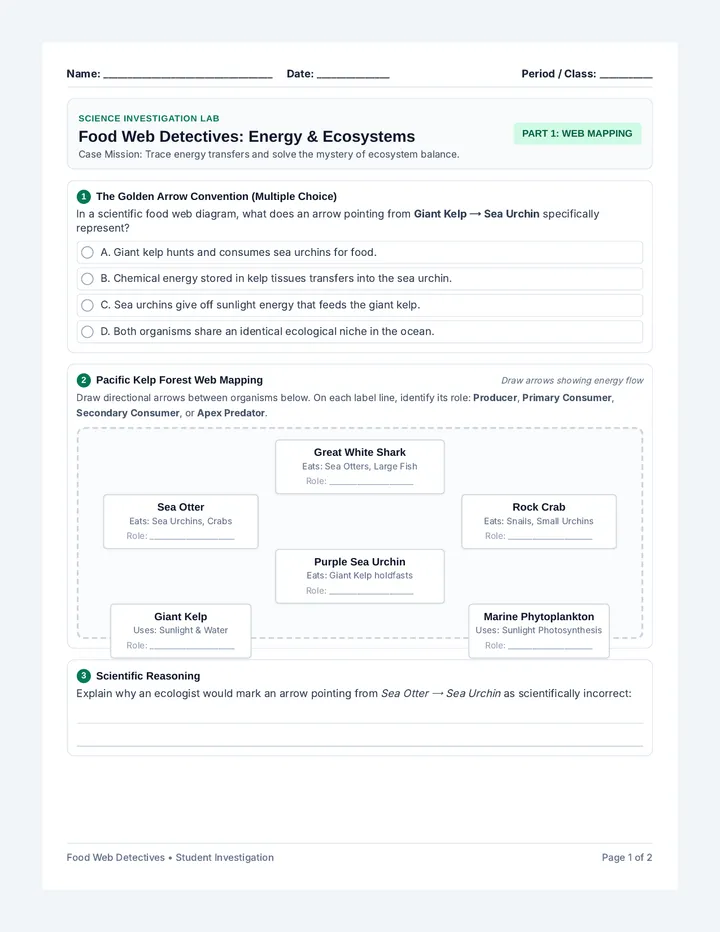
1. Why does every food chain start with a producer instead of a consumer?
2. Match each organism to its feeding type (Write H, C, or O):
Rabbit (eats clover): [ ]
Lion (eats zebra): [ ]
Bear (berries & fish): [ ]
Ready to test yourself? Turn the page to complete the full Practice Challenge!
Independent Practice Challenge
Show What You Know!
Score: / 10
Page 3 of 3
A Biotic & Abiotic Check (3 pts)
1. Which factor in a forest ecosystem is abiotic (non-living)?
A) Pine tree B) River rock C) Black beetle
2. True or False: A dead log on the forest floor is still considered biotic.
[ True ] [ False ]
3. Name one abiotic factor that plants need to survive:
B Photosynthesis Power (2 pts)
4. Complete the blanks with words from the box below:
Word Box: Sunlight • Oxygen • Carbon Dioxide • Glucose
Plants absorb from the air and use energy from to produce food.
5. What is the name of the sweet food/sugar plants make?
A) Oxygen B) Chlorophyll C) Glucose
C Ecosystem Roles & Food Chains (3 pts)
6. Put these 4 organisms in order by writing numbers 1, 2, 3, and 4 in the boxes:
[ ]
Red Hawk
[ ]
Field Mouse
[ ]
Corn Plant
[ ]
Garter Snake
7. An animal that eats both plants and meat is called an:
A) Herbivore B) Carnivore C) Omnivore
8. What is the main job of decomposers (like mushrooms)?
A) Hunt prey B) Recycle dead matter C) Make sunlight
D Ecosystem Thinker (2 pts)
9. In the food chain: Grass ➔ Grasshopper ➔ Frog, which way does the arrow point, and why?
10. Big Question: If a drought causes all the grass to dry up and die, what will happen to the grasshoppers?
Review Complete! How prepared are you for the quiz?
Still Practicing Almost Ready 100% Ready!